Solve System of ODE (Ordinary Differential Equation)s by Euler's Method or Classical Runge-Kutta 4th Order Integration.
rk4.RdSolving initial value problems for systems of first-order ordinary differential equations (ODEs) using Euler's method or the classical Runge-Kutta 4th order integration.
Usage
euler(y, times, func, parms, verbose = FALSE, ynames = TRUE,
  dllname = NULL, initfunc = dllname, initpar = parms,
  rpar = NULL, ipar = NULL, nout = 0, outnames = NULL,
  forcings = NULL, initforc = NULL, fcontrol = NULL, ...)

rk4(y, times, func, parms, verbose = FALSE, ynames = TRUE,
  dllname = NULL, initfunc = dllname, initpar = parms,
  rpar = NULL, ipar = NULL, nout = 0, outnames = NULL,
  forcings = NULL, initforc = NULL, fcontrol = NULL, ...)

euler.1D(y, times, func, parms, nspec = NULL, dimens = NULL,
  names = NULL, verbose = FALSE, ynames = TRUE,
  dllname = NULL, initfunc = dllname, initpar = parms,
  rpar = NULL,  ipar = NULL, nout = 0, outnames = NULL,
  forcings = NULL, initforc = NULL, fcontrol = NULL, ...)
Arguments
- y
the initial (state) values for the ODE system. If
yhas a name attribute, the names will be used to label the output matrix.- times
times at which explicit estimates for
yare desired. The first value intimesmust be the initial time.- func
either an R-function that computes the values of the derivatives in the ODE system (the model definition) at time t, or a character string giving the name of a compiled function in a dynamically loaded shared library.
If
funcis an R-function, it must be defined as:func <- function(t, y, parms,...).tis the current time point in the integration,yis the current estimate of the variables in the ODE system. If the initial valuesyhas anamesattribute, the names will be available insidefunc.parmsis a vector or list of parameters; ... (optional) are any other arguments passed to the function.The return value of
funcshould be a list, whose first element is a vector containing the derivatives ofywith respect totime, and whose next elements are global values that are required at each point intimes. The derivatives must be specified in the same order as the state variablesy.If
funcis a string, thendllnamemust give the name of the shared library (without extension) which must be loaded beforerk4is called. See package vignette"compiledCode"for more details.- parms
vector or list of parameters used in
func.- nspec
for 1D models only: the number of species (components) in the model. If
NULL, thendimensshould be specified.- dimens
for 1D models only: the number of boxes in the model. If
NULL, thennspecshould be specified.- names
for 1D models only: the names of the components; used for plotting.
- verbose
a logical value that, when
TRUE, triggers more verbose output from the ODE solver.- ynames
if
FALSE: names of state variables are not passed to functionfunc; this may speed up the simulation especially for large models.- dllname
a string giving the name of the shared library (without extension) that contains all the compiled function or subroutine definitions refered to in
func. See package vignette"compiledCode".- initfunc
if not
NULL, the name of the initialisation function (which initialises values of parameters), as provided indllname. See package vignette"compiledCode",- initpar
only when
dllnameis specified and an initialisation functioninitfuncis in the DLL: the parameters passed to the initialiser, to initialise the common blocks (FORTRAN) or global variables (C, C++).- rpar
only when
dllnameis specified: a vector with double precision values passed to the DLL-functions whose names are specified byfuncandjacfunc.- ipar
only when
dllnameis specified: a vector with integer values passed to the dll-functions whose names are specified byfuncandjacfunc.- nout
only used if
dllnameis specified and the model is defined in compiled code: the number of output variables calculated in the compiled functionfunc, present in the shared library. Note: it is not automatically checked whether this is indeed the number of output variables calculated in the DLL - you have to perform this check in the code. See package vignette"compiledCode".- outnames
only used if
dllnameis specified andnout> 0: the names of output variables calculated in the compiled functionfunc, present in the shared library.- forcings
only used if
dllnameis specified: a list with the forcing function data sets, each present as a two-columned matrix, with (time, value); interpolation outside the interval [min(times), max(times)] is done by taking the value at the closest data extreme.See forcings or package vignette
"compiledCode".- initforc
if not
NULL, the name of the forcing function initialisation function, as provided indllname. It MUST be present ifforcingshas been given a value. See forcings or package vignette"compiledCode".- fcontrol
A list of control parameters for the forcing functions. See forcings or vignette
compiledCode.- ...
additional arguments passed to
funcallowing this to be a generic function.
Author
Thomas Petzoldt thomas.petzoldt@tu-dresden.de
Details
rk4 and euler are special versions of the two fixed step
solvers with less overhead and less functionality (e.g. no interpolation
and no events) compared to the generic Runge-Kutta codes called by
ode resp. rk.
If you need different internal and external time steps or want to use events,
please use:
rk(y, times, func, parms, method = "rk4") or
rk(y, times, func, parms, method = "euler").
See help pages of rk and rkMethod
for details.
Function euler.1D essentially calls function euler but
contains additional code to support plotting of 1D models, see
ode.1D and plot.1D for details.
Note
For most practical cases, solvers with flexible timestep
(e.g. rk(method = "ode45") and especially solvers of the
Livermore family (ODEPACK, e.g. lsoda) are superior.
Value
A matrix of class deSolve with up to as many rows as elements
in times and as many columns as elements in y plus the
number of "global" values returned in the next elements of the return
from func, plus and additional column for the time value.
There will be a row for each element in times unless the
integration routine returns with an unrecoverable error. If y
has a names attribute, it will be used to label the columns of the
output value.
See also
rkMethodfor a list of available Runge-Kutta parameter sets,rkfor the more general Runge-Code,lsoda,lsode,lsodes,lsodar,vode,daspkfor solvers of the Livermore family,odefor a general interface to most of the ODE solvers,ode.bandfor solving models with a banded Jacobian,ode.1Dfor integrating 1-D models,ode.2Dfor integrating 2-D models,ode.3Dfor integrating 3-D models,dedefor integrating models with delay differential equations,
diagnostics to print diagnostic messages.
Examples
## =======================================================================
## Example: Analytical and numerical solutions of logistic growth
## =======================================================================

## the derivative of the logistic
logist <- function(t, x, parms) {
  with(as.list(parms), {
    dx <- r * x[1] * (1 - x[1]/K)
    list(dx)
  })
}

time  <- 0:100
N0    <- 0.1; r <- 0.5; K <- 100
parms <- c(r = r, K = K)
x <- c(N = N0)

## analytical solution
plot(time, K/(1 + (K/N0-1) * exp(-r*time)), ylim = c(0, 120),
  type = "l", col = "red", lwd = 2)

## reasonable numerical solution with rk4
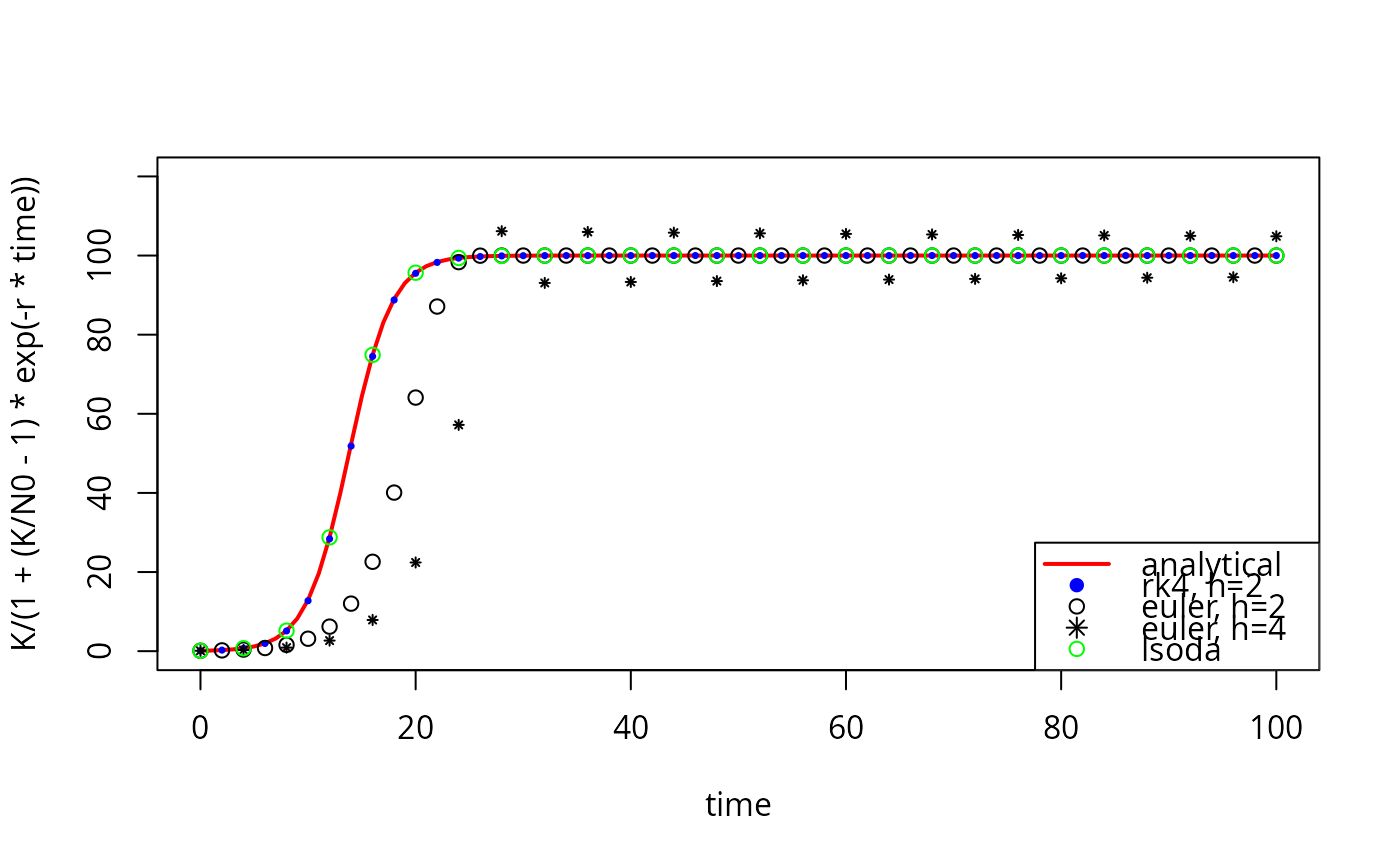
time <- seq(0, 100, 2)
out <- as.data.frame(rk4(x, time, logist, parms))
points(out$time, out$N, pch = 16, col = "blue", cex = 0.5)

## same time step with euler, systematic under-estimation
time <- seq(0, 100, 2)
out <- as.data.frame(euler(x, time, logist, parms))
points(out$time, out$N, pch = 1)

## unstable result
time <- seq(0, 100, 4)
out <- as.data.frame(euler(x, time, logist, parms))
points(out$time, out$N, pch = 8, cex = 0.5)

## method with automatic time step
out <- as.data.frame(lsoda(x, time, logist, parms))
points(out$time, out$N, pch = 1, col = "green")

legend("bottomright",
  c("analytical","rk4, h=2", "euler, h=2",
    "euler, h=4", "lsoda"),
  lty = c(1, NA, NA, NA, NA), lwd = c(2, 1, 1, 1, 1),
  pch = c(NA, 16, 1, 8, 1),
  col = c("red", "blue", "black", "black", "green"))