Solver for Ordinary Differential Equations; Assumes a Banded Jacobian
ode.band.RdSolves a system of ordinary differential equations.
Assumes a banded Jacobian matrix, but does not rearrange the state variables (in contrast to ode.1D). Suitable for 1-D models that include transport only between adjacent layers and that model only one species.
Usage
ode.band(y, times, func, parms, nspec = NULL, dimens = NULL,
  bandup = nspec, banddown = nspec, method = "lsode", names = NULL,
  ...)
Arguments
- y
the initial (state) values for the ODE system, a vector. If
yhas a name attribute, the names will be used to label the output matrix.- times
time sequence for which output is wanted; the first value of
timesmust be the initial time.- func
either an R-function that computes the values of the derivatives in the ODE system (the model definition) at time
t, or a character string giving the name of a compiled function in a dynamically loaded shared library.If
funcis an R-function, it must be defined as:func <- function(t, y, parms, ...).tis the current time point in the integration,yis the current estimate of the variables in the ODE system. If the initial valuesyhas anamesattribute, the names will be available insidefunc.parmsis a vector or list of parameters;...(optional) are any other arguments passed to the function.The return value of
funcshould be a list, whose first element is a vector containing the derivatives ofywith respect totime, and whose next elements are global values that are required at each point intimes.The derivatives must be specified in the same order as the state variablesy.- parms
parameters passed to
func.- nspec
the number of *species* (components) in the model.
- dimens
the number of boxes in the model. If
NULL, thennspecshould be specified.- bandup
the number of nonzero bands above the Jacobian diagonal.
- banddown
the number of nonzero bands below the Jacobian diagonal.
- method
the integrator to use, one of
"vode","lsode","lsoda","lsodar","radau".- names
the names of the components; used for plotting.
- ...
additional arguments passed to the integrator.
Value
A matrix of class deSolve with up to as many rows as elements in times and as
many columns as elements in y plus the number of "global"
values returned in the second element of the return from func,
plus an additional column (the first) for the time value. There will
be one row for each element in times unless the integrator
returns with an unrecoverable error. If y has a names
attribute, it will be used to label the columns of the output value.
The output will have the attributes istate and rstate,
two vectors with several elements. See the help for the selected
integrator for details. the first element of istate returns the
conditions under which the last call to the integrator returned. Normal is
istate = 2. If verbose = TRUE, the settings of
istate and rstate will be written to the screen.
Details
This is the method of choice for single-species 1-D reactive transport models.
For multi-species 1-D models, this method can only be used if the
state variables are arranged per box, per species (e.g. A[1], B[1],
A[2], B[2], A[3], B[3], ... for species A, B). By default, the
model function will have the species arranged as A[1], A[2],
A[3], ... B[1], B[2], B[3], ... in this case, use ode.1D.
See the selected integrator for the additional options.
Examples
## =======================================================================
## The Aphid model from Soetaert and Herman, 2009.
## A practical guide to ecological modelling.
## Using R as a simulation platform. Springer.
## =======================================================================
## 1-D diffusion model
## ================
## Model equations
## ================
Aphid <- function(t, APHIDS, parameters) {
deltax <- c (0.5*delx, rep(delx, numboxes-1), 0.5*delx)
Flux <- -D*diff(c(0, APHIDS, 0))/deltax
dAPHIDS <- -diff(Flux)/delx + APHIDS*r
list(dAPHIDS) # the output
}
## ==================
## Model application
## ==================
## the model parameters:
D <- 0.3 # m2/day diffusion rate
r <- 0.01 # /day net growth rate
delx <- 1 # m thickness of boxes
numboxes <- 60
## distance of boxes on plant, m, 1 m intervals
Distance <- seq(from = 0.5, by = delx, length.out = numboxes)
## Initial conditions, ind/m2
## aphids present only on two central boxes
APHIDS <- rep(0, times = numboxes)
APHIDS[30:31] <- 1
state <- c(APHIDS = APHIDS) # initialise state variables
## RUNNING the model:
times <- seq(0, 200, by = 1) # output wanted at these time intervals
out <- ode.band(state, times, Aphid, parms = 0,
nspec = 1, names = "Aphid")
## ================
## Plotting output
## ================
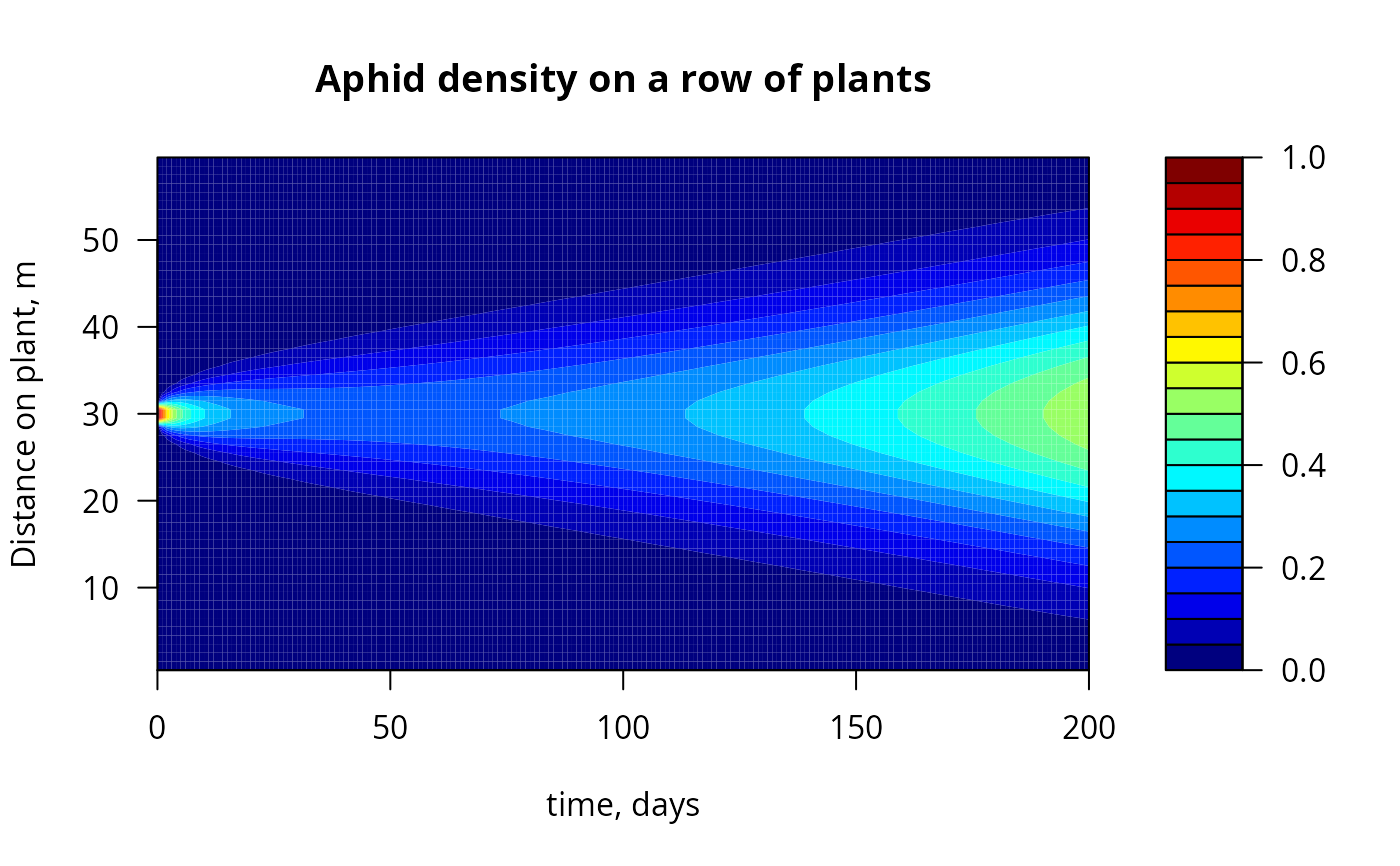
image(out, grid = Distance, method = "filled.contour",
xlab = "time, days", ylab = "Distance on plant, m",
main = "Aphid density on a row of plants")
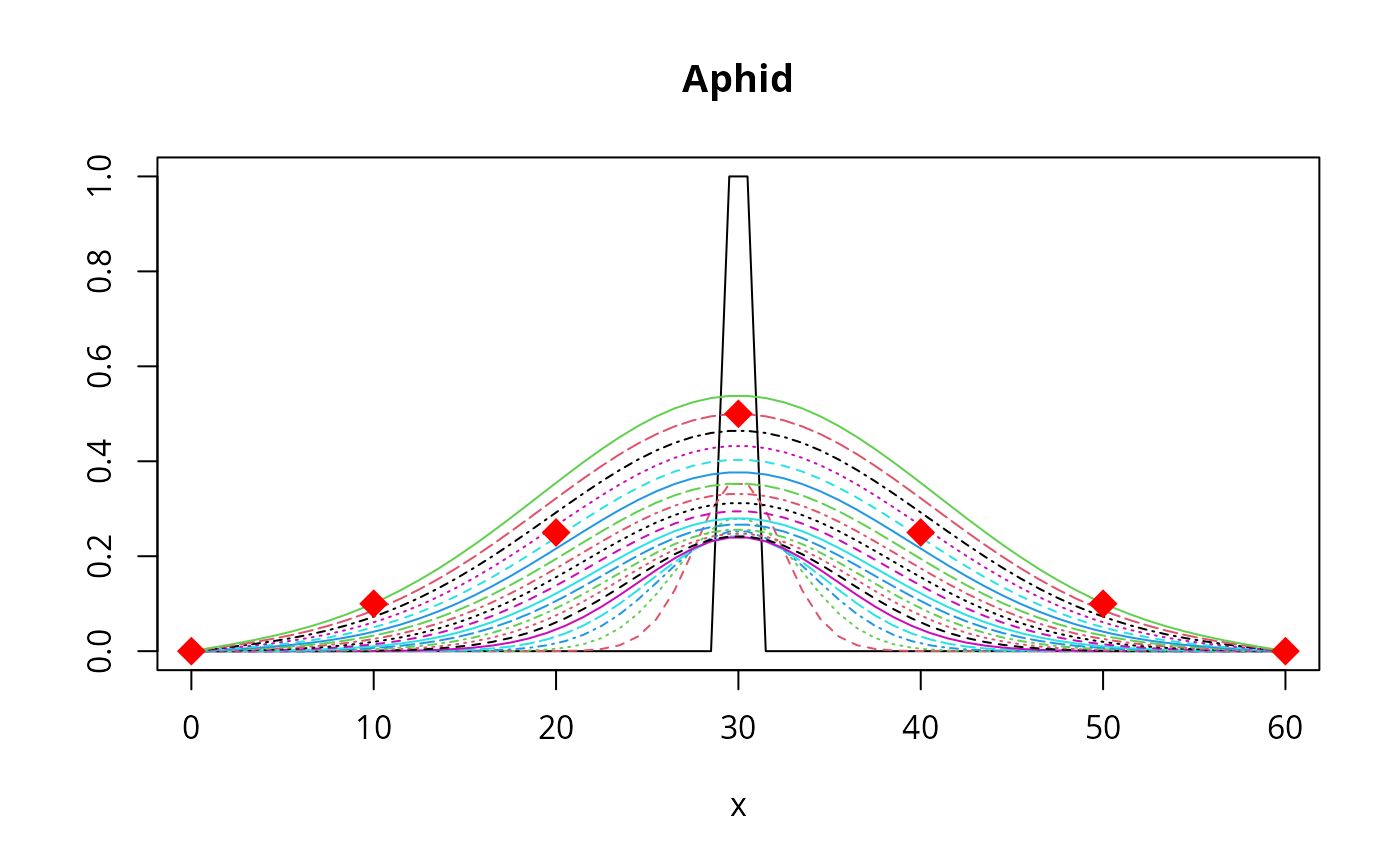
 matplot.1D(out, grid = Distance, type = "l",
subset = time %in% seq(0, 200, by = 10))
# add an observed dataset to 1-D plot (make sure to use correct name):
data <- cbind(dist = c(0,10, 20, 30, 40, 50, 60),
Aphid = c(0,0.1,0.25,0.5,0.25,0.1,0))
matplot.1D(out, grid = Distance, type = "l",
subset = time %in% seq(0, 200, by = 10),
obs = data, obspar = list(pch = 18, cex = 2, col="red"))
matplot.1D(out, grid = Distance, type = "l",
subset = time %in% seq(0, 200, by = 10))
# add an observed dataset to 1-D plot (make sure to use correct name):
data <- cbind(dist = c(0,10, 20, 30, 40, 50, 60),
Aphid = c(0,0.1,0.25,0.5,0.25,0.1,0))
matplot.1D(out, grid = Distance, type = "l",
subset = time %in% seq(0, 200, by = 10),
obs = data, obspar = list(pch = 18, cex = 2, col="red"))
 if (FALSE) { # \dontrun{
plot.1D(out, grid = Distance, type = "l")
} # }
if (FALSE) { # \dontrun{
plot.1D(out, grid = Distance, type = "l")
} # }