Added-Variable Plots
avPlots.RdThese functions construct added-variable, also called partial-regression, plots for linear and generalized linear models.
Usage
avPlots(model, ...)

# Default S3 method
avPlots(model, terms=~., intercept=FALSE,
  layout=NULL, ask, main, ...)

avp(...)

avPlot(model, ...)

# S3 method for class 'lm'
avPlot(model, variable,
  id=TRUE, col = carPalette()[1], col.lines = carPalette()[2],
  xlab, ylab, pch = 1, lwd = 2, cex = par("cex"), pt.wts = FALSE,
  main=paste("Added-Variable Plot:", variable),
  grid=TRUE,
  ellipse=FALSE,
  marginal.scale=FALSE, ...)

# S3 method for class 'glm'
avPlot(model, variable,
  id=TRUE,
  col = carPalette()[1], col.lines = carPalette()[2],
  xlab, ylab, pch = 1, lwd = 2, cex = par("cex"), pt.wts = FALSE,
  type=c("Wang", "Weisberg"),
  main=paste("Added-Variable Plot:", variable), grid=TRUE,
  ellipse=FALSE, ...)

avPlot3d(model, coef1, coef2, id=TRUE, ...)

# S3 method for class 'lm'
avPlot3d(model, coef1, coef2, id=TRUE, fit="linear", ...)

# S3 method for class 'glm'
avPlot3d(model, coef1, coef2, id=TRUE, type=c("Wang", "Weisberg"),
  fit="linear", ...)
Arguments
- model
model object produced by
lmorglm.- terms
A one-sided formula that specifies a subset of the predictors. One added-variable plot is drawn for each term. For example, the specification
terms = ~.-X3would plot against all terms except forX3. If this argument is a quoted name of one of the terms, the added-variable plot is drawn for that term only.- coef1, coef2
the quoted names of the two coefficients for a 3D added variable plot.
- intercept
Include the intercept in the plots; default is
FALSE.- variable
A quoted string giving the name of a regressor in the model matrix for the horizontal axis.
- layout
If set to a value like
c(1, 1)orc(4, 3), the layout of the graph will have this many rows and columns. If not set, the program will select an appropriate layout. If the number of graphs exceed nine, you must select the layout yourself, or you will get a maximum of nine per page. Iflayout=NA, the function does not set the layout and the user can use theparfunction to control the layout, for example to have plots from two models in the same graphics window.- main
The title of the plot; if missing, one will be supplied.
- ask
If
TRUE, ask the user before drawing the next plot; ifFALSEdon't ask.- id
controls point identification; if
FALSE, no points are identified; can be a list of named arguments to theshowLabelsfunction;TRUE, the default, is equivalent tolist(method=list(abs(residuals(model, type="pearson")), "x"), n=2, cex=1, col=carPalette()[1], location="lr"), which identifies the 2 points with the largest residuals and the 2 points with the most extreme horizontal values (i.e., largest partial leverage). ForavPlot3d, point identication is throughIdentify3d.- col
color for points; the default is the second entry in the current car palette (see
carPaletteandpar).- col.lines
color for the fitted line.
- pch
plotting character for points; default is
1(a circle, seepar).- lwd
line width; default is
2(seepar).- cex
size of plotted points; default is taken from
par("cex").- pt.wts
if
TRUE(the default isFALSE), for a weighted least squares fit or a generalized linear model, the areas of plotted points are made proportional to the weights, with the average size taken from thecexargument.- xlab
x-axis label. If omitted a label will be constructed.
- ylab
y-axis label. If omitted a label will be constructed.
- type
if
"Wang"use the method of Wang (1985); if"Weisberg"use the method in the Arc software associated with Cook and Weisberg (1999).- grid
If
TRUE, the default, a light-gray background grid is put on the graph.- ellipse
controls plotting data-concentration ellipses. If
FALSE(the default), no ellipses are plotted. Can be a list of named values givinglevels, a vector of one or more bivariate-normal probability-contour levels at which to plot the ellipses; androbust, a logical value determing whether to use thecov.trobfunction in the MASS package to calculate the center and covariance matrix for the data ellipses.TRUEis equivalent tolist(levels=c(.5, .95), robust=TRUE).- marginal.scale
Consider an added-variable plot of Y versus X given Z. If this argument is
FALSEthen the limits on the horizontal axis are determined by the range of the residuals from the regression of X on Z and the limits on the vertical axis are determined by the range of the residuals from the regressnio of Y on Z. If the argument isTRUE, then the limits on the horizontal axis are determined by the range of X minus it mean, and on the vertical axis by the range of Y minus its means; adjustment is made if necessary to include outliers. This scaling allows visualization of the correlations between Y and Z and between X and Z. For example, if the X and Z are highly correlated, then the points will be concentrated on the middle of the plot.- fit
one or both of
"linear"(linear least-squares, the default) and"robust"(robust regression) surfaces to be fit to the 3D added-variable plot; seescatter3dfor details.- ...
avPlotspasses these arguments toavPlotandavPlotpasses them toplot; foravPlot3d, additional optional arguments to be passed toscatter3d.
Details
The functions intended for direct use are avPlots (for which avp
is an abbreviation) and avPlot3d.
Value
These functions are used for their side effect of producing plots, but also invisibly return the coordinates of the plotted points.
References
Cook, R. D. and Weisberg, S. (1999) Applied Regression, Including Computing and Graphics. Wiley.
Fox, J. (2016) Applied Regression Analysis and Generalized Linear Models, Third Edition. Sage.
Fox, J. and Weisberg, S. (2019) An R Companion to Applied Regression, Third Edition, Sage.
Wang, P C. (1985) Adding a variable in generalized linear models. Technometrics 27, 273–276.
Weisberg, S. (2014) Applied Linear Regression, Fourth Edition, Wiley.
Author
John Fox jfox@mcmaster.ca, Sanford Weisberg sandy@umn.edu
See also
residualPlots, crPlots, ceresPlots, link{dataEllipse}, showLabels, dataEllipse.
Examples
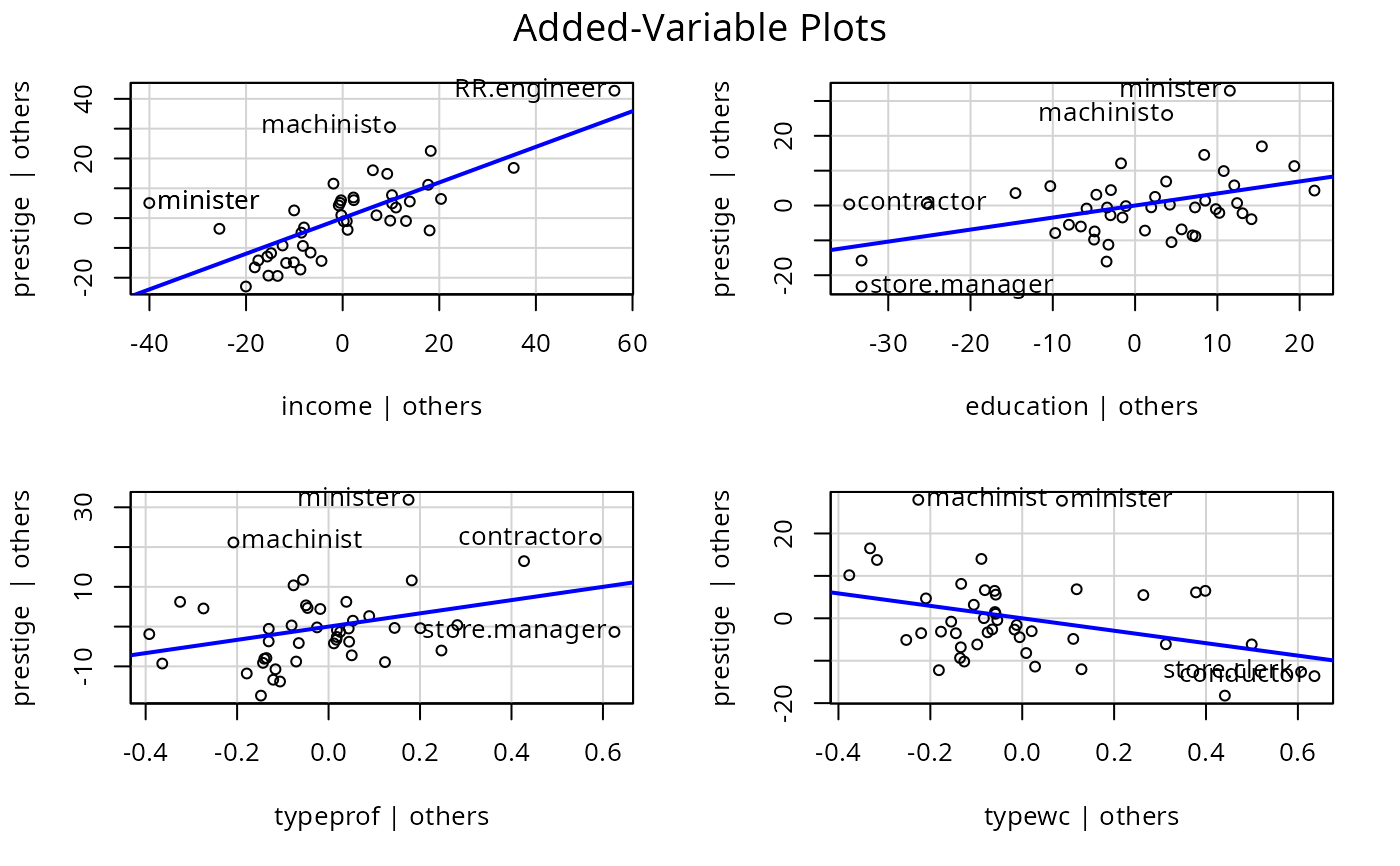
avPlots(lm(prestige ~ income + education + type, data=Duncan))
 avPlots(glm(partic != "not.work" ~ hincome + children,
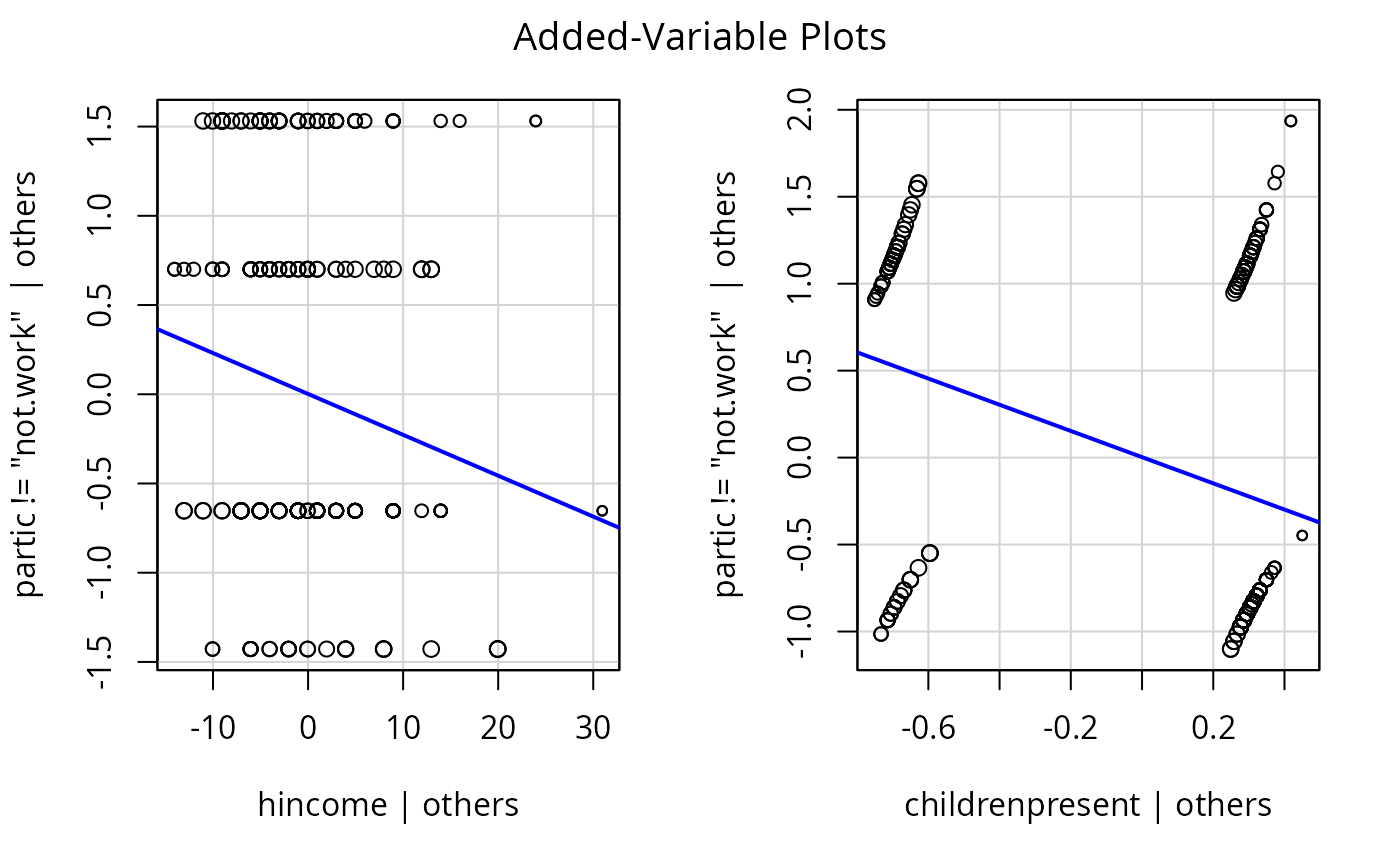
data=Womenlf, family=binomial), id=FALSE, pt.wts=TRUE)
avPlots(glm(partic != "not.work" ~ hincome + children,
data=Womenlf, family=binomial), id=FALSE, pt.wts=TRUE)
 m1 <- lm(partic ~ tfr + menwage + womwage + debt + parttime, Bfox)
par(mfrow=c(1,3))
# marginal plot, ignoring other predictors:
with(Bfox, dataEllipse(womwage, partic, levels=0.5))
abline(lm(partic ~ womwage, Bfox), col="red", lwd=2)
# AV plot, adjusting for others:
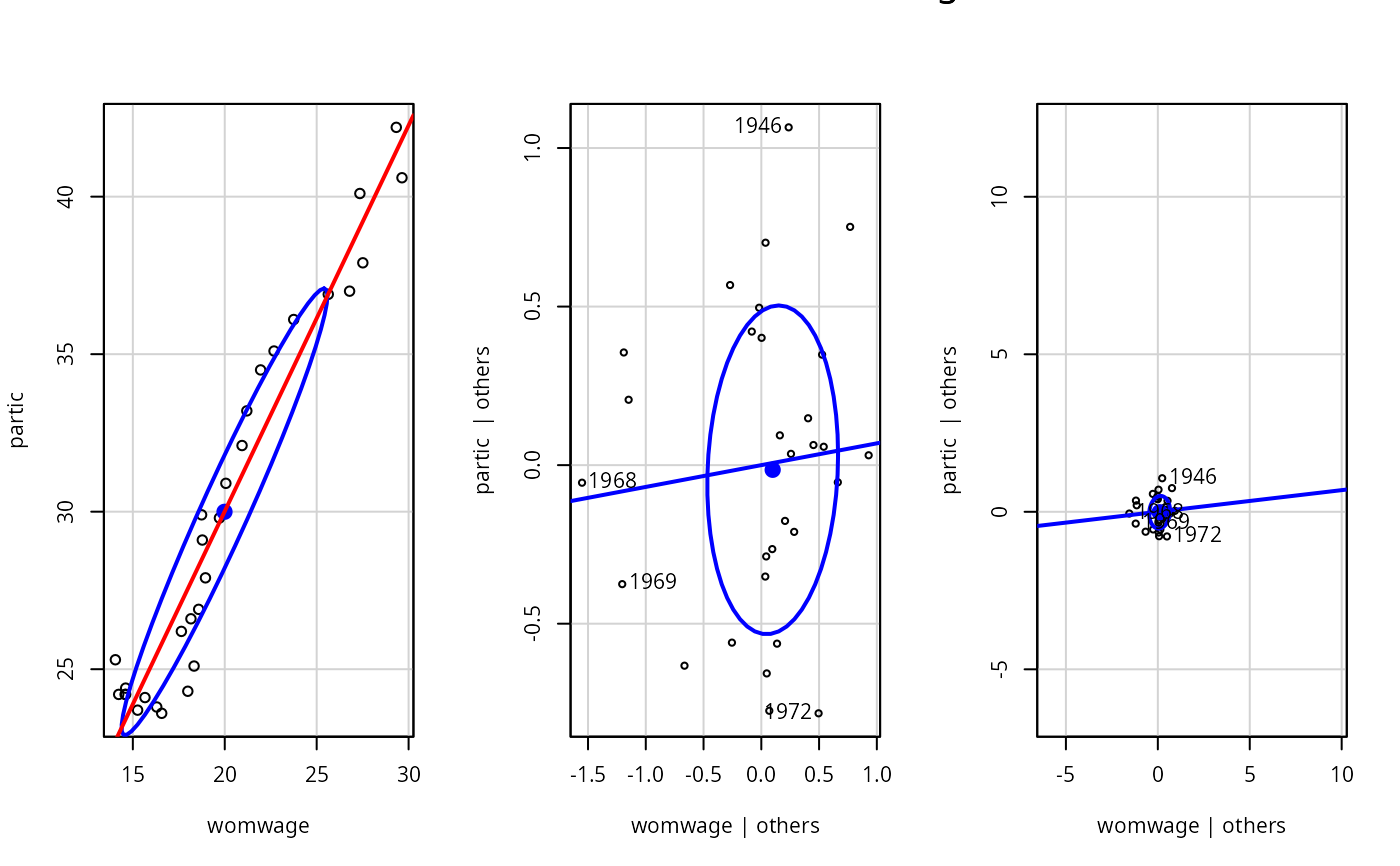
avPlots(m1, ~ womwage, ellipse=list(levels=0.5))
# AV plot, adjusting and scaling as in marginal plot
avPlots(m1, ~ womwage, marginal.scale=TRUE, ellipse=list(levels=0.5))
m1 <- lm(partic ~ tfr + menwage + womwage + debt + parttime, Bfox)
par(mfrow=c(1,3))
# marginal plot, ignoring other predictors:
with(Bfox, dataEllipse(womwage, partic, levels=0.5))
abline(lm(partic ~ womwage, Bfox), col="red", lwd=2)
# AV plot, adjusting for others:
avPlots(m1, ~ womwage, ellipse=list(levels=0.5))
# AV plot, adjusting and scaling as in marginal plot
avPlots(m1, ~ womwage, marginal.scale=TRUE, ellipse=list(levels=0.5))
 # 3D AV plot, requires the rgl package
if (interactive() && require("rgl")){
avPlot3d(lm(prestige ~ income + education + type, data=Duncan),
"income", "education")
}
# 3D AV plot, requires the rgl package
if (interactive() && require("rgl")){
avPlot3d(lm(prestige ~ income + education + type, data=Duncan),
"income", "education")
}