Component+Residual (Partial Residual) Plots
crPlots.RdThese functions construct component+residual plots, also called partial-residual plots, for linear and generalized linear models.
Usage
crPlots(model, ...)

# Default S3 method
crPlots(model, terms = ~., layout = NULL, ask, main,
    ...)

crp(...)

crPlot(model, ...)

# S3 method for class 'lm'
crPlot(model, variable, id=FALSE,
    order=1, line=TRUE, smooth=TRUE,
    col=carPalette()[1], col.lines=carPalette()[-1],
    xlab, ylab, pch=1, lwd=2, grid=TRUE, ...)

crPlot3d(model, var1, var2, ...)

# S3 method for class 'lm'
crPlot3d(model, var1, var2,
    xlab = var1,
    ylab = paste0("C+R(", eff$response, ")"), zlab = var2,
    axis.scales = TRUE, axis.ticks = FALSE, revolutions = 0,
    bg.col = c("white", "black"),
    axis.col = if (bg.col == "white") c("darkmagenta", "black", "darkcyan")
        else c("darkmagenta", "white", "darkcyan"),
    surface.col = carPalette()[2:3], surface.alpha = 0.5,
    point.col = "yellow", text.col = axis.col,
    grid.col = if (bg.col ==  "white") "black" else "gray",
    fogtype = c("exp2", "linear", "exp", "none"),
    fill = TRUE, grid = TRUE, grid.lines = 26,
    smoother = c("loess", "mgcv", "none"), df.mgcv = NULL, loess.args = NULL,
    sphere.size = 1, radius = 1, threshold = 0.01, speed = 1, fov = 60,
    ellipsoid = FALSE, level = 0.5, ellipsoid.alpha = 0.1,
    id = FALSE,
    mouseMode=c(none="none", left="polar", right="zoom", middle="fov",
                 wheel="pull"),
    ...)
Arguments
- model
model object produced by
lmorglm.- terms
A one-sided formula that specifies a subset of the regressors. One component-plus-residual plot is drawn for each regressor. The default
~.is to plot against all numeric regressors. For example, the specificationterms = ~ . - X3would plot against all regressors except forX3, whileterms = ~ log(X4)would give the plot for the predictor X4 that is represented in the model by log(X4). If this argument is a quoted name of one of the predictors, the component-plus-residual plot is drawn for that predictor only.- var1, var2
The quoted names of the two predictors in the model to use for a 3D C+R plot.
- layout
If set to a value like
c(1, 1)orc(4, 3), the layout of the graph will have this many rows and columns. If not set, the program will select an appropriate layout. If the number of graphs exceed nine, you must select the layout yourself, or you will get a maximum of nine per page. Iflayout=NA, the function does not set the layout and the user can use theparfunction to control the layout, for example to have plots from two models in the same graphics window.- ask
If
TRUE, ask the user before drawing the next plot; ifFALSE, the default, don't ask. This is relevant only if not all the graphs can be drawn in one window.- main
The title of the plot; if missing, one will be supplied.
- ...
crPlotspasses these arguments tocrPlot.crPlotpasses them toplot.- variable
A quoted string giving the name of a variable for the horizontal axis.
- id
controls point identification; if
FALSE(the default), no points are identified; can be a list of named arguments to theshowLabelsfunction;TRUEis equivalent tolist(method=list(abs(residuals(model, type="pearson")), "x"), n=2, cex=1, col=carPalette()[1], location="lr"), which identifies the 2 points with the largest residuals and the 2 points with the most extreme horizontal (X) values. For 3D C+R plots, seeIdentify3d.- order
order of polynomial regression performed for predictor to be plotted; default
1.- line
TRUEto plot least-squares line.- smooth
specifies the smoother to be used along with its arguments; if
FALSE, no smoother is shown; can be a list giving the smoother function and its named arguments;TRUE, the default, is equivalent tolist(smoother=loessLine). SeeScatterplotSmoothersfor the smoothers supplied by the car package and their arguments.- smoother, df.mgcv, loess.args
smootherspecifies quoted name of the surface smoother to use for the partial residuals, eitherloess, the default, ormgcv.df.mgcvgives the degrees of freedom for themgcvsmoother;NULL, the default, causes the df to be computed bymgcv.loess.argsis an optional list with named elementsspan,familyanddegree, with defaultspan = 2/3;family = "gaussian"for a binomial or Poisson GLM andfamily = "symmetric"otherwise; anddegree = 1(seeloess).- col
color for points; the default is the first entry in the current car palette (see
carPaletteandpar).- col.lines
a list of at least two colors. The first color is used for the ls line and the second color is used for the fitted lowess line. To use the same color for both, use, for example,
col.lines=c("red", "red")- xlab, ylab, zlab
labels for the x and y axes, and for the z axis of a 3D plot. If not set appropriate labels are created by the function. for the 3D C+R plot, the predictors are on the x and z axes and the response on the y (vertical) axis.
- pch
plotting character for points; default is
1(a circle, seepar).- lwd
line width; default is
2(seepar).- grid
If TRUE, the default, a light-gray background grid is put on the graph. For a 3D C+R plot, see the
gridargument forscatter3d.- grid.lines
number of horizontal and vertical lines to be drawn on regression surfaces for 2D C+R plots (26 by default); the square of
grid.linescorresponds to the number of points at which the fitted partial regression surface is evaluated and so this argument should not be set too small.- axis.scales, axis.ticks, revolutions, bg.col, axis.col, surface.col, surface.alpha, point.col, text.col, grid.col, fogtype, fill, sphere.size, radius, threshold, speed, fov, ellipsoid, level, ellipsoid.alpha, mouseMode
see
scatter3d.
Details
The functions intended for direct use are crPlots, for which crp
is an abbreviation, and, for 3D C+R plots, crPlot3d.
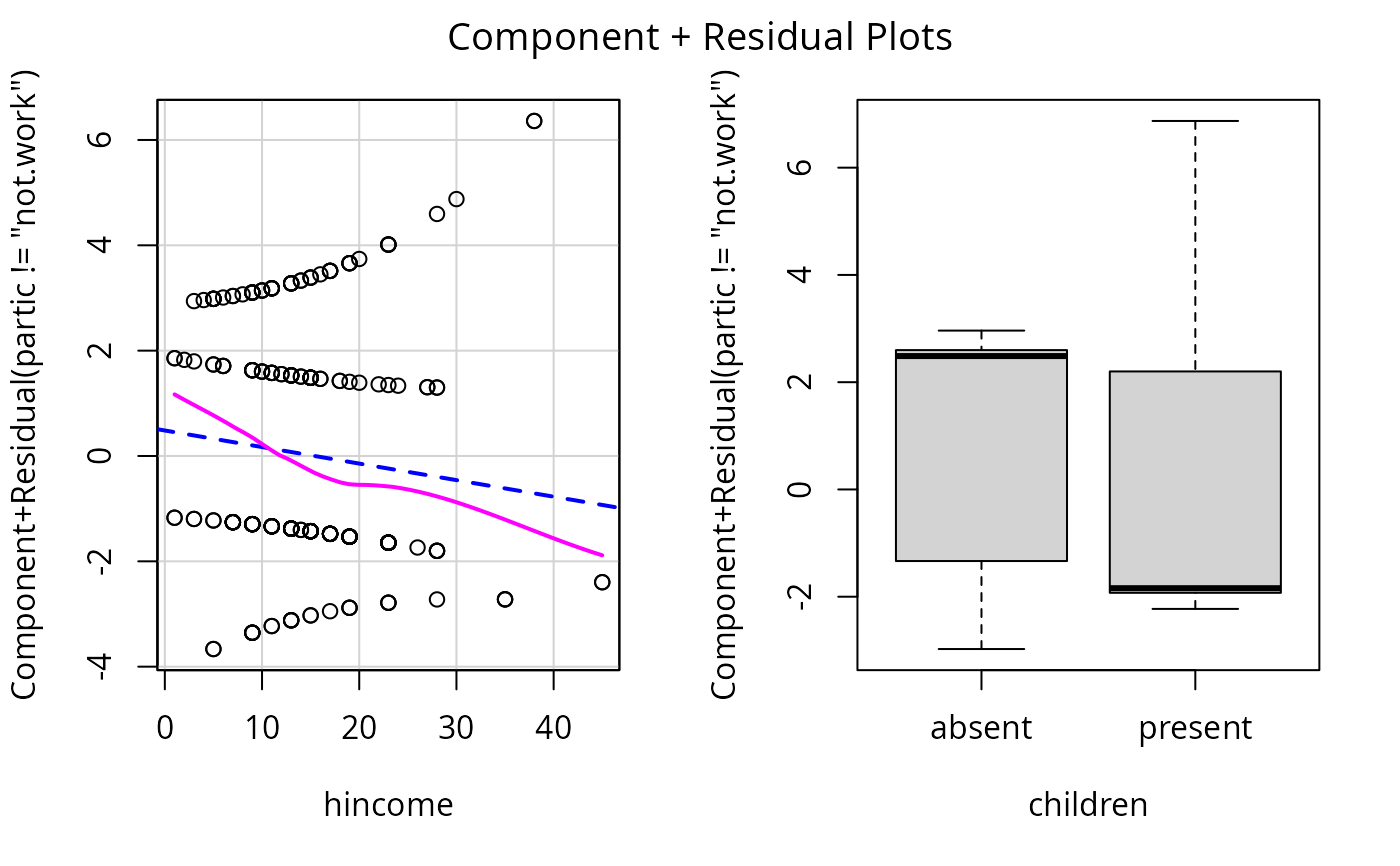
For 2D plots, the model cannot contain interactions, but can contain factors.
Parallel boxplots of the partial residuals are drawn for the levels
of a factor. crPlot3d can handle models with two-way interactions.
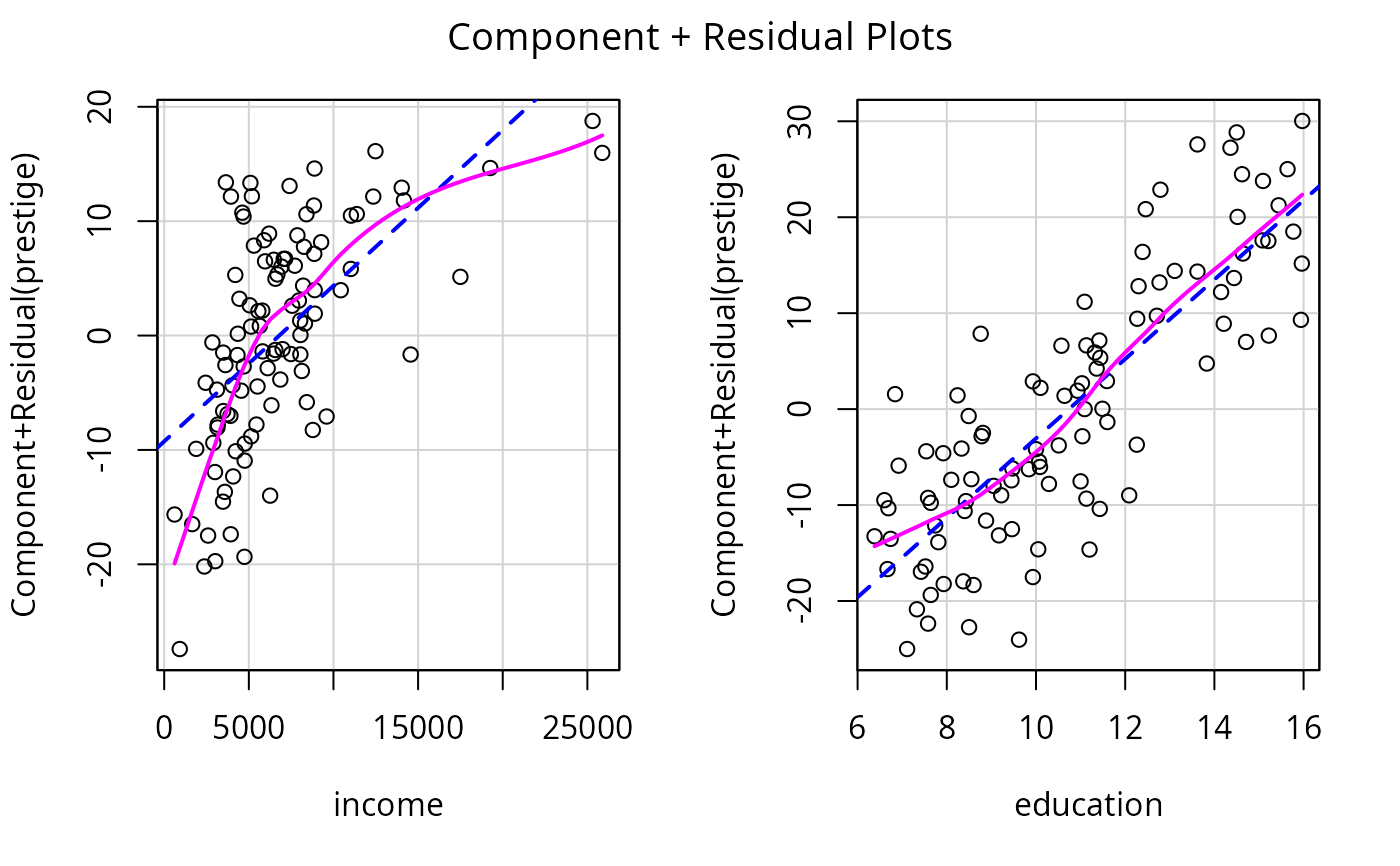
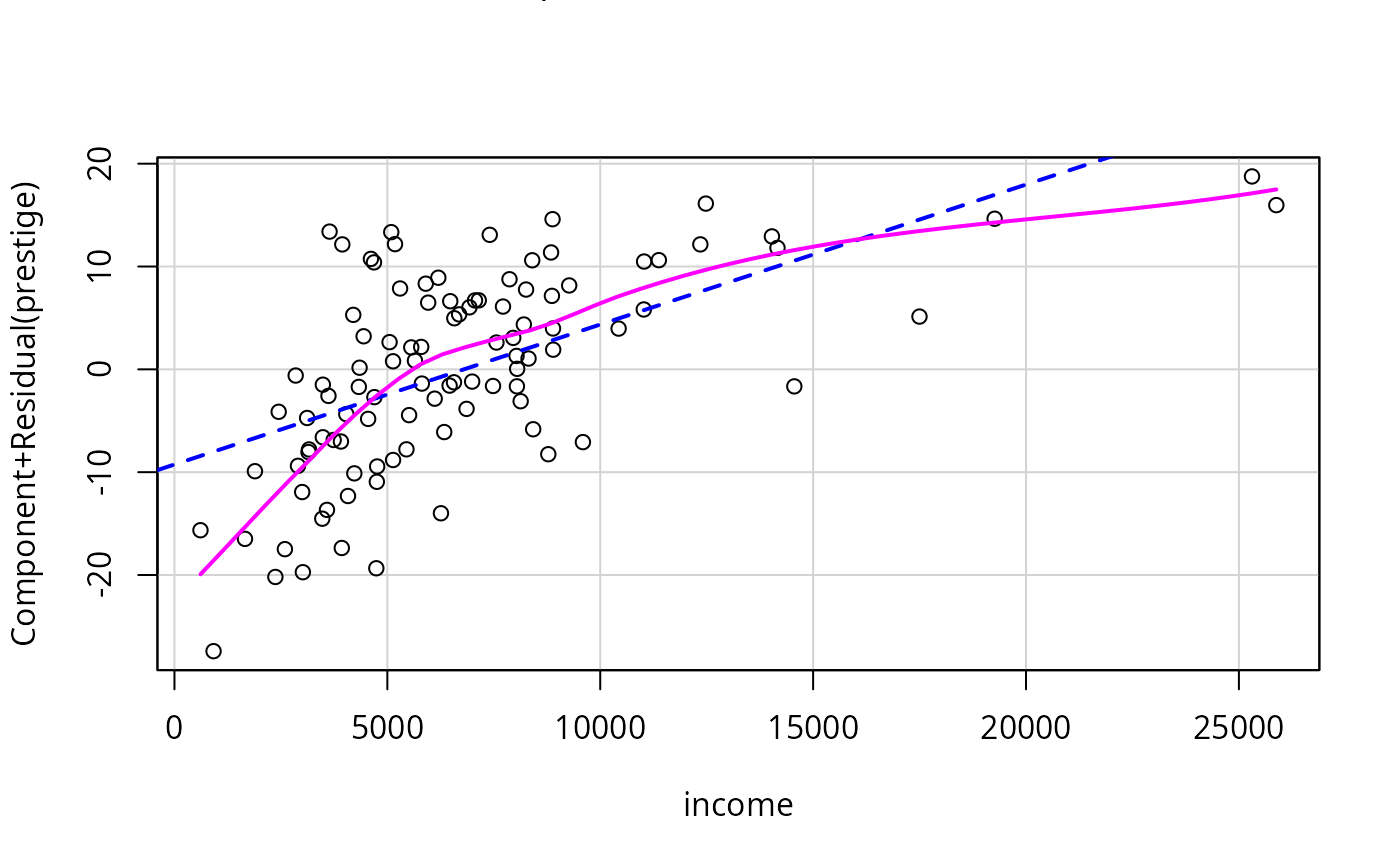
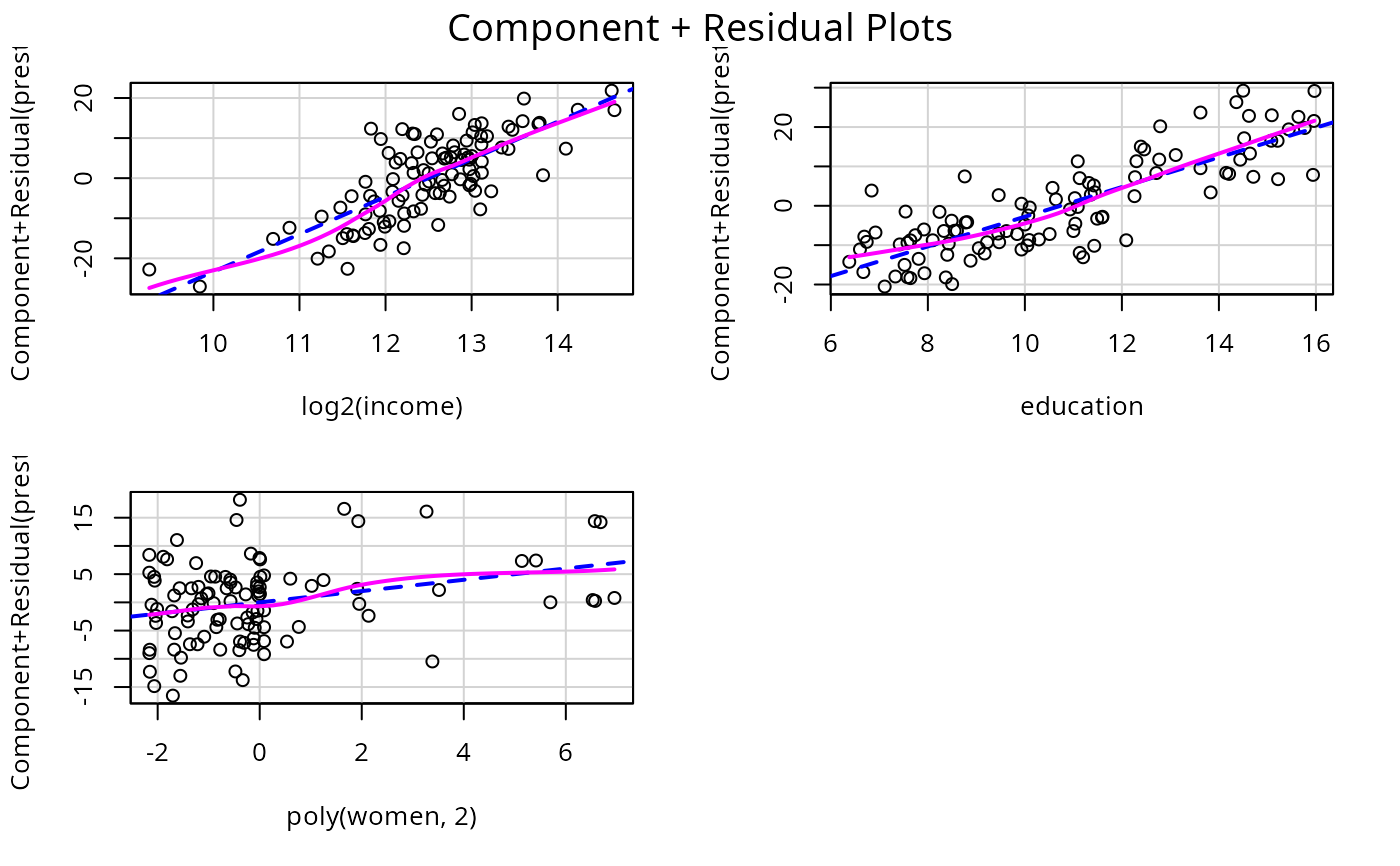
For 2D C+R plots, the fit is represented by a broken blue line and a smooth of the partial residuals by a solid magenta line. For 3D C+R plots, the fit is represented by a blue surface and a smooth of the partial residuals by a magenta surface.
Value
These functions are used for their side effect of producing plots, but also invisibly return the coordinates of the plotted points.
References
Cook, R. D. and Weisberg, S. (1999) Applied Regression, Including Computing and Graphics. Wiley.
Fox, J. (2016) Applied Regression Analysis and Generalized Linear Models, Third Edition. Sage.
Fox, J. and Weisberg, S. (2019) An R Companion to Applied Regression, Third Edition, Sage.
Author
John Fox jfox@mcmaster.ca
Examples
crPlots(m<-lm(prestige ~ income + education, data=Prestige))
 crPlots(m, terms=~ . - education) # get only one plot
 crPlots(lm(prestige ~ log2(income) + education + poly(women,2), data=Prestige))
 crPlots(glm(partic != "not.work" ~ hincome + children,
data=Womenlf, family=binomial), smooth=list(span=0.75))
crPlots(glm(partic != "not.work" ~ hincome + children,
data=Womenlf, family=binomial), smooth=list(span=0.75))
 # 3D C+R plot, requires the rgl, effects, and mgcv packages
if (interactive() && require(rgl) && require(effects) && require(mgcv)){
crPlot3d(lm(prestige ~ income*education + women, data=Prestige),
"income", "education")
}
# 3D C+R plot, requires the rgl, effects, and mgcv packages
if (interactive() && require(rgl) && require(effects) && require(mgcv)){
crPlot3d(lm(prestige ~ income*education + women, data=Prestige),
"income", "education")
}