US Consumption Data (1950–1993)
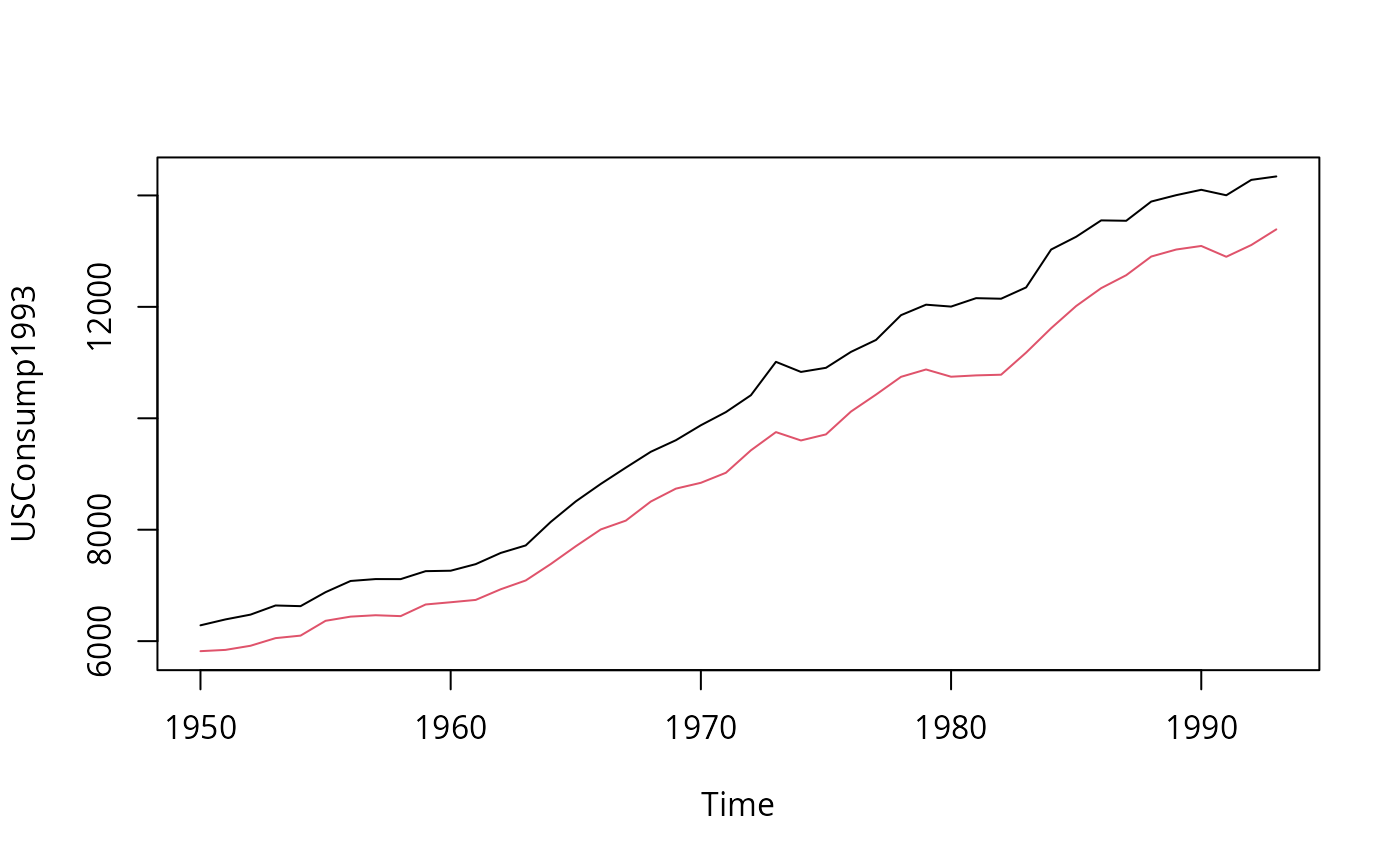
USConsump1993.RdTime series data on US income and consumption expenditure, 1950–1993.
Usage
data("USConsump1993")Format
An annual multiple time series from 1950 to 1993 with 2 variables.
- income
Disposable personal income (in 1987 USD).
- expenditure
Personal consumption expenditures (in 1987 USD).
Examples
## data from Baltagi (2002)
data("USConsump1993", package = "AER")
plot(USConsump1993, plot.type = "single", col = 1:2)
 ## Chapter 5 (p. 122-125)
fm <- lm(expenditure ~ income, data = USConsump1993)
summary(fm)
#>
#> Call:
#> lm(formula = expenditure ~ income, data = USConsump1993)
#>
#> Residuals:
#> Min 1Q Median 3Q Max
#> -294.52 -67.02 4.64 90.02 325.84
#>
#> Coefficients:
#> Estimate Std. Error t value Pr(>|t|)
#> (Intercept) -65.795821 90.990824 -0.723 0.474
#> income 0.915623 0.008648 105.874 <2e-16 ***
#> ---
#> Signif. codes: 0 ‘***’ 0.001 ‘**’ 0.01 ‘*’ 0.05 ‘.’ 0.1 ‘ ’ 1
#>
#> Residual standard error: 153.6 on 42 degrees of freedom
#> Multiple R-squared: 0.9963, Adjusted R-squared: 0.9962
#> F-statistic: 1.121e+04 on 1 and 42 DF, p-value: < 2.2e-16
#>
## Durbin-Watson test (p. 122)
dwtest(fm)
#>
#> Durbin-Watson test
#>
#> data: fm
#> DW = 0.46078, p-value = 3.274e-11
#> alternative hypothesis: true autocorrelation is greater than 0
#>
## Breusch-Godfrey test (Table 5.4, p. 124)
bgtest(fm)
#>
#> Breusch-Godfrey test for serial correlation of order up to 1
#>
#> data: fm
#> LM test = 24.901, df = 1, p-value = 6.034e-07
#>
## Newey-West standard errors (Table 5.5, p. 125)
coeftest(fm, vcov = NeweyWest(fm, lag = 3, prewhite = FALSE, adjust = TRUE))
#>
#> t test of coefficients:
#>
#> Estimate Std. Error t value Pr(>|t|)
#> (Intercept) -65.795821 133.345400 -0.4934 0.6243
#> income 0.915623 0.015458 59.2319 <2e-16 ***
#> ---
#> Signif. codes: 0 ‘***’ 0.001 ‘**’ 0.01 ‘*’ 0.05 ‘.’ 0.1 ‘ ’ 1
#>
## Chapter 8
library("strucchange")
## Recursive residuals
rr <- recresid(fm)
rr
#> [1] 24.900681 30.354827 50.893291 63.260389 -49.805907 -28.404311
#> [7] -31.520559 53.194256 67.696114 -2.646556 9.679147 39.658827
#> [13] -40.126557 -30.260756 2.605633 -78.941467 27.185066 64.363195
#> [19] -64.906717 -71.641013 70.095867 -113.475323 -85.633171 -29.427630
#> [25] 128.328459 220.693133 126.591749 78.394247 -25.955574 -124.178686
#> [31] -90.845193 127.830581 -30.794629 159.780872 201.707127 405.310561
#> [37] 390.953841 373.370919 316.431235 188.109683 134.461285 339.300414
## Recursive CUSUM test
rcus <- efp(expenditure ~ income, data = USConsump1993)
plot(rcus)
## Chapter 5 (p. 122-125)
fm <- lm(expenditure ~ income, data = USConsump1993)
summary(fm)
#>
#> Call:
#> lm(formula = expenditure ~ income, data = USConsump1993)
#>
#> Residuals:
#> Min 1Q Median 3Q Max
#> -294.52 -67.02 4.64 90.02 325.84
#>
#> Coefficients:
#> Estimate Std. Error t value Pr(>|t|)
#> (Intercept) -65.795821 90.990824 -0.723 0.474
#> income 0.915623 0.008648 105.874 <2e-16 ***
#> ---
#> Signif. codes: 0 ‘***’ 0.001 ‘**’ 0.01 ‘*’ 0.05 ‘.’ 0.1 ‘ ’ 1
#>
#> Residual standard error: 153.6 on 42 degrees of freedom
#> Multiple R-squared: 0.9963, Adjusted R-squared: 0.9962
#> F-statistic: 1.121e+04 on 1 and 42 DF, p-value: < 2.2e-16
#>
## Durbin-Watson test (p. 122)
dwtest(fm)
#>
#> Durbin-Watson test
#>
#> data: fm
#> DW = 0.46078, p-value = 3.274e-11
#> alternative hypothesis: true autocorrelation is greater than 0
#>
## Breusch-Godfrey test (Table 5.4, p. 124)
bgtest(fm)
#>
#> Breusch-Godfrey test for serial correlation of order up to 1
#>
#> data: fm
#> LM test = 24.901, df = 1, p-value = 6.034e-07
#>
## Newey-West standard errors (Table 5.5, p. 125)
coeftest(fm, vcov = NeweyWest(fm, lag = 3, prewhite = FALSE, adjust = TRUE))
#>
#> t test of coefficients:
#>
#> Estimate Std. Error t value Pr(>|t|)
#> (Intercept) -65.795821 133.345400 -0.4934 0.6243
#> income 0.915623 0.015458 59.2319 <2e-16 ***
#> ---
#> Signif. codes: 0 ‘***’ 0.001 ‘**’ 0.01 ‘*’ 0.05 ‘.’ 0.1 ‘ ’ 1
#>
## Chapter 8
library("strucchange")
## Recursive residuals
rr <- recresid(fm)
rr
#> [1] 24.900681 30.354827 50.893291 63.260389 -49.805907 -28.404311
#> [7] -31.520559 53.194256 67.696114 -2.646556 9.679147 39.658827
#> [13] -40.126557 -30.260756 2.605633 -78.941467 27.185066 64.363195
#> [19] -64.906717 -71.641013 70.095867 -113.475323 -85.633171 -29.427630
#> [25] 128.328459 220.693133 126.591749 78.394247 -25.955574 -124.178686
#> [31] -90.845193 127.830581 -30.794629 159.780872 201.707127 405.310561
#> [37] 390.953841 373.370919 316.431235 188.109683 134.461285 339.300414
## Recursive CUSUM test
rcus <- efp(expenditure ~ income, data = USConsump1993)
plot(rcus)
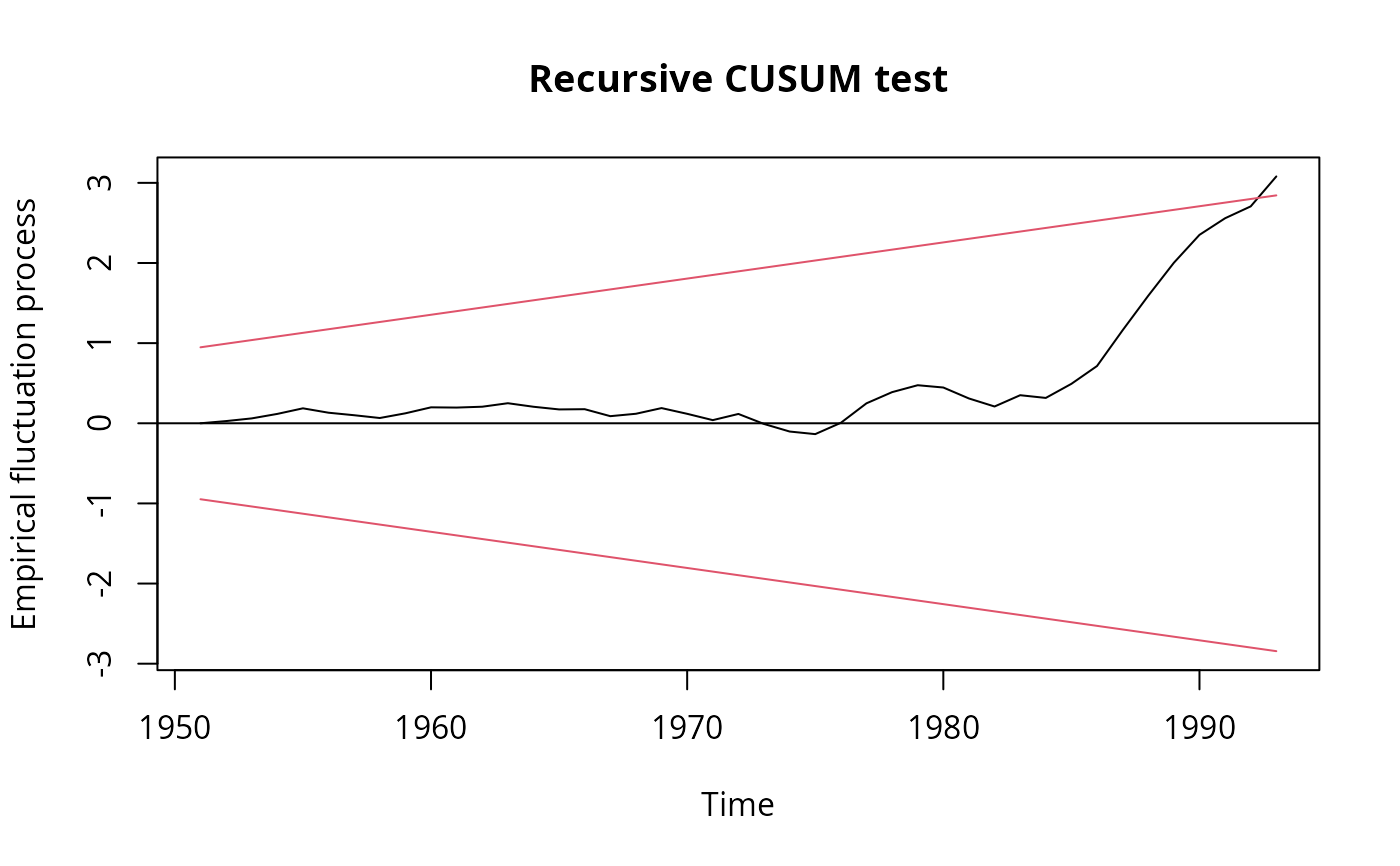 sctest(rcus)
#>
#> Recursive CUSUM test
#>
#> data: rcus
#> S = 1.0267, p-value = 0.02707
#>
## Harvey-Collier test
harvtest(fm)
#>
#> Harvey-Collier test
#>
#> data: fm
#> HC = 3.0802, df = 41, p-value = 0.003685
#>
## NOTE" Mistake in Baltagi (2002) who computes
## the t-statistic incorrectly as 0.0733 via
mean(rr)/sd(rr)/sqrt(length(rr))
#> [1] 0.07333754
## whereas it should be (as in harvtest)
mean(rr)/sd(rr) * sqrt(length(rr))
#> [1] 3.080177
## Rainbow test
raintest(fm, center = 23)
#>
#> Rainbow test
#>
#> data: fm
#> Rain = 4.1448, df1 = 22, df2 = 20, p-value = 0.001116
#>
## J test for non-nested models
library("dynlm")
fm1 <- dynlm(expenditure ~ income + L(income), data = USConsump1993)
fm2 <- dynlm(expenditure ~ income + L(expenditure), data = USConsump1993)
jtest(fm1, fm2)
#> J test
#>
#> Model 1: expenditure ~ income + L(income)
#> Model 2: expenditure ~ income + L(expenditure)
#> Estimate Std. Error t value Pr(>|t|)
#> M1 + fitted(M2) 1.6378 0.20984 7.8051 1.726e-09 ***
#> M2 + fitted(M1) -2.5419 0.61603 -4.1262 0.0001874 ***
#> ---
#> Signif. codes: 0 ‘***’ 0.001 ‘**’ 0.01 ‘*’ 0.05 ‘.’ 0.1 ‘ ’ 1
## Chapter 14
## ACF and PACF for expenditures and first differences
exps <- USConsump1993[, "expenditure"]
(acf(exps))
sctest(rcus)
#>
#> Recursive CUSUM test
#>
#> data: rcus
#> S = 1.0267, p-value = 0.02707
#>
## Harvey-Collier test
harvtest(fm)
#>
#> Harvey-Collier test
#>
#> data: fm
#> HC = 3.0802, df = 41, p-value = 0.003685
#>
## NOTE" Mistake in Baltagi (2002) who computes
## the t-statistic incorrectly as 0.0733 via
mean(rr)/sd(rr)/sqrt(length(rr))
#> [1] 0.07333754
## whereas it should be (as in harvtest)
mean(rr)/sd(rr) * sqrt(length(rr))
#> [1] 3.080177
## Rainbow test
raintest(fm, center = 23)
#>
#> Rainbow test
#>
#> data: fm
#> Rain = 4.1448, df1 = 22, df2 = 20, p-value = 0.001116
#>
## J test for non-nested models
library("dynlm")
fm1 <- dynlm(expenditure ~ income + L(income), data = USConsump1993)
fm2 <- dynlm(expenditure ~ income + L(expenditure), data = USConsump1993)
jtest(fm1, fm2)
#> J test
#>
#> Model 1: expenditure ~ income + L(income)
#> Model 2: expenditure ~ income + L(expenditure)
#> Estimate Std. Error t value Pr(>|t|)
#> M1 + fitted(M2) 1.6378 0.20984 7.8051 1.726e-09 ***
#> M2 + fitted(M1) -2.5419 0.61603 -4.1262 0.0001874 ***
#> ---
#> Signif. codes: 0 ‘***’ 0.001 ‘**’ 0.01 ‘*’ 0.05 ‘.’ 0.1 ‘ ’ 1
## Chapter 14
## ACF and PACF for expenditures and first differences
exps <- USConsump1993[, "expenditure"]
(acf(exps))
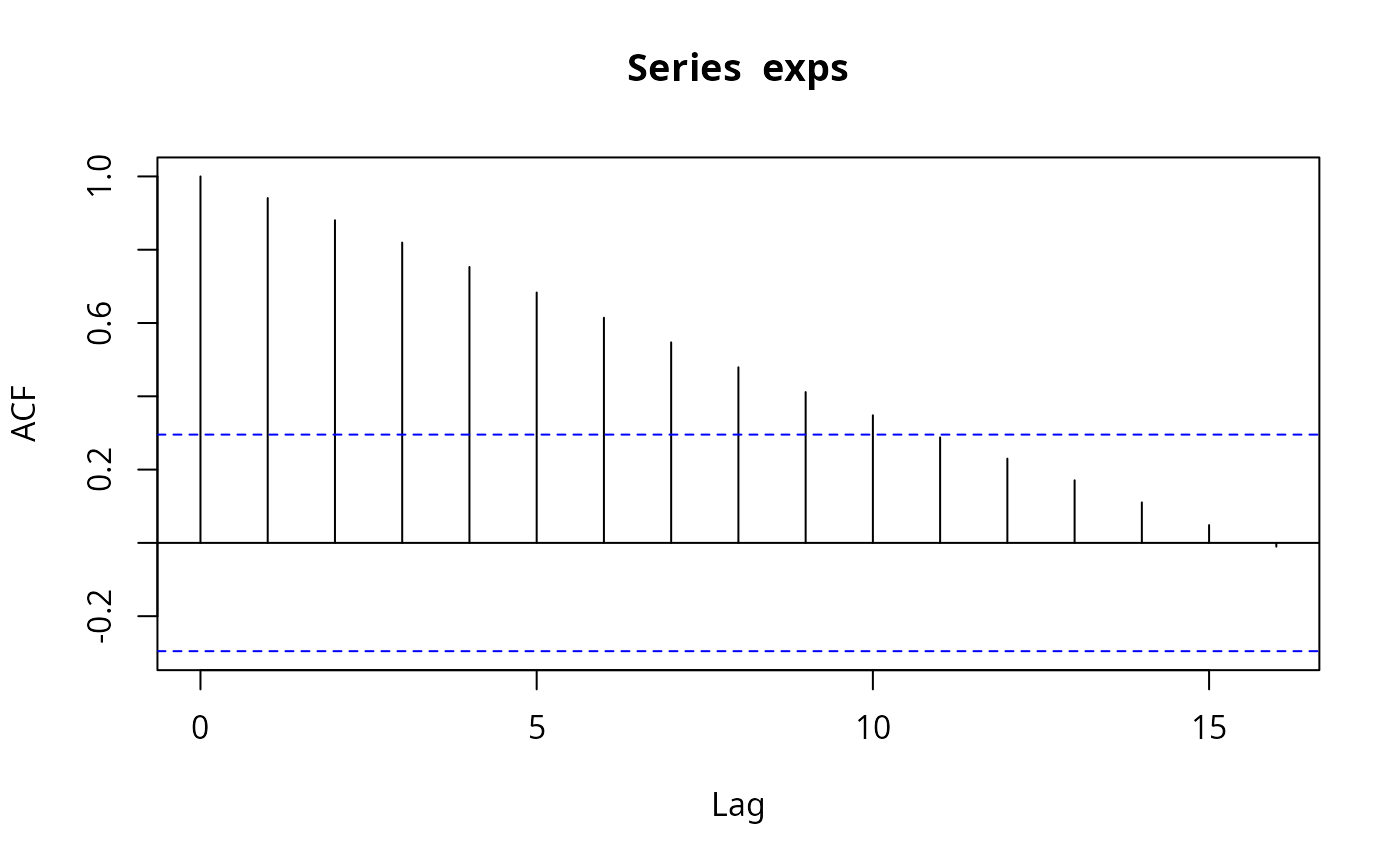 #>
#> Autocorrelations of series ‘exps’, by lag
#>
#> 0 1 2 3 4 5 6 7 8 9 10
#> 1.000 0.941 0.880 0.820 0.753 0.683 0.614 0.547 0.479 0.412 0.348
#> 11 12 13 14 15 16
#> 0.288 0.230 0.171 0.110 0.049 -0.010
(pacf(exps))
#>
#> Autocorrelations of series ‘exps’, by lag
#>
#> 0 1 2 3 4 5 6 7 8 9 10
#> 1.000 0.941 0.880 0.820 0.753 0.683 0.614 0.547 0.479 0.412 0.348
#> 11 12 13 14 15 16
#> 0.288 0.230 0.171 0.110 0.049 -0.010
(pacf(exps))
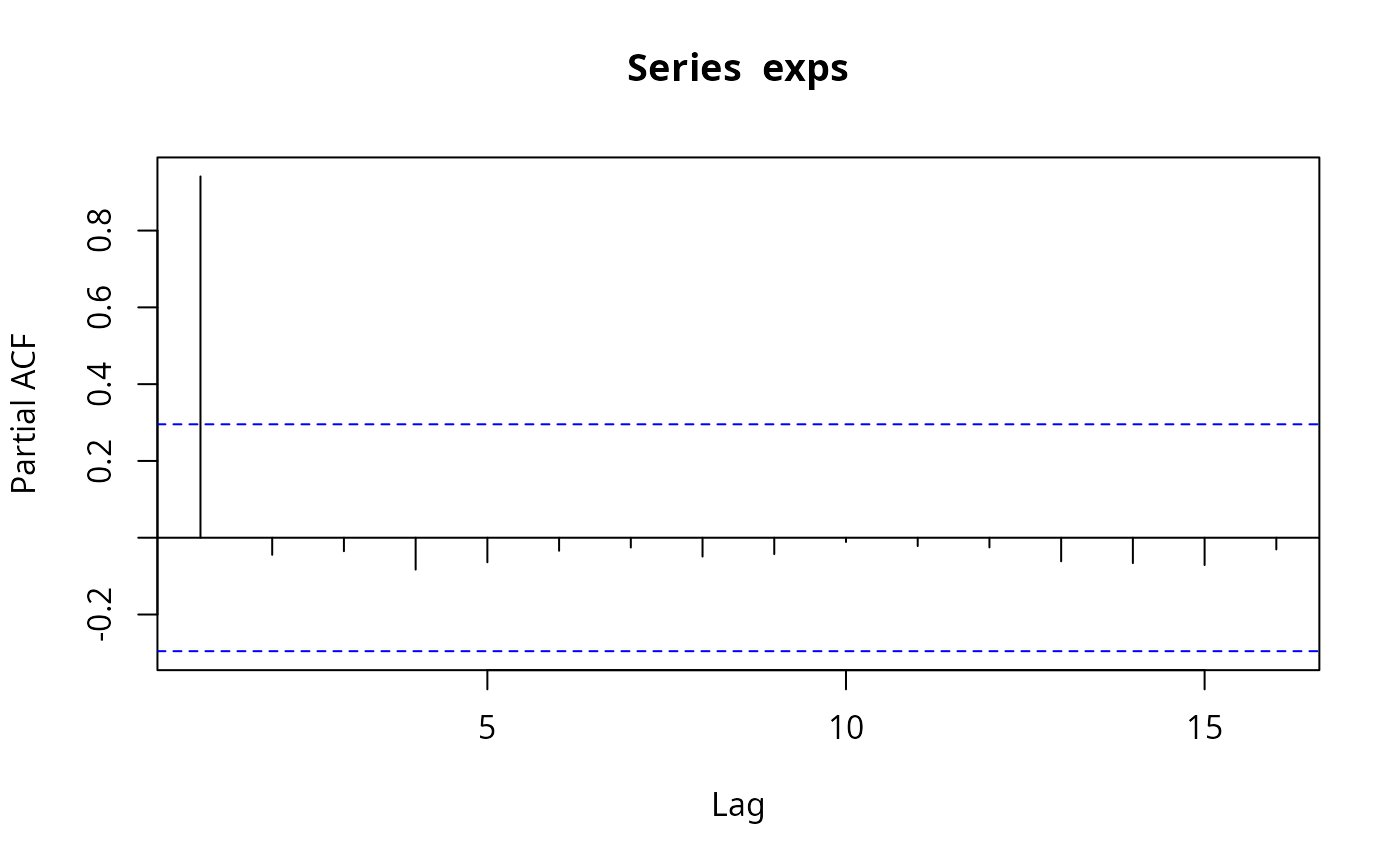 #>
#> Partial autocorrelations of series ‘exps’, by lag
#>
#> 1 2 3 4 5 6 7 8 9 10 11
#> 0.941 -0.045 -0.035 -0.083 -0.064 -0.034 -0.025 -0.049 -0.043 -0.011 -0.022
#> 12 13 14 15 16
#> -0.025 -0.061 -0.066 -0.071 -0.030
(acf(diff(exps)))
#>
#> Partial autocorrelations of series ‘exps’, by lag
#>
#> 1 2 3 4 5 6 7 8 9 10 11
#> 0.941 -0.045 -0.035 -0.083 -0.064 -0.034 -0.025 -0.049 -0.043 -0.011 -0.022
#> 12 13 14 15 16
#> -0.025 -0.061 -0.066 -0.071 -0.030
(acf(diff(exps)))
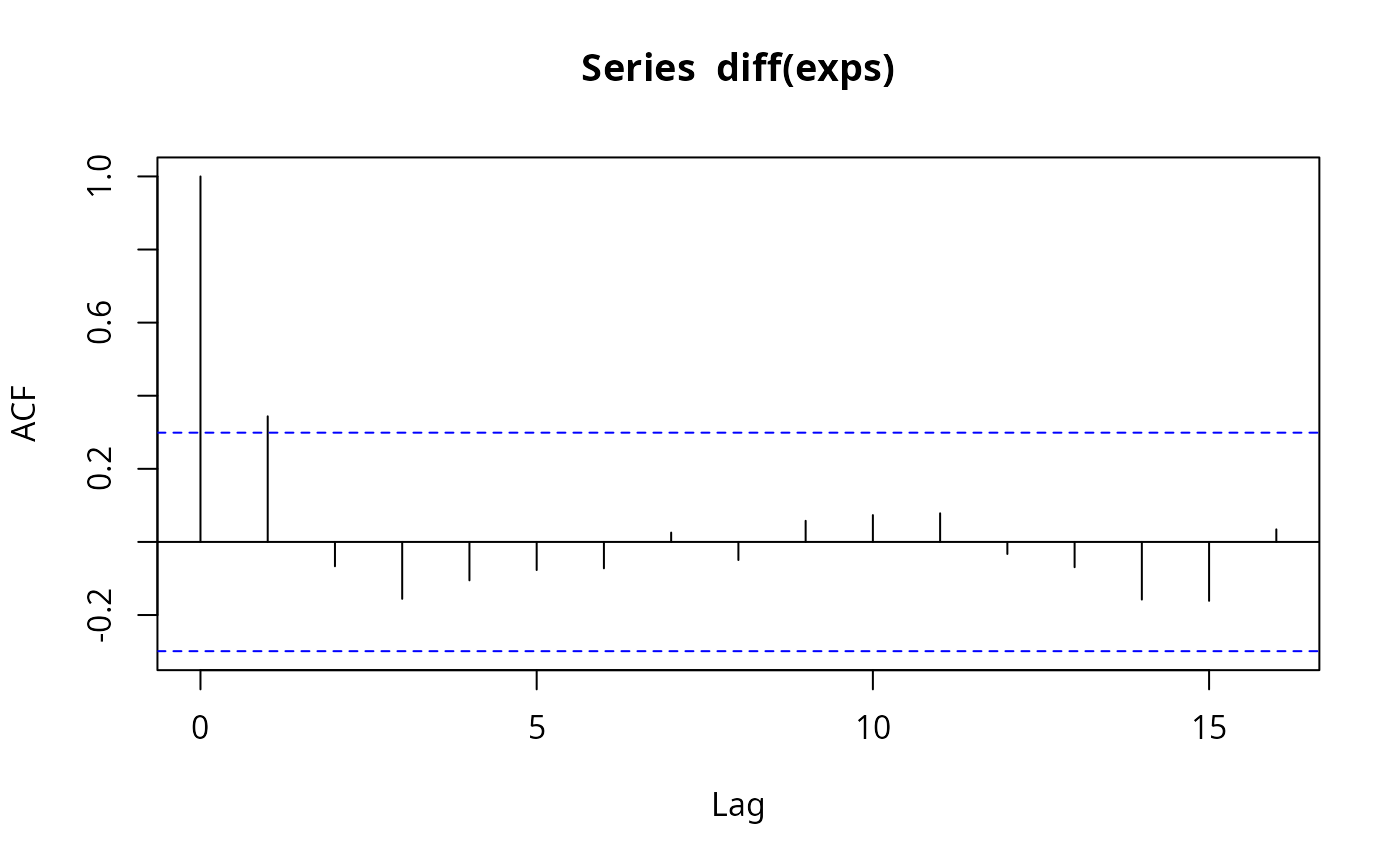 #>
#> Autocorrelations of series ‘diff(exps)’, by lag
#>
#> 0 1 2 3 4 5 6 7 8 9 10
#> 1.000 0.344 -0.067 -0.156 -0.105 -0.077 -0.072 0.026 -0.050 0.058 0.073
#> 11 12 13 14 15 16
#> 0.078 -0.033 -0.069 -0.158 -0.161 0.034
(pacf(diff(exps)))
#>
#> Autocorrelations of series ‘diff(exps)’, by lag
#>
#> 0 1 2 3 4 5 6 7 8 9 10
#> 1.000 0.344 -0.067 -0.156 -0.105 -0.077 -0.072 0.026 -0.050 0.058 0.073
#> 11 12 13 14 15 16
#> 0.078 -0.033 -0.069 -0.158 -0.161 0.034
(pacf(diff(exps)))
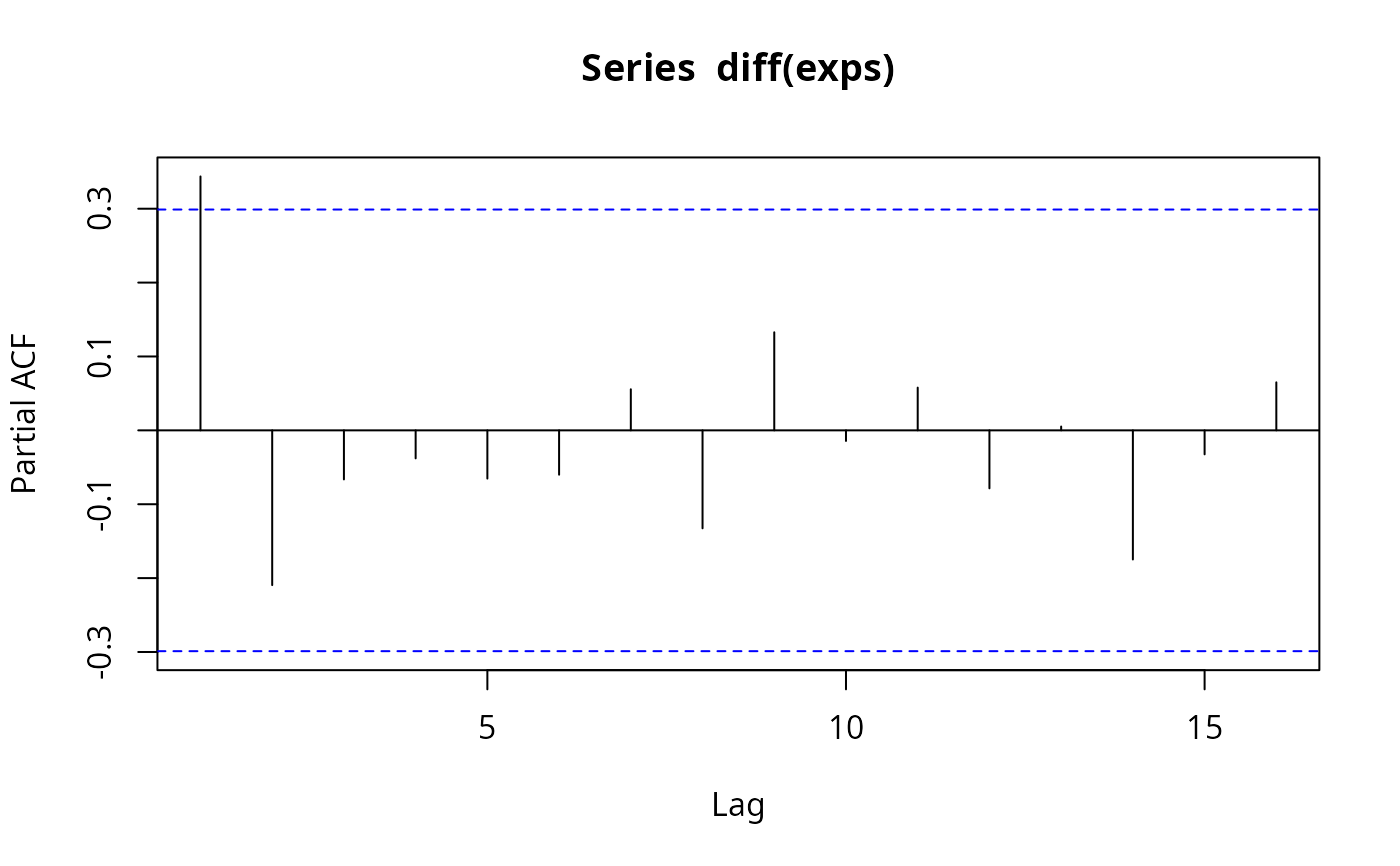 #>
#> Partial autocorrelations of series ‘diff(exps)’, by lag
#>
#> 1 2 3 4 5 6 7 8 9 10 11
#> 0.344 -0.209 -0.066 -0.038 -0.065 -0.060 0.056 -0.133 0.133 -0.014 0.058
#> 12 13 14 15 16
#> -0.079 0.005 -0.175 -0.032 0.065
## dynamic regressions, eq. (14.8)
fm <- dynlm(d(exps) ~ I(time(exps) - 1949) + L(exps))
summary(fm)
#>
#> Time series regression with "ts" data:
#> Start = 1951, End = 1993
#>
#> Call:
#> dynlm(formula = d(exps) ~ I(time(exps) - 1949) + L(exps))
#>
#> Residuals:
#> Min 1Q Median 3Q Max
#> -357.76 -78.18 22.49 108.97 201.06
#>
#> Coefficients:
#> Estimate Std. Error t value Pr(>|t|)
#> (Intercept) 1048.96039 353.81291 2.965 0.00509 **
#> I(time(exps) - 1949) 39.90164 14.31344 2.788 0.00808 **
#> L(exps) -0.19561 0.07398 -2.644 0.01164 *
#> ---
#> Signif. codes: 0 ‘***’ 0.001 ‘**’ 0.01 ‘*’ 0.05 ‘.’ 0.1 ‘ ’ 1
#>
#> Residual standard error: 147.4 on 40 degrees of freedom
#> Multiple R-squared: 0.1784, Adjusted R-squared: 0.1373
#> F-statistic: 4.343 on 2 and 40 DF, p-value: 0.01963
#>
#>
#> Partial autocorrelations of series ‘diff(exps)’, by lag
#>
#> 1 2 3 4 5 6 7 8 9 10 11
#> 0.344 -0.209 -0.066 -0.038 -0.065 -0.060 0.056 -0.133 0.133 -0.014 0.058
#> 12 13 14 15 16
#> -0.079 0.005 -0.175 -0.032 0.065
## dynamic regressions, eq. (14.8)
fm <- dynlm(d(exps) ~ I(time(exps) - 1949) + L(exps))
summary(fm)
#>
#> Time series regression with "ts" data:
#> Start = 1951, End = 1993
#>
#> Call:
#> dynlm(formula = d(exps) ~ I(time(exps) - 1949) + L(exps))
#>
#> Residuals:
#> Min 1Q Median 3Q Max
#> -357.76 -78.18 22.49 108.97 201.06
#>
#> Coefficients:
#> Estimate Std. Error t value Pr(>|t|)
#> (Intercept) 1048.96039 353.81291 2.965 0.00509 **
#> I(time(exps) - 1949) 39.90164 14.31344 2.788 0.00808 **
#> L(exps) -0.19561 0.07398 -2.644 0.01164 *
#> ---
#> Signif. codes: 0 ‘***’ 0.001 ‘**’ 0.01 ‘*’ 0.05 ‘.’ 0.1 ‘ ’ 1
#>
#> Residual standard error: 147.4 on 40 degrees of freedom
#> Multiple R-squared: 0.1784, Adjusted R-squared: 0.1373
#> F-statistic: 4.343 on 2 and 40 DF, p-value: 0.01963
#>