Default axis annotation utilities
axis.default.RdLattice funtions provide control over how the plot axes are annotated
through a common interface. There are two levels of control. The
xscale.components and yscale.components arguments can be
functions that determine tick mark locations and labels given a
packet. For more direct control, the axis argument can be a
function that actually draws the axes. The functions documented here
are the defaults for these arguments. They can additonally be used as
components of user written replacements.
Usage
xscale.components.default(lim,
                          packet.number = 0,
                          packet.list = NULL,
                          top = TRUE,
                          ...)
yscale.components.default(lim,
                          packet.number = 0,
                          packet.list = NULL,
                          right = TRUE,
                          ...)
axis.default(side = c("top", "bottom", "left", "right"),
             scales, components, as.table,
             labels = c("default", "yes", "no"),
             ticks = c("default", "yes", "no"),
             ..., prefix)
Arguments
- lim
the range of the data in that packet (data subset corresponding to a combination of levels of the conditioning variable). The range is not necessarily numeric; e.g. for factors, they could be character vectors representing levels, and for the various date-time representations, they could be vectors of length 2 with the corresponding class.
- packet.number
which packet (counted according to the packet order, described in
print.trellis) is being processed. In cases where all panels have the same limits, this function is called only once (rather than once for each packet), in which case this argument will have the value0.- packet.list
list, as long as the number of packets, giving all the actual packets. Specifically, each component is the list of arguments given to the panel function when and if that packet is drawn in a panel. (This has not yet been implemented.)
- top, right
the value of the
topandrightcomponents of the result, as appropriate. See below for interpretation.- side
on which side the axis is to be drawn. The usual partial matching rules apply.
- scales
the appropriate component of the
scalesargument supplied to the high level function, suitably standardized.- components
list, similar to those produced by
xscale.components.defaultandyscale.components.default.- as.table
the
as.tableargument in the high level function.- labels
whether labels are to be drawn. By default, the rules determined by
scalesare used.- ticks
whether labels are to be drawn. By default, the rules determined by
scalesare used.- ...
many other arguments may be supplied, and are passed on to other internal functions.
- prefix
A character string identifying the plot being drawn (see
print.trellis). Used to retrieve location of current panel in the overall layout, so that axes can be drawn appropriately.
Value
xscale.components.default and yscale.components.default
return a list of the form suitable as the components argument
of axis.default. Valid components in the return value of
xscale.components.default are:
num.limitA numeric limit for the box.
bottomA list with two elements,
ticksandlabels.ticksmust be a list with componentsatandtckwhich give the location and lengths of tick marks.tckcan be a vector, and will be recycled to be as long asat.labelsmust be a list with componentsat,labels, andcheck.overlap.atandlabelsgive the location and labels of the tick labels; this is usually the same as the location of the ticks, but is not required to be so.check.overlapis a logical flag indicating whether overlapping of labels should be avoided by omitting some of the labels while rendering.topThis can be a logical flag; if
TRUE,topis treated as being the same asbottom; ifFALSE, axis annotation for the top axis is omitted. Alternatively,topcan be a list likebottom.
Valid components in the return value of
yscale.components.default are left and right.
Their interpretations are analogous to (respectively) the
bottom and top components described above.
Details
These functions are part of a new API introduced in lattice 0.14 to provide the user more control over how axis annotation is done. While the API has been designed in anticipation of use that was previously unsupported, the implementation has initially focused on reproducing existing capabilities, rather than test new features. At the time of writing, several features are unimplemented. If you require them, please contact the maintainer.
Author
Deepayan Sarkar Deepayan.Sarkar@R-project.org
Examples
str(xscale.components.default(c(0, 1)))
#> List of 3
#> $ num.limit: num [1:2] 0 1
#> $ bottom :List of 2
#> ..$ ticks :List of 2
#> .. ..$ at : num [1:6] 0 0.2 0.4 0.6 0.8 1
#> .. ..$ tck: num 1
#> ..$ labels:List of 3
#> .. ..$ at : num [1:6] 0 0.2 0.4 0.6 0.8 1
#> .. ..$ labels : chr [1:6] "0.0" "0.2" "0.4" "0.6" ...
#> .. ..$ check.overlap: logi TRUE
#> $ top : logi TRUE
set.seed(36872)
rln <- rlnorm(100)
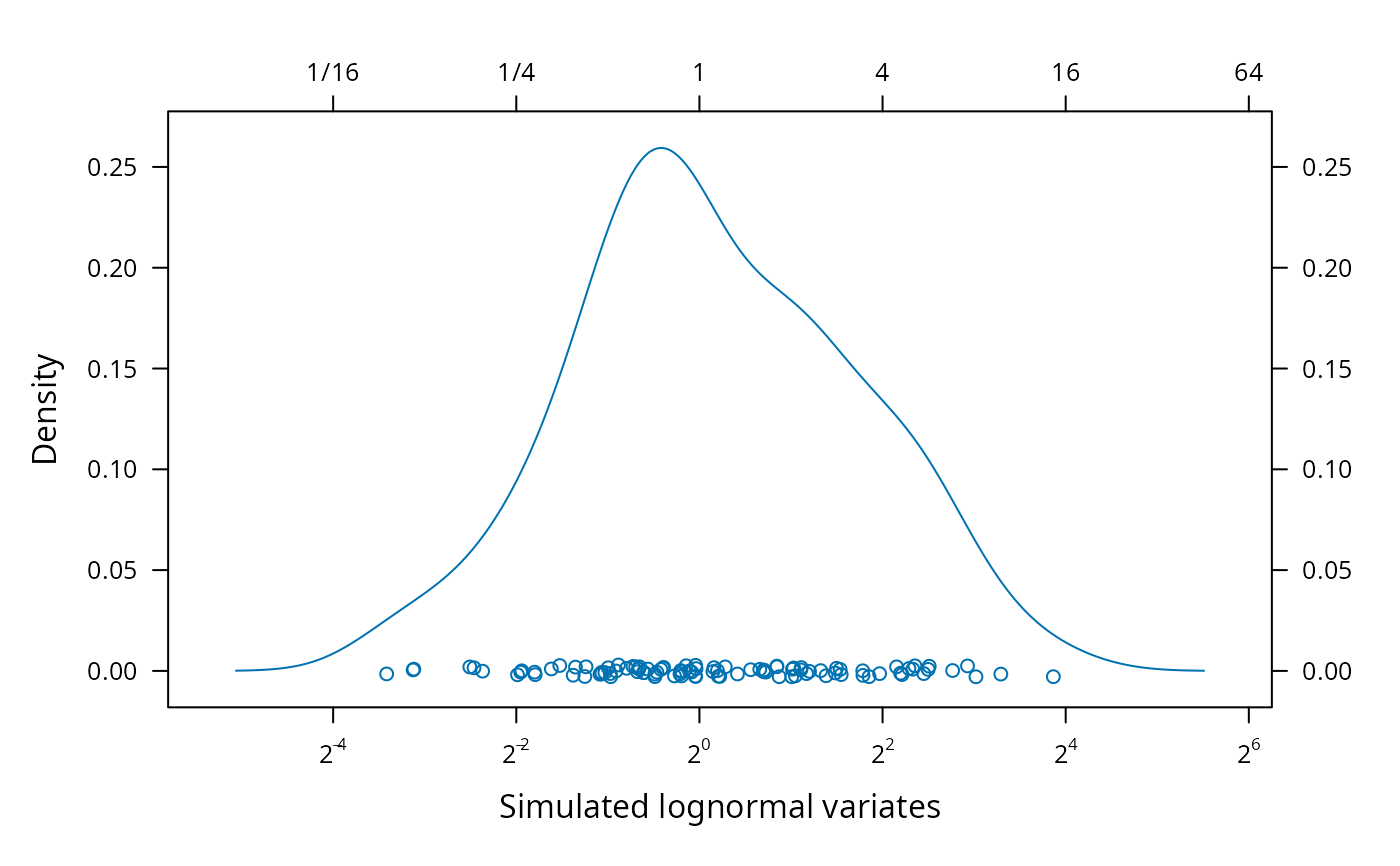
densityplot(rln,
scales = list(x = list(log = 2), alternating = 3),
xlab = "Simulated lognormal variates",
xscale.components = function(...) {
ans <- xscale.components.default(...)
ans$top <- ans$bottom
ans$bottom$labels$labels <- parse(text = ans$bottom$labels$labels)
ans$top$labels$labels <-
if (require(MASS))
fractions(2^(ans$top$labels$at))
else
2^(ans$top$labels$at)
ans
})
#> Loading required package: MASS
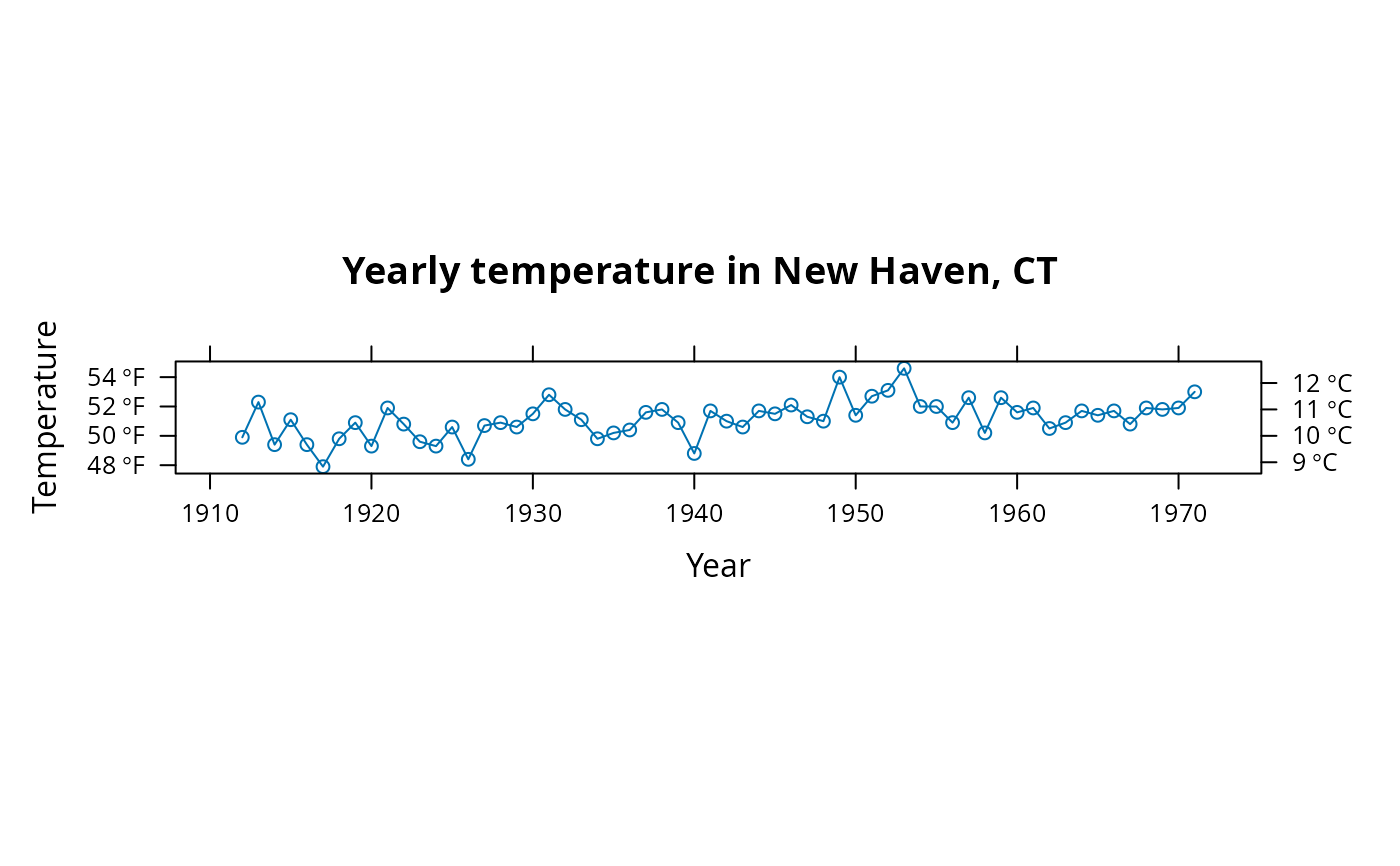
 ## Direct use of axis to show two temperature scales (Celcius and
## Fahrenheit). This does not work for multi-row plots, and doesn't
## do automatic allocation of space
F2C <- function(f) 5 * (f - 32) / 9
C2F <- function(c) 32 + 9 * c / 5
axis.CF <-
function(side, ...)
{
ylim <- current.panel.limits()$ylim
switch(side,
left = {
prettyF <- pretty(ylim)
labF <- parse(text = sprintf("%s ~ degree * F", prettyF))
panel.axis(side = side, outside = TRUE,
at = prettyF, labels = labF)
},
right = {
prettyC <- pretty(F2C(ylim))
labC <- parse(text = sprintf("%s ~ degree * C", prettyC))
panel.axis(side = side, outside = TRUE,
at = C2F(prettyC), labels = labC)
},
axis.default(side = side, ...))
}
xyplot(nhtemp ~ time(nhtemp), aspect = "xy", type = "o",
scales = list(y = list(alternating = 3)),
axis = axis.CF, xlab = "Year", ylab = "Temperature",
main = "Yearly temperature in New Haven, CT")
## Direct use of axis to show two temperature scales (Celcius and
## Fahrenheit). This does not work for multi-row plots, and doesn't
## do automatic allocation of space
F2C <- function(f) 5 * (f - 32) / 9
C2F <- function(c) 32 + 9 * c / 5
axis.CF <-
function(side, ...)
{
ylim <- current.panel.limits()$ylim
switch(side,
left = {
prettyF <- pretty(ylim)
labF <- parse(text = sprintf("%s ~ degree * F", prettyF))
panel.axis(side = side, outside = TRUE,
at = prettyF, labels = labF)
},
right = {
prettyC <- pretty(F2C(ylim))
labC <- parse(text = sprintf("%s ~ degree * C", prettyC))
panel.axis(side = side, outside = TRUE,
at = C2F(prettyC), labels = labC)
},
axis.default(side = side, ...))
}
xyplot(nhtemp ~ time(nhtemp), aspect = "xy", type = "o",
scales = list(y = list(alternating = 3)),
axis = axis.CF, xlab = "Year", ylab = "Temperature",
main = "Yearly temperature in New Haven, CT")
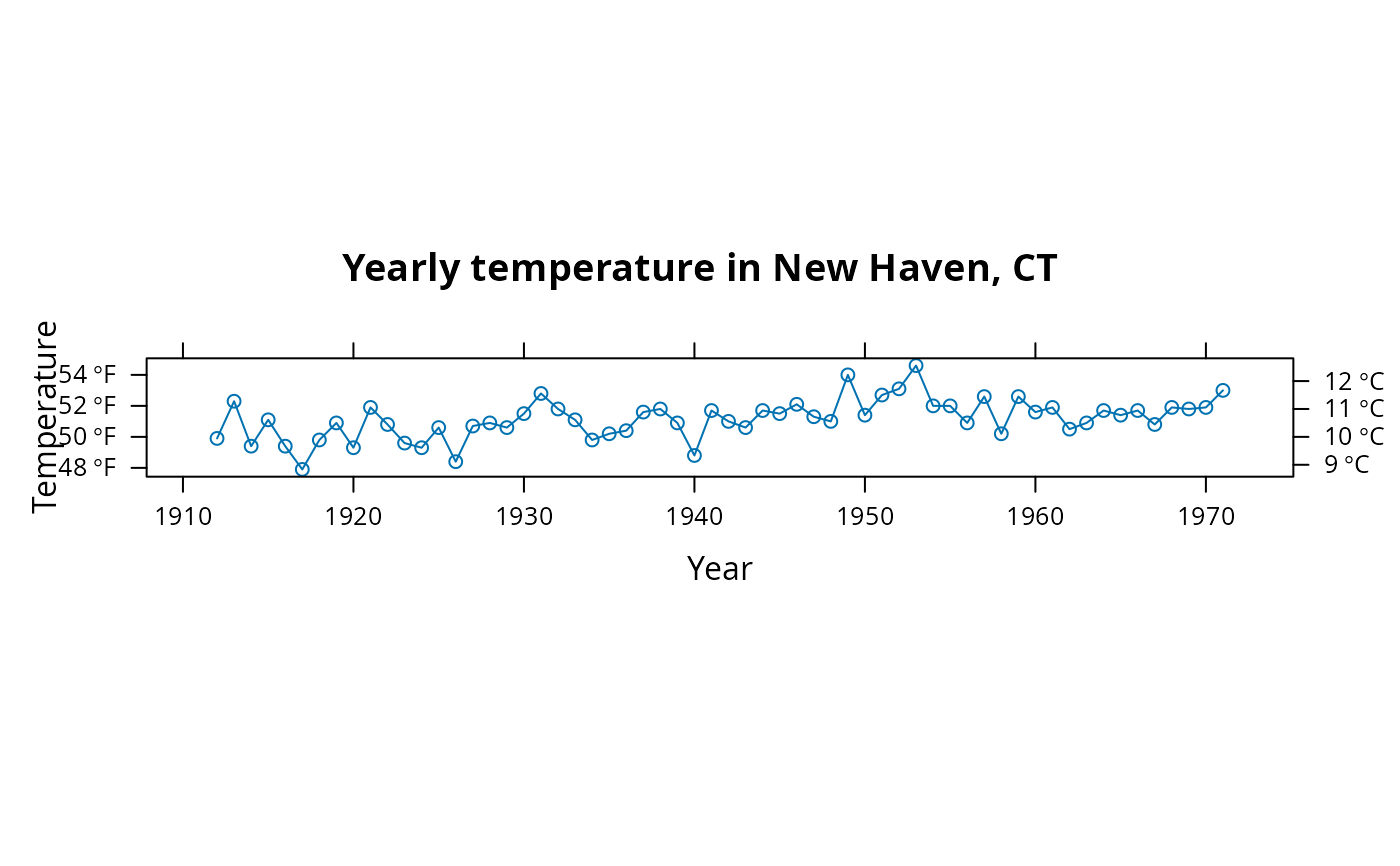 ## version using yscale.components
yscale.components.CF <-
function(...)
{
ans <- yscale.components.default(...)
ans$right <- ans$left
ans$left$labels$labels <-
parse(text = sprintf("%s ~ degree * F", ans$left$labels$at))
prettyC <- pretty(F2C(ans$num.limit))
ans$right$ticks$at <- C2F(prettyC)
ans$right$labels$at <- C2F(prettyC)
ans$right$labels$labels <-
parse(text = sprintf("%s ~ degree * C", prettyC))
ans
}
xyplot(nhtemp ~ time(nhtemp), aspect = "xy", type = "o",
scales = list(y = list(alternating = 3)),
yscale.components = yscale.components.CF,
xlab = "Year", ylab = "Temperature",
main = "Yearly temperature in New Haven, CT")
## version using yscale.components
yscale.components.CF <-
function(...)
{
ans <- yscale.components.default(...)
ans$right <- ans$left
ans$left$labels$labels <-
parse(text = sprintf("%s ~ degree * F", ans$left$labels$at))
prettyC <- pretty(F2C(ans$num.limit))
ans$right$ticks$at <- C2F(prettyC)
ans$right$labels$at <- C2F(prettyC)
ans$right$labels$labels <-
parse(text = sprintf("%s ~ degree * C", prettyC))
ans
}
xyplot(nhtemp ~ time(nhtemp), aspect = "xy", type = "o",
scales = list(y = list(alternating = 3)),
yscale.components = yscale.components.CF,
xlab = "Year", ylab = "Temperature",
main = "Yearly temperature in New Haven, CT")