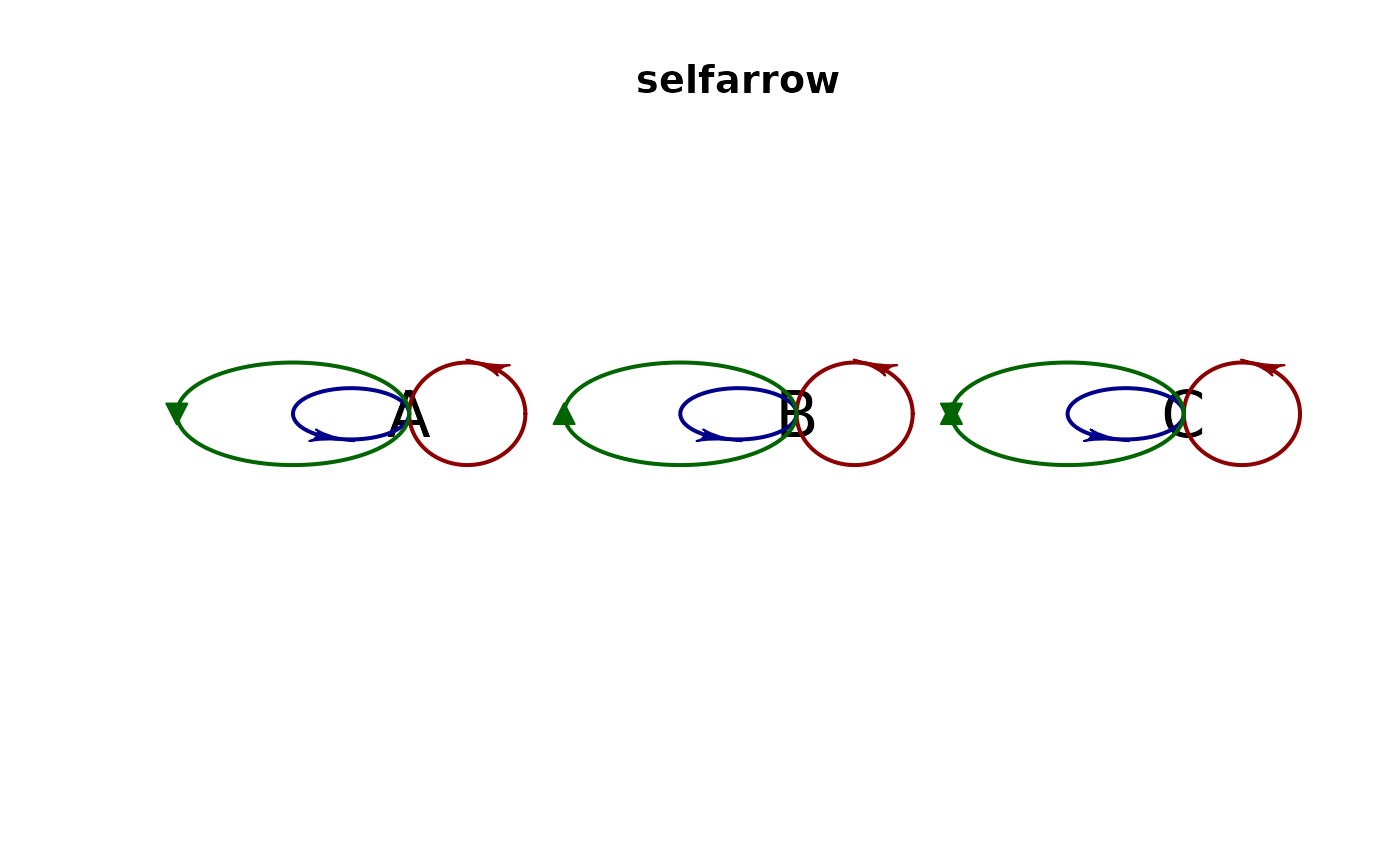
adds a circular, self-pointing arrow to a plot
selfarrow.Rdadds a circular arrow, from and to the same point
selfarrow(pos, lwd = 2, lty = 1, lcol = "black", arr.pos = 0.5,
          path = "L", curve = c(0.1, 0.1), dr = 0.01, code = 1, ...)
Arguments
- pos
2-valued vector with coordinates (x,y) of points *from and to* which to draw arrow.
- lwd
line width.
- lty
line type.
- lcol
line color.
- arr.pos
relative position of arrowhead.
- path
position of circle: R, L, U, D for right, left, up and down respectively.
- curve
relative size of curve (fraction of arrow length).
- dr
size of segments, in radians, to draw ellipse (decrease for smoother).
- code
how to put the arrowhead.
- ...
arguments passed to function Arrows.
Value
coordinates (x,y) where arrowhead is drawn
Details
draws a circular arrow from and to one point
The position of the arrowhead on the circle is set with arr.pos,
a value between 0 (at start) and 1(at end of circle)
The type of the arrowhead is set with arr.type which can take the
values:
"none" : skips the drawing of arrows.
"simple" : uses comparable R function arrows.
"triangle": uses filled triangle.
"curved" : draws arrowhead with curved edges.
"circle" : draws circular head.
"ellipse" : draws ellepsoid head.
"T" : draws T-shaped (blunt) head.
The size of the arrow head can be specified with the arguments
arr.length and arr.width.
See Arrowhead for details on arrow head.
See also
straightarrow, segmentarrow,
curvedarrow,
bentarrow,treearrow, splitarrow,
arrows: the comparable R function,
Arrows: more complicated arrow function from package
shape.
Examples
openplotmat(main = "selfarrow")

pos <- coordinates(3, mx = 0.05)

text(pos, LETTERS[1:3], cex = 2)

for (i in 1:3)
  selfarrow(pos = pos[i, ], path = "R", arr.pos = 0.2,
            curve = c(0.05, 0.1), lcol = "darkred")

for (i in 1:3)
  selfarrow(pos = pos[i, ], path = "L", arr.pos = 0.7,
            lcol = "darkblue", curve = c(0.05, 0.05))

for (i in 1:3)
  selfarrow(pos = pos[i, ], path = "L", arr.pos = 0.5,
            lcol = "darkgreen", code = i, arr.type = "triangle")