Compute the Ellipsoid Hull or Spanning Ellipsoid of a Point Set
ellipsoidhull.RdCompute the “ellipsoid hull” or “spanning ellipsoid”, i.e. the ellipsoid of minimal volume (‘area’ in 2D) such that all given points lie just inside or on the boundary of the ellipsoid.
Arguments
- x
the \(n\) \(p\)-dimensional points asnumeric \(n\times p\) matrix.
- tol
convergence tolerance for Titterington's algorithm. Setting this to much smaller values may drastically increase the number of iterations needed, and you may want to increas
maxitas well.- maxit
integer giving the maximal number of iteration steps for the algorithm.
- ret.wt, ret.sqdist, ret.pr
logicals indicating if additional information should be returned,
ret.wtspecifying the weights,ret.sqdistthe squared distances andret.prthe final probabilities in the algorithms.- digits,...
the usual arguments to
printmethods.
Details
The “spanning ellipsoid” algorithm is said to stem from
Titterington(1976), in Pison et al (1999) who use it for
clusplot.default.
The problem can be seen as a special case of the “Min.Vol.”
ellipsoid of which a more more flexible and general implementation is
cov.mve in the MASS package.
Value
an object of class "ellipsoid", basically a list
with several components, comprising at least
- cov
\(p\times p\) covariance matrix description the ellipsoid.
- loc
\(p\)-dimensional location of the ellipsoid center.
- d2
average squared radius. Further, \(d2 = t^2\), where \(t\) is “the value of a t-statistic on the ellipse boundary” (from
ellipsein the ellipse package), and hence, more usefully,d2 = qchisq(alpha, df = p), wherealphais the confidence level for p-variate normally distributed data with location and covariancelocandcovto lie inside the ellipsoid.- wt
the vector of weights iff
ret.wtwas true.- sqdist
the vector of squared distances iff
ret.sqdistwas true.- prob
the vector of algorithm probabilities iff
ret.prwas true.- it
number of iterations used.
- tol, maxit
just the input argument, see above.
- eps
the achieved tolerance which is the maximal squared radius minus \(p\).
- ierr
error code as from the algorithm;
0means ok.- conv
logical indicating if the converged. This is defined as
it < maxit && ierr == 0.
References
Pison, G., Struyf, A. and Rousseeuw, P.J. (1999)
Displaying a Clustering with CLUSPLOT,
Computational Statistics and Data Analysis, 30, 381–392.
D.M. Titterington (1976) Algorithms for computing D-optimal design on finite design spaces. In Proc.\ of the 1976 Conf.\ on Information Science and Systems, 213–216; John Hopkins University.
Author
Martin Maechler did the present class implementation; Rousseeuw et al did the underlying original code.
See also
predict.ellipsoid which is also the
predict method for ellipsoid objects.
volume.ellipsoid for an example of ‘manual’
ellipsoid object construction;
further ellipse from package ellipse
and ellipsePoints from package sfsmisc.
chull for the convex hull,
clusplot which makes use of this; cov.mve.
Examples
x <- rnorm(100)
xy <- unname(cbind(x, rnorm(100) + 2*x + 10))
exy. <- ellipsoidhull(xy)
exy. # >> calling print.ellipsoid()
#> 'ellipsoid' in 2 dimensions:
#>  center = (  0.18269 10.29225 ); squared ave.radius d^2 =  2
#>  and shape matrix =
#>        [,1]    [,2]
#> [1,] 2.9976  6.2991
#> [2,] 6.2991 17.2486
#>   hence, area  =  21.789

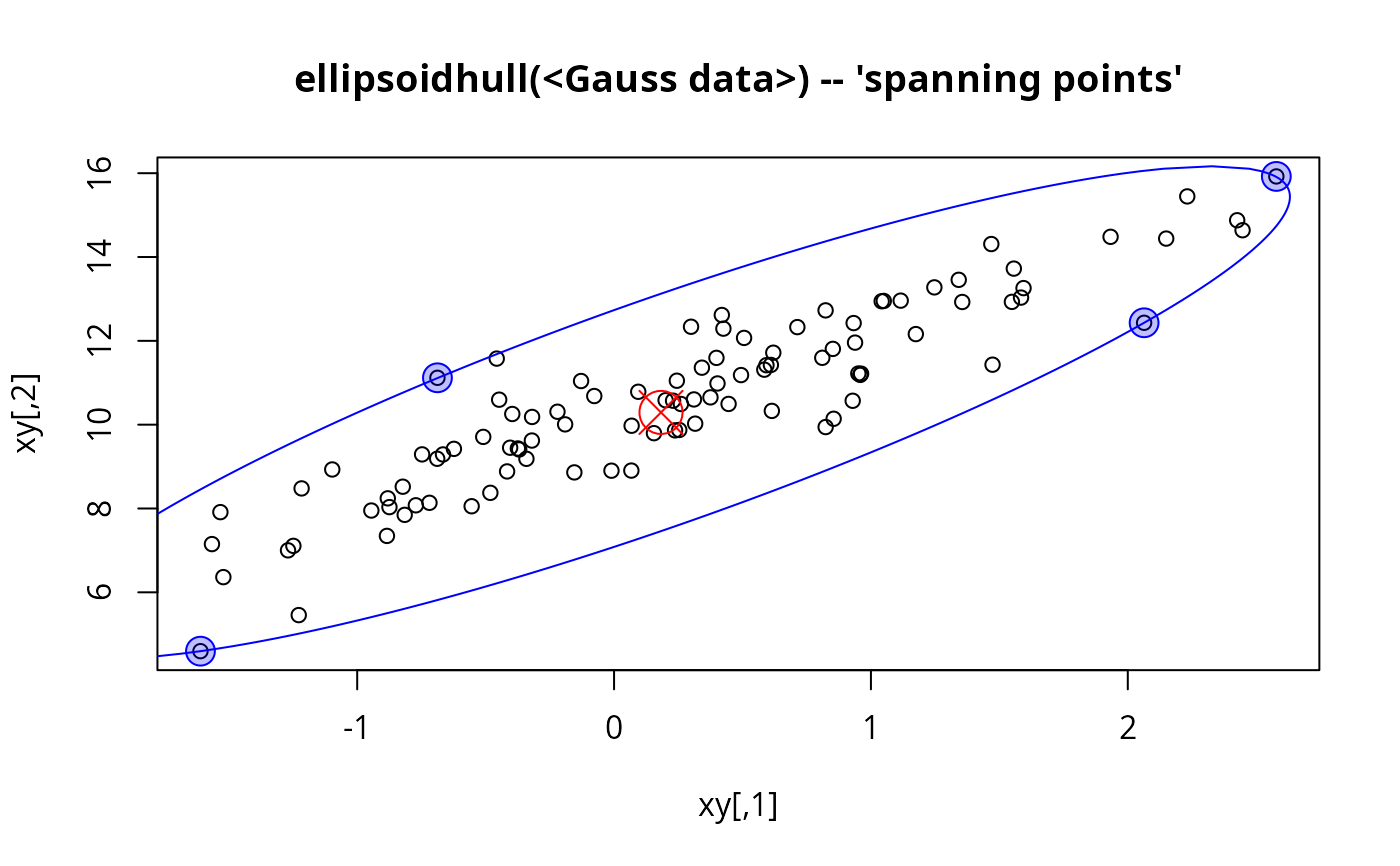
plot(xy, main = "ellipsoidhull(<Gauss data>) -- 'spanning points'")
lines(predict(exy.), col="blue")
points(rbind(exy.$loc), col = "red", cex = 3, pch = 13)

exy <- ellipsoidhull(xy, tol = 1e-7, ret.wt = TRUE, ret.sqdist = TRUE)
str(exy) # had small 'tol', hence many iterations
#> List of 12
#>  $ loc   : num [1:2] 0.18 10.29
#>  $ cov   : num [1:2, 1:2] 3.01 6.32 6.32 17.28
#>  $ d2    : num 2
#>  $ wt    : num [1:100] 2.99e-142 4.75e-119 3.32e-50 3.97e-12 0.00 ...
#>  $ sqdist: num [1:100] 0.34067 0.45399 1.08155 1.74986 0.00242 ...
#>  $ prob  : NULL
#>  $ tol   : num 1e-07
#>  $ eps   : num 9.65e-08
#>  $ it    : int 183
#>  $ maxit : num 5000
#>  $ ierr  : int 0
#>  $ conv  : logi TRUE
#>  - attr(*, "class")= chr "ellipsoid"
(ii <- which(zapsmall(exy $ wt) > 1e-6))
#> [1] 33 43 91 95
## --> only about 4 to 6  "spanning ellipsoid" points
round(exy$wt[ii],3); sum(exy$wt[ii]) # weights summing to 1
#> [1] 0.196 0.309 0.187 0.308
#> [1] 0.9999998
points(xy[ii,], pch = 21, cex = 2,
       col="blue", bg = adjustcolor("blue",0.25))