Choose a Predictor Transformation Visually or Numerically
invTranPlot.RdinvTranPlot
draws a two-dimensional scatterplot of \(Y\) versus
\(X\), along with the OLS
fit from the regression of \(Y\) on
\((X^{\lambda}-1)/\lambda\). invTranEstimate
finds the nonlinear least squares estimate of \(\lambda\) and its
standard error.
Usage
invTranPlot(x, ...)

# S3 method for class 'formula'
invTranPlot(x, data, subset, na.action, id=FALSE, ...)

# Default S3 method
invTranPlot(x, y, lambda=c(-1, 0, 1), robust=FALSE,
        lty.lines=rep(c("solid", "dashed", "dotdash", "longdash", "twodash"),
        length=1 + length(lambda)), lwd.lines=2,
        col=carPalette()[1], col.lines=carPalette(),
        xlab=deparse(substitute(x)), ylab=deparse(substitute(y)),
        family="bcPower", optimal=TRUE, key="auto", id=FALSE,
        grid=TRUE, ...)

invTranEstimate(x, y, family="bcPower", confidence=0.95, robust=FALSE)
Arguments
- x
The predictor variable, or a formula with a single response and a single predictor
- y
The response variable
- data
An optional data frame to get the data for the formula
- subset
Optional, as in
lm, select a subset of the cases- na.action
Optional, as in
lm, the action for missing data- lambda
The powers used in the plot. The optimal power than minimizes the residual sum of squares is always added unless optimal is
FALSE.- robust
If
TRUE, then the estimated transformation is computed using Huber M-estimation with the MAD used to estimate scale and k=1.345. The default isFALSE.- family
The transformation family to use,
"bcPower","yjPower", or a user-defined family.- confidence
returns a profile likelihood confidence interval for the optimal transformation with this confidence level. If
FALSE, or ifrobust=TRUE, no interval is returned.- optimal
Include the optimal value of lambda?
- lty.lines
line types corresponding to the powers
- lwd.lines
the width of the plotted lines, defaults to 2 times the standard
- col
color(s) of the points in the plot. If you wish to distinguish points according to the levels of a factor, we recommend using symbols, specified with the
pchargument, rather than colors.- col.lines
color of the fitted lines corresponding to the powers. The default is to use the colors returned by
carPalette- key
The default is
"auto", in which case a legend is added to the plot, either above the top marign or in the bottom right or top right corner. Set to NULL to suppress the legend.- xlab
Label for the horizontal axis.
- ylab
Label for the vertical axis.
- id
controls point identification; if
FALSE(the default), no points are identified; can be a list of named arguments to theshowLabelsfunction;TRUEis equivalent tolist(method=list(method="x", n=2, cex=1, col=carPalette()[1], location="lr"), which identifies the 2 points with the most extreme horizontal values — i.e., the response variable in the model.- ...
Additional arguments passed to the plot method, such as
pch.- grid
If TRUE, the default, a light-gray background grid is put on the graph
Value
invTranPlot
plots a graph and returns a data frame with \(\lambda\) in the
first column, and the residual sum of squares from the regression
for that \(\lambda\) in the second column.
invTranEstimate returns a list with elements lambda for the
estimate, se for its standard error, and RSS, the minimum
value of the residual sum of squares.
References
Fox, J. and Weisberg, S. (2011) An R Companion to Applied Regression, Second Edition, Sage.
Prendergast, L. A., & Sheather, S. J. (2013) On sensitivity of inverse response plot estimation and the benefits of a robust estimation approach. Scandinavian Journal of Statistics, 40(2), 219-237.
Weisberg, S. (2014) Applied Linear Regression, Fourth Edition, Wiley, Chapter 7.
Author
Sanford Weisberg, sandy@umn.edu
Examples
with(UN, invTranPlot(ppgdp, infantMortality))
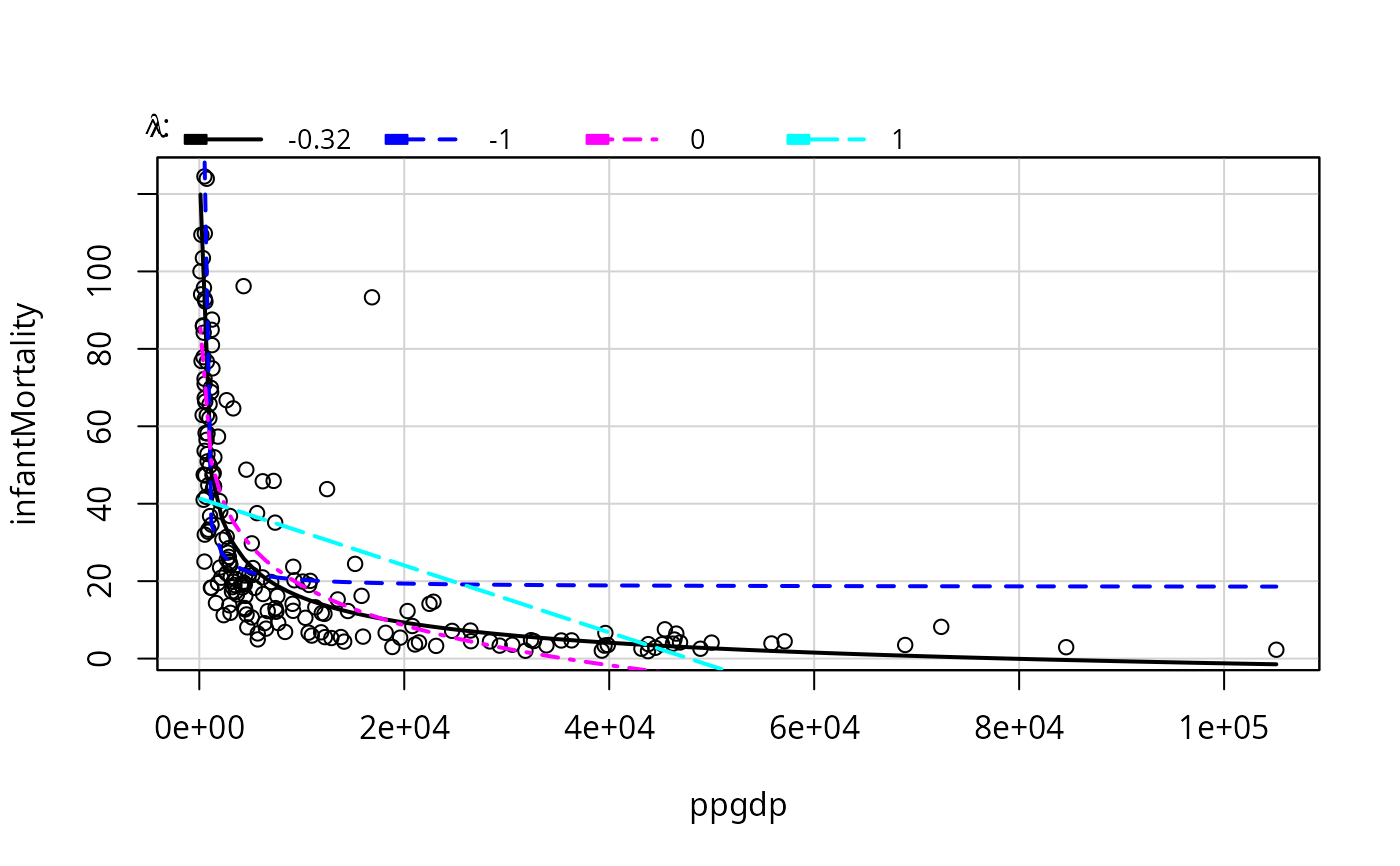 #> lambda RSS
#> 1 -0.3208097 54816.14
#> 2 -1.0000000 83395.51
#> 3 0.0000000 62851.31
#> 4 1.0000000 120583.35
with(UN, invTranEstimate(ppgdp, infantMortality))
#> $lambda
#> [1] -0.3208097
#>
#> $lowerCI
#> [1] -0.4034811
#>
#> $upperCI
#> [1] -0.2386709
#>
#> lambda RSS
#> 1 -0.3208097 54816.14
#> 2 -1.0000000 83395.51
#> 3 0.0000000 62851.31
#> 4 1.0000000 120583.35
with(UN, invTranEstimate(ppgdp, infantMortality))
#> $lambda
#> [1] -0.3208097
#>
#> $lowerCI
#> [1] -0.4034811
#>
#> $upperCI
#> [1] -0.2386709
#>