The multivariate truncated normal distribution
mtruncnorm.RdThe probability density function, the distribution function and random
number generation for the d-dimensional truncated normal (Gaussian)
random variable.
dmtruncnorm(x, mean, varcov, lower, upper, log = FALSE, ...)
pmtruncnorm(x, mean, varcov, lower, upper, ...)
rmtruncnorm(n, mean, varcov, lower, upper, start, burnin=5, thinning=1)
Arguments
- x
either a vector of length
dor a matrix withdcolumns,representing the coordinates of the point(s) where the density must be evaluated. Here we denoted=ncol(varcov); see ‘Details’ for restrictions.- mean
a
d-vector representing the mean value of the pre-truncation normal distribution.- varcov
a symmetric positive definite matrix with dimensions
(d,d)representing the variance matrix of the pre-truncation normal distribution.- lower
a
d-vector representing the lower truncation values of the component variables;-Infvalues are allowed. If missing, it is set equal torep(-Inf, d).- upper
a
d-vector representing the upper truncation values of the component variables;Infvalues are allowed. If missing, it is set equal torep(Inf, d).- log
a logical value (default value is
FALSE); ifTRUE, the logarithm of the density is computed.- ...
arguments passed to
sadmvn, amongmaxpts,abseps,releps.- n
the number of (pseudo) random vectors to be generated.
- start
an optional vector of initial values; see ‘Details’.
- burnin
the number of burnin iterations of the Gibbs sampler (default:
5); see ‘Details’.- thinning
a positive integer representing the thinning factor of the internally generated Gibbs sequence (default:
1); see ‘Details’.
Details
For dmtruncnorm and pmtruncnorm,
the dimension d cannot exceed 20.
If this threshold is exceeded, NAs are returned.
The constraint originates from the underlying function sadmvn.
If d>1, rmtruncnorm uses a Gibbs sampling scheme as described by
Breslaw (1994) and by Kotecha & Djurić (1999),
Detailed algebraic expressions are provided by Wilhelm (2022).
After some initial settings in R, the core iteration is performed by
a compiled FORTRAN 77 subroutine, for numerical efficiency.
If the start vector is not supplied, the mean value of the truncated
distribution is used. This choice should provide a good starting point for the
Gibbs iteration, which explains why the default value for the burnin
stage is so small. Since successive random vectors generated by a Gibbs
sampler are not independent, which can be a problem in certain applications.
This dependence is typically ameliorated by generating a larger-than-required
number of random vectors, followed by a ‘thinning’ stage; this can
be obtained by setting the thinning argument larger that 1.
The overall number of generated points is burnin+n*thinning, and the
returned object is formed by those with index in burnin+(1:n)*thinning.
If d=1, the values are sampled using a non-iterative procedure,
essentially as in equation (4) of Breslaw (1994), except that in this case
the mean and the variance do not refer to a conditional distribution,
but are the arguments supplied in the calling statement.
Value
dmtruncnorm and pmtruncnorm return a numeric vector;
rmtruncnorm returns a matrix, unless either n=1 or d=1,
in which case it returns a vector.
References
Breslaw, J.A. (1994) Random sampling from a truncated multivariate normal distribution. Appl. Math. Lett. vol.7, pp.1-6.
Kotecha, J.H. and Djurić, P.M. (1999). Gibbs sampling approach for generation of truncated multivariate Gaussian random variables. In ICASSP'99: Proceedings of IEEE International Conference on Acoustics, Speech, and Signal Processing, vol.3, pp.1757-1760. doi:10.1109/ICASSP.1999.756335 .
Wilhelm, S. (2022). Gibbs sampler for the truncated multivariate normal distribution. Vignette of R package https://cran.r-project.org/package=tmvtnorm, version 1.5.
Examples
# example with d=2
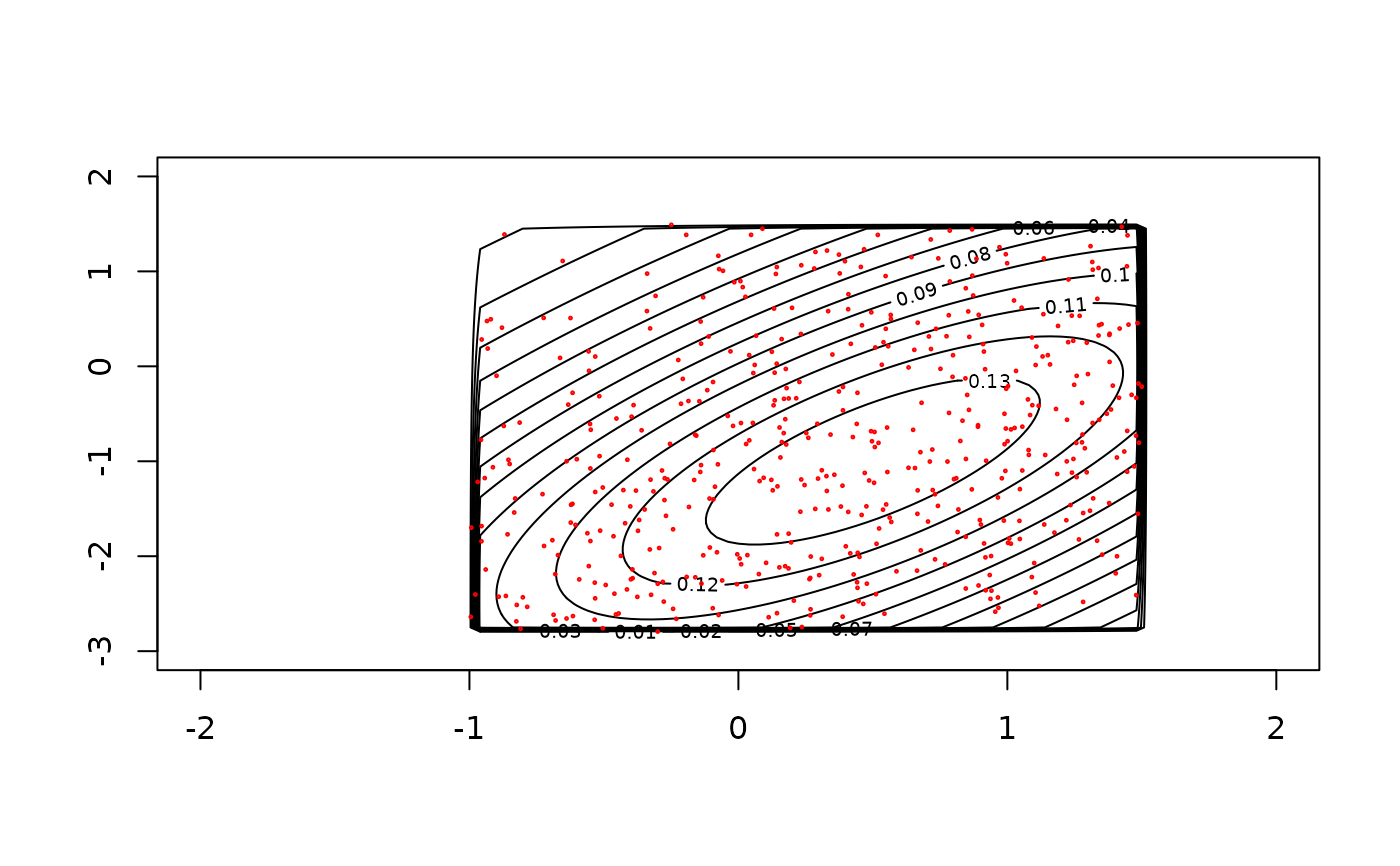
m2 <- c(0.5, -1)
V2 <- matrix(c(3, 3, 3, 6), 2, 2)
low <- c(-1, -2.8)
up <- c(1.5, 1.5)
# plotting truncated normal density using 'dmtruncnorm' and 'contour' functions
plot_fxy(dmtruncnorm, xlim=c(-2, 2), ylim=c(-3, 2), mean=m2, varcov=V2,
lower=low, upper=up, npt=101)
set.seed(1)
x <- rmtruncnorm(n=500, mean=m2, varcov=V2, lower=low, upper=up)
points(x, cex=0.2, col="red")
 #------
# example with d=1
set.seed(1)
low <- -4
hi <- 3
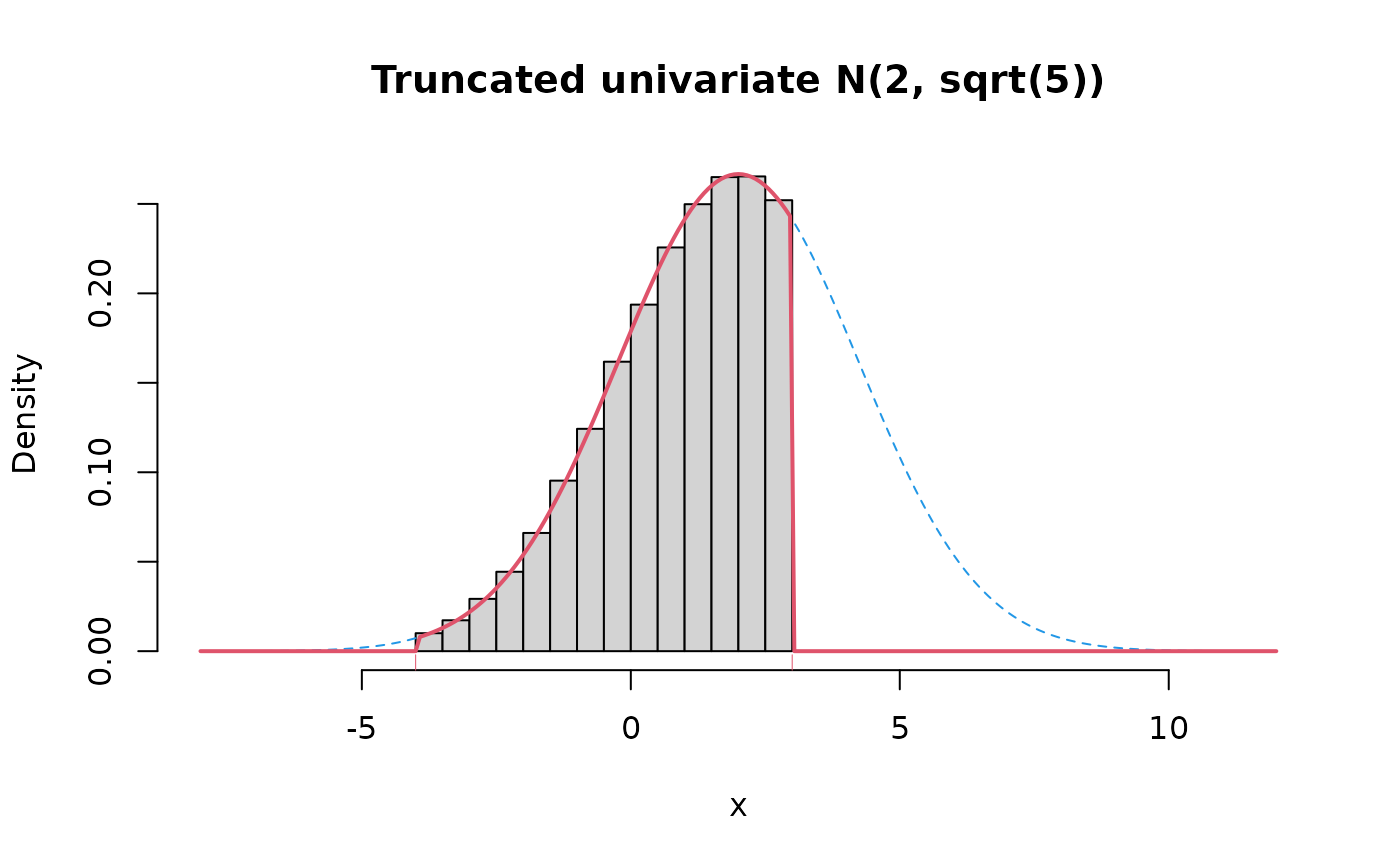
x <- rmtruncnorm(1e5, mean=2, varcov=5, lower=low, upper=hi)
hist(x, prob=TRUE, xlim=c(-8, 12), main="Truncated univariate N(2, sqrt(5))")
rug(c(low, hi), col=2)
x0 <- seq(-8, 12, length=251)
pdf <- dnorm(x0, 2, sqrt(5))
p <- pnorm(c(low, hi), 2, sqrt(5))
lines(x0, pdf/diff(p), col=4, lty=2)
lines(x0, dmtruncnorm(x0, 2, 5, low, hi), col=2, lwd=2)
#------
# example with d=1
set.seed(1)
low <- -4
hi <- 3
x <- rmtruncnorm(1e5, mean=2, varcov=5, lower=low, upper=hi)
hist(x, prob=TRUE, xlim=c(-8, 12), main="Truncated univariate N(2, sqrt(5))")
rug(c(low, hi), col=2)
x0 <- seq(-8, 12, length=251)
pdf <- dnorm(x0, 2, sqrt(5))
p <- pnorm(c(low, hi), 2, sqrt(5))
lines(x0, pdf/diff(p), col=4, lty=2)
lines(x0, dmtruncnorm(x0, 2, 5, low, hi), col=2, lwd=2)