An Example of Augmenting a Latin Hypercube
Rob Carnell
2026-03-05
Source:vignettes/augment_lhs.Rmd
augment_lhs.RmdSuppose that a computer simulation study is being designed that
requires expensive runs. A Latin hypercube design is desired for this
simulation so that the expectation of the simulation output can be
estimated efficiently given the distributions of the input variables.
Latin hypercubes are most often used in highly dimensional problems, but
the example shown is of small dimension. Suppose further that the total
extent of funding is uncertain. Enough money is available for 5 runs,
and there is a chance that there will be enough for 5 more. However, if
the money for the additional 5 runs does not materialize, then the first
5 runs must be a Latin hypercube alone. A design for this situation can
be created using the lhs package.
First create a random Latin hypercube using the
randomLHS(n, k) command:
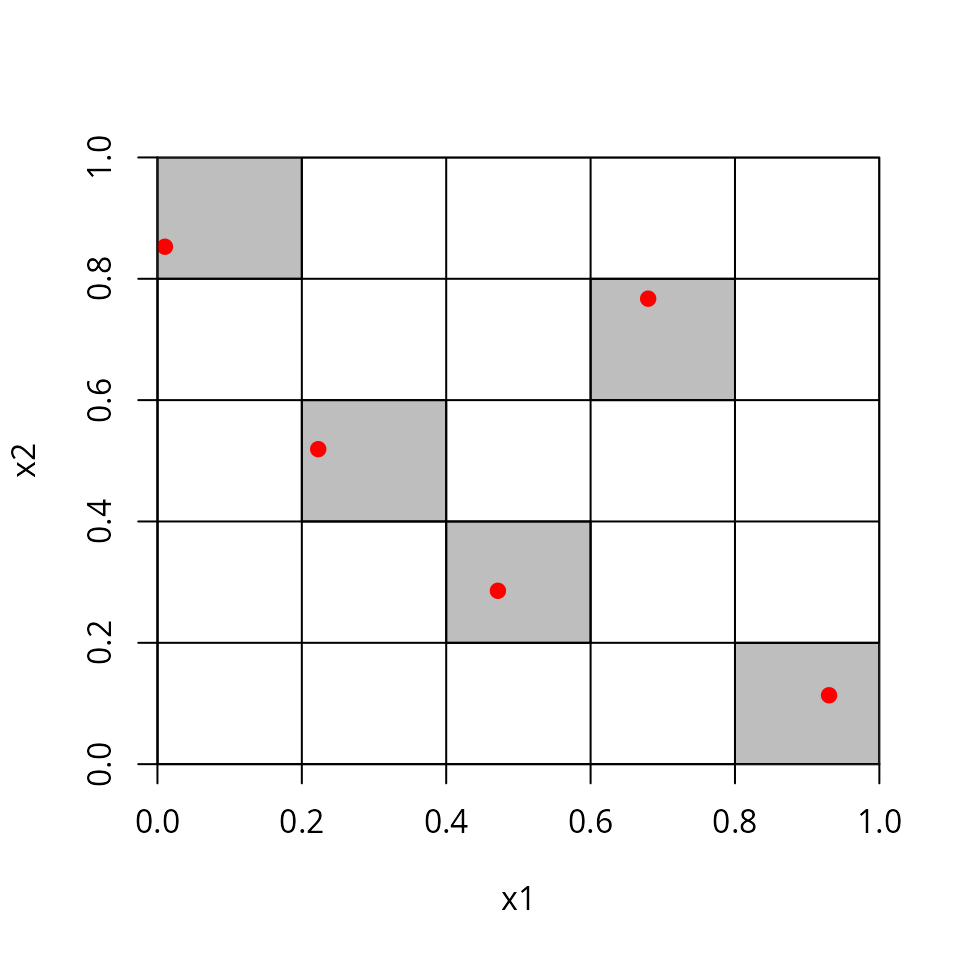
A <- randomLHS(5,2)An example of this hypercube is shown in Figure 1. Note that the Latin property of the hypercube requires that each of the 5 equal probability intervals be filled (i.e. each row and each column is filled with one point). Also notice that the exact location of the design point is randomly sampled from within that cell using a uniform distribution for each marginal variable.
 |
Next, in order to augment the design with more points use
augmentLHS(lhs, m). The following will add 5 more points to
the design:
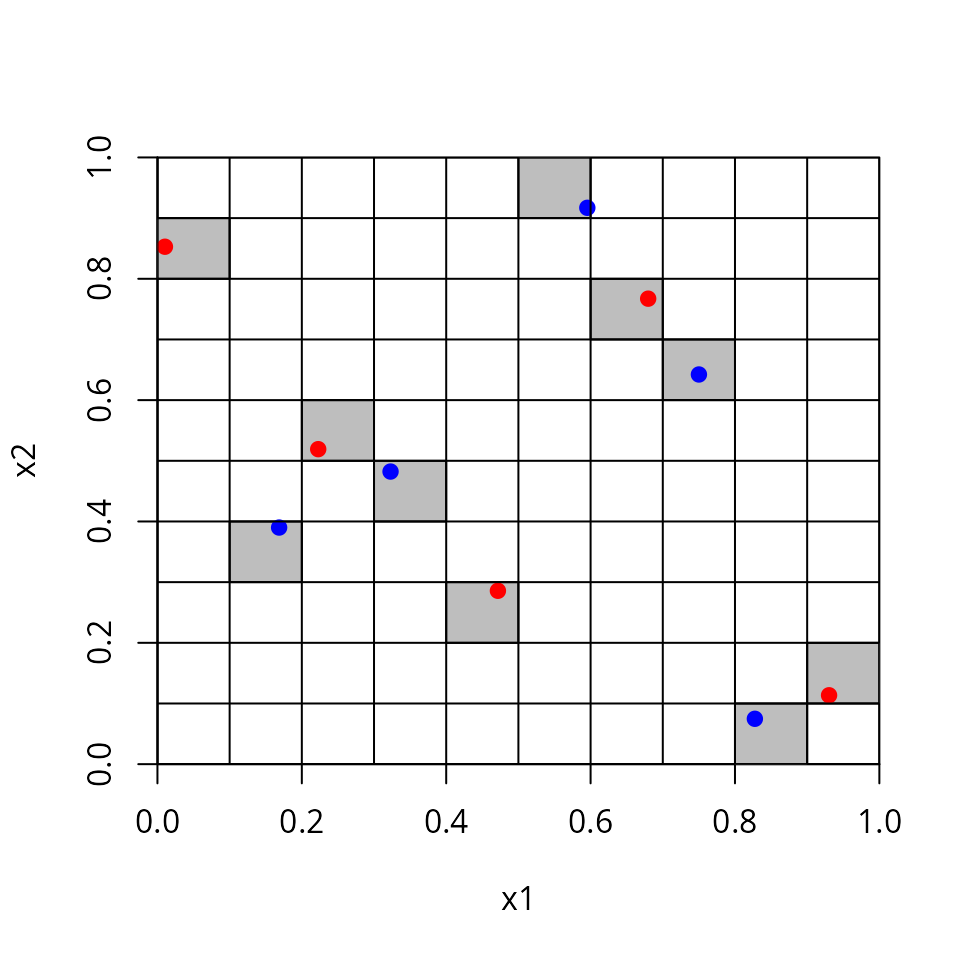
B <- augmentLHS(A, 5)The augmentLHS function works by re-dividing the
original design into n+m intervals (e.g. 5+5=10) keeping
the original design points exactly in the same position. It then
randomly fills the empty row-column sets. The results are shown in
Figure 2.
 |
The augmentLHS function uses the following algorithm
(see the documentation for augmentLHS):
- Create a new
(n+m)bykmatrix to hold the candidate points after the design has been re-partitioned into(n+m)^2cells, wherenis number of points in the originallhsmatrix. - Then randomly sweep through each column (1…
k) in the repartitioned design to find the missing cells. - For each column (variable), randomly search for an empty row,
generate a random value that fits in that row, record the value in the
new matrix. The new matrix can contain more than
mpoints unlessm = 2n, in which case the new matrix will contain exactlymfilled rows. - Finally, keep only the first
mrows of the new matrix. It is guaranteed that there will bemfull rows (points) in the new matrix. The deleted rows are partially full. The additional candidate points are selected randomly because of the random search used to find empty cells.
Also notice that because the original points are randomly placed within the cells, depending on how you bin the marginal distributions, a histogram (of x1 for example) will not necessarily be exactly uniform.
Now, the augmenting points do not necessarily form a Latin Hypercube themselves. The original design and augmenting points may form a Latin Hypercube, or there may be more than one point per row in the augmented design. If the augmented points are equal to the number of original points, then a strictly uniform Latin hypercube is guaranteed. An example of an augmented design which is not uniform in the marginal distributions is given in Figure 3 and Figure 4. The commands were:
A <- randomLHS(7, 2)
B <- augmentLHS(A, 3)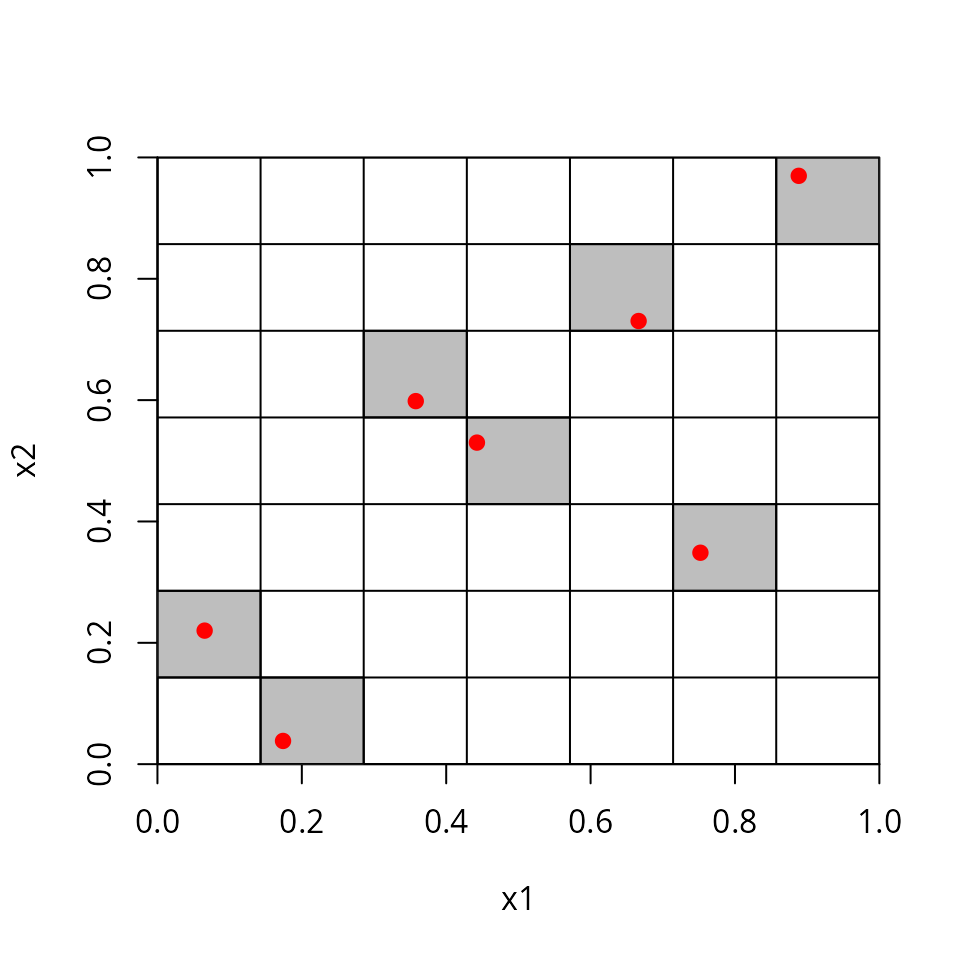 |