Fit a generalized linear mixed model (GLMM) using Template Model Builder (TMB).
Usage
glmmTMB(
  formula,
  data = NULL,
  family = gaussian(),
  ziformula = ~0,
  dispformula = ~1,
  weights = NULL,
  offset = NULL,
  contrasts = NULL,
  na.action,
  se = TRUE,
  verbose = FALSE,
  doFit = TRUE,
  control = glmmTMBControl(),
  REML = FALSE,
  start = NULL,
  map = NULL,
  sparseX = NULL,
  priors = NULL,
  subset = NULL
)
Arguments
- formula
combined fixed and random effects formula, following lme4 syntax.
- data
data frame (tibbles are OK) containing model variables. Not required, but strongly recommended; if
datais not specified, downstream methods such as prediction with new data (predict(fitted_model, newdata = ...)) will fail. If it is necessary to callglmmTMBwith model variables taken from the environment rather than from a data frame, specifyingdata=NULLwill suppress the warning message.- family
a family function, a character string naming a family function, or the result of a call to a family function (variance/link function) information. See
familyfor a generic discussion of families orfamily_glmmTMBfor details ofglmmTMB-specific families.- ziformula
a one-sided (i.e., no response variable) formula for zero-inflation combining fixed and random effects: the default
~0specifies no zero-inflation. Specifying~.sets the zero-inflation formula identical to the right-hand side offormula(i.e., the conditional effects formula); terms can also be added or subtracted. When using~.as the zero-inflation formula in models where the conditional effects formula contains an offset term, the offset term will automatically be dropped. The zero-inflation model uses a logit link.- dispformula
a one-sided formula for dispersion combining fixed and random effects: the default
~1specifies the standard dispersion given any family. The argument is ignored for families that do not have a dispersion parameter. For an explanation of the dispersion parameter for each family, seesigma. The dispersion model uses a log link. In Gaussian mixed models,dispformula=~0fixes the residual variance to be 0 (actually a small non-zero value), forcing variance into the random effects. The precise value can be controlled viacontrol=glmmTMBControl(zero_dispval=...); the default value issqrt(.Machine$double.eps).- weights
weights, as in
glm. Not automatically scaled to have sum 1.- offset
offset for conditional model (only).
- contrasts
an optional list, e.g.,
list(fac1="contr.sum"). See thecontrasts.argofmodel.matrix.default.- na.action
a function that specifies how to handle observations containing
NAs. The default action (na.omit, inherited from the 'factory fresh' value ofgetOption("na.action")) strips any observations with any missing values in any variables. Usingna.action = na.excludewill similarly drop observations with missing values while fitting the model, but will fill inNAvalues for the predicted and residual values for cases that were excluded during the fitting process because of missingness.- se
whether to return standard errors.
- verbose
whether progress indication should be printed to the console.
- doFit
whether to fit the full model, or (if FALSE) return the preprocessed data and parameter objects, without fitting the model.
- control
control parameters, see
glmmTMBControl.- REML
whether to use REML estimation rather than maximum likelihood.
- start
starting values, expressed as a list with possible components
beta,betazi,betadisp(fixed-effect parameters for conditional, zero-inflation, dispersion models);b,bzi,bdisp(conditional modes for conditional, zero-inflation, and dispersion models);theta,thetazi,thetadisp(random-effect parameters, on the standard deviation/Cholesky scale, for conditional, z-i, and disp models);psi(extra family parameters, e.g., shape for Tweedie models).- map
a list specifying which parameter values should be fixed to a constant value rather than estimated.
mapshould be a named list containing factors corresponding to a subset of the internal parameter names (seestartparameter). Distinct factor values are fitted as separate parameter values,NAvalues are held fixed: e.g.,map=list(beta=factor(c(1,2,3,NA)))would fit the first three fixed-effect parameters of the conditional model and fix the fourth parameter to its starting value. In general, users will probably want to usestartto specify non-default starting values for fixed parameters. SeeMakeADFunfor more details.- sparseX
a named logical vector containing (possibly) elements named "cond", "zi", "disp" to indicate whether fixed-effect model matrices for particular model components should be generated as sparse matrices, e.g.
c(cond=TRUE). Default is allFALSE- priors
a data frame of priors, in a similar format to that accepted by the
brmspackage; seepriors- subset
an optional vector specifying a subset of observations to be used in the fitting process (see
model.frame)
Details
Binomial models with more than one trial (i.e., not binary/Bernoulli) can either be specified in the form
prob ~ ..., weights = N, or in the more typical two-column matrixcbind(successes,failures)~...form.Behavior of
REML=TRUEfor Gaussian responses matcheslme4::lmer. It may also be useful in some cases with non-Gaussian responses (Millar 2011). Simulations should be done first to verify.Because the
df.residualmethod forglmmTMBcurrently counts the dispersion parameter, users should multiply this value bysqrt(nobs(fit) / (1+df.residual(fit)))when comparing withlm.Although models can be fitted without specifying a
dataargument, its use is strongly recommended; drawing model components from the global environment, or usingdf$varnotation within model formulae, can lead to confusing (and sometimes hard-to-detect) errors.By default, vector-valued random effects are fitted with unstructured (general symmetric positive definite) variance-covariance matrices. Structured variance-covariance matrices can be specified in the form
struc(terms|group), wherestrucis one ofdiag(diagonal, heterogeneous variance)ar1(autoregressive order-1, homogeneous variance)hetar1(autoregressive order-1, heterogeneous variance)cs(compound symmetric, heterogeneous variance)homcs(compound symmetric, homogeneous variance)ou(* Ornstein-Uhlenbeck, homogeneous variance)exp(* exponential autocorrelation)gau(* Gaussian autocorrelation)mat(* Matérn process correlation)toep(* Toeplitz, heterogeneous variance)homtoep(* Toeplitz, homogeneous variance)rr(reduced-rank/factor-analytic model)homdiag(diagonal, homogeneous variance)propto(* proportional to user-specified variance-covariance matrix)equalto(* equal to user-specified variance-covariance matrix)
Structures marked with * are experimental/untested. See
vignette("covstruct", package = "glmmTMB")for more information.For backward compatibility, the
familyargument can also be specified as a list comprising the name of the distribution and the link function (e.g.list(family="binomial", link="logit")). However, this alternative is now deprecated; it produces a warning and will be removed at some point in the future. Furthermore, certain capabilities such as Pearson residuals or predictions on the data scale will only be possible if components such asvarianceandlinkfunare present, seefamily.Smooths taken from the
mgcvpackage can be included inglmmTMBformulas usings; these terms will appear as additional components in both the fixed and the random-effects terms. This functionality is experimental for now. We recommend usingREML=TRUE. Seesfor details of specifying smooths (andsmooth2randomand the appendix of Wood (2004) for technical details).
Note
For more information about the glmmTMB package, see Brooks et al. (2017) and the vignette(package="glmmTMB") collection. For the underlying TMB package that performs the model estimation, see Kristensen et al. (2016).
References
Brooks, M. E., Kristensen, K., van Benthem, K. J., Magnusson, A., Berg, C. W., Nielsen, A., Skaug, H. J., Mächler, M. and Bolker, B. M. (2017). glmmTMB balances speed and flexibility among packages for zero-inflated generalized linear mixed modeling. The R Journal, 9(2), 378–400.
Kristensen, K., Nielsen, A., Berg, C. W., Skaug, H. and Bell, B. (2016). TMB: Automatic differentiation and Laplace approximation. Journal of Statistical Software, 70, 1–21.
Millar, R. B. (2011). Maximum Likelihood Estimation and Inference: With Examples in R, SAS and ADMB. Wiley, New York. Wood, S. N. (2004) Stable and Efficient Multiple Smoothing Parameter Estimation for Generalized Additive Models. Journal of the American Statistical Association 99(467): 673–86. doi:10.1198/016214504000000980
Examples
# \donttest{
(m1 <- glmmTMB(count ~ mined + (1|site),
zi=~mined,
family=poisson, data=Salamanders))
#> Formula: count ~ mined + (1 | site)
#> Zero inflation: ~mined
#> Data: Salamanders
#> AIC BIC logLik -2*log(L) df.resid
#> 1908.4695 1930.8080 -949.2348 1898.4695 639
#> Random-effects (co)variances:
#>
#> Conditional model:
#> Groups Name Std.Dev.
#> site (Intercept) 0.28
#>
#> Number of obs: 644 / Conditional model: site, 23
#>
#> Fixed Effects:
#>
#> Conditional model:
#> (Intercept) minedno
#> 0.0879 1.1419
#>
#> Zero-inflation model:
#> (Intercept) minedno
#> 1.139 -1.736
summary(m1)
#> Family: poisson ( log )
#> Formula: count ~ mined + (1 | site)
#> Zero inflation: ~mined
#> Data: Salamanders
#>
#> AIC BIC logLik -2*log(L) df.resid
#> 1908.5 1930.8 -949.2 1898.5 639
#>
#> Random effects:
#>
#> Conditional model:
#> Groups Name Variance Std.Dev.
#> site (Intercept) 0.07843 0.28
#> Number of obs: 644, groups: site, 23
#>
#> Conditional model:
#> Estimate Std. Error z value Pr(>|z|)
#> (Intercept) 0.0879 0.2329 0.377 0.706
#> minedno 1.1419 0.2462 4.639 3.5e-06 ***
#> ---
#> Signif. codes: 0 ‘***’ 0.001 ‘**’ 0.01 ‘*’ 0.05 ‘.’ 0.1 ‘ ’ 1
#>
#> Zero-inflation model:
#> Estimate Std. Error z value Pr(>|z|)
#> (Intercept) 1.1393 0.2351 4.846 1.26e-06 ***
#> minedno -1.7361 0.2620 -6.626 3.44e-11 ***
#> ---
#> Signif. codes: 0 ‘***’ 0.001 ‘**’ 0.01 ‘*’ 0.05 ‘.’ 0.1 ‘ ’ 1
##' ## Zero-inflated negative binomial model
(m2 <- glmmTMB(count ~ spp + mined + (1|site),
zi=~spp + mined,
family=nbinom2, data=Salamanders))
#> Formula: count ~ spp + mined + (1 | site)
#> Zero inflation: ~spp + mined
#> Data: Salamanders
#> AIC BIC logLik -2*log(L) df.resid
#> 1670.2990 1750.7176 -817.1495 1634.2990 626
#> Random-effects (co)variances:
#>
#> Conditional model:
#> Groups Name Std.Dev.
#> site (Intercept) 0.3799
#>
#> Number of obs: 644 / Conditional model: site, 23
#>
#> Dispersion parameter for nbinom2 family (): 1.51
#>
#> Fixed Effects:
#>
#> Conditional model:
#> (Intercept) sppPR sppDM sppEC-A sppEC-L sppDES-L
#> -0.6104 -0.9637 0.1707 -0.3871 0.4879 0.5895
#> sppDF minedno
#> -0.1133 1.4294
#>
#> Zero-inflation model:
#> (Intercept) sppPR sppDM sppEC-A sppEC-L sppDES-L
#> 0.9100 1.1614 -0.9393 1.0424 -0.5623 -0.8930
#> sppDF minedno
#> -2.5398 -2.5630
## Hurdle Poisson model
(m3 <- glmmTMB(count ~ spp + mined + (1|site),
zi=~spp + mined,
family=truncated_poisson, data=Salamanders))
#> Formula: count ~ spp + mined + (1 | site)
#> Zero inflation: ~spp + mined
#> Data: Salamanders
#> AIC BIC logLik -2*log(L) df.resid
#> 1790.1669 1866.1177 -878.0834 1756.1669 627
#> Random-effects (co)variances:
#>
#> Conditional model:
#> Groups Name Std.Dev.
#> site (Intercept) 0.2306
#>
#> Number of obs: 644 / Conditional model: site, 23
#>
#> Fixed Effects:
#>
#> Conditional model:
#> (Intercept) sppPR sppDM sppEC-A sppEC-L sppDES-L
#> -0.06702 -0.52093 0.22458 -0.19548 0.64672 0.60514
#> sppDF minedno
#> 0.04602 1.01447
#>
#> Zero-inflation model:
#> (Intercept) sppPR sppDM sppEC-A sppEC-L sppDES-L
#> 1.7556 1.6785 -0.4269 1.1046 -0.4269 -0.6716
#> sppDF minedno
#> -0.4269 -2.4038
## Binomial model
data(cbpp, package="lme4")
(bovine <- glmmTMB(cbind(incidence, size-incidence) ~ period + (1|herd),
family=binomial, data=cbpp))
#> Formula: cbind(incidence, size - incidence) ~ period + (1 | herd)
#> Data: cbpp
#> AIC BIC logLik -2*log(L) df.resid
#> 194.05256 204.17932 -92.02628 184.05256 51
#> Random-effects (co)variances:
#>
#> Conditional model:
#> Groups Name Std.Dev.
#> herd (Intercept) 0.6423
#>
#> Number of obs: 56 / Conditional model: herd, 15
#>
#> Fixed Effects:
#>
#> Conditional model:
#> (Intercept) period2 period3 period4
#> -1.3985 -0.9923 -1.1287 -1.5803
## Dispersion model
sim1 <- function(nfac=40, nt=100, facsd=0.1, tsd=0.15, mu=0, residsd=1)
{
dat <- expand.grid(fac=factor(letters[1:nfac]), t=1:nt)
n <- nrow(dat)
dat$REfac <- rnorm(nfac, sd=facsd)[dat$fac]
dat$REt <- rnorm(nt, sd=tsd)[dat$t]
dat$x <- rnorm(n, mean=mu, sd=residsd) + dat$REfac + dat$REt
dat
}
set.seed(101)
d1 <- sim1(mu=100, residsd=10)
d2 <- sim1(mu=200, residsd=5)
d1$sd <- "ten"
d2$sd <- "five"
dat <- rbind(d1, d2)
m0 <- glmmTMB(x ~ sd + (1|t), dispformula=~sd, data=dat)
fixef(m0)$disp
#> (Intercept) sdten
#> 1.6014350 0.6932378
c(log(5), log(10)-log(5)) # expected dispersion model coefficients
#> [1] 1.6094379 0.6931472
## Using 'map' to fix random-effects SD to 10
m1_map <- update(m1, map=list(theta=factor(NA)),
start=list(theta=log(10)))
VarCorr(m1_map)
#>
#> Conditional model:
#> Groups Name Std.Dev.
#> site (Intercept) 10
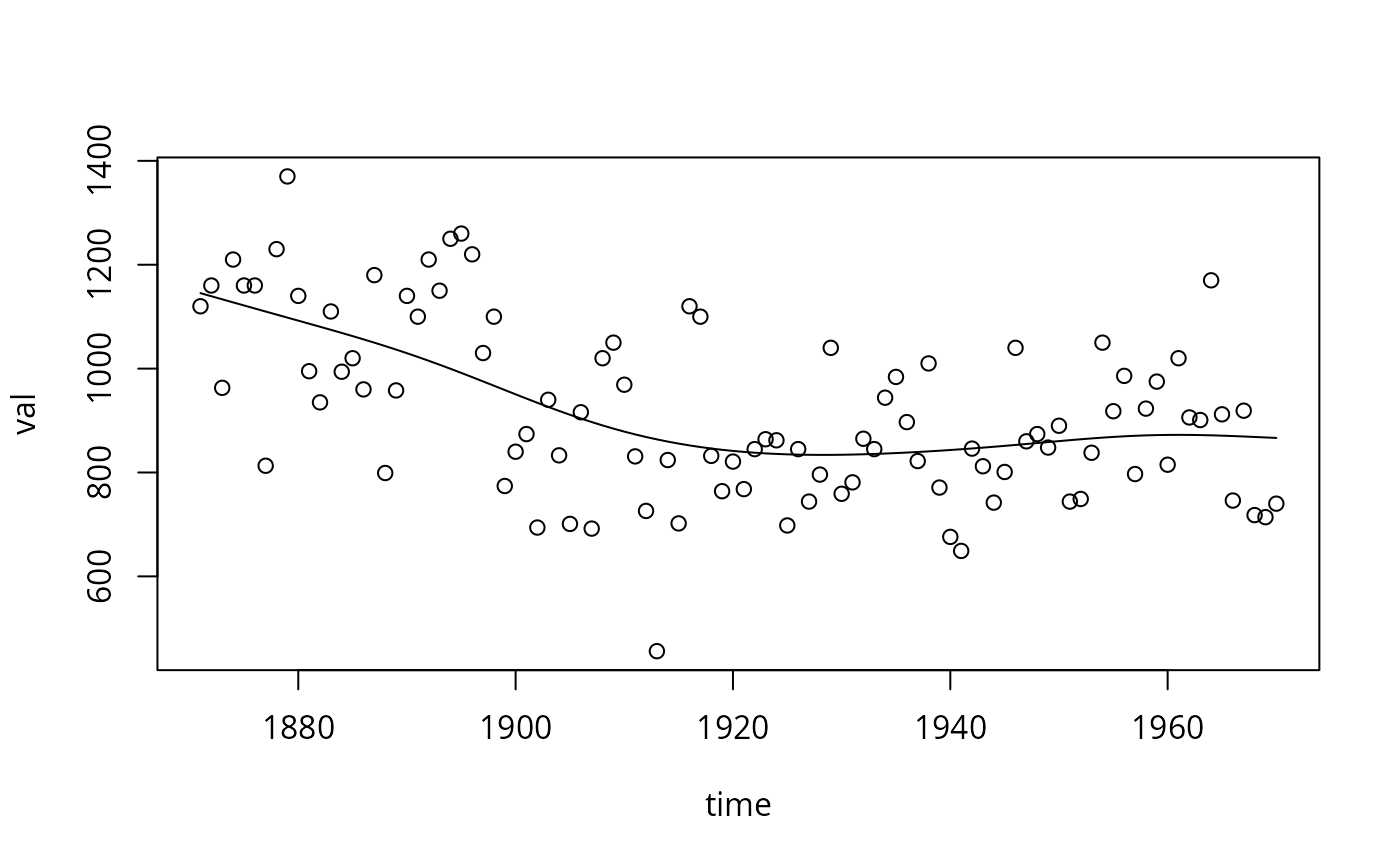
## smooth terms
data("Nile")
ndat <- data.frame(time = c(time(Nile)), val = c(Nile))
sm1 <- glmmTMB(val ~ s(time), data = ndat,
REML = TRUE, start = list(theta = 5))
plot(val ~ time, data = ndat)
lines(ndat$time, predict(sm1))
 ## reduced-rank model
m1_rr <- glmmTMB(abund ~ Species + rr(Species + 0|id, d = 1),
data = spider_long)
# }
## reduced-rank model
m1_rr <- glmmTMB(abund ~ Species + rr(Species + 0|id, d = 1),
data = spider_long)
# }