Bagged Clustering
bclust.RdCluster the data in x using the bagged clustering
algorithm. A partitioning cluster algorithm such as
kmeans is run repeatedly on bootstrap samples from the
original data. The resulting cluster centers are then combined using
the hierarchical cluster algorithm hclust.
Usage
bclust(x, centers=2, iter.base=10, minsize=0,
       dist.method="euclidean",
       hclust.method="average", base.method="kmeans",
       base.centers=20, verbose=TRUE,
       final.kmeans=FALSE, docmdscale=FALSE,
       resample=TRUE, weights=NULL, maxcluster=base.centers, ...)
hclust.bclust(object, x, centers, dist.method=object$dist.method,
              hclust.method=object$hclust.method, final.kmeans=FALSE,
              docmdscale = FALSE, maxcluster=object$maxcluster)
# S3 method for class 'bclust'
plot(x, maxcluster=x$maxcluster, main, ...)
centers.bclust(object, k)
clusters.bclust(object, k, x=NULL)
Arguments
- x
Matrix of inputs (or object of class
"bclust"for plot).- centers, k
Number of clusters.
- iter.base
Number of runs of the base cluster algorithm.
- minsize
Minimum number of points in a base cluster.
- dist.method
Distance method used for the hierarchical clustering, see
distfor available distances.- hclust.method
Linkage method used for the hierarchical clustering, see
hclustfor available methods.- base.method
Partitioning cluster method used as base algorithm.
- base.centers
Number of centers used in each repetition of the base method.
- verbose
Output status messages.
- final.kmeans
If
TRUE, a final kmeans step is performed using the output of the bagged clustering as initialization.- docmdscale
Logical, if
TRUEacmdscaleresult is included in the return value.- resample
Logical, if
TRUEthe base method is run on bootstrap samples ofx, else directly onx.- weights
Vector of length
nrow(x), weights for the resampling. By default all observations have equal weight.- maxcluster
Maximum number of clusters memberships are to be computed for.
- object
Object of class
"bclust".- main
Main title of the plot.
- ...
Optional arguments top be passed to the base method in
bclust, ignored inplot.
Details
First, iter.base bootstrap samples of the original data in
x are created by drawing with replacement. The base cluster
method is run on each of these samples with base.centers
centers. The base.method must be the name of a partitioning
cluster function returning a list with the same components as the
return value of kmeans.
This results in a collection of iter.base *
base.centers centers, which are subsequently clustered using
the hierarchical method hclust. Base centers with less
than minsize points in there respective partitions are removed
before the hierarchical clustering.
The resulting dendrogram is then cut to produce centers
clusters. Hence, the name of the argument centers is a little
bit misleading as the resulting clusters need not be convex, e.g.,
when single linkage is used. The name was chosen for compatibility
with standard partitioning cluster methods such as
kmeans.
A new hierarchical clustering (e.g., using another
hclust.method) re-using previous base runs can be
performed by running hclust.bclust on the return value of
bclust.
Value
bclust and hclust.bclust return objects of class
"bclust" including the components
- hclust
Return value of the hierarchical clustering of the collection of base centers (Object of class
"hclust").- cluster
Vector with indices of the clusters the inputs are assigned to.
- centers
Matrix of centers of the final clusters. Only useful, if the hierarchical clustering method produces convex clusters.
- allcenters
Matrix of all
iter.base * base.centerscenters found in the base runs.
References
Friedrich Leisch. Bagged clustering. Working Paper 51, SFB “Adaptive Information Systems and Modeling in Economics and Management Science”, August 1999. doi:10.57938/9b129f95-b53b-44ce-a129-5b7a1168d832
Examples
data(iris)
bc1 <- bclust(iris[,1:4], 3, base.centers=5)
#> Committee Member: 1(1) 2(1) 3(1) 4(1) 5(1) 6(1) 7(1) 8(1) 9(1) 10(1)
#> Computing Hierarchical Clustering
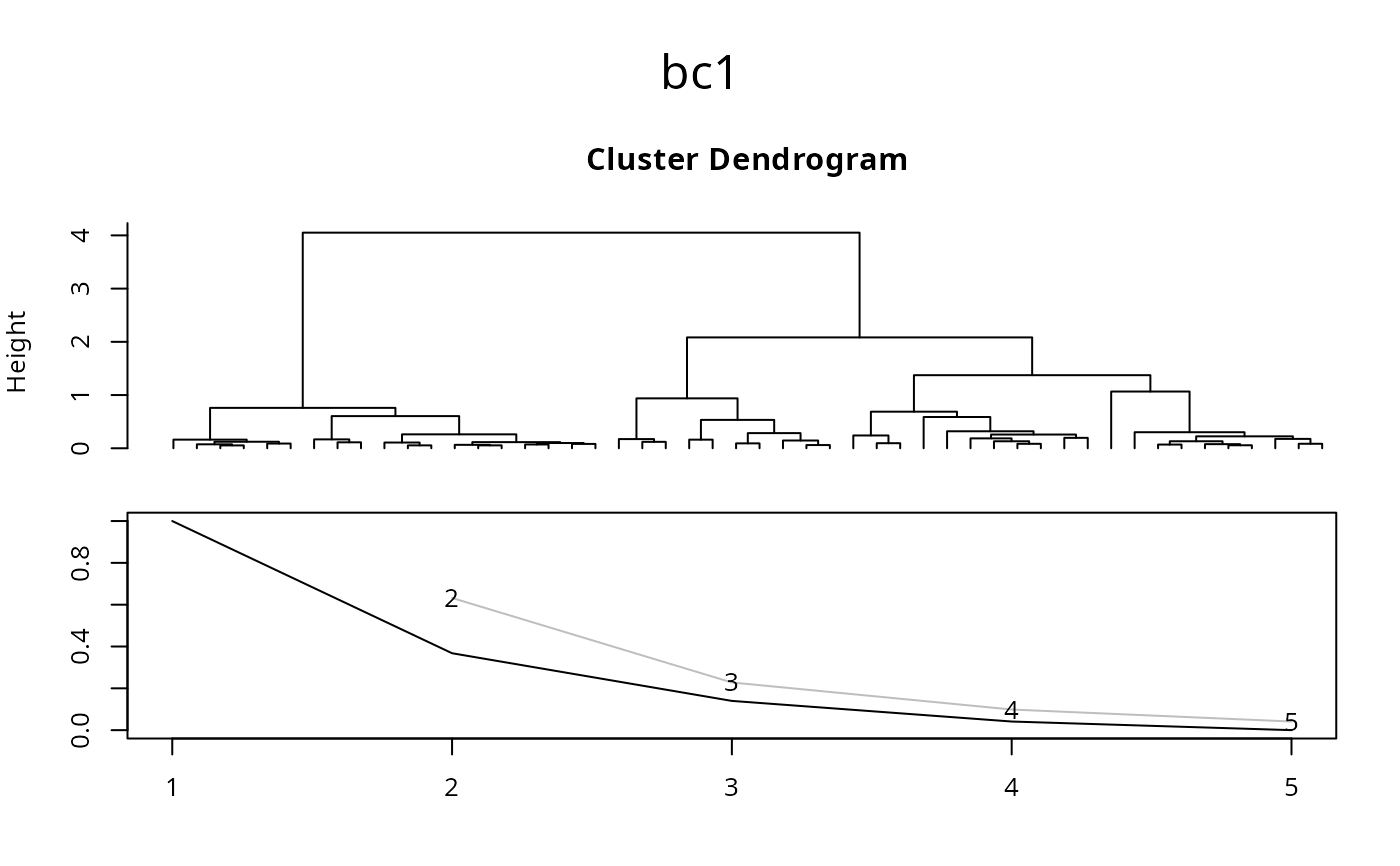
plot(bc1)
 table(clusters.bclust(bc1, 3))
#>
#> 1 2 3
#> 72 50 28
centers.bclust(bc1, 3)
#> [,1] [,2] [,3] [,4]
#> [1,] 5.919204 2.763804 4.426290 1.456563
#> [2,] 5.022182 3.454259 1.458944 0.247232
#> [3,] 7.078234 3.142672 5.959044 2.114061
table(clusters.bclust(bc1, 3))
#>
#> 1 2 3
#> 72 50 28
centers.bclust(bc1, 3)
#> [,1] [,2] [,3] [,4]
#> [1,] 5.919204 2.763804 4.426290 1.456563
#> [2,] 5.022182 3.454259 1.458944 0.247232
#> [3,] 7.078234 3.142672 5.959044 2.114061