Create a list of tiles in a tessellation
tile.list.RdFor each point in the set being tessellated produces a list entry describing the Dirichlet/Voronoi tile containing that point.
tile.list(object,minEdgeLength=NULL,clipp=NULL)Arguments
- object
An object of class
deldiras produced by the functiondeldir().- minEdgeLength
Positive numeric scalar specifying the minimum length that an edge of a tile may have. It is used to eliminate edges that are effectively of zero length, which can cause tiles to be “invalid”. This argument defaults to
sqrt(.Machine$double.eps)time the diameter (length of the diagonal) of the “rectangular window” associated with the tessellation. This rectangular window is available as therwcomponent ofobject.- clipp
An object specifying a polygon to which the tessellation, whose tiles are being determined, should be clipped. It should consist either of:
a list containing two components x and y giving the coordinates of the vertices of a single polygon. The last vertex should not repeat the first vertex. Or:
a list of list(x,y) structures giving the coordinates of the vertices of several polygons.
If this argument is provided then the tiles in the list that is produced are “clipped” to the polygon specified by
clipp. Empty tiles (those which do not intersect the polygon specified byclipp) are omitted. The clipping process may subdivide some of the tiles into two or more discontiguous parts.
Value
A list with one entry for each of the points in the set being
tessellated, or for each of the tiles that are retained after clipping
if clipp is not NULL. Each entry is in turn a list
with a number of components. These components always include:
- ptNum
The index of the point in the original sequence of points that is being tessellated. Note that if a point is one of a set of duplicated points then
ptNumis the first of the indices of the points in this set.- pt
The coordinates of the point whose tile is being described.
- area
The area of the tile.
If the tile in question has not been subdivided by the clipping process then the list components also include:
- x
The
xcoordinates of the vertices of the tile, in anticlockwise order.- y
The
ycoordinates of the vertices of the tile, in anticlockwise order.- bp
Vector of logicals indicating whether the tile vertex is a “real” vertex, or a boundary point, i.e. a point where the tile edge intersects the boundary of the enclosing rectangle.
If the tile in question has been subdivided then the list
does not have the foregoing three components but rather has a
component tileParts which is in turn a list of length equal
to the number of parts into which the tile was subdivided. Each
component of tileParts is yet another list with four
components x, y, bp and area as described above
and as are appropriate for the part in question.
- z
The “auxiliary value” or “tag” associated with the
pt; present only if such values were supplied in the call todeldir().
Acknowledgement
The author expresses sincere thanks to Majid Yazdani who found and
pointed out a serious bug in tile.list in a previous version
(0.0-5) of the deldir package.
Warning
The set of vertices of each tile may be “incomplete”. Only vertices which lie within the enclosing rectangle, and “boundary points” are listed.
Note that the enclosing rectangle may be specified by the user
in the call to deldir().
In contrast to some earlier versions of deldir, the corners
of the enclosing rectangle are now included as vertices of tiles.
I.e. a tile which in fact extends beyond the rectangular window
and contains a corner of that window will have that corner added
to its list of vertices. Thus the corresponding polygon is the
intersection of the tile with the enclosing rectangle.
See also
deldir(), plot.tile.list()
triang.list() plot.triang.list()
Examples
    set.seed(42)
    x <- runif(20)
    y <- runif(20)
    z <- deldir(x,y)
    w <- tile.list(z)

    z <- deldir(x,y,rw=c(0,1,0,1))
    w <- tile.list(z)

    z <- deldir(x,y,rw=c(0,1,0,1),dpl=list(ndx=2,ndy=2))
    w <- tile.list(z)
    if(require(polyclip)) {
        CP <- list(x=c(0.49,0.35,0.15,0.20,0.35,0.42,
                       0.43,0.62,0.46,0.63,0.82,0.79),
                   y=c(0.78,0.86,0.79,0.54,0.58,0.70,
                       0.51,0.46,0.31,0.20,0.37,0.54))
        wc <- tile.list(z,clipp=CP) # 10 tiles are retained; the third tile,
                                    # corresponding to point 6, is
                                    # subdivided into two parts.
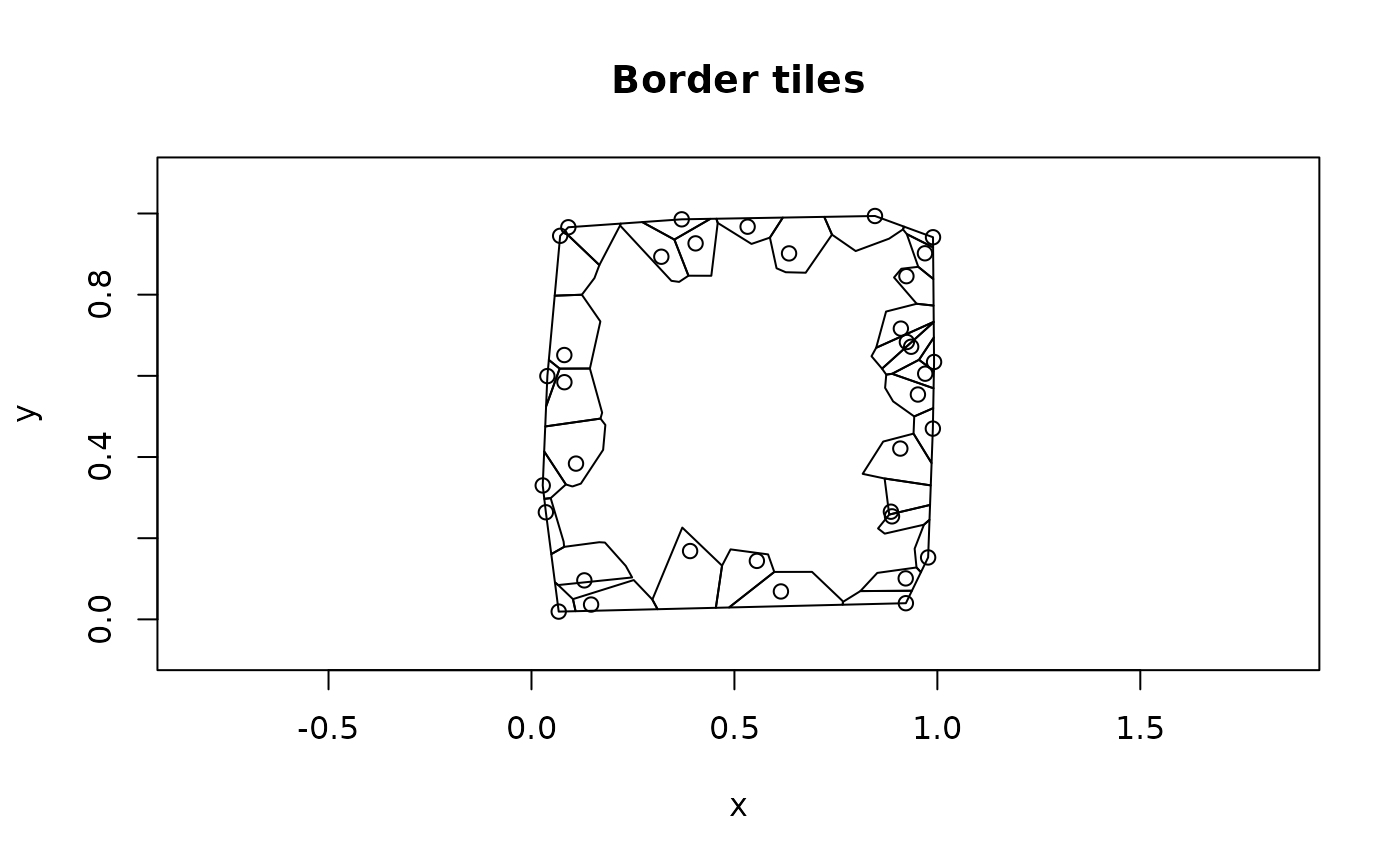
    # Determine the tiles on the border of a clipping region.
    # Example due to Huimin Wang.
    set.seed(112)
    x      <- runif(100)
    y      <- runif(100)
    dxy    <- deldir(x,y)
    txy    <- tile.list(dxy)
    chind  <- chull(x,y)
    bdry   <- list(x=x[chind],y=y[chind])
    ctxy   <- tile.list(dxy,clipp=bdry)
    inside <- lapply(ctxy,function(tile,bdry){insidePoly(tile$x,tile$y,bdry)},
                                            bdry=bdry)
    border <- sapply(inside,function(x){any(!x) | any(attr(x,"on.boundary"))})
    plot(ctxy[border],main="Border tiles")
    }