List Delaunay neighbours.
getNbrs.RdLists the indices (or identifiers if these are provided) of the Delaunay neighbours of each point in the set of points being triangulated/tessellated.
getNbrs(object, interior = NULL)Arguments
- object
An object of class
"deldir", as returned by the functiondeldir().- interior
Either a rectangle, i.e. a numeric vector of length 4,
(xmin,xmax,ymin,ymax), or a polygon (a list with components named"x"and"y", which are numeric vectors of equal length, sayn. The pairs(x[i],y[i])specify the vertices of the polygon and should be presented in anticlockwise order. The last vertex should NOT repeat the first.If
interioris given as a rectangle, its entries must satisfyxmin < xmaxandymin < ymax. Moreover, in this case,interiormust be a subset of the rectangular windowrw(seedeldir()) with respect to which the points in question are being triangulated/tessellated. That is, its entries must satisfyrw[1] <= xmin,xmax <= rw[2],rw[3] <= yminandymax <= rw[4].
Details
If interior is specified then Delaunay neighbours are listed
only for those points which lie in interior. Note that
these neighbours need not themselves lie in interior.
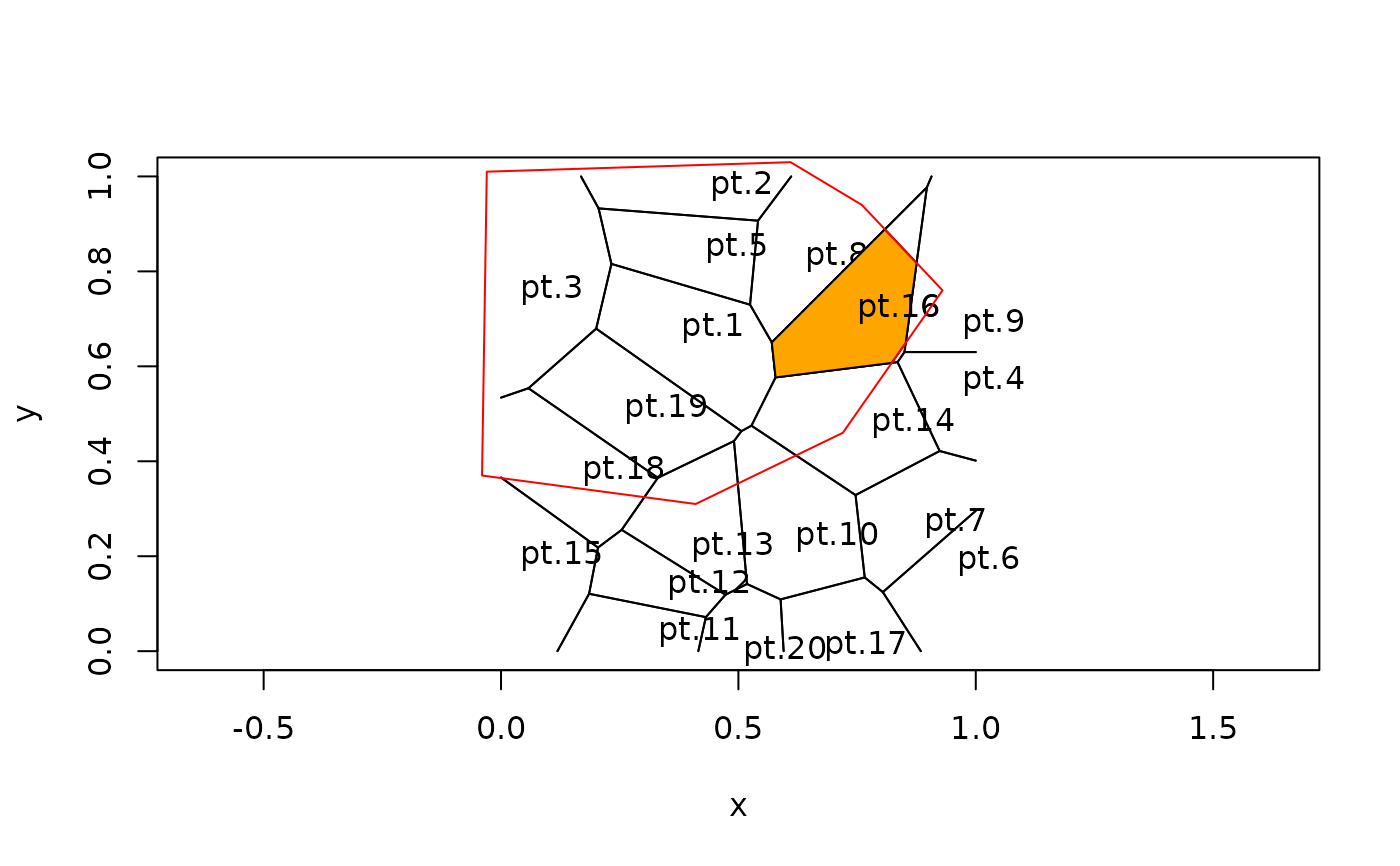
Note also that it is possible for points i and j to
be neighbours even though the “clipped” versions of the tiles
are discontiguous.
Value
A (named) list of length equal to the number points in the set
being triangulated/tessellated, or to the number of such points that
lie in interior if that argument was specified. The names
of the list are the identifiers of the points as specified by
id if id was specified in the call to deldir()
that produced object. If id was not specified, then
the names are the indices of the points, coerced to character mode.
The entries of this list are vectors of the identifiers or indices of the Delaunay neighbours of the point corresponding to that entry.
References
See deldir() for references.
Warning
Be careful about addressing the entries of the list returned
by this function. If id was not specified in the call
to deldir() that produced object, then the names
of this list are the point indices coerced to character mode.
If interior was specified then the name of \(i\)-th entry
of the list will not in general be i. E.g. given that
xxx is the list returned by this function, xxx[[14]]
will not in general give the Delaunay neighbours of point 14.
Instead, specify xxx[["14"]] or xxx[[id[14]]] where
id is the vector of identifiers supplied in the call to
deldir().
Examples
set.seed(42)
x <- runif(60)
y <- runif(60)
dxy <- deldir(x,y,rw=c(0,1,0,1))
nbrs <- getNbrs(dxy,interior=c(0.2,0.8,0.2,0.8))
nbrs[["14"]] # Correct.
#> NULL
nbrs[[14]]   # Incorrect.
#> [1]  6 15 27 33 19
names(nbrs)[14] # The result is 42.
#> [1] "pt.42"
# Thus nbrs[[14]] actually gives the Delaunay neighbours of point 42.

# Demonstrate that neighbours can have discontiguous clipped tiles.
if(require(polyclip)) {
    x <- c(0.38,0.44,0.04,0.97,0.43,0.96,0.89,0.64,0.97,0.62,0.33,0.35,
           0.40,0.78,0.04,0.75,0.68,0.17,0.26,0.51)
    y <- c(0.68,0.98,0.76,0.57,0.85,0.19,0.27,0.83,0.69,0.24,0.04,0.14,
           0.22,0.48,0.20,0.72,0.01,0.38,0.51,0.00)
    CP <- list(x=c(0.72,0.93,0.76,0.61,-0.03,-0.04,0.41),
               y=c(0.46,0.76,0.94,1.03,1.01,0.37,0.31))
    dxy <- deldir(x,y,rw=c(0,1,0,1))
    TL <- tile.list(dxy)
    plot(TL,labelPts=TRUE)
    plot(TL[16],clipp=CP,fillcol="orange",labelPts=TRUE,add=TRUE)
    polygon(CP,border="red")
    nbrs <- getNbrs(dxy,interior=CP) # Tiles are clipped to CP.
# Note that point 14 is a neighbour of point 16, even though their
# clipped tiles do not meet.
}
#> Loading required package: polyclip
#> polyclip 1.10-7 built from Clipper C++ version 6.4.0