Ever used an R function that produced a not-very-helpful error message, just to discover after minutes of debugging that you simply passed a wrong argument?
Blaming the laziness of the package author for not doing such standard checks (in a dynamically typed language such as R) is at least partially unfair, as R makes these types of checks cumbersome and annoying. Well, that’s how it was in the past.
Enter checkmate.
Virtually every standard type of user error when passing arguments into function can be caught with a simple, readable line which produces an informative error message in case. A substantial part of the package was written in C to minimize any worries about execution time overhead.
Intro
As a motivational example, consider you have a function to calculate
the faculty of a natural number and the user may choose between using
either the stirling approximation or R’s factorial function
(which internally uses the gamma function). Thus, you have two
arguments, n and method. Argument
n must obviously be a positive natural number and
method must be either "stirling" or
"factorial". Here is a version of all the hoops you need to
jump through to ensure that these simple requirements are met:
fact <- function(n, method = "stirling") {
  if (length(n) != 1)
    stop("Argument 'n' must have length 1")
  if (!is.numeric(n))
    stop("Argument 'n' must be numeric")
  if (is.na(n))
    stop("Argument 'n' may not be NA")
  if (is.double(n)) {
    if (is.nan(n))
      stop("Argument 'n' may not be NaN")
    if (is.infinite(n))
      stop("Argument 'n' must be finite")
    if (abs(n - round(n, 0)) > sqrt(.Machine$double.eps))
      stop("Argument 'n' must be an integerish value")
    n <- as.integer(n)
  }
  if (n < 0)
    stop("Argument 'n' must be >= 0")
  if (length(method) != 1)
    stop("Argument 'method' must have length 1")
  if (!is.character(method) || !method %in% c("stirling", "factorial"))
    stop("Argument 'method' must be either 'stirling' or 'factorial'")

  if (method == "factorial")
    factorial(n)
  else
    sqrt(2 * pi * n) * (n / exp(1))^n
}
And for comparison, here is the same function using checkmate:
fact <- function(n, method = "stirling") {
  assertCount(n)
  assertChoice(method, c("stirling", "factorial"))

  if (method == "factorial")
    factorial(n)
  else
    sqrt(2 * pi * n) * (n / exp(1))^n
}
Function overview
The functions can be split into four functional groups, indicated by their prefix.
If prefixed with assert, an error is thrown if the
corresponding check fails. Otherwise, the checked object is returned
invisibly. There are many different coding styles out there in the wild,
but most R programmers stick to either camelBack or
underscore_case. Therefore, checkmate offers
all functions in both flavors: assert_count is just an
alias for assertCount but allows you to retain your
favorite style.
The family of functions prefixed with test always return
the check result as logical value. Again, you can use
test_count and testCount interchangeably.
Functions starting with check return the error message
as a string (or TRUE otherwise) and can be used if you need
more control and, e.g., want to grep on the returned error message.
expect is the last family of functions and is intended
to be used with the testthat package.
All performed checks are logged into the testthat reporter.
Because testthat uses the underscore_case, the
extension functions only come in the underscore style.
All functions are categorized into objects to check on the package help page.
In case you miss flexibility
You can use assert to perform multiple checks at once and throw an assertion if all checks fail.
Here is an example where we check that x is either of class
foo or class bar:
f <- function(x) {
  assert(
    checkClass(x, "foo"),
    checkClass(x, "bar")
  )
}
Note that assert(, combine = "or") and
assert(, combine = "and") allow to control the logical
combination of the specified checks, and that the former is the
default.
Argument Checks for the Lazy
The following functions allow a special syntax to define argument
checks using a special format specification. E.g.,
qassert(x, "I+") asserts that x is an integer
vector with at least one element and no missing values. This very simple
domain specific language covers a large variety of frequent argument
checks with only a few keystrokes. You choose what you like best.
checkmate as testthat extension
To extend testthat, you
need to IMPORT, DEPEND or SUGGEST on the checkmate package.
Here is a minimal example:
# file: tests/test-all.R
library(testthat)
library(checkmate) # for testthat extensions
test_check("mypkg")
Now you are all set and can use more than 30 new expectations in your tests.
test_that("checkmate is a sweet extension for testthat", {
  x = runif(100)
  expect_numeric(x, len = 100, any.missing = FALSE, lower = 0, upper = 1)
  # or, equivalent, using the lazy style:
  qexpect(x, "N100[0,1]")
})
Speed considerations
In comparison with tediously writing the checks yourself in R (c.f.
factorial example at the beginning of the vignette), R is sometimes a
tad faster while performing checks on scalars. This seems odd at first,
because checkmate is mostly written in C and should be comparably fast.
Yet many of the functions in the base package are not
regular functions, but primitives. While primitives jump directly into
the C code, checkmate has to use the considerably slower
.Call interface. As a result, it is possible to write (very
simple) checks using only the base functions which, under some
circumstances, slightly outperform checkmate. However, if you go one
step further and wrap the custom check into a function to convenient
re-use it, the performance gain is often lost (see benchmark 1).
For larger objects the tide has turned because checkmate avoids many
unnecessary intermediate variables. Also note that the quick/lazy
implementation in
qassert/qtest/qexpect is often a
tad faster because only two arguments have to be evaluated (the object
and the rule) to determine the set of checks to perform.
Below you find some (probably unrepresentative) benchmark. But also
note that this one here has been executed from inside knitr
which is often the cause for outliers in the measured execution time.
Better run the benchmark yourself to get unbiased results.
Benchmark 1: Assert that x is a flag
library(checkmate)
library(ggplot2)
library(microbenchmark)

x = TRUE
r = function(x, na.ok = FALSE) { stopifnot(is.logical(x), length(x) == 1, na.ok || !is.na(x)) }
cm = function(x) assertFlag(x)
cmq = function(x) qassert(x, "B1")
mb = microbenchmark(r(x), cm(x), cmq(x))
print(mb)
## Unit: microseconds
## expr min lq mean median uq max neval
## r(x) 2.318 2.4725 20.39810 2.614 3.0595 1736.530 100
## cm(x) 1.582 1.7250 10.55037 1.889 2.2385 762.532 100
## cmq(x) 1.053 1.1190 7.00049 1.188 1.3790 541.497 100
autoplot(mb)## Warning: `aes_string()` was deprecated in ggplot2 3.0.0.
## ℹ Please use tidy evaluation idioms with `aes()`.
## ℹ See also `vignette("ggplot2-in-packages")` for more information.
## ℹ The deprecated feature was likely used in the microbenchmark package.
## Please report the issue at
## <https://github.com/joshuaulrich/microbenchmark/issues/>.
## This warning is displayed once per session.
## Call `lifecycle::last_lifecycle_warnings()` to see where this warning was
## generated.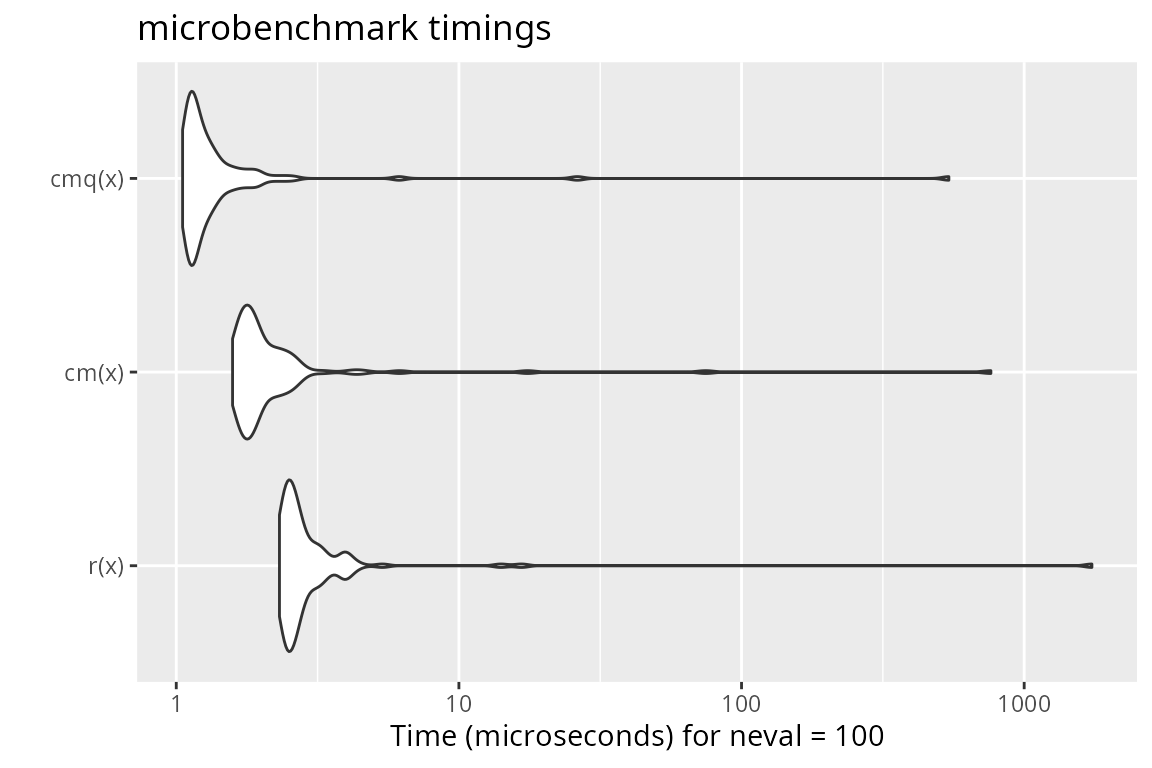
Benchmark 2: Assert that x is a numeric of length 1000
with no missing nor NaN values
x = runif(1000)
r = function(x) stopifnot(is.numeric(x), length(x) == 1000, all(!is.na(x) & x >= 0 & x <= 1))
cm = function(x) assertNumeric(x, len = 1000, any.missing = FALSE, lower = 0, upper = 1)
cmq = function(x) qassert(x, "N1000[0,1]")
mb = microbenchmark(r(x), cm(x), cmq(x))
print(mb)
## Unit: microseconds
## expr min lq mean median uq max neval
## r(x) 9.985 10.480 36.05002 10.8285 11.2450 2475.593 100
## cm(x) 4.552 4.793 11.77764 4.9085 5.0995 624.671 100
## cmq(x) 4.440 4.518 11.16423 4.5775 4.6955 627.249 100
autoplot(mb)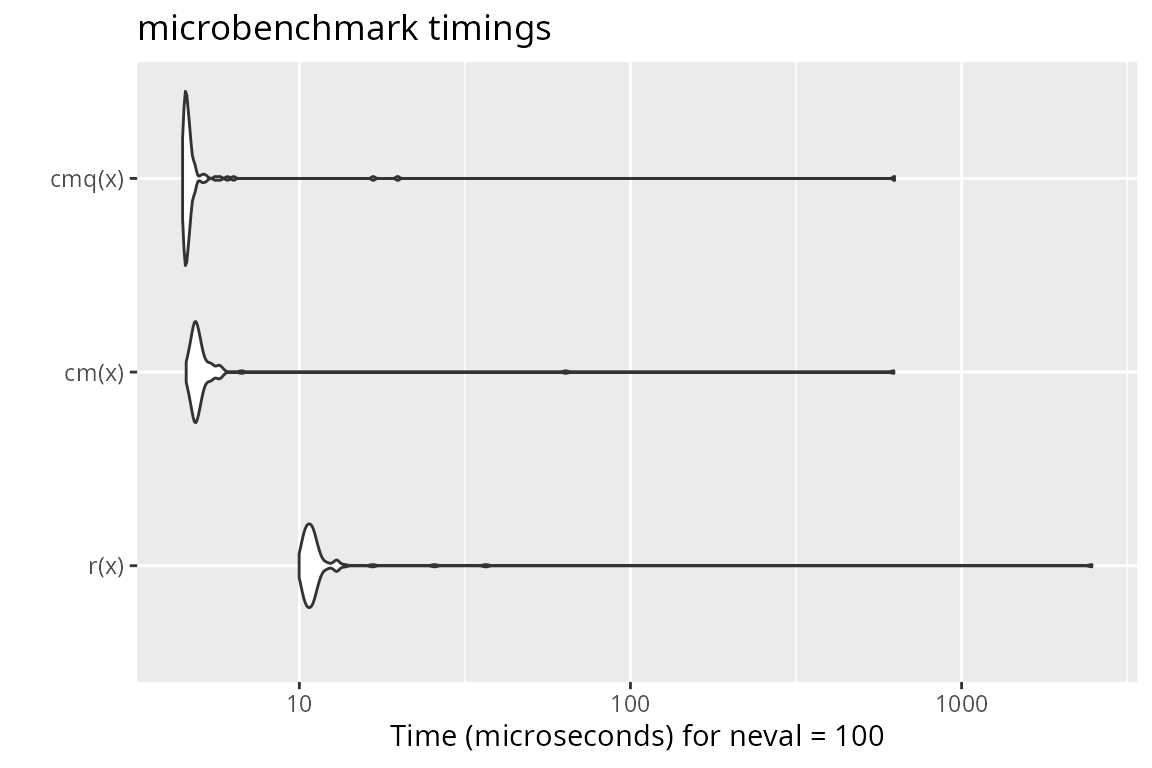
Benchmark 3: Assert that x is a character vector with
no missing values nor empty strings
x = sample(letters, 10000, replace = TRUE)
r = function(x) stopifnot(is.character(x), !any(is.na(x)), all(nchar(x) > 0))
cm = function(x) assertCharacter(x, any.missing = FALSE, min.chars = 1)
cmq = function(x) qassert(x, "S+[1,]")
mb = microbenchmark(r(x), cm(x), cmq(x))
print(mb)
## Unit: microseconds
## expr min lq mean median uq max neval
## r(x) 215.852 243.5130 311.34063 280.5815 343.9335 2131.743 100
## cm(x) 57.602 63.6635 86.94346 78.0005 89.5905 714.216 100
## cmq(x) 80.633 84.1965 99.34315 87.6235 95.3340 928.326 100
autoplot(mb)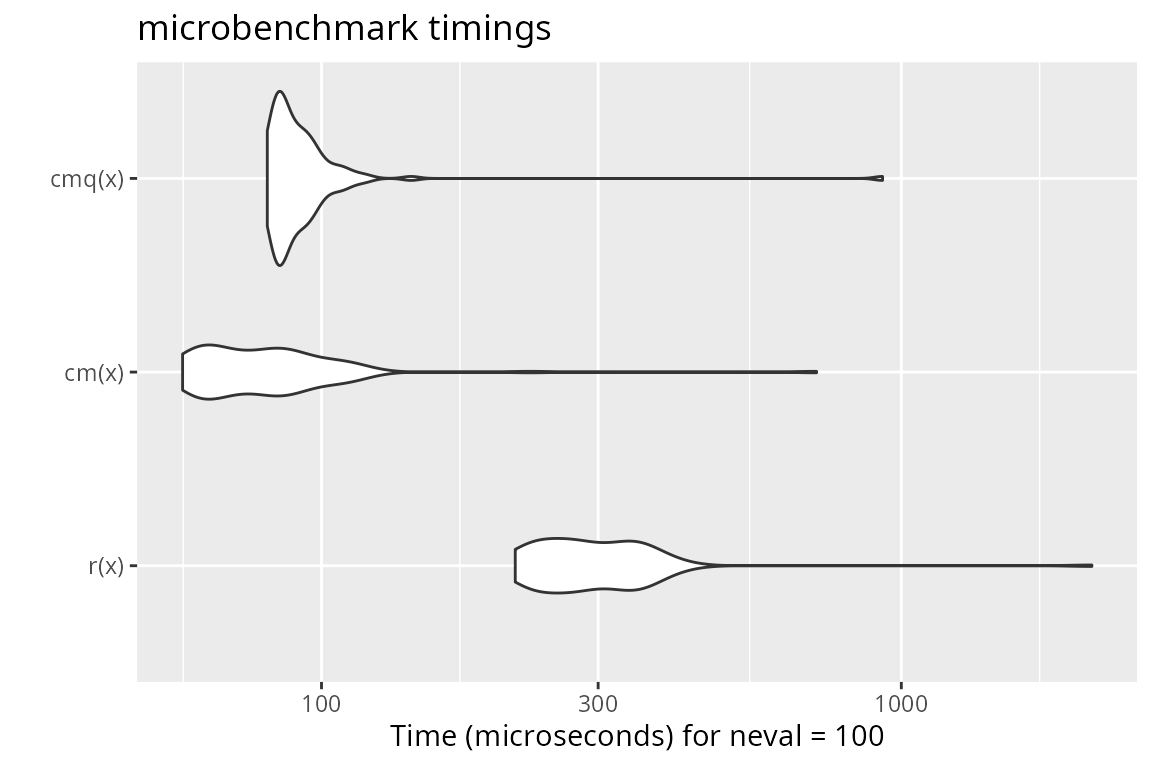
Benchmark 4: Test that x is a data frame with no
missing values
N = 10000
x = data.frame(a = runif(N), b = sample(letters[1:5], N, replace = TRUE), c = sample(c(FALSE, TRUE), N, replace = TRUE))
r = function(x) is.data.frame(x) && !any(sapply(x, function(x) any(is.na(x))))
cm = function(x) testDataFrame(x, any.missing = FALSE)
cmq = function(x) qtest(x, "D")
mb = microbenchmark(r(x), cm(x), cmq(x))
print(mb)
## Unit: microseconds
## expr min lq mean median uq max neval
## r(x) 50.810 51.8535 77.52861 53.2595 58.3840 2034.928 100
## cm(x) 26.432 26.7585 41.76327 27.4505 30.1875 1030.115 100
## cmq(x) 21.860 21.9185 29.20673 21.9710 22.5660 643.104 100
autoplot(mb)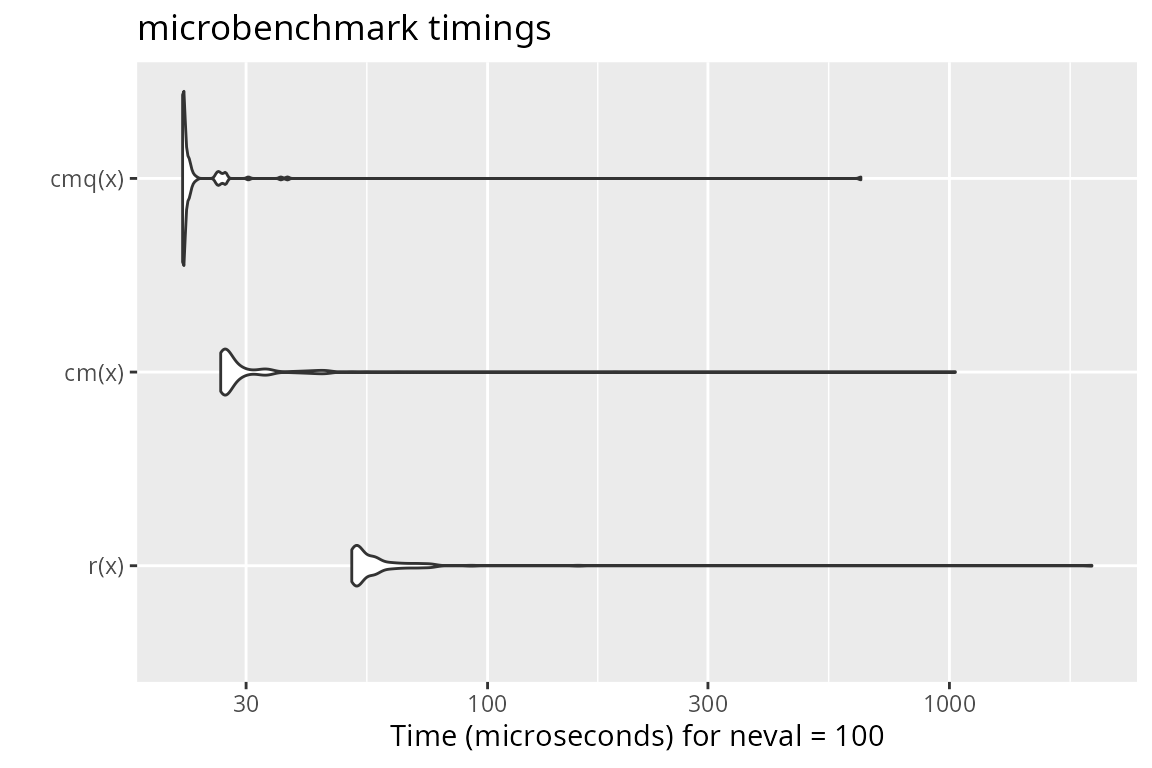
# checkmate tries to stop as early as possible
x$a[1] = NA
mb = microbenchmark(r(x), cm(x), cmq(x))
print(mb)
## Unit: nanoseconds
## expr min lq mean median uq max neval
## r(x) 42896 43620.0 47905.42 44099.0 47249 108150 100
## cm(x) 3658 4073.5 4915.32 4324.0 5003 32928 100
## cmq(x) 696 771.5 960.47 871.5 985 5846 100
autoplot(mb)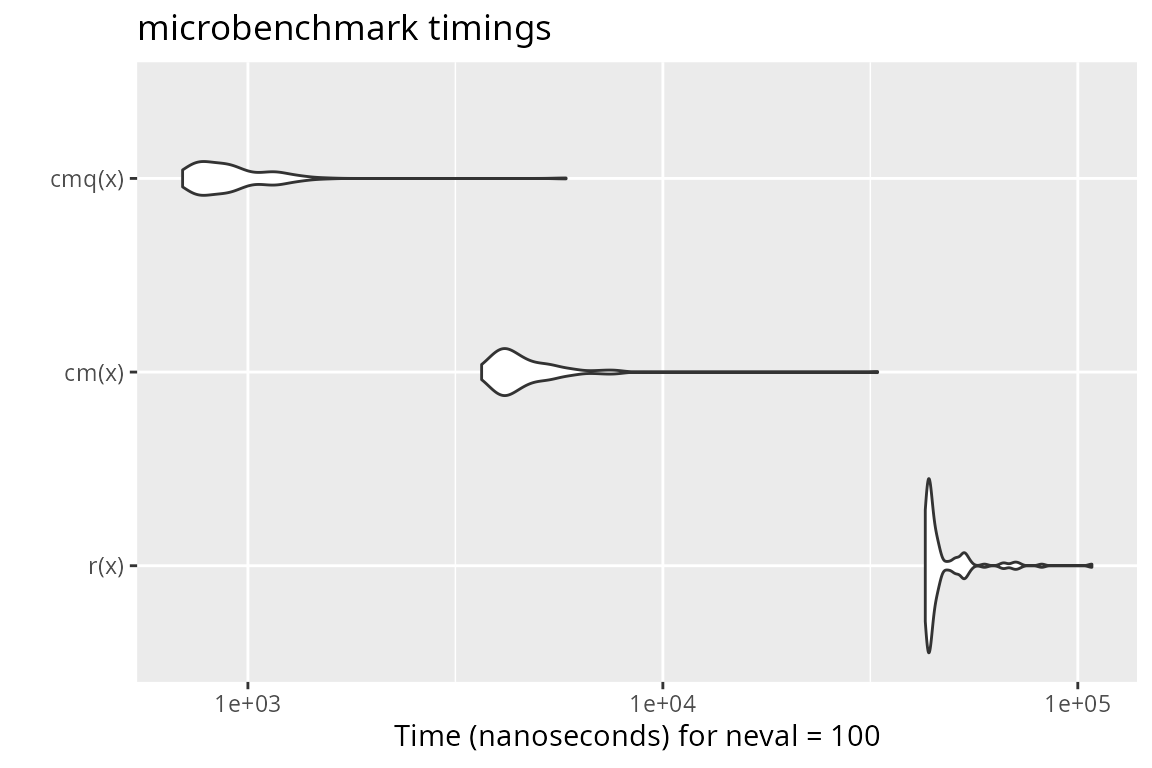
Benchmark 5: Assert that x is an increasing sequence of
integers with no missing values
N = 10000
x.altrep = seq_len(N) # this is an ALTREP in R version >= 3.5.0
x.sexp = c(x.altrep)  # this is a regular SEXP OTOH
r = function(x) stopifnot(is.integer(x), !any(is.na(x)), !is.unsorted(x))
cm = function(x) assertInteger(x, any.missing = FALSE, sorted = TRUE)
mb = microbenchmark(r(x.sexp), cm(x.sexp), r(x.altrep), cm(x.altrep))
print(mb)
## Unit: microseconds
## expr min lq mean median uq max neval
## r(x.sexp) 22.211 24.8140 42.88150 25.360 27.2815 1593.477 100
## cm(x.sexp) 9.243 9.4890 20.38901 9.822 10.9740 939.655 100
## r(x.altrep) 26.944 27.2710 29.56239 27.720 29.1365 53.595 100
## cm(x.altrep) 2.484 2.7675 4.09801 2.940 3.3280 87.416 100
autoplot(mb)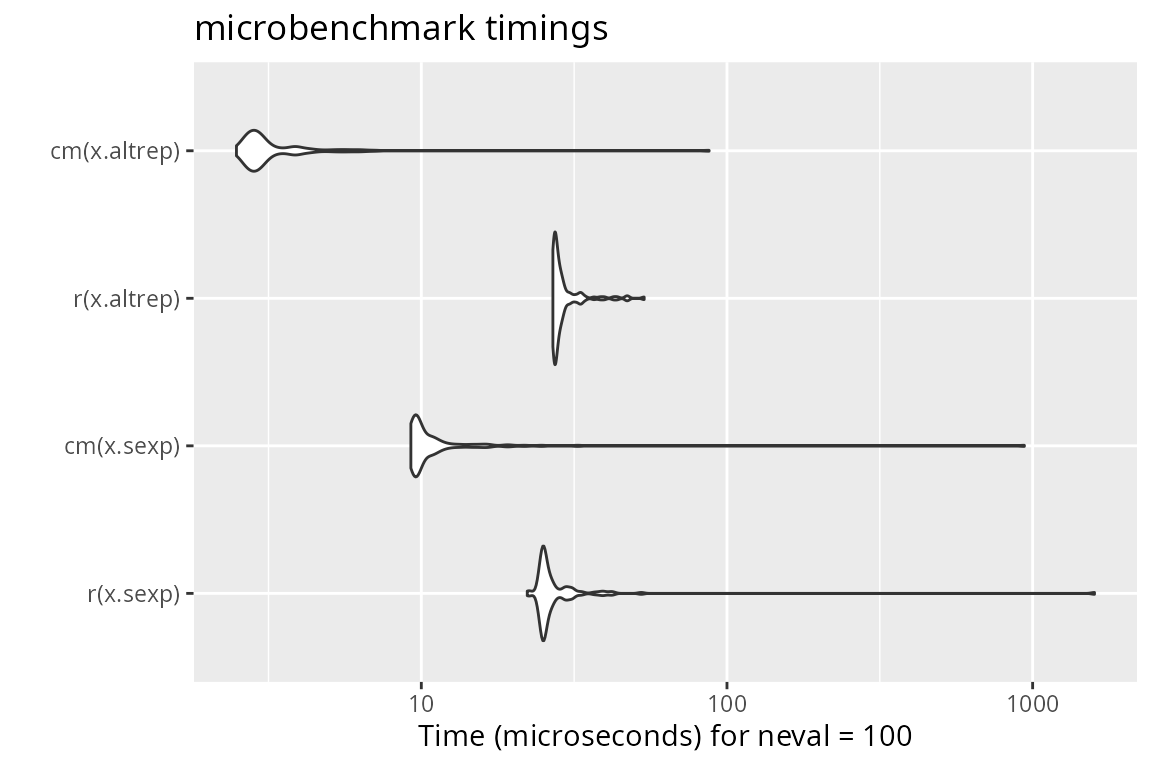
Extending checkmate
To extend checkmate a custom check* function has to be
written. For example, to check for a square matrix one can re-use parts
of checkmate and extend the check with additional functionality:
checkSquareMatrix = function(x, mode = NULL) {
  # check functions must return TRUE on success
  # and a custom error message otherwise
  res = checkMatrix(x, mode = mode)
  if (!isTRUE(res))
    return(res)
  if (nrow(x) != ncol(x))
    return("Must be square")
  return(TRUE)
}

# a quick test:
X = matrix(1:9, nrow = 3)
checkSquareMatrix(X)
## [1] TRUE
checkSquareMatrix(X, mode = "character")## [1] "Must store characters"
checkSquareMatrix(X[1:2, ])## [1] "Must be square"The respective counterparts to the check-function can be
created using the constructors makeAssertionFunction,
makeTestFunction
and makeExpectationFunction:
# For assertions:
assert_square_matrix = assertSquareMatrix = makeAssertionFunction(checkSquareMatrix)
print(assertSquareMatrix)
## function (x, mode = NULL, .var.name = checkmate::vname(x), add = NULL)
## {
## if (missing(x))
## stop(sprintf("argument \"%s\" is missing, with no default",
## .var.name))
## res = checkSquareMatrix(x, mode)
## checkmate::makeAssertion(x, res, .var.name, add)
## }
# For tests:
test_square_matrix = testSquareMatrix = makeTestFunction(checkSquareMatrix)
print(testSquareMatrix)
## function (x, mode = NULL)
## {
## isTRUE(checkSquareMatrix(x, mode))
## }
# For expectations:
expect_square_matrix = makeExpectationFunction(checkSquareMatrix)
print(expect_square_matrix)
## function (x, mode = NULL, info = NULL, label = vname(x))
## {
## if (missing(x))
## stop(sprintf("Argument '%s' is missing", label))
## res = checkSquareMatrix(x, mode)
## makeExpectation(x, res, info, label)
## }Note that all the additional arguments .var.name,
add, info and label are
automatically joined with the function arguments of your custom check
function. Also note that if you define these functions inside an R
package, the constructors are called at build-time (thus, there is no
negative impact on the runtime).
Calling checkmate from C/C++
The package registers two functions which can be used in other packages’ C/C++ code for argument checks.
These are the counterparts to qassert and qtest. Due to their simplistic interface, they perfectly suit the requirements of most type checks in C/C++.
For detailed background information on the register mechanism, see the Exporting C Code section in Hadley’s Book “R Packages” or WRE. Here is a step-by-step guide to get you started:
- Add
checkmateto your “Imports” and “LinkingTo” sections in your DESCRIPTION file. - Create a stub C source file
"checkmate_stub.c", see below. - Include the provided header file
<checkmate.h>in each compilation unit where you want to use checkmate.
File contents for (2):
#include <checkmate.h>
#include <checkmate_stub.c>
Session Info
For the sake of completeness, here the sessionInfo() for
the benchmark (but remember the note before on knitr
possibly biasing the results).
## R version 4.5.1 (2025-06-13)
## Platform: x86_64-pc-linux-gnu
## Running under: Ubuntu 24.04.3 LTS
##
## Matrix products: default
## BLAS:   /usr/lib/x86_64-linux-gnu/openblas-pthread/libblas.so.3
## LAPACK: /usr/lib/x86_64-linux-gnu/openblas-pthread/libopenblasp-r0.3.26.so;  LAPACK version 3.12.0
##
## locale:
##  [1] LC_CTYPE=C.UTF-8       LC_NUMERIC=C           LC_TIME=C.UTF-8
##  [4] LC_COLLATE=C.UTF-8     LC_MONETARY=C.UTF-8    LC_MESSAGES=C.UTF-8
##  [7] LC_PAPER=C.UTF-8       LC_NAME=C              LC_ADDRESS=C
## [10] LC_TELEPHONE=C         LC_MEASUREMENT=C.UTF-8 LC_IDENTIFICATION=C
##
## time zone: Etc/UTC
## tzcode source: system (glibc)
##
## attached base packages:
## [1] stats     graphics  grDevices utils     datasets  methods   base
##
## other attached packages:
## [1] microbenchmark_1.5.0 ggplot2_4.0.2        checkmate_2.3.4
##
## loaded via a namespace (and not attached):
##  [1] vctrs_0.7.1        cli_3.6.5          knitr_1.51         rlang_1.1.7
##  [5] xfun_0.56          otel_0.2.0         S7_0.2.1           textshaping_1.0.4
##  [9] jsonlite_2.0.0     glue_1.8.0         backports_1.5.0    htmltools_0.5.9
## [13] ragg_1.5.0         sass_0.4.10        scales_1.4.0       rmarkdown_2.30
## [17] grid_4.5.1         evaluate_1.0.5     jquerylib_0.1.4    fastmap_1.2.0
## [21] yaml_2.3.12        lifecycle_1.0.5    compiler_4.5.1     RColorBrewer_1.1-3
## [25] fs_1.6.6           htmlwidgets_1.6.4  rstudioapi_0.18.0  farver_2.1.2
## [29] systemfonts_1.3.1  digest_0.6.39      R6_2.6.1           pillar_1.11.1
## [33] bslib_0.10.0       withr_3.0.2        gtable_0.3.6       tools_4.5.1
## [37] pkgdown_2.2.0      cachem_1.1.0       desc_1.4.3