Spread-Level Plots
spreadLevelPlot.RdCreates plots for examining the possible dependence of spread on level, or an extension of these plots to the studentized residuals from linear models.
Usage
spreadLevelPlot(x, ...)

slp(...)

# S3 method for class 'formula'
spreadLevelPlot(x, data=NULL, subset, na.action,
    main=paste("Spread-Level Plot for", varnames[response],
    "by", varnames[-response]), ...)

# Default S3 method
spreadLevelPlot(x, by, robust.line=TRUE,
  start=0, xlab="Median", ylab="Hinge-Spread",
  point.labels=TRUE, las=par("las"),
  main=paste("Spread-Level Plot for", deparse(substitute(x)),
    "by", deparse(substitute(by))),
  col=carPalette()[1], col.lines=carPalette()[2],
    pch=1, lwd=2, grid=TRUE, ...)

# S3 method for class 'lm'
spreadLevelPlot(x, robust.line=TRUE,
  xlab="Fitted Values", ylab="Absolute Studentized Residuals", las=par("las"),
  main=paste("Spread-Level Plot for\n", deparse(substitute(x))),
  pch=1, col=carPalette()[1], col.lines=carPalette()[2:3], lwd=2, grid=TRUE,
    id=FALSE, smooth=TRUE, ...)

# S3 method for class 'spreadLevelPlot'
print(x, ...)
Arguments
- x
a formula of the form
y ~ x, whereyis a numeric vector andxis a factor, or anlmobject to be plotted; alternatively a numeric vector.- data
an optional data frame containing the variables to be plotted. By default the variables are taken from the environment from which
spreadLevelPlotis called.- subset
an optional vector specifying a subset of observations to be used.
- na.action
a function that indicates what should happen when the data contain
NAs. The default is set by thena.actionsetting ofoptions.- by
a factor, numeric vector, or character vector defining groups.
- robust.line
if
TRUEa robust line is fit using therlmfunction in theMASSpackage; ifFALSEa line is fit usinglm.- start
add the constant
startto each data value.- main
title for the plot.
- xlab
label for horizontal axis.
- ylab
label for vertical axis.
- point.labels
if
TRUElabel the points in the plot with group names.- las
if
0, ticks labels are drawn parallel to the axis; set to1for horizontal labels (seepar).- col
color for points; the default is the first entry in the current car palette (see
carPaletteandpar).- col.lines
for the default method, the line color, defaulting to the second entry in the car color palette; for the
"lm"method, a vector of two colors for, respectively, the fitted straight line and a nonparametric regression smooth line, default to the second and third entries in the car color palette.- pch
plotting character for points; default is
1(a circle, seepar).- lwd
line width; default is
2(seepar).- grid
If TRUE, the default, a light-gray background grid is put on the graph
- id
controls point identification; if
FALSE(the default), no points are identified; can be a list of named arguments to theshowLabelsfunction;TRUEis equivalent tolist(method=list("x", "y"), n=2, cex=1, col=carPalette()[1], location="lr"), which identifies the 2 points the most extreme horizontal ("X", absolute studentized residual) values and the 2 points with the most extreme horizontal ("Y", fitted values) values.- smooth
specifies the smoother to be used along with its arguments; if
FALSE, no smoother is shown; can be a list giving the smoother function and its named arguments;TRUE, the default, is equivalent tolist(smoother=loessLine). SeeScatterplotSmoothersfor the smoothers supplied by the car package and their arguments.- ...
arguments passed to plotting functions.
Details
Except for linear models, computes the statistics for, and plots, a Tukey spread-level plot of log(hinge-spread) vs. log(median) for the groups; fits a line to the plot; and calculates a spread-stabilizing transformation from the slope of the line.
For linear models, plots log(abs(studentized residuals) vs. log(fitted values). Point labeling was added in November, 2016.
The function slp is an abbreviation for spreadLevelPlot.
Value
An object of class spreadLevelPlot containing:
- Statistics
a matrix with the lower-hinge, median, upper-hinge, and hinge-spread for each group. (Not for an
lmobject.)- PowerTransformation
spread-stabilizing power transformation, calculated as \(1 - slope\) of the line fit to the plot.
References
Fox, J. (2016) Applied Regression Analysis and Generalized Linear Models, Third Edition. Sage.
Fox, J. and Weisberg, S. (2019) An R Companion to Applied Regression, Third Edition, Sage.
Hoaglin, D. C., Mosteller, F. and Tukey, J. W. (Eds.) (1983) Understanding Robust and Exploratory Data Analysis. Wiley.
Author
John Fox jfox@mcmaster.ca
Examples
spreadLevelPlot(interlocks + 1 ~ nation, data=Ornstein)
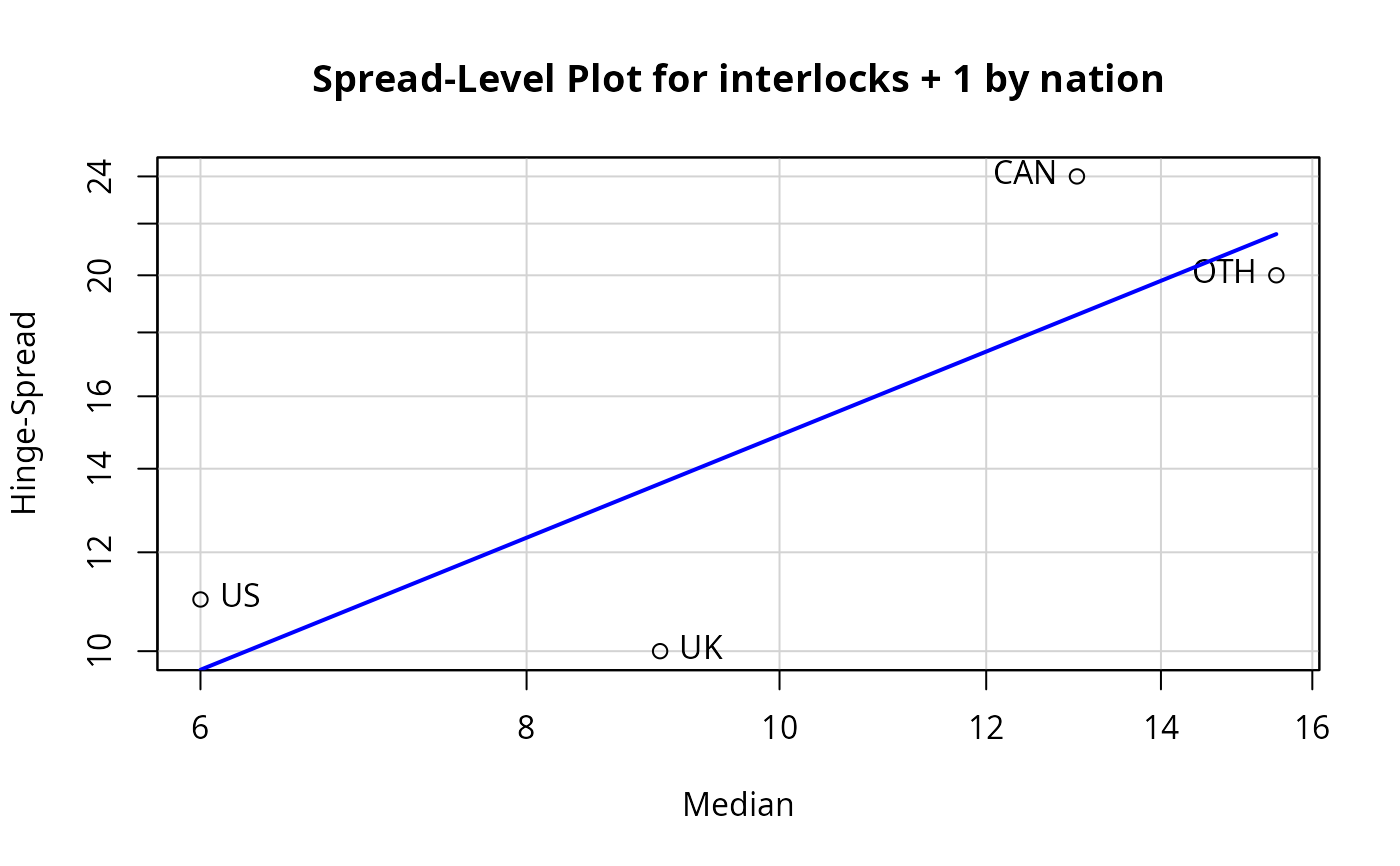 #> LowerHinge Median UpperHinge Hinge-Spread
#> US 2 6.0 13 11
#> UK 4 9.0 14 10
#> CAN 6 13.0 30 24
#> OTH 4 15.5 24 20
#>
#> Suggested power transformation: 0.1534487
slp(lm(interlocks + 1 ~ assets + sector + nation, data=Ornstein))
#> Warning:
#> 1 negative fitted value removed
#> LowerHinge Median UpperHinge Hinge-Spread
#> US 2 6.0 13 11
#> UK 4 9.0 14 10
#> CAN 6 13.0 30 24
#> OTH 4 15.5 24 20
#>
#> Suggested power transformation: 0.1534487
slp(lm(interlocks + 1 ~ assets + sector + nation, data=Ornstein))
#> Warning:
#> 1 negative fitted value removed
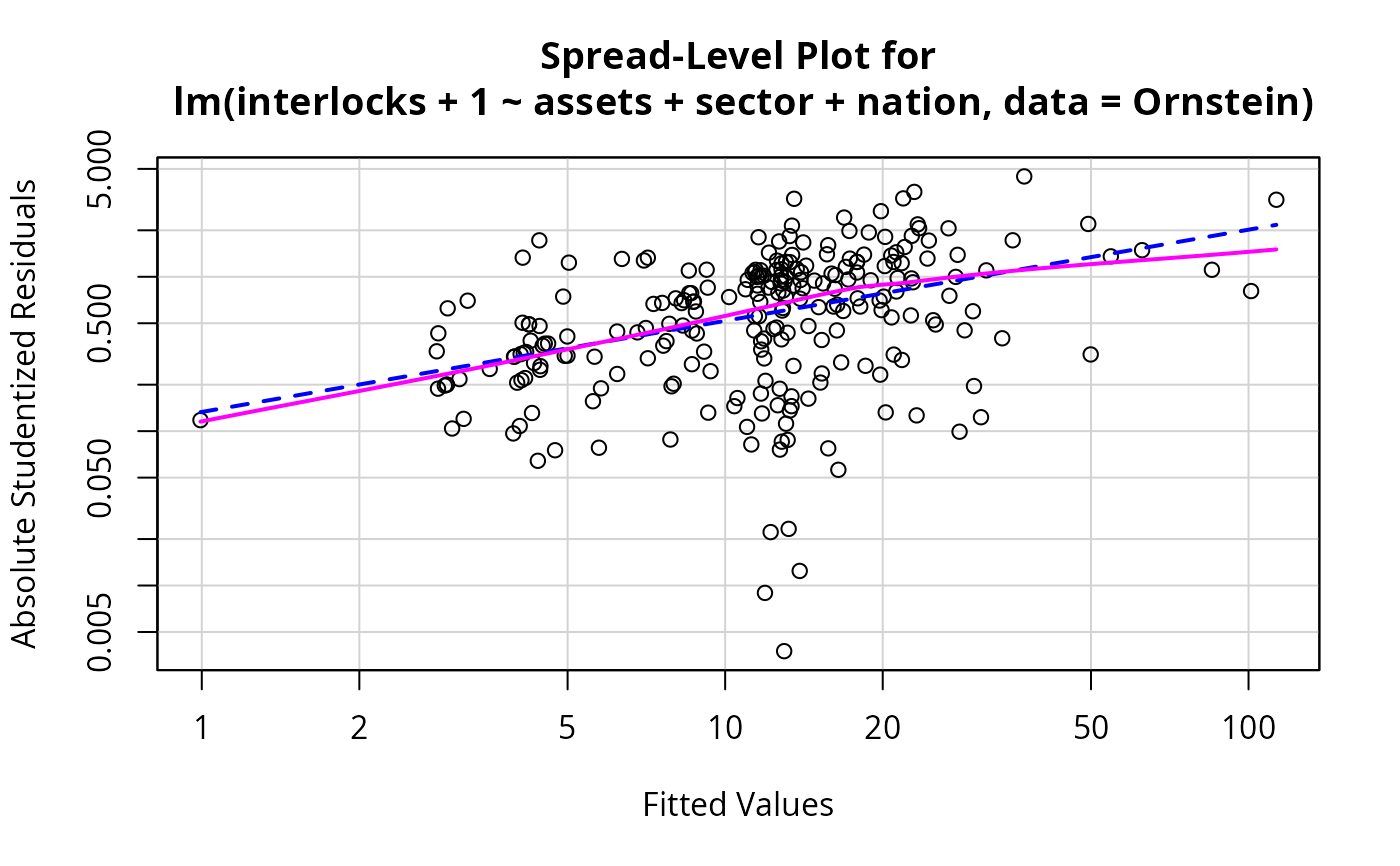 #>
#> Suggested power transformation: 0.4096738
#>
#> Suggested power transformation: 0.4096738