Regression Influence Plot
influencePlot.RdThis function creates a “bubble” plot of Studentized residuals versus hat values, with the areas of the circles representing the observations proportional to the value Cook's distance. Vertical reference lines are drawn at twice and three times the average hat value, horizontal reference lines at -2, 0, and 2 on the Studentized-residual scale.
Usage
influencePlot(model, ...)

# S3 method for class 'lm'
influencePlot(model, scale=10,
 xlab="Hat-Values", ylab="Studentized Residuals", id=TRUE,
 fill=TRUE, fill.col=carPalette()[2], fill.alpha=0.5, ...)

# S3 method for class 'lmerMod'
influencePlot(model, ...)
Arguments
- model
a linear, generalized-linear, or linear mixed model; the
"lmerMod"method calls the"lm"method and can take the same arguments.- scale
a factor to adjust the size of the circles.
- xlab, ylab
axis labels.
- id
settings for labelling points; see
link{showLabels}for details. To omit point labelling, setid=FALSE; the default,id=TRUEis equivalent toid=list(method="noteworthy", n=2, cex=1, col=carPalette()[1], location="lr"). The defaultmethod="noteworthy"is used only in this function and indicates setting labels for points with large Studentized residuals, hat-values or Cook's distances. Setid=list(method="identify")for interactive point identification.- fill
if
TRUE(the default) fill the circles, with the opacity of the filled color proportional to Cook's D, using thealphafunction in the scales package to compute the opacity of the fill.- fill.col
color to use for the filled points, taken by default from the second element of the
carPalettecolor palette.- fill.alpha
the maximum alpha (opacity) of the points.
- ...
arguments to pass to the
plotandpointsfunctions.
Value
If points are identified, returns a data frame with the hat values, Studentized residuals and Cook's distance of the identified points. If no points are identified, nothing is returned. This function is primarily used for its side-effect of drawing a plot.
References
Fox, J. (2016) Applied Regression Analysis and Generalized Linear Models, Third Edition. Sage.
Fox, J. and Weisberg, S. (2019) An R Companion to Applied Regression, Third Edition, Sage.
Author
John Fox jfox@mcmaster.ca, minor changes by S. Weisberg sandy@umn.edu and a contribution from Michael Friendly
Examples
influencePlot(lm(prestige ~ income + education, data=Duncan))
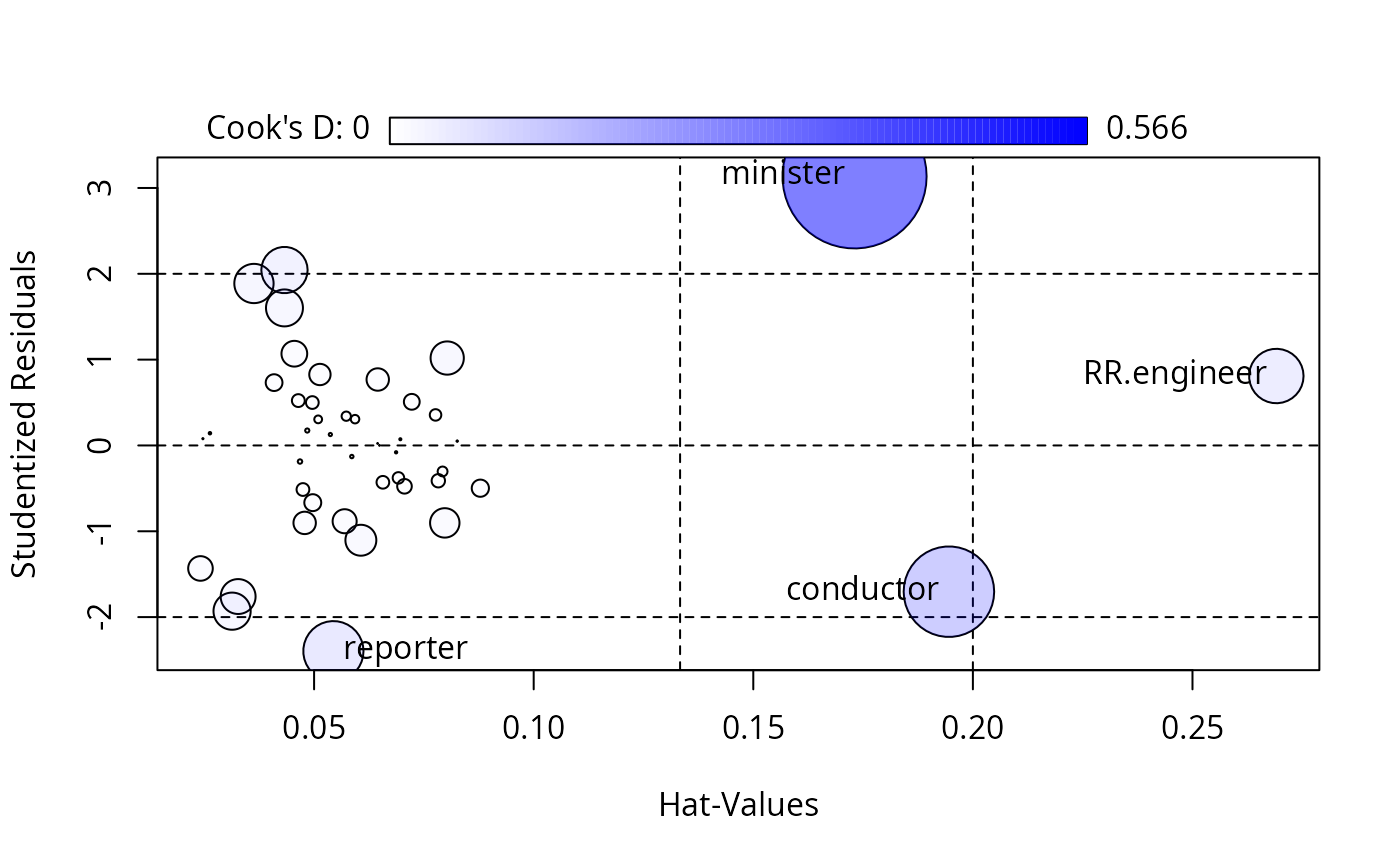 #> StudRes Hat CookD
#> minister 3.1345186 0.17305816 0.56637974
#> reporter -2.3970224 0.05439356 0.09898456
#> conductor -1.7040324 0.19454165 0.22364122
#> RR.engineer 0.8089221 0.26908963 0.08096807
if (FALSE) # requires user interaction to identify points
influencePlot(lm(prestige ~ income + education, data=Duncan),
id=list(method="identify"))
# \dontrun{}
#> StudRes Hat CookD
#> minister 3.1345186 0.17305816 0.56637974
#> reporter -2.3970224 0.05439356 0.09898456
#> conductor -1.7040324 0.19454165 0.22364122
#> RR.engineer 0.8089221 0.26908963 0.08096807
if (FALSE) # requires user interaction to identify points
influencePlot(lm(prestige ~ income + education, data=Duncan),
id=list(method="identify"))
# \dontrun{}