Derivatives of the Incomplete Gamma Integral (Unscaled Version)
pgamma.deriv.unscaled.RdThe first two derivatives of the incomplete gamma integral with scaling.
Arguments
- q, shape
As in
pgammaandpgamma.derivbut these must be vectors of positive values only and finite.
Details
Define
$$G(x, a) = \int_0^x t^{a-1} e^{-t} dt$$
so that
\(G(x, a)\) is pgamma(x, a) * gamma(a).
Write \(x = q\) and shape = \(a\).
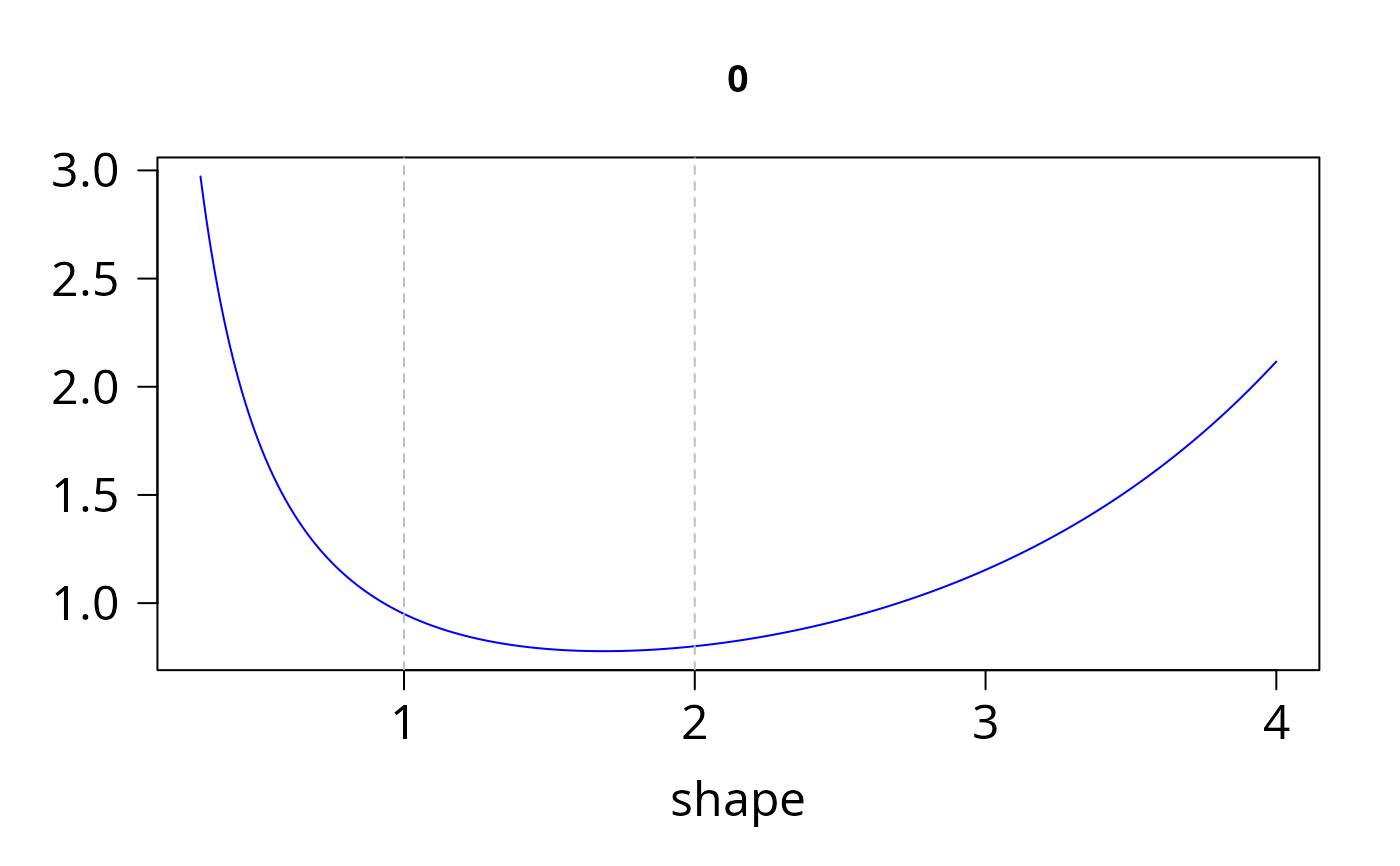
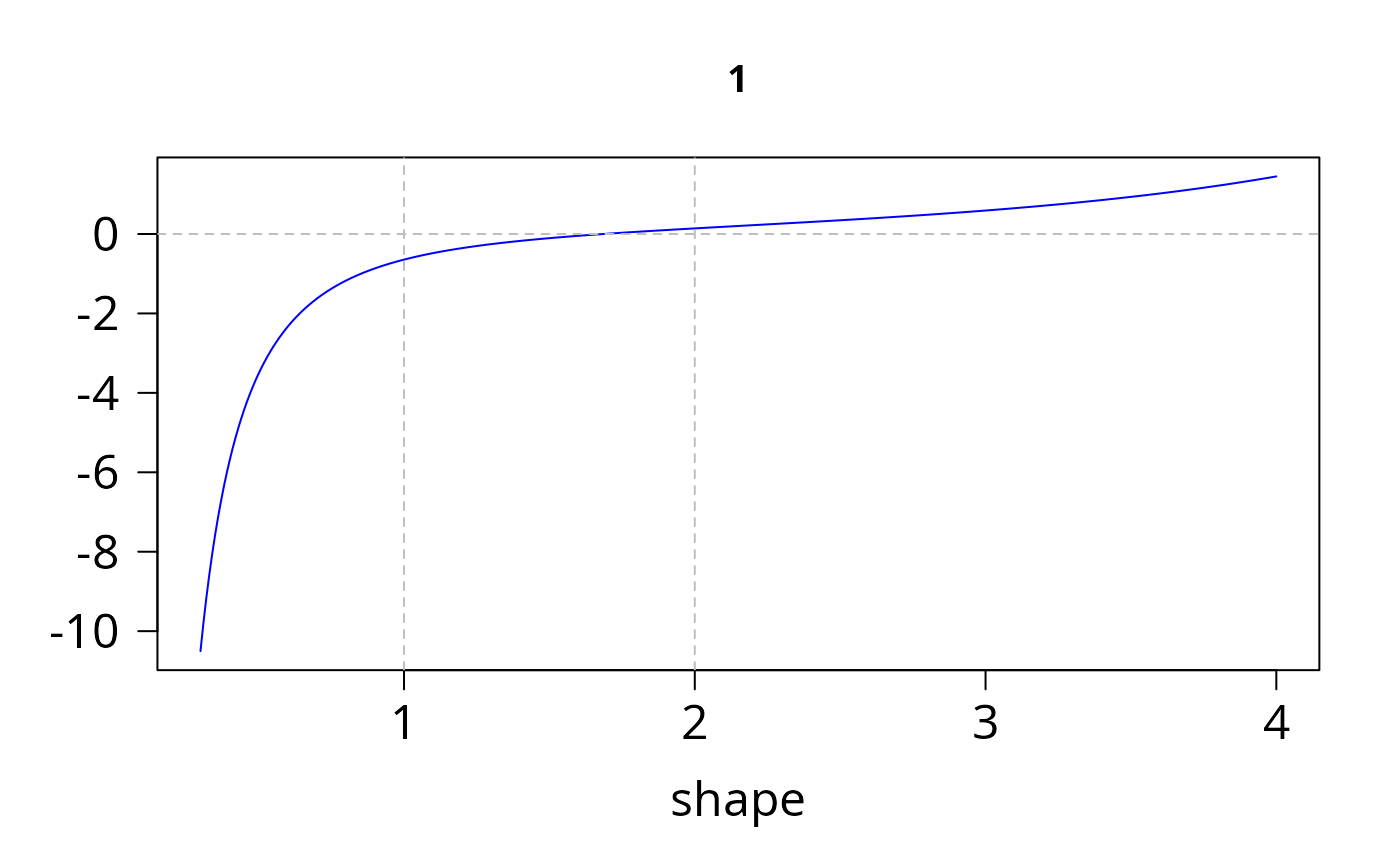
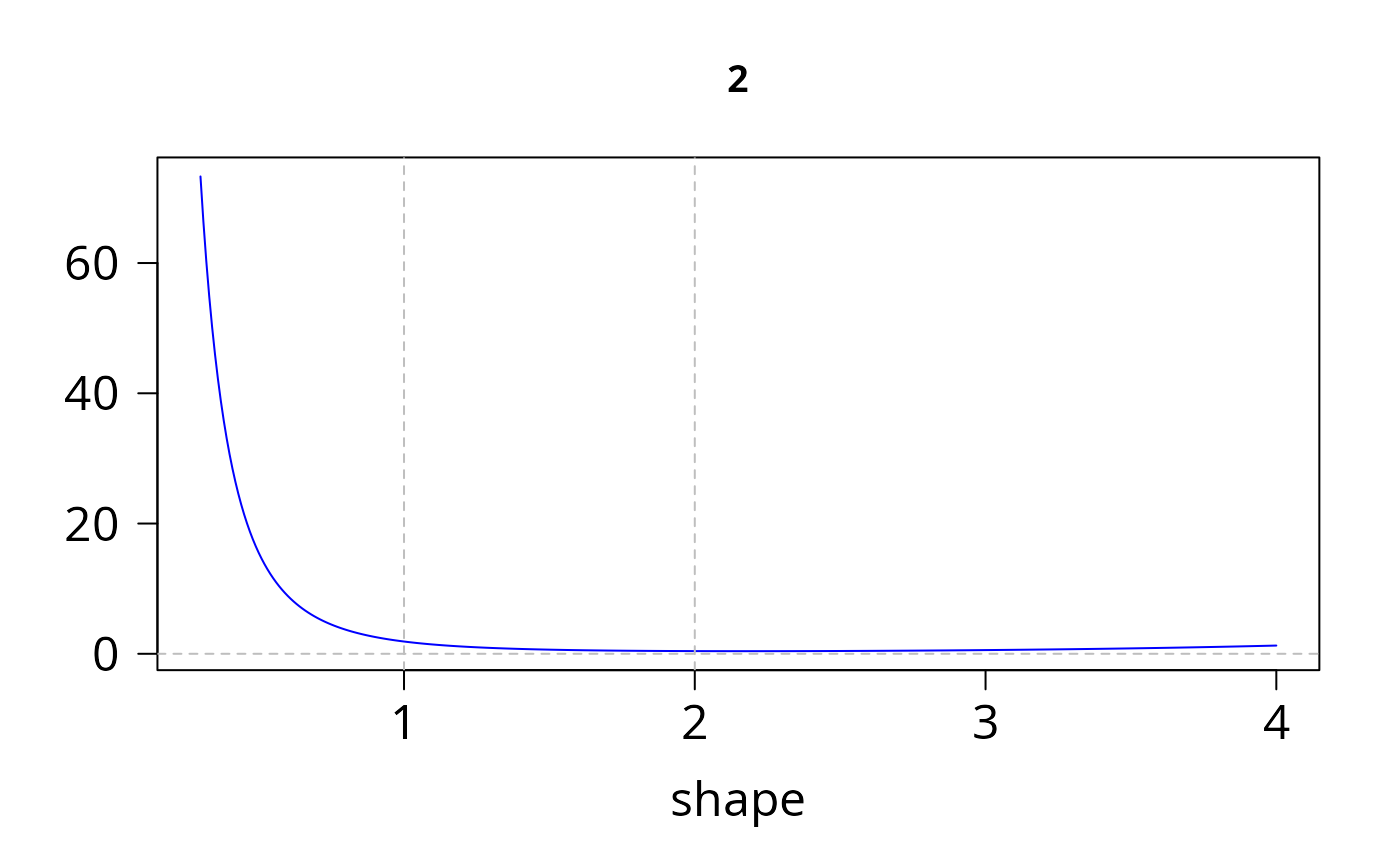
The 0th and first and second derivatives with respect to \(a\)
of \(G\) are returned. This function is similar in spirit to
pgamma.deriv
but here there is no gamma function to scale things.
Currently a 3-column matrix is returned (in the future this
may change and an argument may be supplied so that only what
is required by the user is computed.)
This function is based on Wingo (1989).
References
See truncweibull.
Examples
x <- 3; aa <- seq(0.3, 04, by = 0.01)
ans.u <- pgamma.deriv.unscaled(x, aa)
head(ans.u)
#> 0 1 2
#> [1,] 2.972153 -10.503878 73.29731
#> [2,] 2.870660 -9.806261 66.37775
#> [3,] 2.775811 -9.173526 60.29808
#> [4,] 2.686999 -8.597913 54.93484
#> [5,] 2.603685 -8.072785 50.18570
#> [6,] 2.525394 -7.592438 45.96540
if (FALSE) par(mfrow = c(1, 3))
for (jay in 1:3) {
plot(aa, ans.u[, jay], type = "l", col = "blue", cex.lab = 1.5,
cex.axis = 1.5, las = 1, main = colnames(ans.u)[jay],
log = "", xlab = "shape", ylab = "")
abline(h = 0, v = 1:2, lty = "dashed", col = "gray") # Inaccurate at 1 and 2
}
 # \dontrun{}