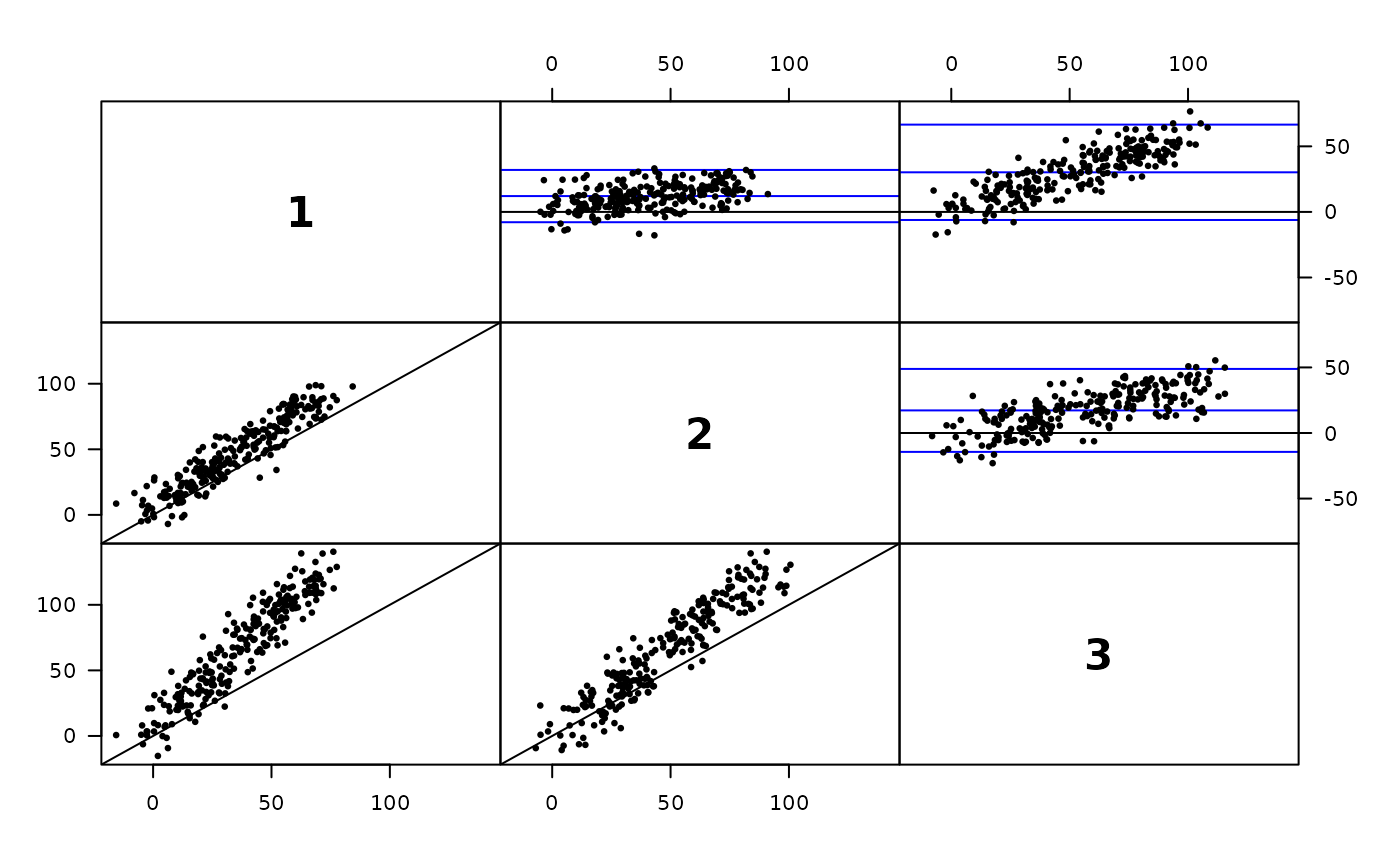
Simulate a dataframe containing replicate measurements on the same items using different methods.
Source:R/Meth.sim.R
Meth.sim.RdSimulates a dataframe representing data from a method comparison study. It
is returned as a Meth object.
Arguments
- Ni
The number of items (patient, animal, sample, unit etc.)
- Nm
The number of methods of measurement.
- Nr
The (maximal) number of replicate measurements for each (item,method) pair.
- nr
The minimal number of replicate measurements for each (item,method) pair. If
nr<Nr, the number of replicates for each (meth,item) pair is uniformly distributed on the pointsnr:Nr, otherwisenris ignored. Different number of replicates is only meaningful if replicates are not linked, hencenris also ignored whensigma.ir>0.- alpha
A vector of method-specific intercepts for the linear equation relating the "true" underlying item mean measurement to the mean measurement on each method.
- beta
A vector of method-specific slopes for the linear equation relating the "true" underlying item mean measurement to the mean measurement on each method.
- mu.range
The range across items of the "true" mean measurement. Item means are uniformly spaced across the range. If a vector length
Niis given, the values of that vector will be used as "true" means.- sigma.mi
A vector of method-specific standard deviations for a method by item random effect. Some or all components can be zero.
- sigma.ir
Method-specific standard deviations for the item by replicate random effect.
- sigma.mir
A vector of method-specific residual standard deviations for a method by item by replicate random effect (residual variation). All components must be greater than zero.
- m.thin
Fraction of the observations from each method to keep.
- i.thin
Fraction of the observations from each item to keep. If both
m.thinandi.thinare given the thinning is by their componentwise product.
Value
A Meth object, i.e. dataframe with columns
meth, item, repl and y, representing results
from a method comparison study.
Details
Data are simulated according to the following model for an observation
\(y_{mir}\): $$y_{mir} = \alpha_m + \beta_m(\mu_i+b_{ir} +
c_{mi}) + e_{mir}$$ where
\(b_{ir}\) is a random item by repl interaction (with
standard deviation for method \(m\) the corresponding component of the
vector \(\sigma_ir\)), \(c_{mi}\) is a random
meth by item interaction (with standard deviation for method
\(m\) the corresponding component of the vector \(\sigma_mi\))
and \(e_{mir}\) is a residual error term (with standard deviation
for method \(m\) the corresponding component of the vector
\(\sigma_mir\)). The \(\mu_i\)'s are uniformly spaced
in a range specified by mu.range.
See also
Examples
  Meth.sim( Ni=4, Nr=3 )
  xx <- Meth.sim( Nm=3, Nr=5, nr=2, alpha=1:3, beta=c(0.7,0.9,1.2), m.thin=0.7 )
  summary( xx )
#>        #Replicates
#> Method  1  2  3  4  5 #Items #Obs: 1040 Values:  min      med       max
#>      1  2 14 31 32 21    100        356   -15.609748 34.97557  84.29873
#>      2  4 16 28 35 17    100        345    -6.933551 46.86464 100.62993
#>      3  1 20 31 35 13    100        339   -15.230222 67.02680 140.47183
  plot( xx )