Histograms for Variables in a Data Frame
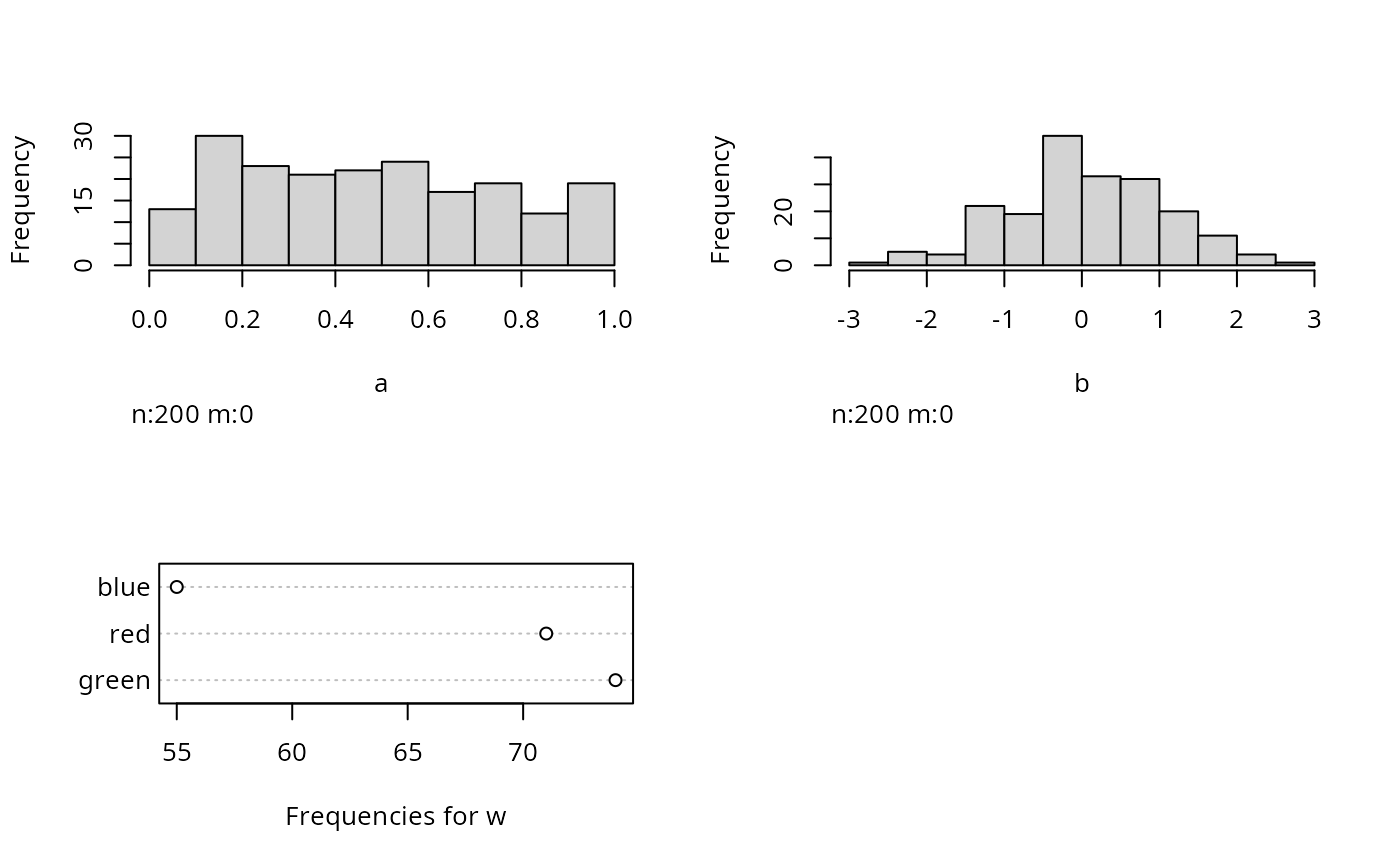
hist.data.frame.RdThis functions tries to compute the maximum number of histograms that will fit on one page, then it draws a matrix of histograms. If there are more qualifying variables than will fit on a page, the function waits for a mouse click before drawing the next page.
Usage
# S3 method for class 'data.frame'
hist(x, n.unique = 3, nclass = "compute",
                na.big = FALSE, rugs = FALSE, freq=TRUE, mtitl = FALSE, ...)
Arguments
- x
a data frame
- n.unique
minimum number of unique values a variable must have before a histogram is drawn
- nclass
number of bins. Default is max(2,trunc(min(n/10,25*log(n,10))/2)), where n is the number of non-missing values for a variable.
- na.big
set to
TRUEto draw the number of missing values on the top of the histogram in addition to in a subtitle. In the subtitle, n is the number of non-missing values and m is the number of missing values- rugs
set to
TRUEto add rug plots at the top of each histogram- freq
see
hist. Default is to show frequencies.- mtitl
set to a character string to set aside extra outside top margin and to use the string for an overall title
- ...
arguments passed to
scat1d