Expenditure and Default Data
CreditCard.RdCross-section data on the credit history for a sample of applicants for a type of credit card.
Usage
data("CreditCard")Format
A data frame containing 1,319 observations on 12 variables.
- card
Factor. Was the application for a credit card accepted?
- reports
Number of major derogatory reports.
- age
Age in years plus twelfths of a year.
- income
Yearly income (in USD 10,000).
- share
Ratio of monthly credit card expenditure to yearly income.
- expenditure
Average monthly credit card expenditure.
- owner
Factor. Does the individual own their home?
- selfemp
Factor. Is the individual self-employed?
- dependents
Number of dependents.
- months
Months living at current address.
- majorcards
Number of major credit cards held.
- active
Number of active credit accounts.
Details
According to Greene (2003, p. 952) dependents equals 1 + number of dependents,
our calculations suggest that it equals number of dependents.
Greene (2003) provides this data set twice in Table F21.4 and F9.1, respectively.
Table F9.1 has just the observations, rounded to two digits. Here, we give the
F21.4 version, see the examples for the F9.1 version. Note that age has some
suspiciously low values (below one year) for some applicants. One of these differs
between the F9.1 and F21.4 version.
Source
Online complements to Greene (2003). Table F21.4.
https://pages.stern.nyu.edu/~wgreene/Text/tables/tablelist5.htm
References
Greene, W.H. (2003). Econometric Analysis, 5th edition. Upper Saddle River, NJ: Prentice Hall.
Examples
data("CreditCard")
## Greene (2003)
## extract data set F9.1
ccard <- CreditCard[1:100,]
ccard$income <- round(ccard$income, digits = 2)
ccard$expenditure <- round(ccard$expenditure, digits = 2)
ccard$age <- round(ccard$age + .01)
## suspicious:
CreditCard$age[CreditCard$age < 1]
#> [1] 0.5000000 0.1666667 0.5833333 0.7500000 0.5833333 0.5000000 0.7500000
## the first of these is also in TableF9.1 with 36 instead of 0.5:
ccard$age[79] <- 36
## Example 11.1
ccard <- ccard[order(ccard$income),]
ccard0 <- subset(ccard, expenditure > 0)
cc_ols <- lm(expenditure ~ age + owner + income + I(income^2), data = ccard0)
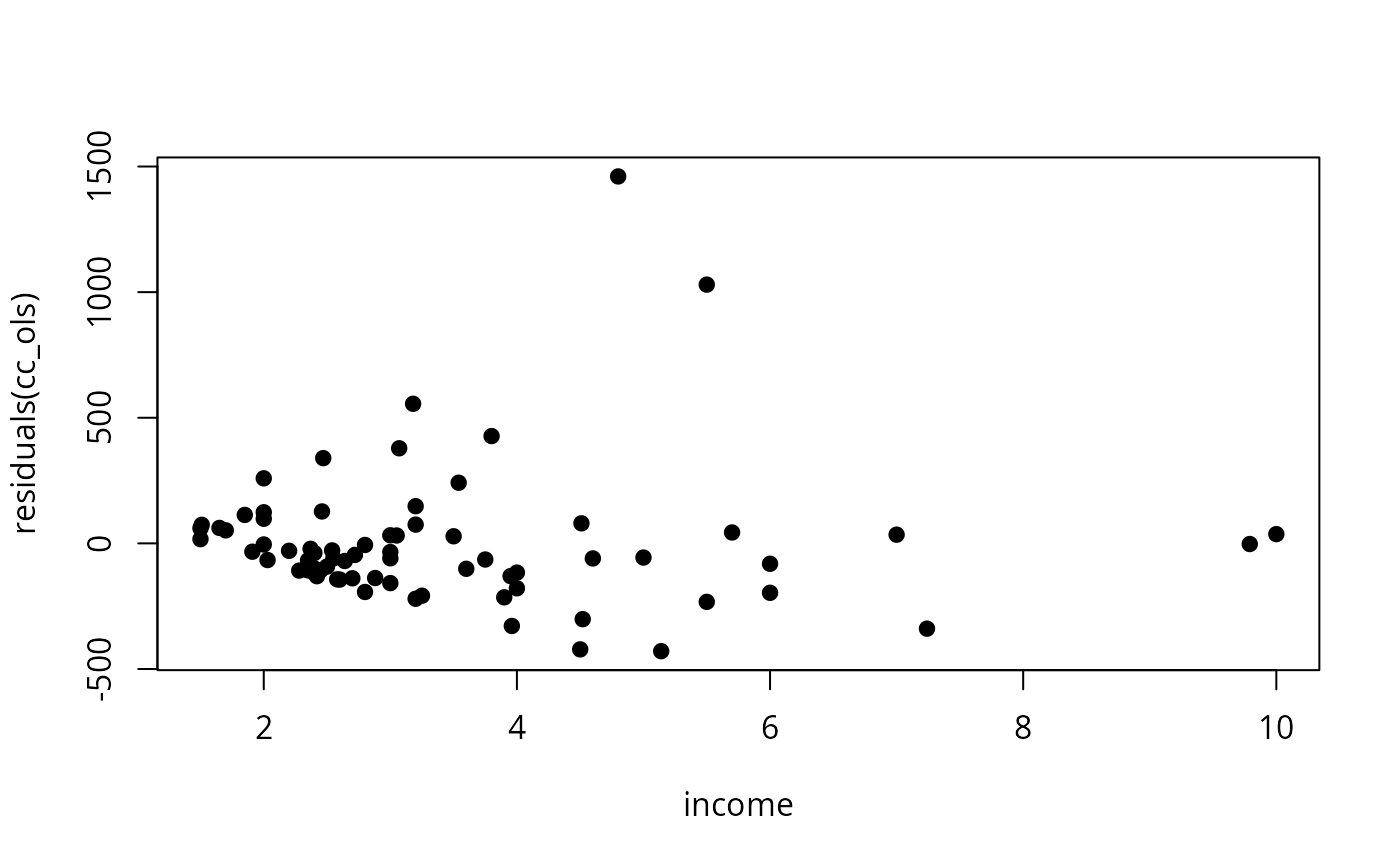
## Figure 11.1
plot(residuals(cc_ols) ~ income, data = ccard0, pch = 19)
 ## Table 11.1
mean(ccard$age)
#> [1] 32.08
prop.table(table(ccard$owner))
#>
#> no yes
#> 0.64 0.36
mean(ccard$income)
#> [1] 3.3692
summary(cc_ols)
#>
#> Call:
#> lm(formula = expenditure ~ age + owner + income + I(income^2),
#> data = ccard0)
#>
#> Residuals:
#> Min 1Q Median 3Q Max
#> -429.03 -130.39 -51.14 53.96 1460.55
#>
#> Coefficients:
#> Estimate Std. Error t value Pr(>|t|)
#> (Intercept) -237.127 199.324 -1.190 0.23838
#> age -3.086 5.515 -0.560 0.57759
#> owneryes 27.911 82.920 0.337 0.73747
#> income 234.416 80.365 2.917 0.00481 **
#> I(income^2) -15.002 7.469 -2.009 0.04861 *
#> ---
#> Signif. codes: 0 ‘***’ 0.001 ‘**’ 0.01 ‘*’ 0.05 ‘.’ 0.1 ‘ ’ 1
#>
#> Residual standard error: 284.7 on 67 degrees of freedom
#> Multiple R-squared: 0.2436, Adjusted R-squared: 0.1985
#> F-statistic: 5.396 on 4 and 67 DF, p-value: 0.0007932
#>
sqrt(diag(vcovHC(cc_ols, type = "HC0")))
#> (Intercept) age owneryes income I(income^2)
#> 212.953161 3.300911 92.190987 88.874353 6.945292
sqrt(diag(vcovHC(cc_ols, type = "HC2")))
#> (Intercept) age owneryes income I(income^2)
#> 221.050557 3.446920 95.675689 92.092471 7.200369
sqrt(diag(vcovHC(cc_ols, type = "HC1")))
#> (Intercept) age owneryes income I(income^2)
#> 220.756215 3.421863 95.569059 92.130897 7.199783
bptest(cc_ols, ~ (age + income + I(income^2) + owner)^2 + I(age^2) + I(income^4), data = ccard0)
#>
#> studentized Breusch-Pagan test
#>
#> data: cc_ols
#> BP = 14.329, df = 12, p-value = 0.2802
#>
gqtest(cc_ols)
#>
#> Goldfeld-Quandt test
#>
#> data: cc_ols
#> GQ = 15.004, df1 = 31, df2 = 31, p-value = 1.374e-11
#> alternative hypothesis: variance increases from segment 1 to 2
#>
bptest(cc_ols, ~ income + I(income^2), data = ccard0, studentize = FALSE)
#>
#> Breusch-Pagan test
#>
#> data: cc_ols
#> BP = 41.931, df = 2, p-value = 7.85e-10
#>
bptest(cc_ols, ~ income + I(income^2), data = ccard0)
#>
#> studentized Breusch-Pagan test
#>
#> data: cc_ols
#> BP = 6.1884, df = 2, p-value = 0.04531
#>
## More examples can be found in:
## help("Greene2003")
## Table 11.1
mean(ccard$age)
#> [1] 32.08
prop.table(table(ccard$owner))
#>
#> no yes
#> 0.64 0.36
mean(ccard$income)
#> [1] 3.3692
summary(cc_ols)
#>
#> Call:
#> lm(formula = expenditure ~ age + owner + income + I(income^2),
#> data = ccard0)
#>
#> Residuals:
#> Min 1Q Median 3Q Max
#> -429.03 -130.39 -51.14 53.96 1460.55
#>
#> Coefficients:
#> Estimate Std. Error t value Pr(>|t|)
#> (Intercept) -237.127 199.324 -1.190 0.23838
#> age -3.086 5.515 -0.560 0.57759
#> owneryes 27.911 82.920 0.337 0.73747
#> income 234.416 80.365 2.917 0.00481 **
#> I(income^2) -15.002 7.469 -2.009 0.04861 *
#> ---
#> Signif. codes: 0 ‘***’ 0.001 ‘**’ 0.01 ‘*’ 0.05 ‘.’ 0.1 ‘ ’ 1
#>
#> Residual standard error: 284.7 on 67 degrees of freedom
#> Multiple R-squared: 0.2436, Adjusted R-squared: 0.1985
#> F-statistic: 5.396 on 4 and 67 DF, p-value: 0.0007932
#>
sqrt(diag(vcovHC(cc_ols, type = "HC0")))
#> (Intercept) age owneryes income I(income^2)
#> 212.953161 3.300911 92.190987 88.874353 6.945292
sqrt(diag(vcovHC(cc_ols, type = "HC2")))
#> (Intercept) age owneryes income I(income^2)
#> 221.050557 3.446920 95.675689 92.092471 7.200369
sqrt(diag(vcovHC(cc_ols, type = "HC1")))
#> (Intercept) age owneryes income I(income^2)
#> 220.756215 3.421863 95.569059 92.130897 7.199783
bptest(cc_ols, ~ (age + income + I(income^2) + owner)^2 + I(age^2) + I(income^4), data = ccard0)
#>
#> studentized Breusch-Pagan test
#>
#> data: cc_ols
#> BP = 14.329, df = 12, p-value = 0.2802
#>
gqtest(cc_ols)
#>
#> Goldfeld-Quandt test
#>
#> data: cc_ols
#> GQ = 15.004, df1 = 31, df2 = 31, p-value = 1.374e-11
#> alternative hypothesis: variance increases from segment 1 to 2
#>
bptest(cc_ols, ~ income + I(income^2), data = ccard0, studentize = FALSE)
#>
#> Breusch-Pagan test
#>
#> data: cc_ols
#> BP = 41.931, df = 2, p-value = 7.85e-10
#>
bptest(cc_ols, ~ income + I(income^2), data = ccard0)
#>
#> studentized Breusch-Pagan test
#>
#> data: cc_ols
#> BP = 6.1884, df = 2, p-value = 0.04531
#>
## More examples can be found in:
## help("Greene2003")