Benderly and Zwick Data: Inflation, Growth and Stock Returns
BenderlyZwick.RdTime series data, 1952–1982.
Usage
data("BenderlyZwick")Format
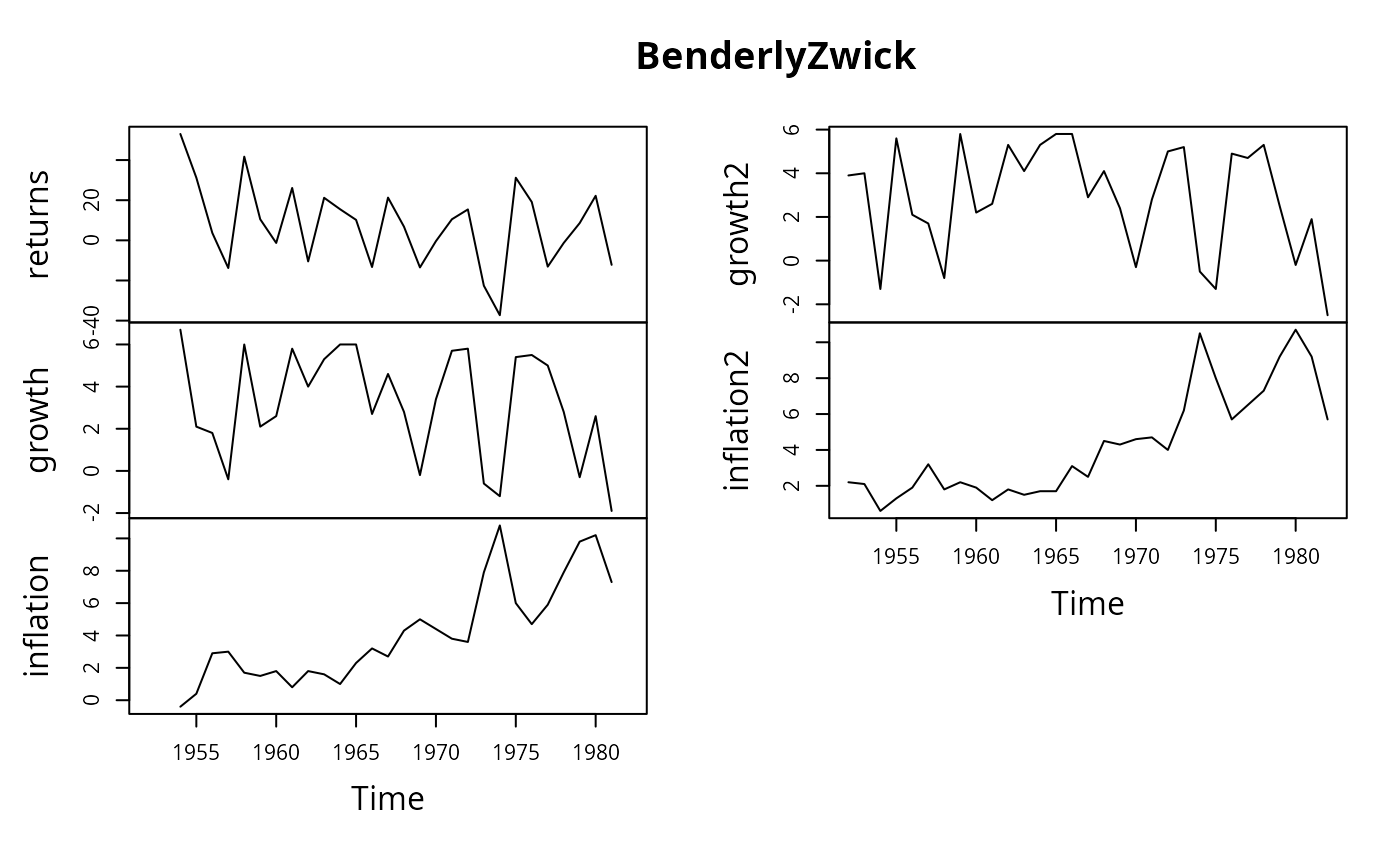
An annual multiple time series from 1952 to 1982 with 5 variables.
- returns
real annual returns on stocks, measured using the Ibbotson-Sinquefeld data base.
- growth
annual growth rate of output, measured by real GNP (from the given year to the next year).
- inflation
inflation rate, measured as growth of price rate (from December of the previous year to December of the present year).
- growth2
annual growth rate of real GNP as given by Baltagi.
- inflation2
inflation rate as given by Baltagi
Source
The first three columns of the data are from Table 1 in Benderly and Zwick (1985). The remaining columns are taken from the online complements of Baltagi (2002). The first column is identical in both sources, the other two variables differ in their numeric values and additionally the growth series seems to be lagged differently. Baltagi (2002) states Lott and Ray (1992) as the source for his version of the data set.
References
Baltagi, B.H. (2002). Econometrics, 3rd ed. Berlin, Springer.
Benderly, J., and Zwick, B. (1985). Inflation, Real Balances, Output and Real Stock Returns. American Economic Review, 75, 1115–1123.
Lott, W.F., and Ray, S.C. (1992). Applied Econometrics: Problems with Data Sets. New York: The Dryden Press.
Zaman, A., Rousseeuw, P.J., and Orhan, M. (2001). Econometric Applications of High-Breakdown Robust Regression Techniques. Economics Letters, 71, 1–8.
Examples
data("BenderlyZwick")
plot(BenderlyZwick)
 ## Benderly and Zwick (1985), p. 1116
library("dynlm")
bz_ols <- dynlm(returns ~ growth + inflation,
data = BenderlyZwick/100, start = 1956, end = 1981)
summary(bz_ols)
#>
#> Time series regression with "ts" data:
#> Start = 1956, End = 1981
#>
#> Call:
#> dynlm(formula = returns ~ growth + inflation, data = BenderlyZwick/100,
#> start = 1956, end = 1981)
#>
#> Residuals:
#> Min 1Q Median 3Q Max
#> -0.279553 -0.073666 -0.004526 0.085589 0.224095
#>
#> Coefficients:
#> Estimate Std. Error t value Pr(>|t|)
#> (Intercept) -0.1238 0.0833 -1.486 0.150747
#> growth 5.2255 1.2702 4.114 0.000424 ***
#> inflation 0.1882 1.1053 0.170 0.866312
#> ---
#> Signif. codes: 0 ‘***’ 0.001 ‘**’ 0.01 ‘*’ 0.05 ‘.’ 0.1 ‘ ’ 1
#>
#> Residual standard error: 0.1333 on 23 degrees of freedom
#> (0 observations deleted due to missingness)
#> Multiple R-squared: 0.5119, Adjusted R-squared: 0.4695
#> F-statistic: 12.06 on 2 and 23 DF, p-value: 0.0002617
#>
## Zaman, Rousseeuw and Orhan (2001)
## use larger period, without scaling
bz_ols2 <- dynlm(returns ~ growth + inflation,
data = BenderlyZwick, start = 1954, end = 1981)
summary(bz_ols2)
#>
#> Time series regression with "ts" data:
#> Start = 1954, End = 1981
#>
#> Call:
#> dynlm(formula = returns ~ growth + inflation, data = BenderlyZwick,
#> start = 1954, end = 1981)
#>
#> Residuals:
#> Min 1Q Median 3Q Max
#> -27.235 -8.478 -0.848 6.322 25.171
#>
#> Coefficients:
#> Estimate Std. Error t value Pr(>|t|)
#> (Intercept) -3.586 8.581 -0.418 0.6796
#> growth 4.778 1.368 3.492 0.0018 **
#> inflation -1.046 1.145 -0.913 0.3698
#> ---
#> Signif. codes: 0 ‘***’ 0.001 ‘**’ 0.01 ‘*’ 0.05 ‘.’ 0.1 ‘ ’ 1
#>
#> Residual standard error: 15.02 on 25 degrees of freedom
#> (2 observations deleted due to missingness)
#> Multiple R-squared: 0.4961, Adjusted R-squared: 0.4558
#> F-statistic: 12.31 on 2 and 25 DF, p-value: 0.0001902
#>
## Benderly and Zwick (1985), p. 1116
library("dynlm")
bz_ols <- dynlm(returns ~ growth + inflation,
data = BenderlyZwick/100, start = 1956, end = 1981)
summary(bz_ols)
#>
#> Time series regression with "ts" data:
#> Start = 1956, End = 1981
#>
#> Call:
#> dynlm(formula = returns ~ growth + inflation, data = BenderlyZwick/100,
#> start = 1956, end = 1981)
#>
#> Residuals:
#> Min 1Q Median 3Q Max
#> -0.279553 -0.073666 -0.004526 0.085589 0.224095
#>
#> Coefficients:
#> Estimate Std. Error t value Pr(>|t|)
#> (Intercept) -0.1238 0.0833 -1.486 0.150747
#> growth 5.2255 1.2702 4.114 0.000424 ***
#> inflation 0.1882 1.1053 0.170 0.866312
#> ---
#> Signif. codes: 0 ‘***’ 0.001 ‘**’ 0.01 ‘*’ 0.05 ‘.’ 0.1 ‘ ’ 1
#>
#> Residual standard error: 0.1333 on 23 degrees of freedom
#> (0 observations deleted due to missingness)
#> Multiple R-squared: 0.5119, Adjusted R-squared: 0.4695
#> F-statistic: 12.06 on 2 and 23 DF, p-value: 0.0002617
#>
## Zaman, Rousseeuw and Orhan (2001)
## use larger period, without scaling
bz_ols2 <- dynlm(returns ~ growth + inflation,
data = BenderlyZwick, start = 1954, end = 1981)
summary(bz_ols2)
#>
#> Time series regression with "ts" data:
#> Start = 1954, End = 1981
#>
#> Call:
#> dynlm(formula = returns ~ growth + inflation, data = BenderlyZwick,
#> start = 1954, end = 1981)
#>
#> Residuals:
#> Min 1Q Median 3Q Max
#> -27.235 -8.478 -0.848 6.322 25.171
#>
#> Coefficients:
#> Estimate Std. Error t value Pr(>|t|)
#> (Intercept) -3.586 8.581 -0.418 0.6796
#> growth 4.778 1.368 3.492 0.0018 **
#> inflation -1.046 1.145 -0.913 0.3698
#> ---
#> Signif. codes: 0 ‘***’ 0.001 ‘**’ 0.01 ‘*’ 0.05 ‘.’ 0.1 ‘ ’ 1
#>
#> Residual standard error: 15.02 on 25 degrees of freedom
#> (2 observations deleted due to missingness)
#> Multiple R-squared: 0.4961, Adjusted R-squared: 0.4558
#> F-statistic: 12.31 on 2 and 25 DF, p-value: 0.0001902
#>