Plotting (Log) Odds Ratios
plot.loddsratio.RdProduces a (conditional) line plot of extended (log) odds ratios.
# S3 method for class 'loddsratio'
plot(x, baseline = TRUE, gp_baseline = gpar(lty = 2),
     lines = TRUE, lwd_lines = 3,
     confidence = TRUE, conf_level = 0.95, lwd_confidence = 2,
     whiskers = 0, transpose = FALSE,
     col = NULL, cex = 0.8, pch = NULL,
     bars = NULL, gp_bars = gpar(fill = "lightgray", alpha = 0.5),
     bar_width = unit(0.05, "npc"),

     legend = TRUE, legend_pos = "topright", legend_inset = c(0, 0),
     legend_vgap = unit(0.5, "lines"),
     gp_legend_frame = gpar(lwd = 1, col = "black"),
     gp_legend_title = gpar(fontface = "bold"),
     gp_legend = gpar(), legend_lwd = 1, legend_size = 1,

     xlab = NULL, ylab = NULL, xlim = NULL, ylim = NULL,
     main = NULL, gp_main = gpar(fontsize = 12, fontface = "bold"),
     newpage = TRUE, pop = FALSE, return_grob = FALSE,
     add = FALSE, prefix = "", ...)
# S3 method for class 'loddsratio'
lines(x, legend = FALSE, confidence = FALSE, cex = 0, ...)
Arguments
- x
an object of class
loddsratio.- baseline
if
TRUE, a dashed line is plotted at a value of 1 (in case of odds) or 0 (in case of log-odds).- gp_baseline
object of class
"gpar"used for the baseline.- lines
if
TRUE, the points are connected by lines (only sensible if the variable represented by the x-axis is ordinal).- lwd_lines
Width of the connecting lines (in
charunits).- confidence
logical; shall confindence intervals be plotted?
- conf_level
confidence level used for confidence intervals.
- lwd_confidence
Line width of the confidence interval bars (in
charunits).- whiskers
width of the confidence interval whiskers.
- transpose
if
TRUE, the plot is transposed.- col
character vector specifying the colors of the fitted lines, by default chosen with
rainbow_hcl.- cex
size of the plot symbols (in lines).
- pch
character or numeric vector of symbols used for plotting the (possibly conditioned) observed values, recycled as needed.
- bars
logical; shall bars be plotted additionally to the points? Defaults to
TRUEin case of only one conditioning variable.- gp_bars
object of class
"gpar"used for the bars.- bar_width
Width of the bars, if drawn.
- legend
logical; if
TRUE(default), a legend is drawn.- legend_pos
numeric vector of length 2, specifying x and y coordinates of the legend, or a character string (e.g.,
"topleft","center"etc.). Defaults to"topleft"if the fitted curve's slope is positive, and"topright"else.- legend_inset
numeric vector or length 2 specifying the inset from the legend's x and y coordinates in npc units.
- legend_vgap
vertical space between the legend's line entries.
- gp_legend_frame
object of class
"gpar"used for the legend frame.- gp_legend_title
object of class
"gpar"used for the legend title.- gp_legend
object of class
"gpar"used for the legend defaults.- legend_lwd
line width used in the legend for the different groups.
- legend_size
size used for the group symbols (in char units).
- xlab
label for the x-axis. Defaults to
"Strata"iftransposeisFALSE.- ylab
label for the y-axis. Defaults to
"Strata"iftransposeisTRUE.- xlim
x-axis limits. Ignored if
transposeisFALSE.- ylim
y-axis limits. Ignored if
transposeisTRUE.- main
user-specified main title.
- gp_main
object of class
"gpar"used for the main title.- newpage
logical; if
TRUE, the plot is drawn on a new page.- pop
logical; if
TRUE, all newly generated viewports are popped after plotting.- return_grob
logical. Should a snapshot of the display be returned as a grid grob?
- add
logical; should the plot added to an existing log odds ratio plot?
- prefix
character string used as prefix for the viewport name.
- ...
other graphics parameters (see
par).
Value
if return_grob is TRUE, a grob object corresponding to
the plot. NULL (invisibly) else.
Details
The function basically produces conditioned line plots of the (log)
odds ratios structure provided in x.
The lines method can be used to overlay different plots (for
example, observed and expected values).
cotabplot can be used for stratified analyses (see examples).
References
M. Friendly (2000), Visualizing Categorical Data. SAS Institute, Cary, NC.
See also
Examples
## 2 x 2 x k cases
data(CoalMiners, package = "vcd")
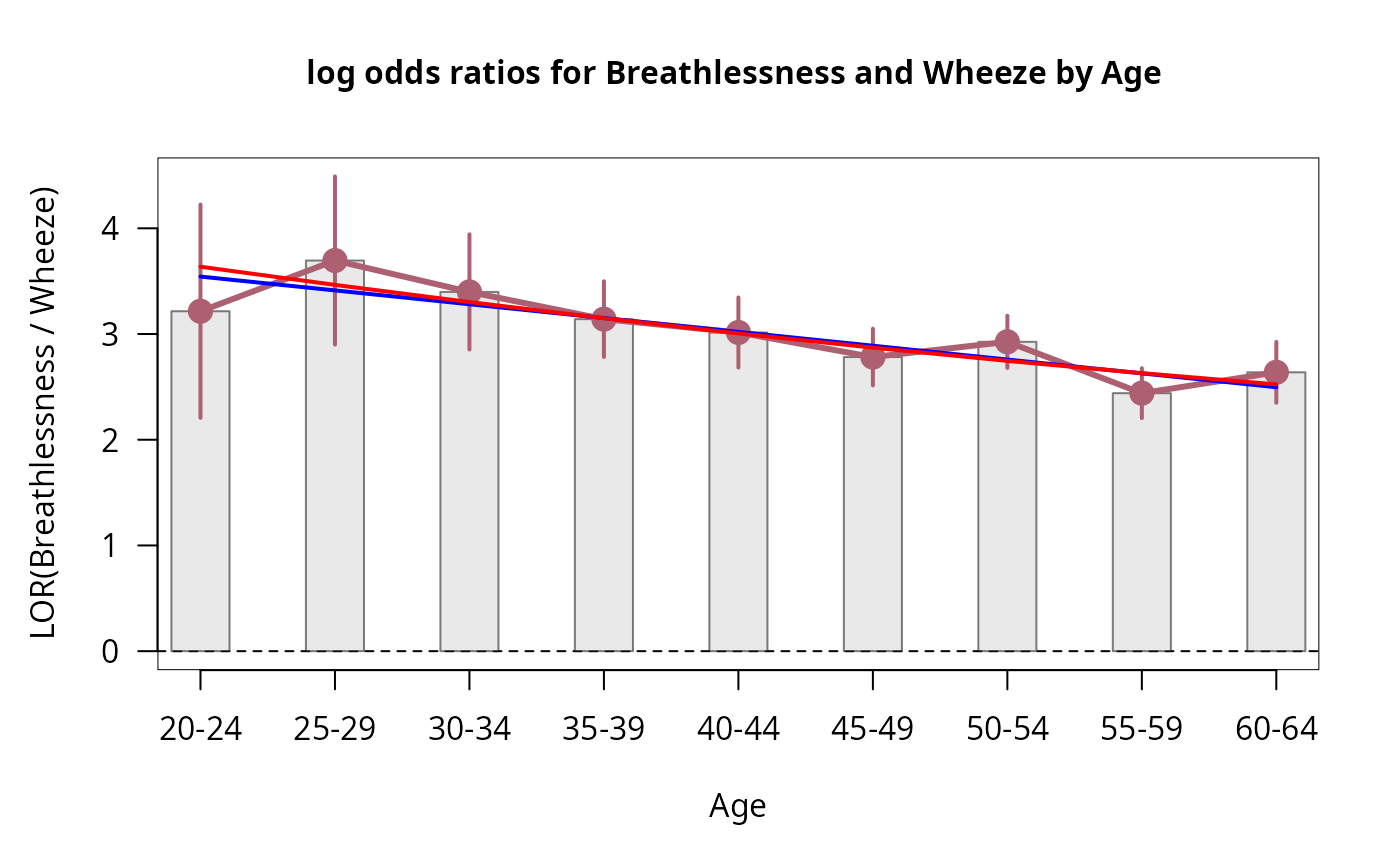
lor_CM <- loddsratio(CoalMiners)
plot(lor_CM)
lor_CM_df <- as.data.frame(lor_CM)
# fit linear models using WLS
age <- seq(20, 60, by = 5)
lmod <- lm(LOR ~ age, weights = 1 / ASE^2, data = lor_CM_df)
grid.lines(seq_along(age), fitted(lmod), gp = gpar(col = "blue", lwd = 2), default.units = "native")
qmod <- lm(LOR ~ poly(age, 2), weights = 1 / ASE^2, data = lor_CM_df)
grid.lines(seq_along(age), fitted(qmod), gp = gpar(col = "red", lwd = 2), default.units = "native")
 ## 2 x k x 2
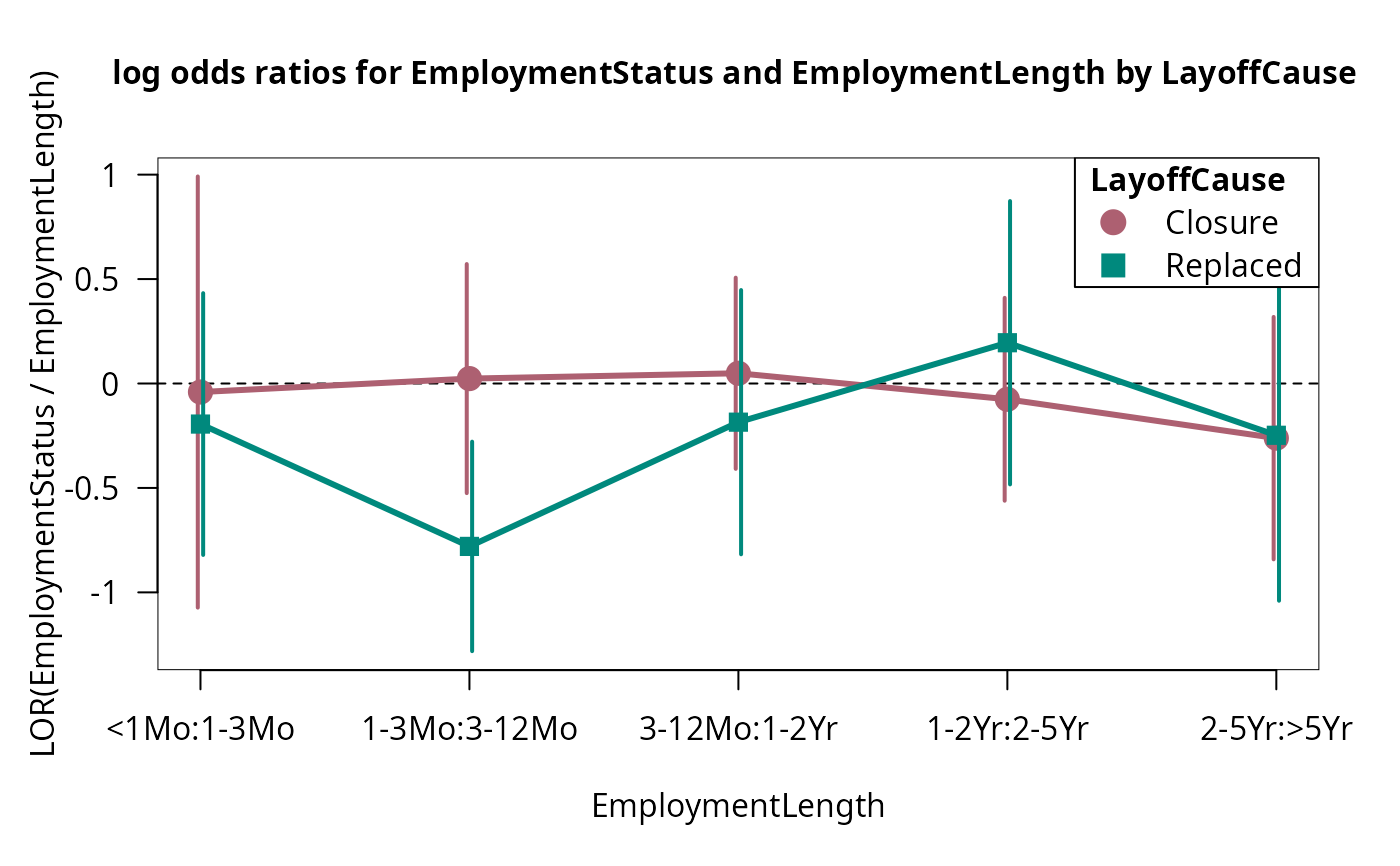
lor_Emp <-loddsratio(Employment)
plot(lor_Emp)
## 2 x k x 2
lor_Emp <-loddsratio(Employment)
plot(lor_Emp)
 ## 4 way tables
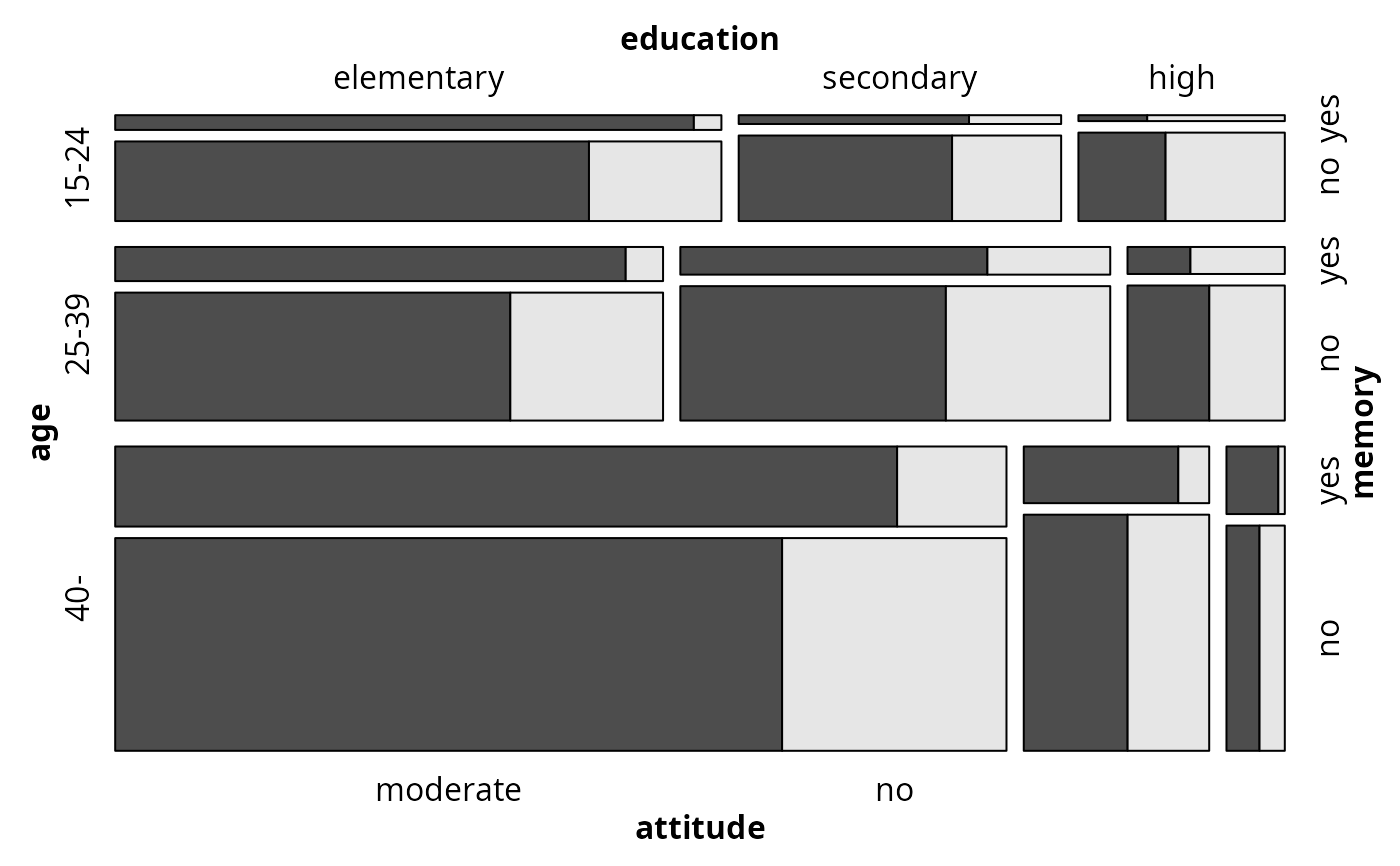
data(Punishment, package = "vcd")
mosaic(attitude ~ age + education + memory, data = Punishment,
highlighting_direction="left", rep = c(attitude = FALSE))
## 4 way tables
data(Punishment, package = "vcd")
mosaic(attitude ~ age + education + memory, data = Punishment,
highlighting_direction="left", rep = c(attitude = FALSE))
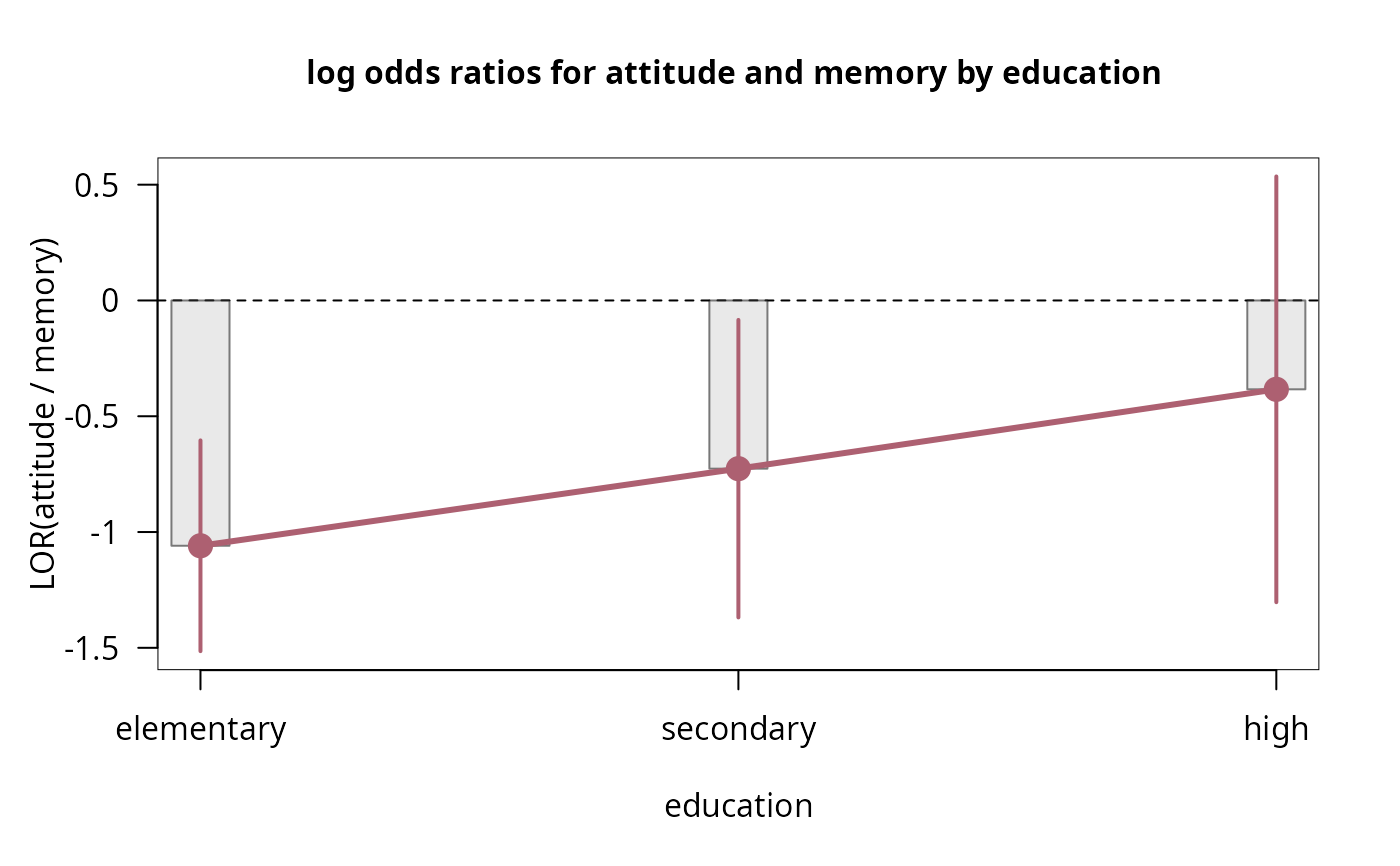
 # visualize the log odds ratios, by education
plot(loddsratio(~ attitude + memory | education, data = Punishment))
# visualize the log odds ratios, by education
plot(loddsratio(~ attitude + memory | education, data = Punishment))
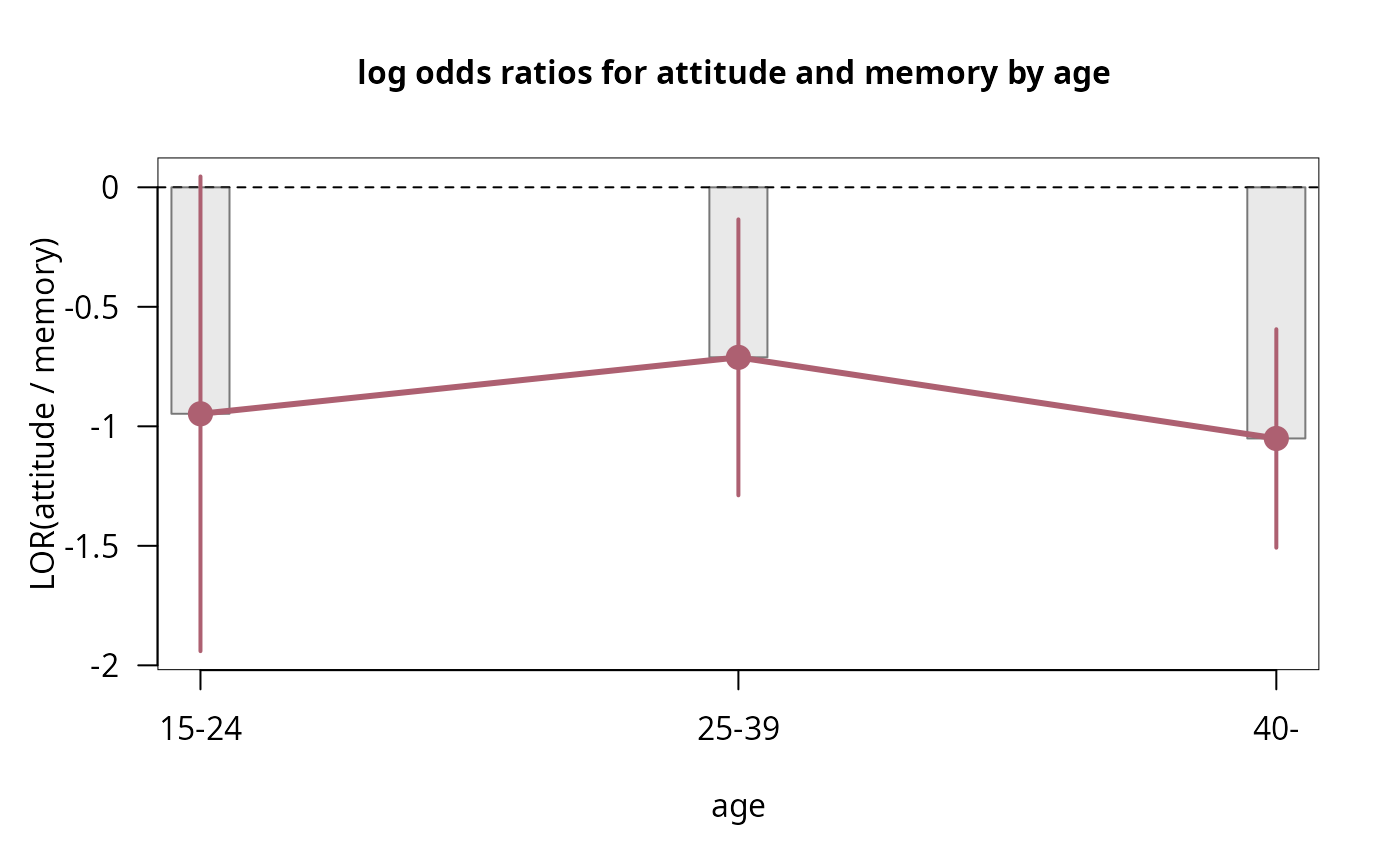
 # visualize the log odds ratios, by age
plot(loddsratio(~ attitude + memory | age, data = Punishment))
# visualize the log odds ratios, by age
plot(loddsratio(~ attitude + memory | age, data = Punishment))
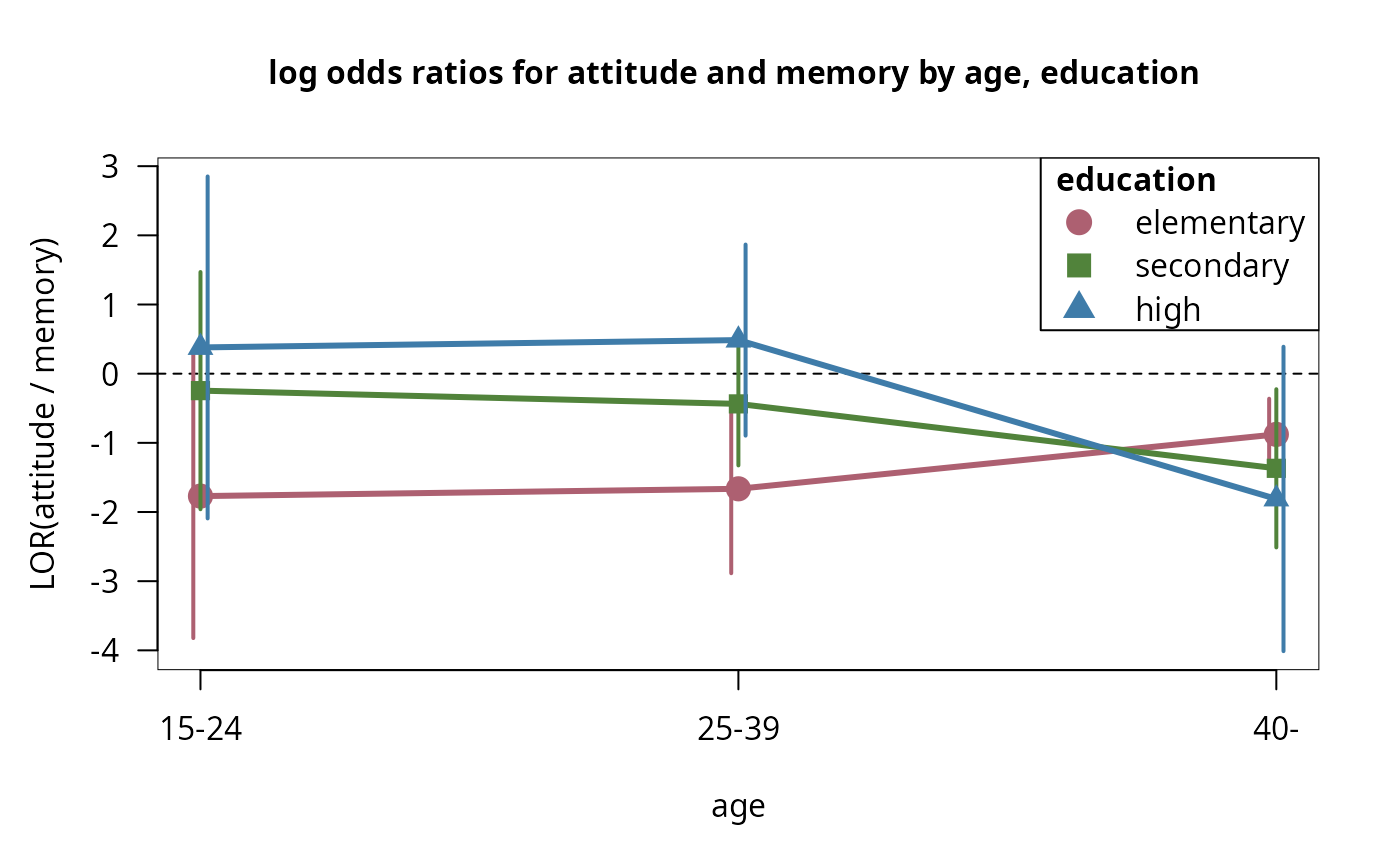
 # visualize the log odds ratios, by age and education
plot(loddsratio(~ attitude + memory | age + education, data = Punishment))
# visualize the log odds ratios, by age and education
plot(loddsratio(~ attitude + memory | age + education, data = Punishment))
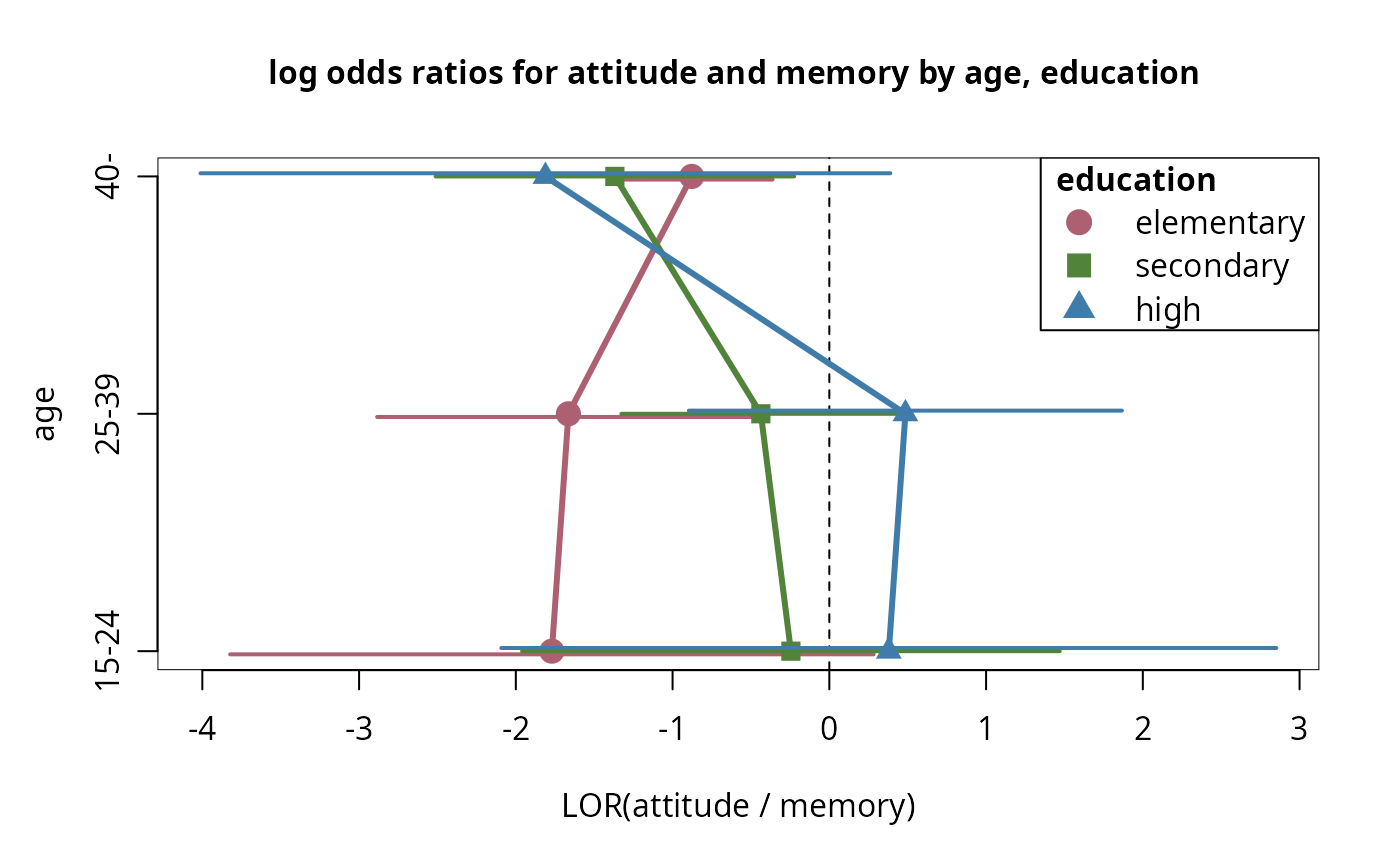
 # same, transposed
plot(loddsratio(~ attitude + memory | age + education, data = Punishment), transpose = TRUE)
# same, transposed
plot(loddsratio(~ attitude + memory | age + education, data = Punishment), transpose = TRUE)
 # alternative visualization methods
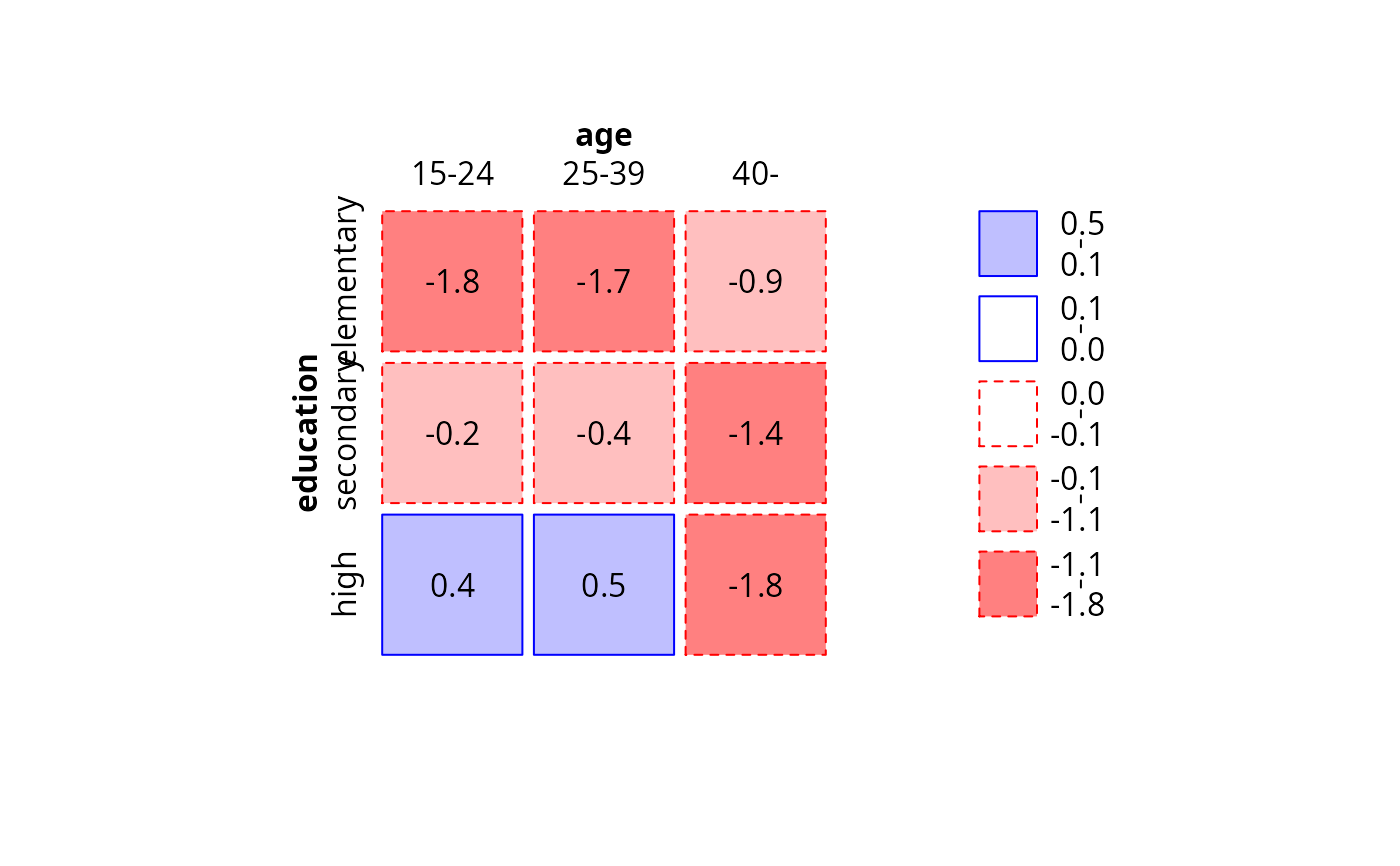
image(loddsratio(Freq ~ ., data = Punishment))
# alternative visualization methods
image(loddsratio(Freq ~ ., data = Punishment))
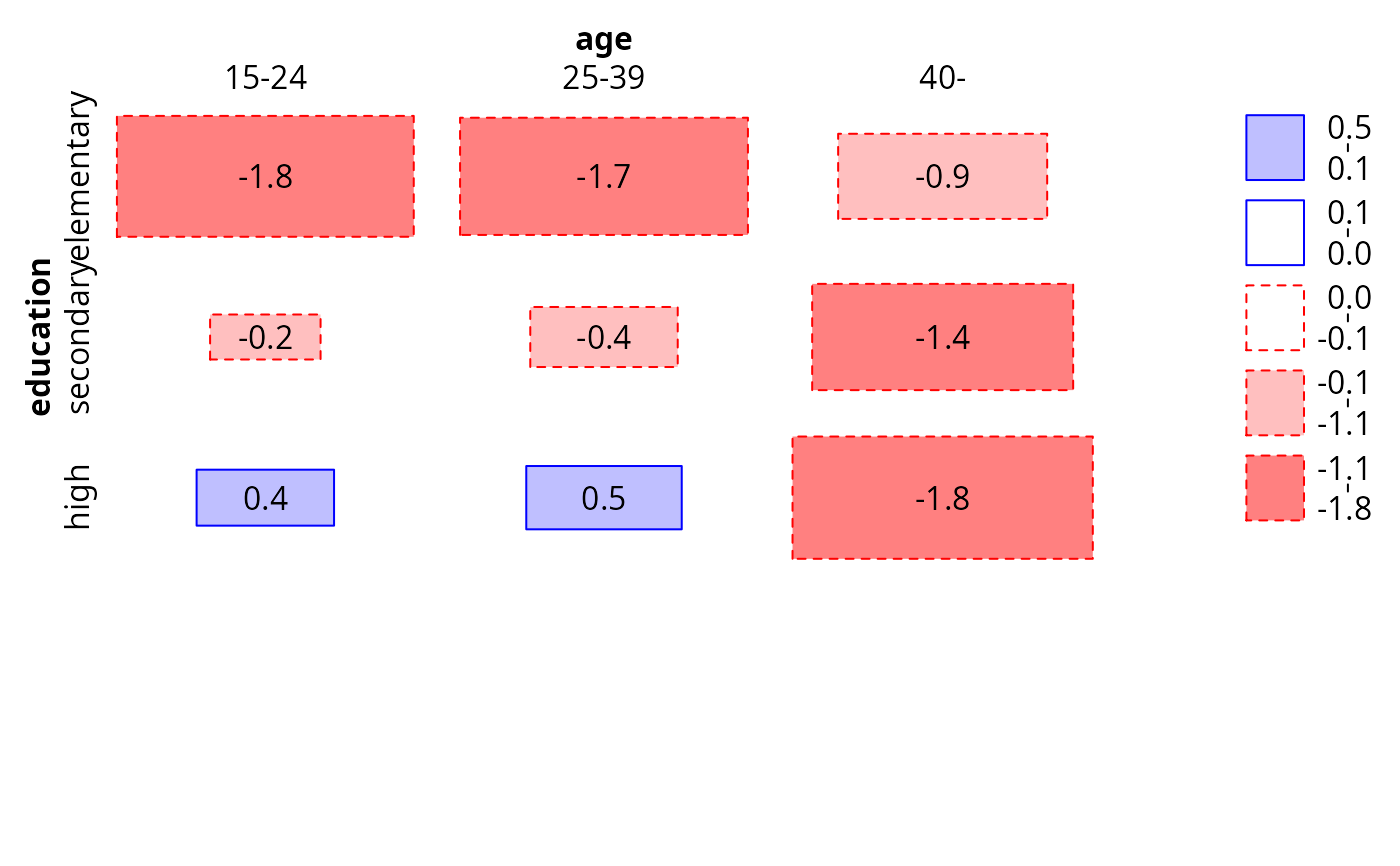
 tile(loddsratio(Freq ~ ., data = Punishment))
 ## cotabplots for more complex tables
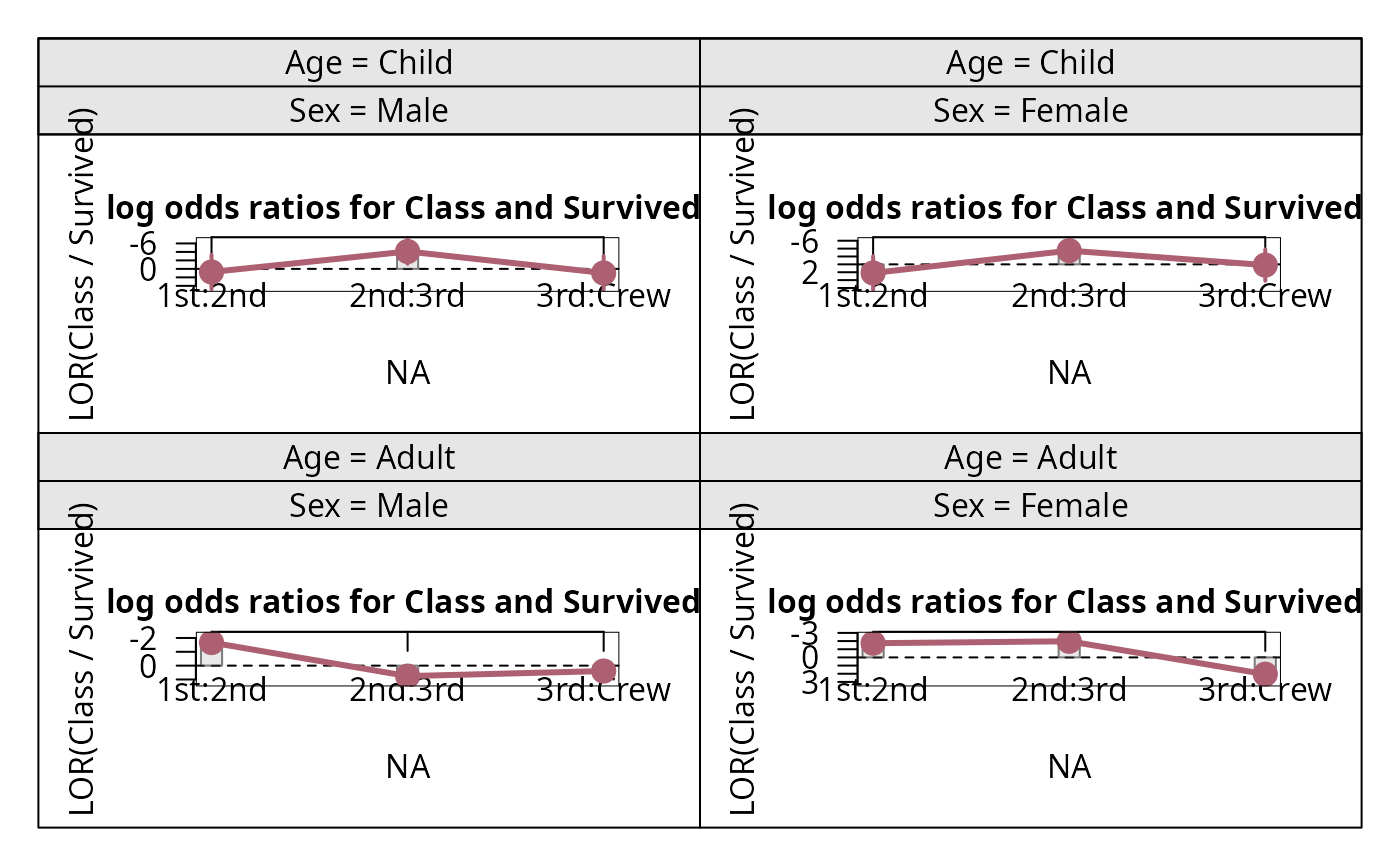
cotabplot(Titanic, cond = c("Age","Sex"), panel = cotab_loddsratio)
## cotabplots for more complex tables
cotabplot(Titanic, cond = c("Age","Sex"), panel = cotab_loddsratio)
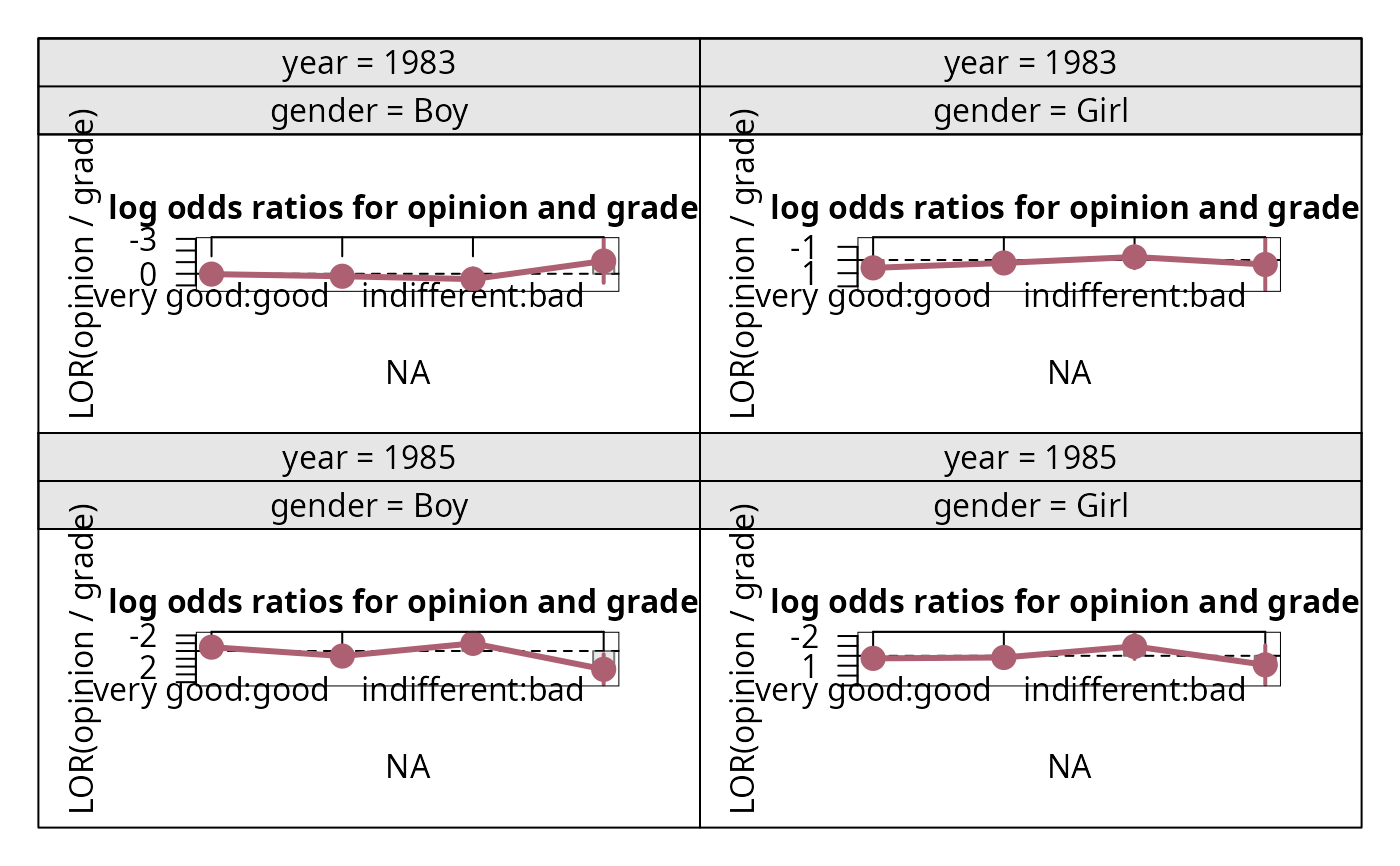
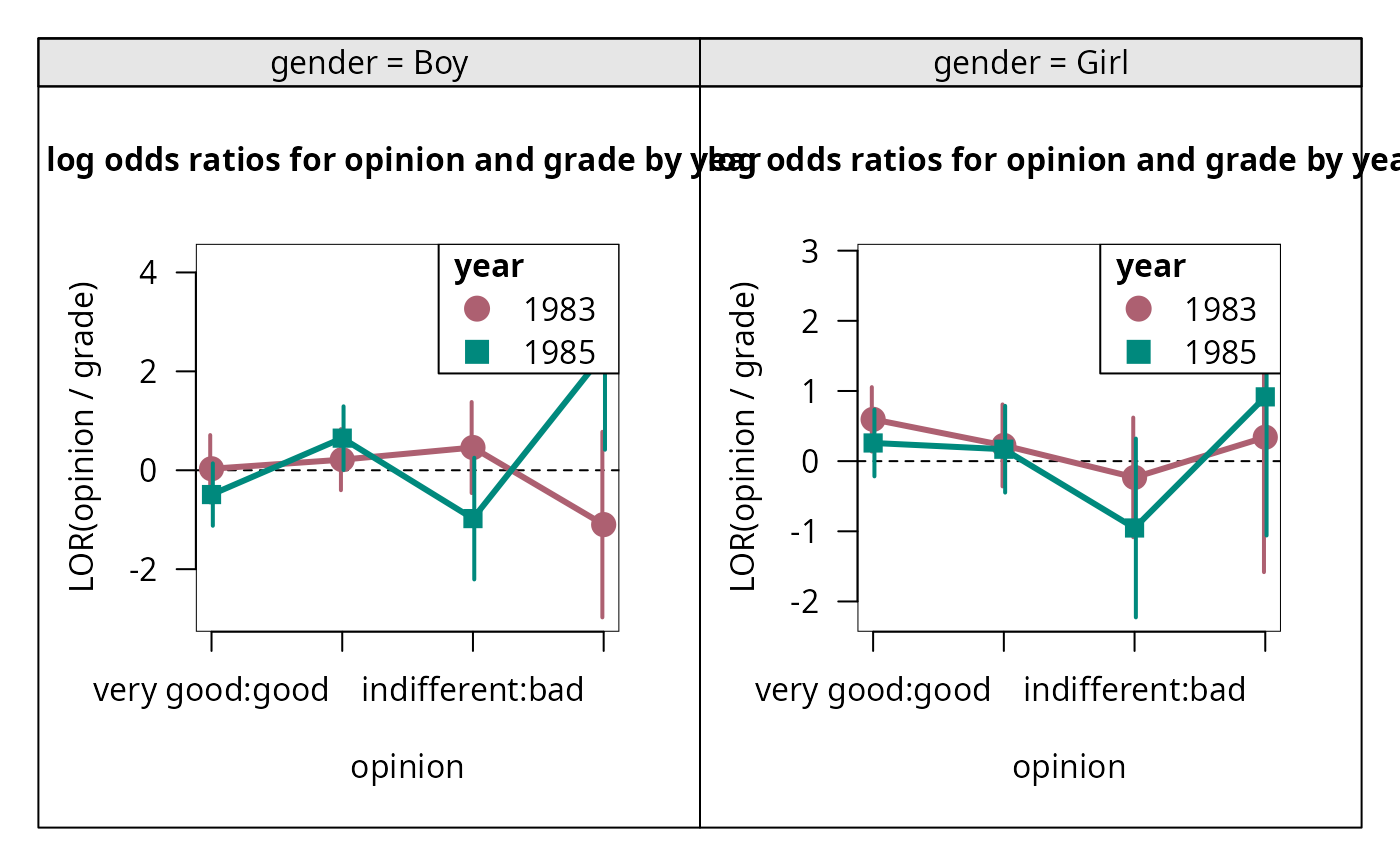
 cotabplot(Freq ~ opinion + grade + year | gender, data = JointSports, panel = cotab_loddsratio)
 cotabplot(Freq ~ opinion + grade | year + gender, data = JointSports, panel = cotab_loddsratio)