Diagnostic Distribution Plots
distplot.RdDiagnostic distribution plots: poissonness, binomialness and negative binomialness plots.
distplot(x, type = c("poisson", "binomial", "nbinomial"),
  size = NULL, lambda = NULL, legend = TRUE, xlim = NULL, ylim = NULL,
  conf_int = TRUE, conf_level = 0.95, main = NULL,
  xlab = "Number of occurrences", ylab = "Distribution metameter",
  gp = gpar(cex = 0.8), lwd=2, gp_conf_int = gpar(lty = 2),
  name = "distplot", newpage = TRUE,
  pop =TRUE, return_grob = FALSE, ...)
Arguments
- x
either a vector of counts, a 1-way table of frequencies of counts or a data frame or matrix with frequencies in the first column and the corresponding counts in the second column.
- type
a character string indicating the distribution.
- size
the size argument for the binomial and negative binomial distribution. If set to
NULLandtypeis"binomial", thensizeis taken to be the maximum count. If set toNULLandtypeis"nbinomial", thensizeis estimated from the data.- lambda
parameter of the poisson distribution. If type is
"poisson"andlambdais specified a leveled poissonness plot is produced.- legend
logical. Should a legend be plotted?
- xlim
limits for the x axis.
- ylim
limits for the y axis.
- conf_int
logical. Should confidence intervals be plotted?
- conf_level
confidence level for confidence intervals.
- main
a title for the plot.
- xlab
a label for the x axis.
- ylab
a label for the y axis.
- gp
a
"gpar"object controlling the grid graphical parameters of the points.- gp_conf_int
a
"gpar"object controlling the grid graphical parameters of the confidence intervals.- lwd
line width for the fitted line
- name
name of the plotting viewport.
- newpage
logical. Should
grid.newpagebe called before plotting?- pop
logical. Should the viewport created be popped?
- return_grob
logical. Should a snapshot of the display be returned as a grid grob?
- ...
further arguments passed to
grid.points.
Details
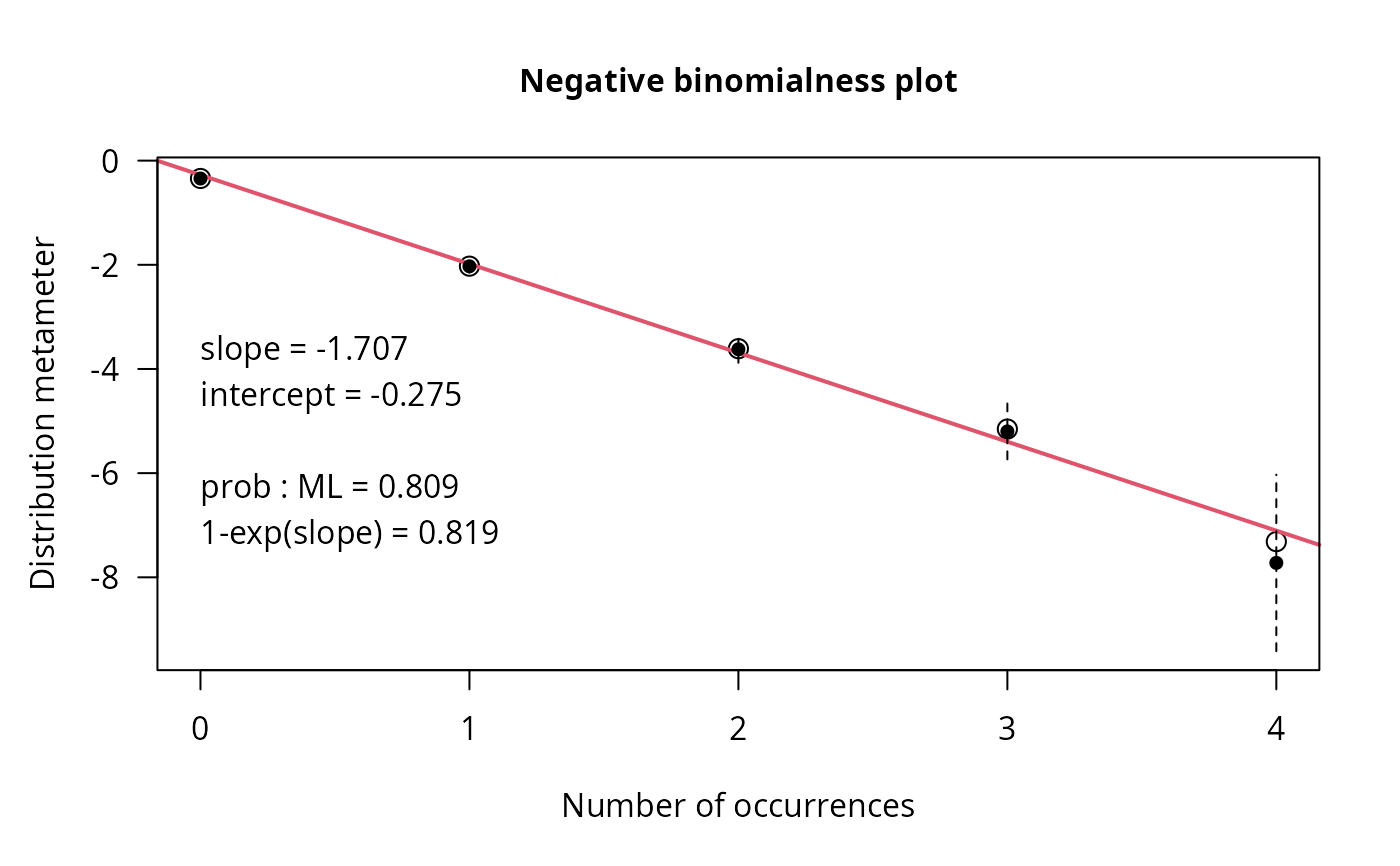
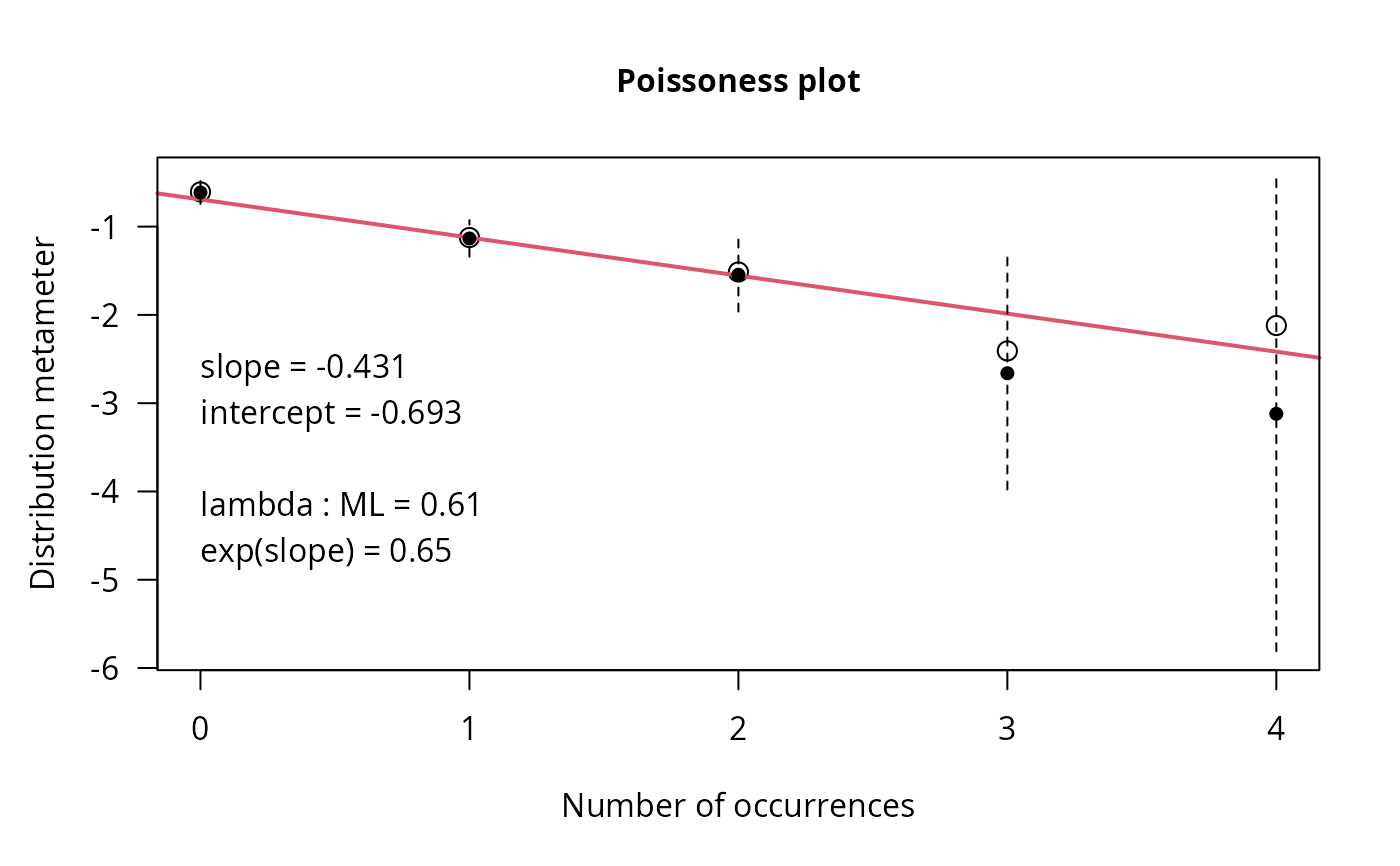
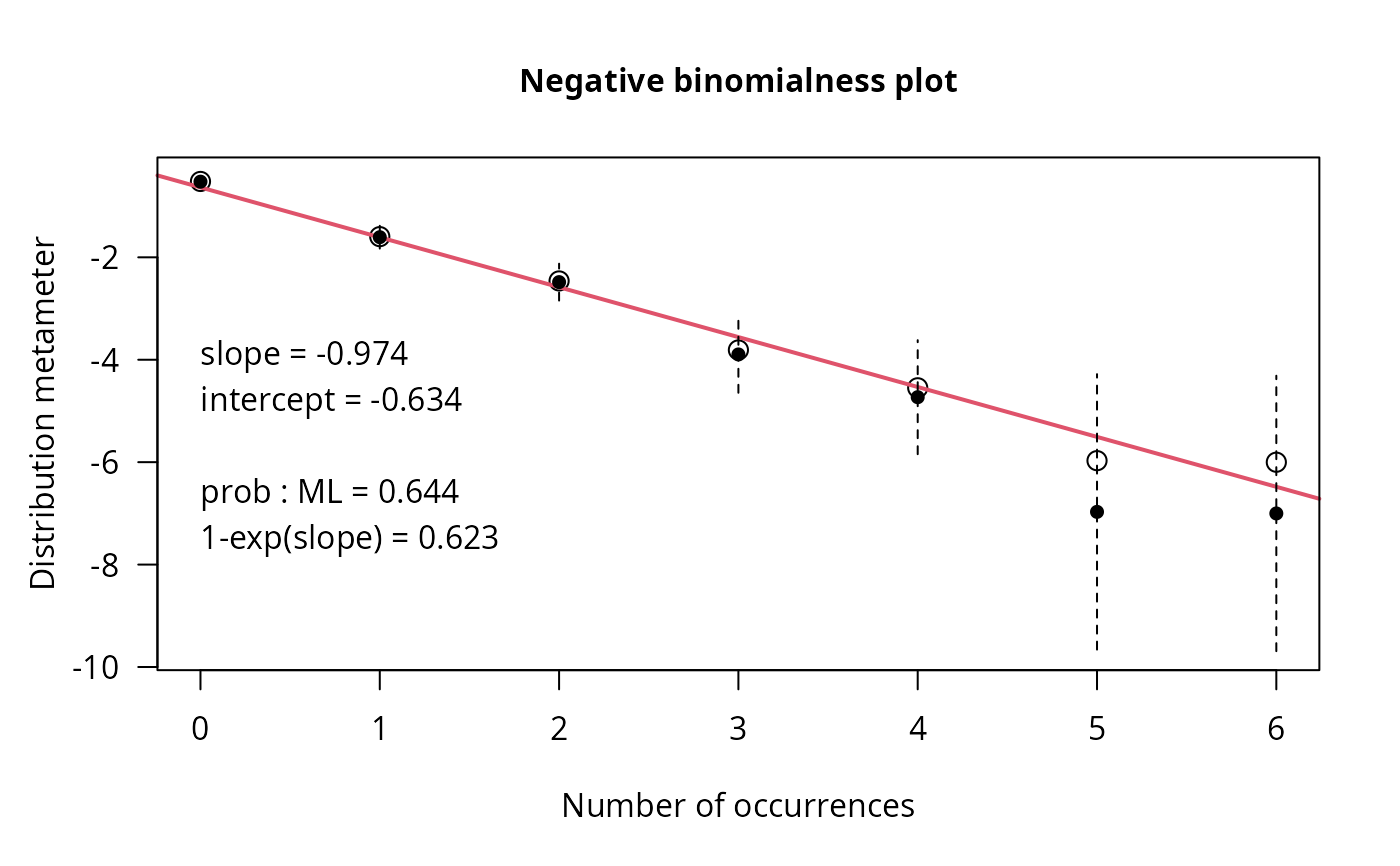
distplot plots the number of occurrences (counts) against the
distribution metameter of the specified distribution. If the
distribution fits the data, the plot should show a straight line.
See Friendly (2000) for details.
In these plots, the open points show the observed count metameters;
the filled points show the confidence interval centers, and the
dashed lines show the conf_level confidence intervals for
each point.
Value
Returns invisibly a data frame containing the counts (Counts),
frequencies (Freq) and other details of the computations used
to construct the plot.
References
D. C. Hoaglin (1980), A poissonness plot, The American Statistican, 34, 146–149.
D. C. Hoaglin & J. W. Tukey (1985), Checking the shape of discrete distributions. In D. C. Hoaglin, F. Mosteller, J. W. Tukey (eds.), Exploring Data Tables, Trends and Shapes, chapter 9. John Wiley & Sons, New York.
M. Friendly (2000), Visualizing Categorical Data. SAS Institute, Cary, NC.
Examples
## Simulated data examples:
dummy <- rnbinom(1000, size = 1.5, prob = 0.8)
distplot(dummy, type = "nbinomial")
 ## Real data examples:
data("HorseKicks")
data("Federalist")
data("Saxony")
distplot(HorseKicks, type = "poisson")
## Real data examples:
data("HorseKicks")
data("Federalist")
data("Saxony")
distplot(HorseKicks, type = "poisson")
 distplot(HorseKicks, type = "poisson", lambda = 0.61)
 distplot(Federalist, type = "poisson")
 distplot(Federalist, type = "nbinomial", size = 1)
 distplot(Federalist, type = "nbinomial")
 distplot(Saxony, type = "binomial", size = 12)