Bangdiwala's Observer Agreement Chart
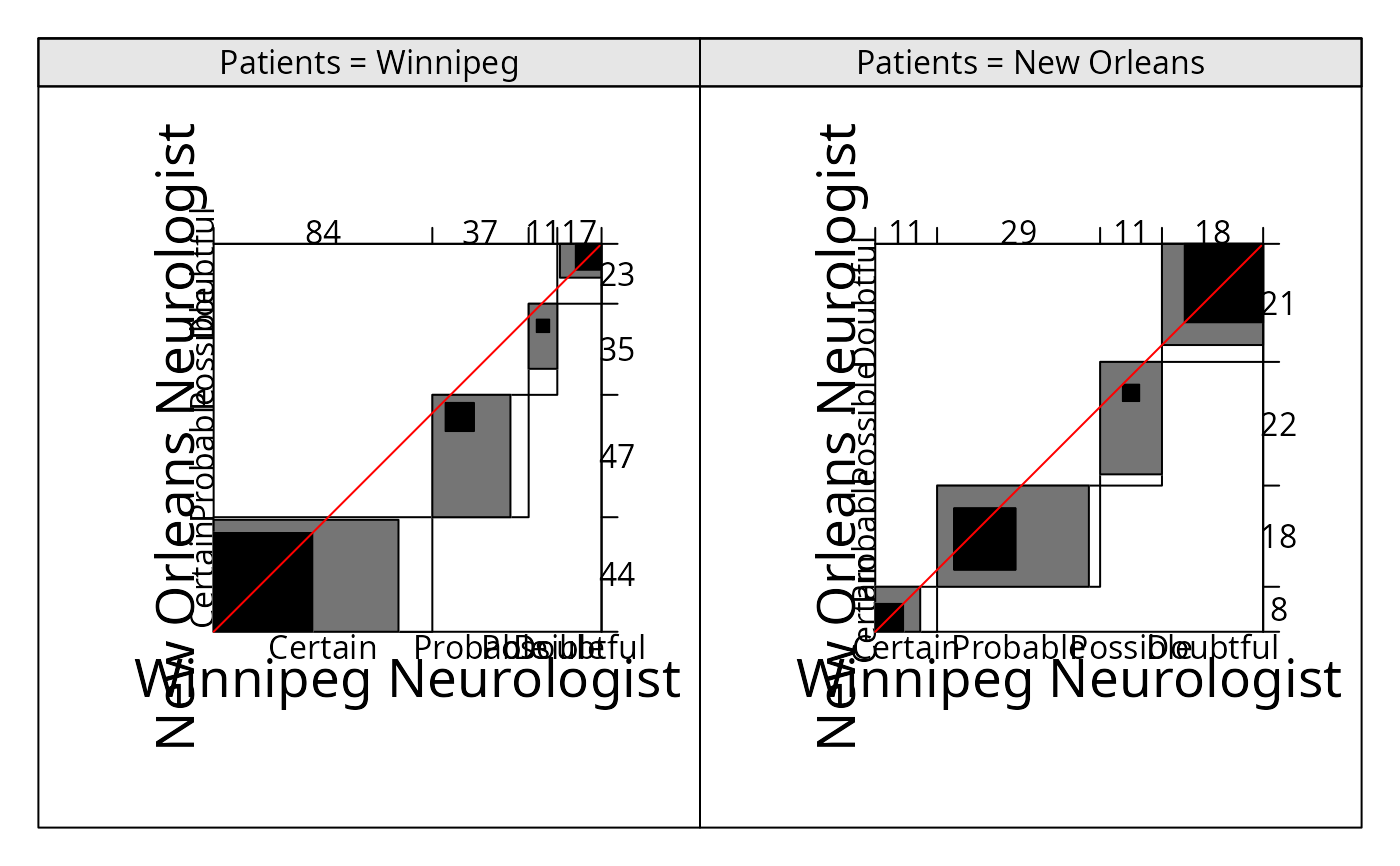
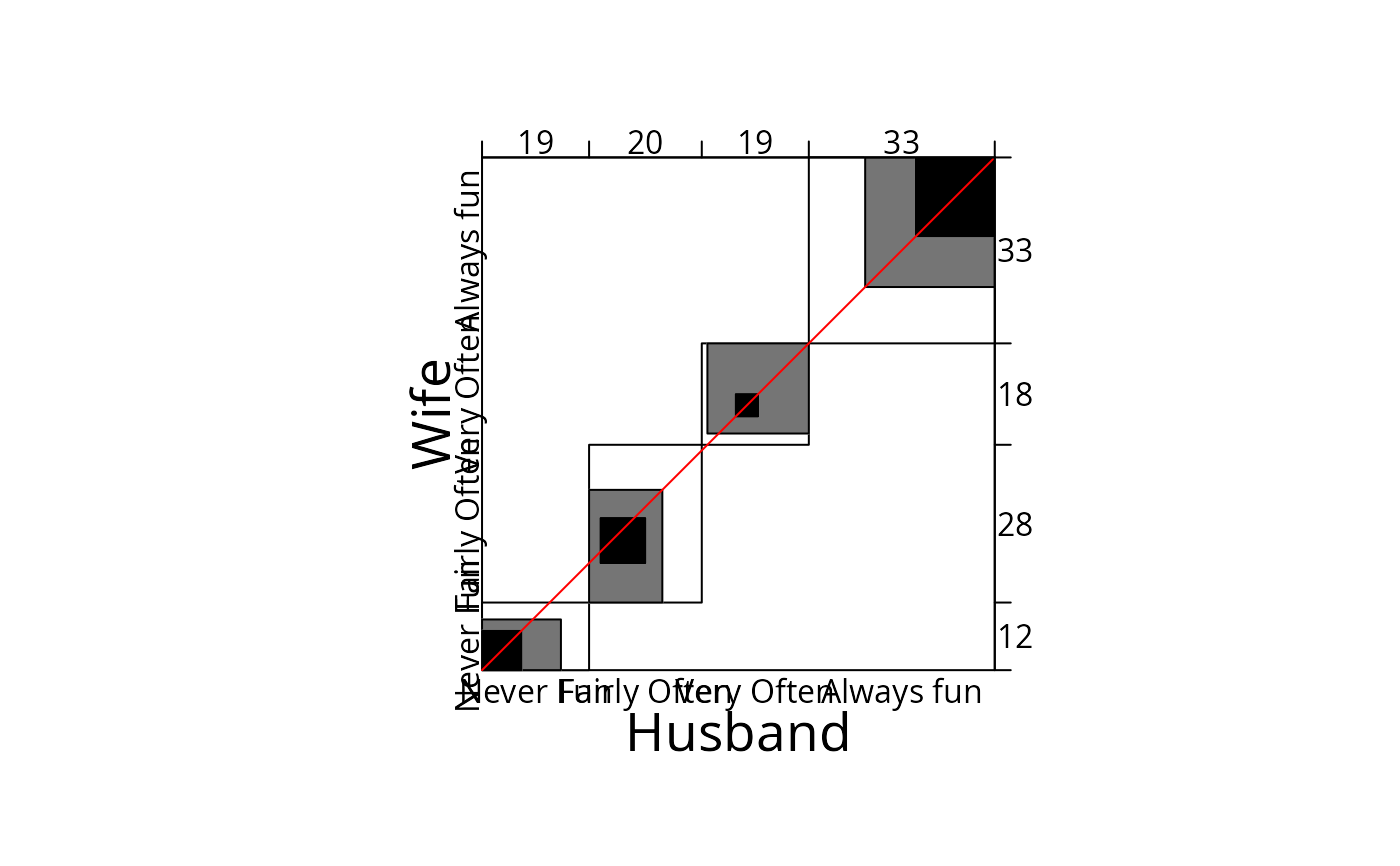
agreementplot.RdRepresentation of a \(k \times k\) confusion matrix, where the observed and expected diagonal elements are represented by superposed black and white rectangles, respectively. The function also computes a statistic measuring the strength of agreement (relation of respective area sums).
# Default S3 method
agreementplot(x, reverse_y = TRUE, main = NULL,
              weights = c(1, 1 - 1/(ncol(x) - 1)^2), margins = par("mar"),
              newpage = TRUE, pop = TRUE,
              xlab = names(dimnames(x))[2],
              ylab = names(dimnames(x))[1],
              xlab_rot = 0, xlab_just = "center",
              ylab_rot = 90, ylab_just = "center",
              fill_col = function(j) gray((1 - (weights[j]) ^ 2) ^ 0.5),
              line_col = "red", xscale = TRUE, yscale = TRUE,
              return_grob = FALSE,
              prefix = "", ...)
# S3 method for class 'formula'
agreementplot(formula, data = NULL, ..., subset)
Arguments
- x
a confusion matrix, i.e., a table with equal-sized dimensions.
- reverse_y
if
TRUE, the y axis is reversed (i.e., the rectangles' positions correspond to the contingency table).- main
user-specified main title.
- weights
vector of weights for successive larger observed areas, used in the agreement strength statistic, and also for the shading. The first element should be 1.
- margins
vector of margins (see
par).- newpage
logical; if
TRUE, the plot is drawn on a new page.- pop
logical; if
TRUE, all newly generated viewports are popped after plotting.- return_grob
logical. Should a snapshot of the display be returned as a grid grob?
- xlab, ylab
labels of x- and y-axis.
- xlab_rot, ylab_rot
rotation angle for the category labels.
- xlab_just, ylab_just
justification for the category labels.
- fill_col
a function, giving the fill colors used for exact and partial agreement
- line_col
color used for the diagonal reference line
- formula
a formula, such as
y ~ x. For details, seextabs.- data
a data frame (or list), or a contingency table from which the variables in
formulashould be taken.- subset
an optional vector specifying a subset of the rows in the data frame to be used for plotting.
- xscale, yscale
logicals indicating whether the marginals should be added on the x-axis/y-axis, respectively.
- prefix
character string used as prefix for the viewport name
- ...
further graphics parameters (see
par).
Details
Weights can be specified to allow for partial agreement, taking into
account contributions from off-diagonal cells. Partial agreement
is typically represented in the display by lighter shading, as given by
fill_col(j), corresponding to weights[j].
A weight vector of length 1 means strict agreement only, each additional element increases the maximum number of disagreement steps.
cotabplot can be used for stratified analyses (see examples).
Value
Invisibly returned, a list with components
- Bangdiwala
the unweighted agreement strength statistic.
- Bangdiwala_Weighted
the weighted statistic.
- weights
the weight vector used.
References
Bangdiwala, S. I. (1988). The Agreement Chart. Department of Biostatistics, University of North Carolina at Chapel Hill, Institute of Statistics Mimeo Series No. 1859, https://repository.lib.ncsu.edu/bitstreams/fea554e9-8750-4f1a-8419-ee126ce1a790/download
Bangdiwala, S. I., Ana S. Haedo, Marcela L. Natal, and Andres Villaveces. The agreement chart as an alternative to the receiver-operating characteristic curve for diagnostic tests. Journal of Clinical Epidemiology, 61 (9), 866-874.
Michael Friendly (2000), Visualizing Categorical Data. SAS Institute, Cary, NC.
Examples
data("SexualFun")
agreementplot(t(SexualFun))
 data("MSPatients")
if (FALSE) { # \dontrun{
## best visualized using a resized device, e.g. using:
## get(getOption("device"))(width = 12)
pushViewport(viewport(layout = grid.layout(ncol = 2)))
pushViewport(viewport(layout.pos.col = 1))
agreementplot(t(MSPatients[,,1]), main = "Winnipeg Patients",
newpage = FALSE)
popViewport()
pushViewport(viewport(layout.pos.col = 2))
agreementplot(t(MSPatients[,,2]), main = "New Orleans Patients",
newpage = FALSE)
popViewport(2)
dev.off()
} # }
## alternatively, use cotabplot:
cotabplot(MSPatients, panel = cotab_agreementplot)
data("MSPatients")
if (FALSE) { # \dontrun{
## best visualized using a resized device, e.g. using:
## get(getOption("device"))(width = 12)
pushViewport(viewport(layout = grid.layout(ncol = 2)))
pushViewport(viewport(layout.pos.col = 1))
agreementplot(t(MSPatients[,,1]), main = "Winnipeg Patients",
newpage = FALSE)
popViewport()
pushViewport(viewport(layout.pos.col = 2))
agreementplot(t(MSPatients[,,2]), main = "New Orleans Patients",
newpage = FALSE)
popViewport(2)
dev.off()
} # }
## alternatively, use cotabplot:
cotabplot(MSPatients, panel = cotab_agreementplot)