Download Historical Finance Data
get.hist.quote.RdDownload historical financial data from a given data provider over the WWW.
Arguments
- instrument
a character string giving the name of the quote symbol to download. See the web page of the data provider for information about the available quote symbols.
- start
an R object specifying the date of the start of the period to download. This must be in a form which is recognized by
as.POSIXct, which includes R POSIX date/time objects, objects of class"date"(from packagedate) and"chron"and"dates"(from packagechron), and character strings representing dates in ISO 8601 format. Defaults to 1992-01-02.- end
an R object specifying the end of the download period, see above. Defaults to yesterday.
- quote
a character string or vector indicating whether to download opening, high, low, or closing quotes, or volume. For the default provider, this can be specified as
"Open","High","Low","Close","Adjusted", and"Volume", respectively. Abbreviations are allowed.- provider
a character string with the name of the data provider. Currently, only
"yahoo"is supported viagetSymbolsfrom package quantmod for the Yahoo Finance source. Provider"oanda"is no longer available.- method
No longer used.
- origin
an R object specifying the origin of the Julian dates, see above. Defaults to 1899-12-30 (Popular spreadsheet programs internally also use Julian dates with this origin).
- compression
Governs the granularity of the retrieved data;
"d"for daily,"w"for weekly or"m"for monthly. Defaults to"d". For the provider"oanda", this argument is ignored.- retclass
character specifying which class the return value should have: can be either
"zoo"(with"Date"index), or"ts"(with numeric index corresponding to days sinceorigin).- quiet
logical. Should status messages (if any) be suppressed?
- drop
logical. If
TRUEthe result is coerced to the lowest possible dimension. Default isFALSE.
Value
A time series containing the data either as a "zoo" series
(default) or a "ts" series. The "zoo" series is created
with zoo and has an index of class "Date".
If a "ts" series is returned, the index is in physical time,
i.e., weekends, holidays, and missing days are filled with NAs
if not available. The time scale is given in Julian dates (days since
the origin).
See also
getSymbols for downloads from various
providers;
zoo,
ts,
as.Date,
as.POSIXct,
Examples
tryCatch({
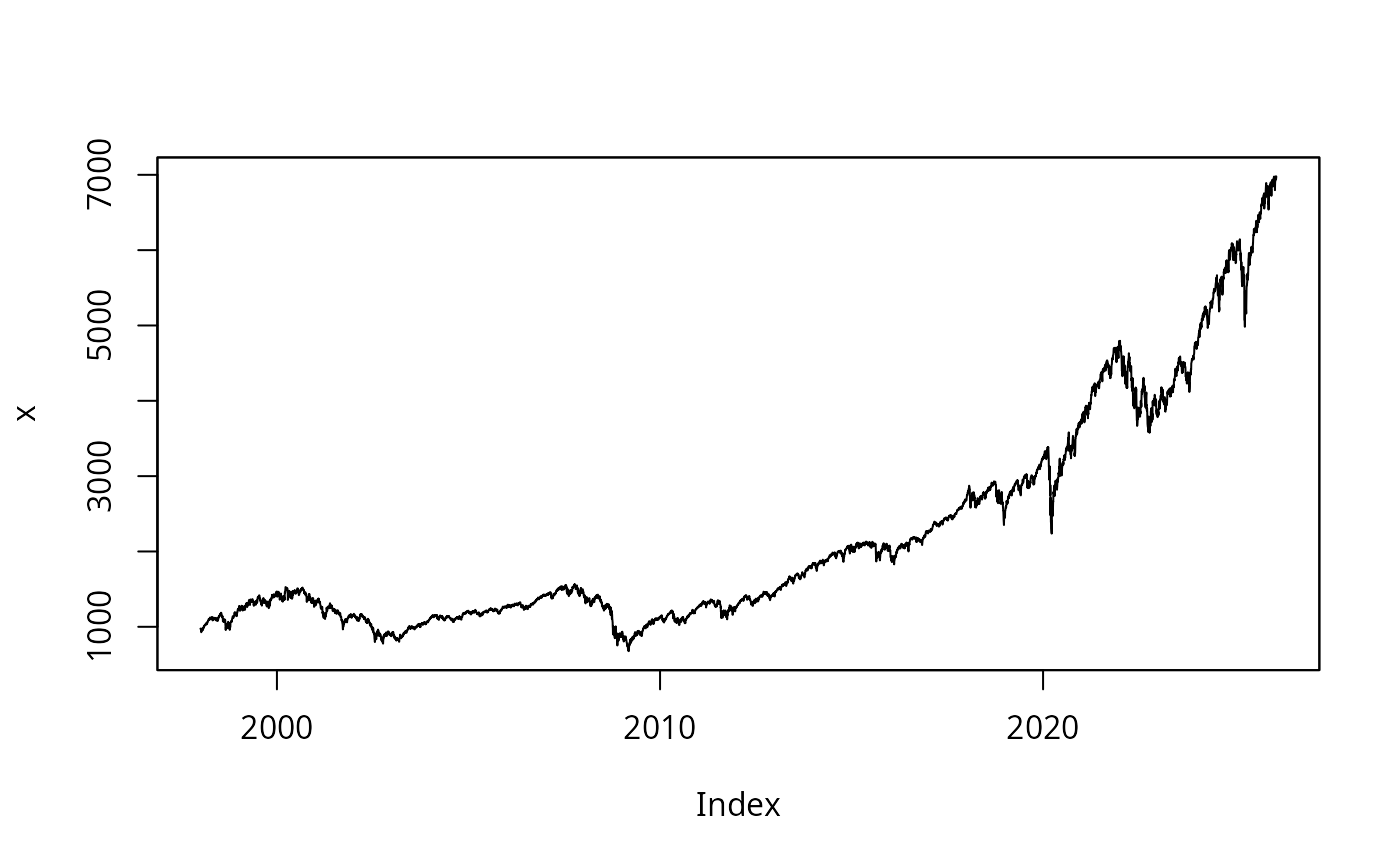
x <- get.hist.quote(instrument = "^gspc", start = "1998-01-01",
quote = "Close")
plot(x)
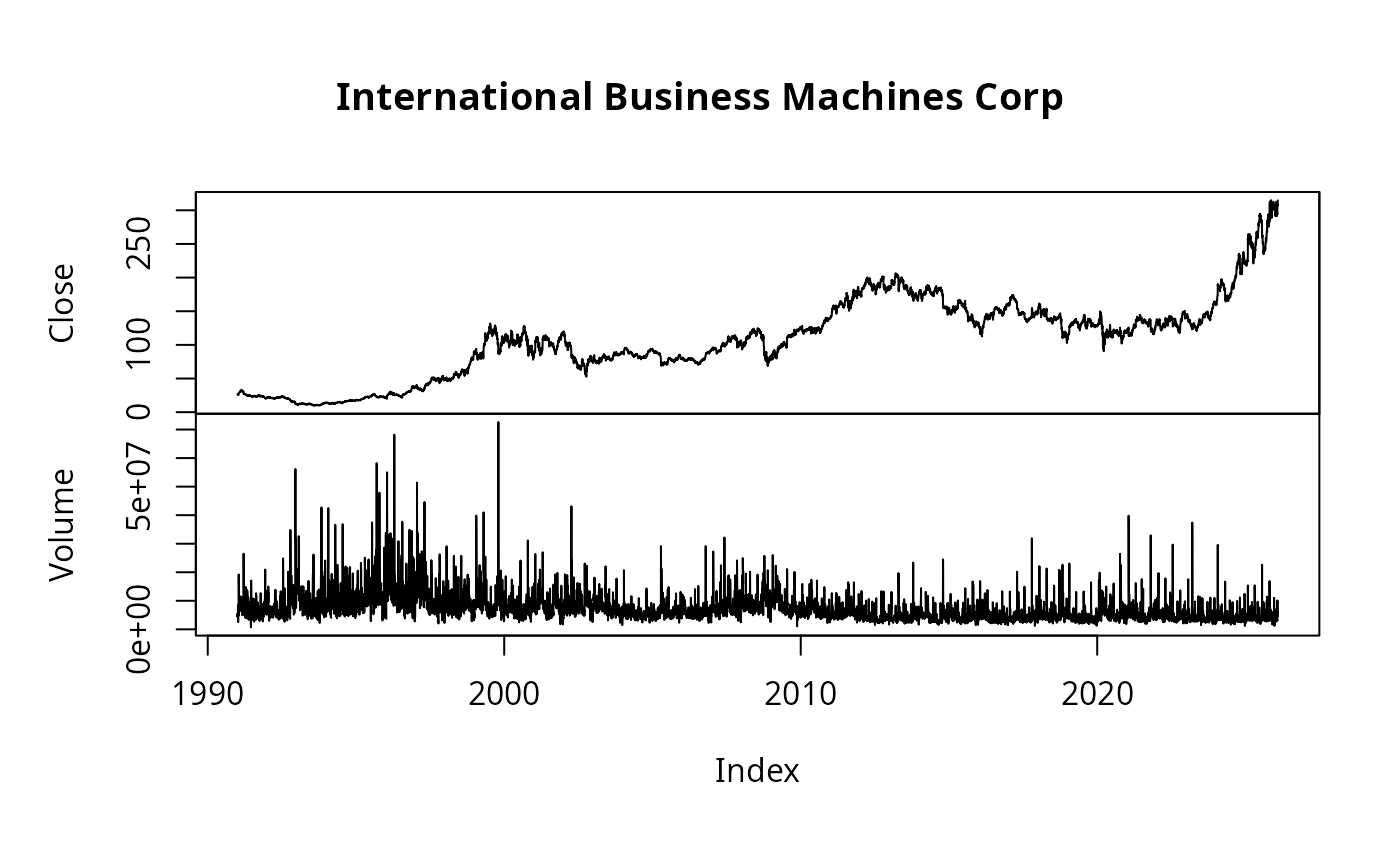
x <- get.hist.quote(instrument = "ibm", quote = c("Cl", "Vol"))
plot(x, main = "International Business Machines Corp")
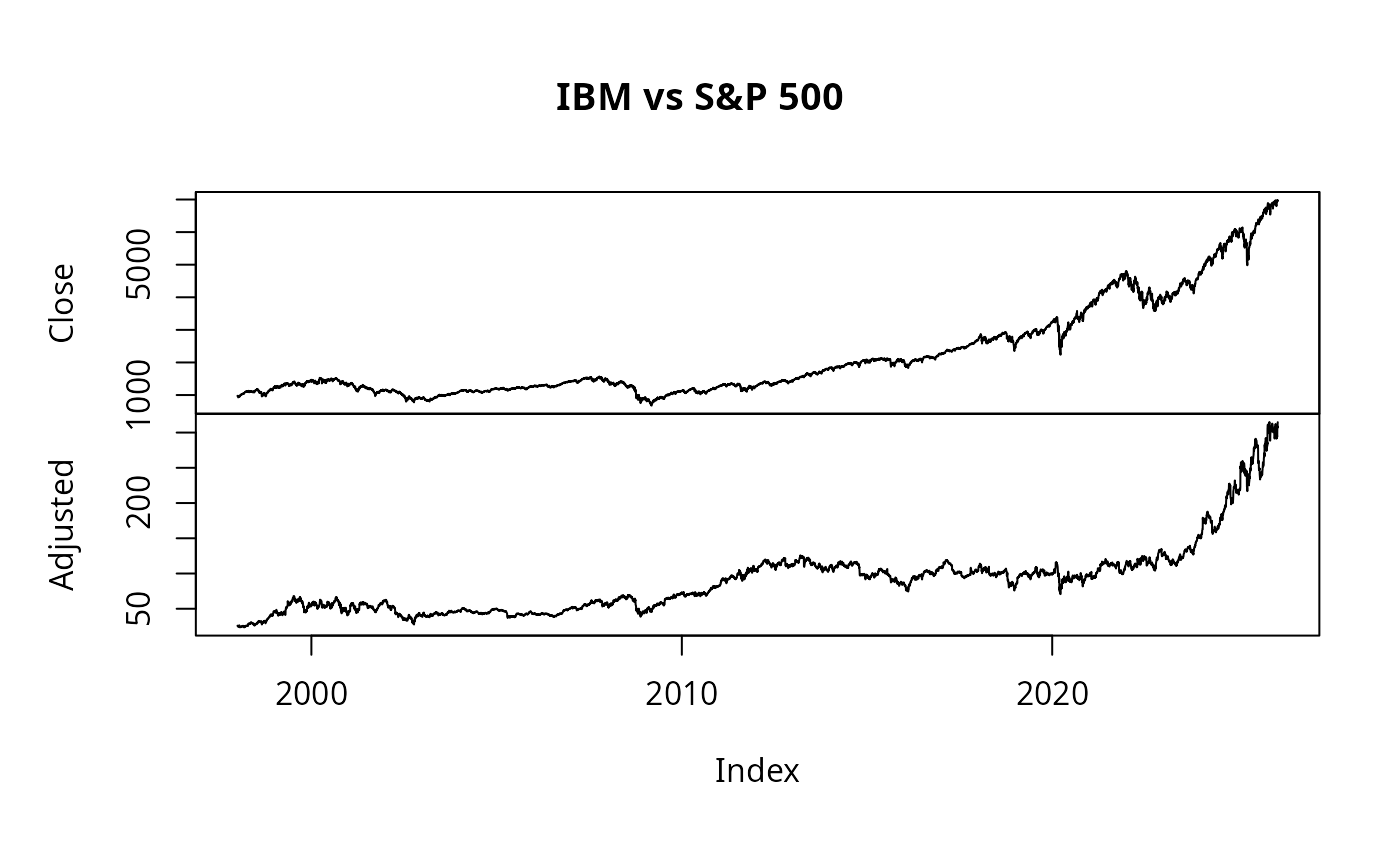
spc <- get.hist.quote(instrument = "^gspc", start = "1998-01-01",
quote = "Close")
ibm <- get.hist.quote(instrument = "ibm", start = "1998-01-01",
quote = "Adj")
require("zoo") # For merge() method.
x <- merge(spc, ibm)
plot(x, main = "IBM vs S&P 500")
}, error = identity)
#> time series starts 1998-01-02
#> time series ends 2026-02-02
 #> time series ends 2026-02-02
 #> time series starts 1998-01-02
#> time series ends 2026-02-02
#> time series starts 1998-01-02
#> time series ends 2026-02-02
#> Loading required package: zoo
#>
#> Attaching package: ‘zoo’
#> The following objects are masked from ‘package:base’:
#>
#> as.Date, as.Date.numeric
#> time series starts 1998-01-02
#> time series ends 2026-02-02
#> time series starts 1998-01-02
#> time series ends 2026-02-02
#> Loading required package: zoo
#>
#> Attaching package: ‘zoo’
#> The following objects are masked from ‘package:base’:
#>
#> as.Date, as.Date.numeric