Reweight (optimise) the weights on frames
reweight.RdEvaluates a set of expressions for different frame weights in a dual-frame/multi-frame design, so that an optimal or compromise-optimal set of frame weights can be chosen
Arguments
- design
dual-frame or multiframe design object
- targets, totals
A list of quoted expressions estimating the variance of a survey estimator (
targets), or a list of formulas that will be turned into targets for the variances of totals.- estimator
As in
multiframe:"constant"is a constant weight for all observations in an overlap between frames,"expected"weights by the reciprocal of the expected numbers of times a unit is sampled and is not optimisable.- theta
As in
multiframe, a fixed weight for observations in frame 1 also sampled in frame 2- theta_grid
Grid for optimising theta over, with
estimator="constant"- x
object produced by
reweight- y
ignored
- type,...
in the
plotmethod these are passed tomatplot
Details
Traditionally, this optimisation has been done with totals, which is a good default and more mathematically tractable. However, when the point of multiple-frame sampling is to improve precision for a rare sub-population, or when you're doing regression modelling, you might want to optimise for something else.
Value
An object of class "dualframe_with_rewt".
The coef method returns the optimal theta for each target.
The rewt element includes the variances of each target on a grid of
theta in variances
Examples
data(phoneframes)
A_in_frames<-cbind(1, DatA$Domain=="ab")
B_in_frames<-cbind(DatB$Domain=="ba",1)
Bdes_pps<-svydesign(id=~1, fpc=~ProbB, data=DatB,pps=ppsmat(PiklB))
Ades_pps <-svydesign(id=~1, fpc=~ProbA,data=DatA,pps=ppsmat(PiklA))
## Not very good weighting
mf_pps<-multiframe(list(Ades_pps,Bdes_pps),list(A_in_frames,B_in_frames),theta=0.5)
svytotal(~Lei+Feed+Tax+Clo,mf_pps, na.rm=TRUE)
#> total SE
#> Lei 52082 1458.9
#> Feed 575470 18075.2
#> Tax 205157 7231.1
#> Clo 70450 2395.1
## try to optimise
mf_opt<-reweight(mf_pps, totals=list(~Lei, ~Feed,~Tax,~Clo))
coef(mf_opt)
#> [1] 0.75 0.80 0.90 0.75
plot(mf_opt)
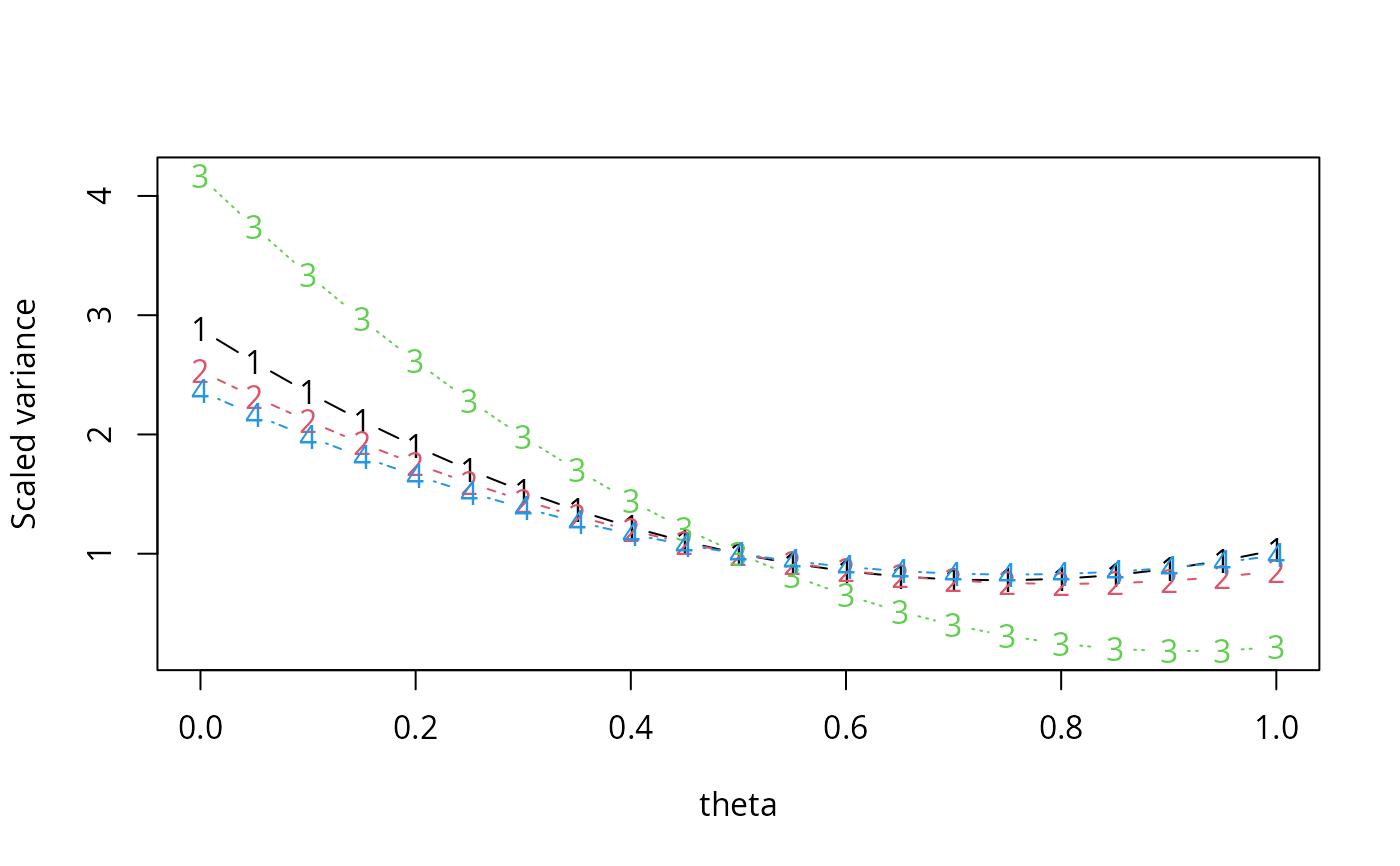 ## a good compromise is 0.80 for everything except Tax
## and it's still pretty good there
## (Tax will be biased because it's missing for landline-only)
mf_pps_opt<-reweight(mf_opt,theta=0.80)
svytotal(~Lei+Feed+Tax+Clo,mf_pps_opt, na.rm=TRUE)
#> total SE
#> Lei 53544 1296.2
#> Feed 586855 15613.8
#> Tax 212601 3574.0
#> Clo 72234 2181.7
## Targets other than totals
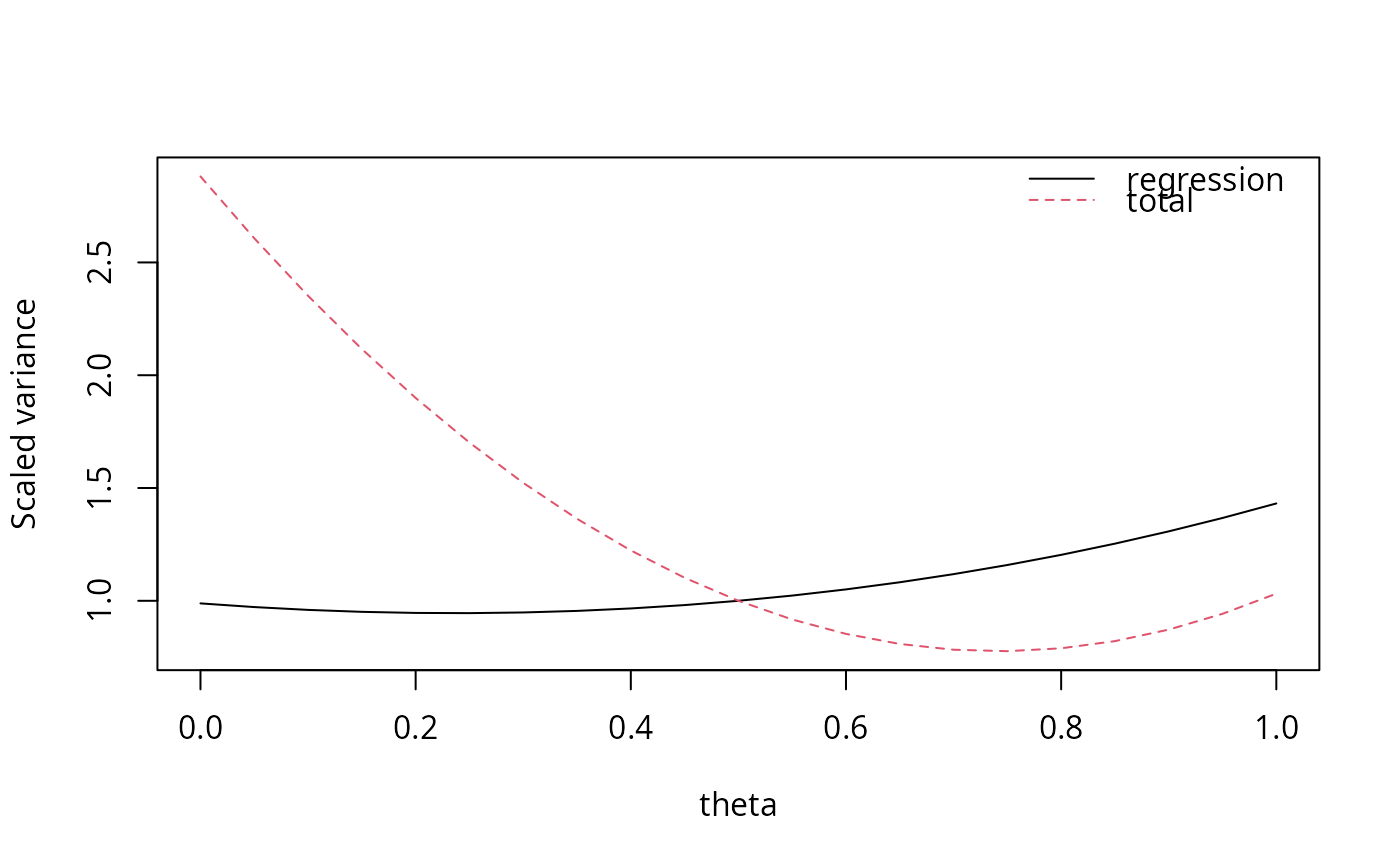
mf_reg<-reweight(mf_pps,
targets=list(quote(vcov(svyglm(Lei~Feed+Clo, design=.DESIGN))[1,1]),
quote(vcov(svytotal(~Lei,.DESIGN))))
)
plot(mf_reg,type="l")
legend("topright",bty="n",lty=1:2,col=1:2, legend=c("regression","total"))
## a good compromise is 0.80 for everything except Tax
## and it's still pretty good there
## (Tax will be biased because it's missing for landline-only)
mf_pps_opt<-reweight(mf_opt,theta=0.80)
svytotal(~Lei+Feed+Tax+Clo,mf_pps_opt, na.rm=TRUE)
#> total SE
#> Lei 53544 1296.2
#> Feed 586855 15613.8
#> Tax 212601 3574.0
#> Clo 72234 2181.7
## Targets other than totals
mf_reg<-reweight(mf_pps,
targets=list(quote(vcov(svyglm(Lei~Feed+Clo, design=.DESIGN))[1,1]),
quote(vcov(svytotal(~Lei,.DESIGN))))
)
plot(mf_reg,type="l")
legend("topright",bty="n",lty=1:2,col=1:2, legend=c("regression","total"))
 ## Zooming in on optimality for a particular variable (for compatibility)
mf_opt1<-reweight(mf_pps, totals=list(~Feed),theta_grid=seq(0.7,0.9,length=100))
coef(mf_opt1) # Frames2::Hartley gives 0.802776
#> [1] 0.8030303
## Zooming in on optimality for a particular variable (for compatibility)
mf_opt1<-reweight(mf_pps, totals=list(~Feed),theta_grid=seq(0.7,0.9,length=100))
coef(mf_opt1) # Frames2::Hartley gives 0.802776
#> [1] 0.8030303