Fit multiple smooth additive quantile regression models
mqgam.RdThis function fits a smooth additive regression model to several quantiles.
Arguments
- form
A GAM formula, or a list of formulae. See ?mgcv::gam details.
- data
A data frame or list containing the model response variable and covariates required by the formula. By default the variables are taken from environment(formula): typically the environment from which gam is called.
- qu
A vectors of quantiles of interest. Each entry should be in (0, 1).
- discrete
If TRUE then covariate discretisation is used for faster model fitting. See
mgcv::bam for details.- lsig
The value of the log learning rate used to create the Gibbs posterior. By defauls
lsig=NULLand this parameter is estimated by posterior calibration described in Fasiolo et al. (2017). Obviously, the function is much faster if the user provides a value.- err
An upper bound on the error of the estimated quantile curve. Should be in (0, 1). If it is a vector, it should be of the same length of
qu. Since qgam v1.3 it is selected automatically, using the methods of Fasiolo et al. (2017). The old default waserr=0.05.- multicore
If TRUE the calibration will happen in parallel.
- cluster
An object of class
c("SOCKcluster", "cluster"). This allowes the user to pass her own cluster, which will be used ifmulticore == TRUE. The user has to remember to stop the cluster.- ncores
Number of cores used. Relevant if
multicore == TRUE.- paropts
a list of additional options passed into the foreach function when parallel computation is enabled. This is important if (for example) your code relies on external data or packages: use the .export and .packages arguments to supply them so that all cluster nodes have the correct environment set up for computing.
- control
A list of control parameters. The only one relevant here is
link, which is the link function used (see?elfand?elflssfor defaults). All other control parameters are used bytuneLearnFast. See?tuneLearnFastfor details.- argGam
A list of parameters to be passed to
mgcv::gam. This list can potentially include all the arguments listed in?gam, with the exception offormula,familyanddata.
Value
A list with entries:
fit= agamObject, one for each entry ofqu. Notice that the slotsmodelandsmoothof each object has been removed to save memory. See?gamObject.model= themodelslot of thegamObjects in thefitslot. This is the same for every fit, hence only one copy is stored.smooth= thesmoothslot of thegamObjects in thefitslot. This is the same for every fit, hence only one copy is stored.calibr= a list which is the output of an internal call totuneLearnFast, which is used for calibrating the learning rate. See?tuneLearnFastfor details.
References
Fasiolo, M., Wood, S.N., Zaffran, M., Nedellec, R. and Goude, Y., 2020. Fast calibrated additive quantile regression. Journal of the American Statistical Association (to appear). doi:10.1080/01621459.2020.1725521 .
Fasiolo, M., Wood, S.N., Zaffran, M., Nedellec, R. and Goude, Y., 2021. qgam: Bayesian Nonparametric Quantile Regression Modeling in R. Journal of Statistical Software, 100(9), 1-31, doi:10.18637/jss.v100.i09 .
Examples
#####
# Multivariate Gaussian example
####
library(qgam)
set.seed(2)
dat <- gamSim(1, n=300, dist="normal", scale=2)
#> Gu & Wahba 4 term additive model
fit <- mqgam(y~s(x0)+s(x1)+s(x2)+s(x3), data=dat, qu = c(0.2, 0.8))
#> Estimating learning rate. Each dot corresponds to a loss evaluation.
#> qu = 0.2...........done
#> qu = 0.8...............done
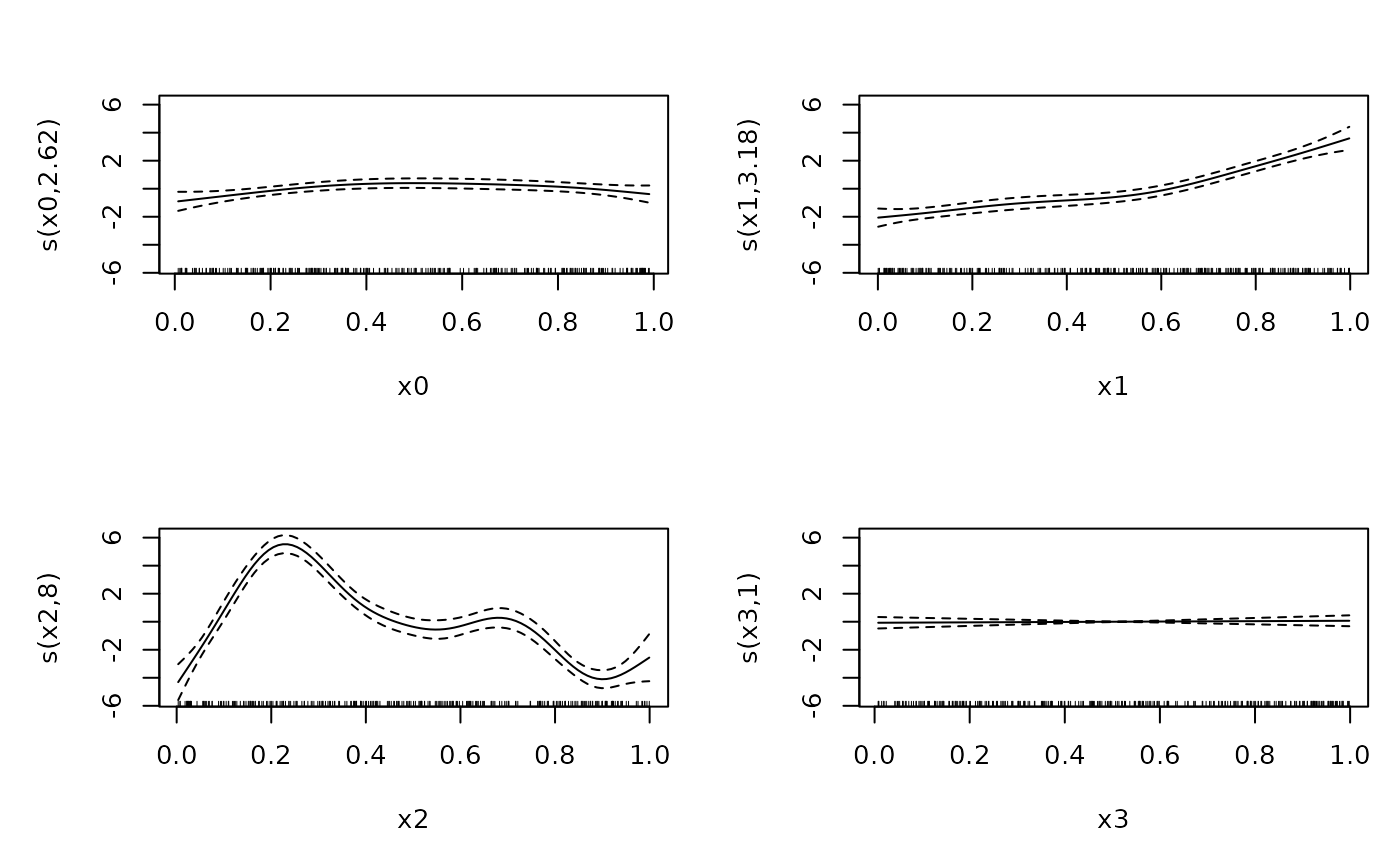
invisible( qdo(fit, 0.2, plot, pages = 1) )
 #####
# Univariate "car" example
####
library(qgam); library(MASS)
# Fit for quantile 0.8 using the best sigma
quSeq <- c(0.2, 0.4, 0.6, 0.8)
set.seed(6436)
fit <- mqgam(accel~s(times, k=20, bs="ad"), data = mcycle, qu = quSeq)
#> Estimating learning rate. Each dot corresponds to a loss evaluation.
#> qu = 0.4............done
#> qu = 0.6..........done
#> qu = 0.2..............done
#> qu = 0.8.........done
# Plot the fit
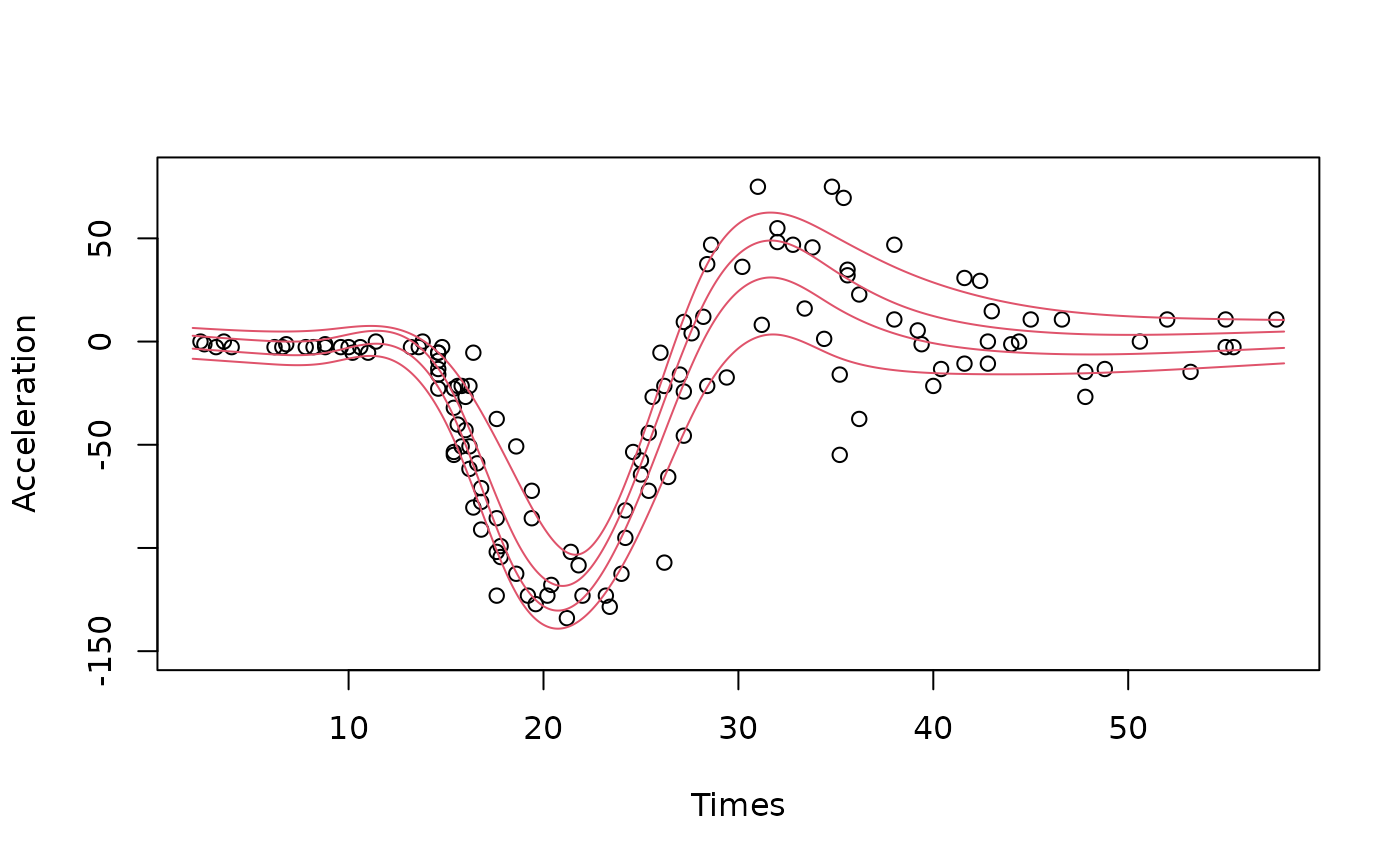
xSeq <- data.frame(cbind("accel" = rep(0, 1e3), "times" = seq(2, 58, length.out = 1e3)))
plot(mcycle$times, mcycle$accel, xlab = "Times", ylab = "Acceleration", ylim = c(-150, 80))
for(iq in quSeq){
pred <- qdo(fit, iq, predict, newdata = xSeq)
lines(xSeq$times, pred, col = 2)
}
#####
# Univariate "car" example
####
library(qgam); library(MASS)
# Fit for quantile 0.8 using the best sigma
quSeq <- c(0.2, 0.4, 0.6, 0.8)
set.seed(6436)
fit <- mqgam(accel~s(times, k=20, bs="ad"), data = mcycle, qu = quSeq)
#> Estimating learning rate. Each dot corresponds to a loss evaluation.
#> qu = 0.4............done
#> qu = 0.6..........done
#> qu = 0.2..............done
#> qu = 0.8.........done
# Plot the fit
xSeq <- data.frame(cbind("accel" = rep(0, 1e3), "times" = seq(2, 58, length.out = 1e3)))
plot(mcycle$times, mcycle$accel, xlab = "Times", ylab = "Acceleration", ylim = c(-150, 80))
for(iq in quSeq){
pred <- qdo(fit, iq, predict, newdata = xSeq)
lines(xSeq$times, pred, col = 2)
}