Convert a table with counts to a matrix or data.frame representing those counts.
table2matrix.RdSome historical sets are reported as summary tables of counts in a limited number of bins. Transforming these tables to data.frames representing the original values is useful for pedagogical purposes. (E.g., transforming the original Galton table of height x cubits in order to demonstrate regression.) The column and row names must be able to be converted to numeric values.
table2matrix(x, labs = NULL)
table2df(x, count=NULL,labs = NULL)
Arguments
Details
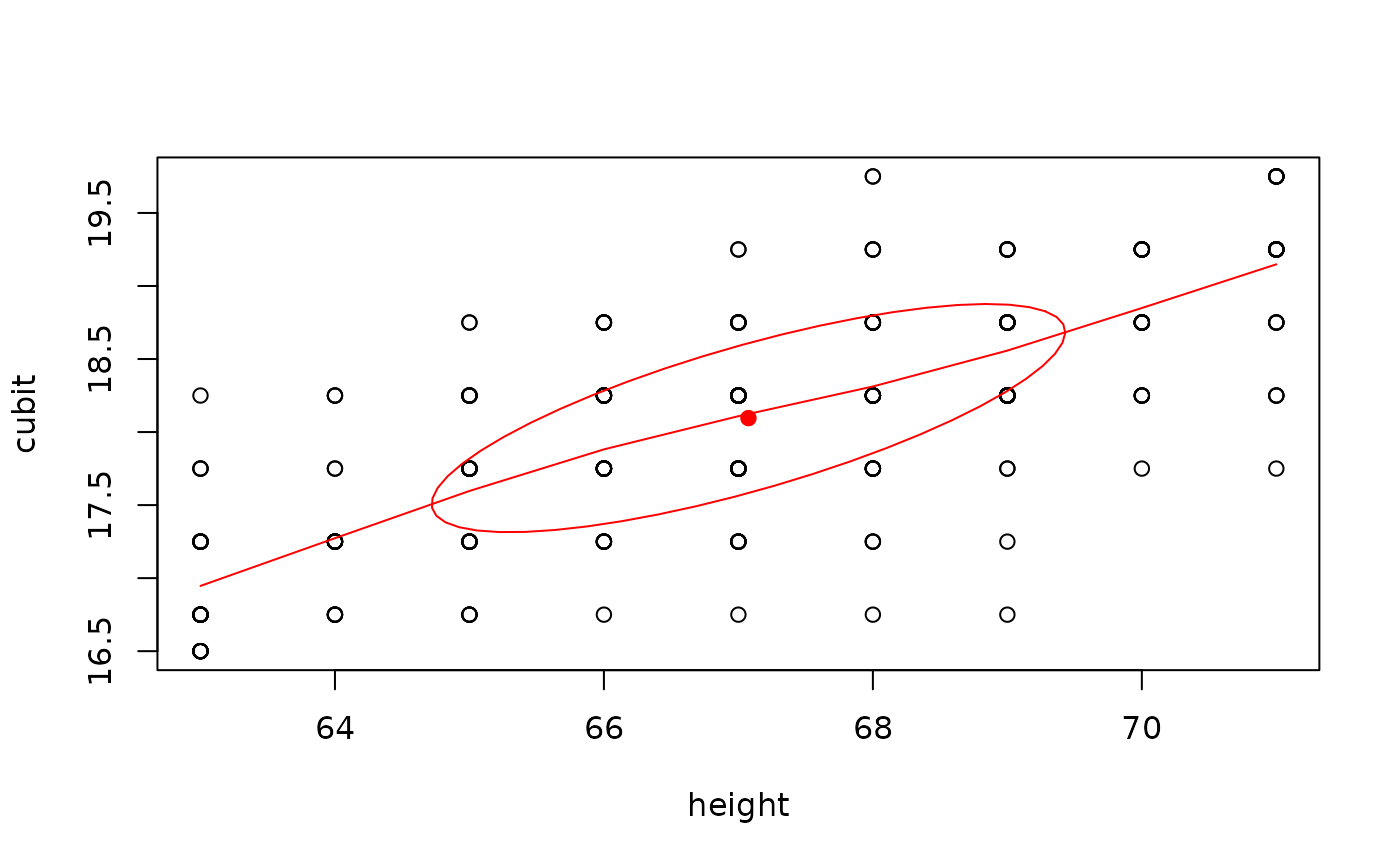
The original Galton (1888) of heights by cubits (arm length) is in tabular form. To show this as a correlation or as a scatter plot, it is useful to convert the table to a matrix or data frame of two columns.
This function may also be used to convert an item response pattern table into a data table. e.g., the Bock data set bock.
Value
A matrix (or data.frame) of sum(x) rows and two columns.
Examples
if(require(psychTools)) {
data(cubits)
cubit <- table2matrix(psychTools::cubits,labs=c("height","cubit"))
describe(cubit)
ellipses(cubit,n=1)
data(bock)
responses <- table2df(bock.table[,2:6],count=bock.table[,7],labs= paste("lsat6.",1:5,sep=""))
describe(responses)
}
 #> vars n mean sd median trimmed mad min max range skew kurtosis
#> lsat6.1 1 1000 0.92 0.27 1 1.00 0 0 1 1 -3.20 8.22
#> lsat6.2 2 1000 0.71 0.45 1 0.76 0 0 1 1 -0.92 -1.16
#> lsat6.3 3 1000 0.55 0.50 1 0.57 0 0 1 1 -0.22 -1.95
#> lsat6.4 4 1000 0.76 0.43 1 0.83 0 0 1 1 -1.24 -0.48
#> lsat6.5 5 1000 0.87 0.34 1 0.96 0 0 1 1 -2.17 2.72
#> se
#> lsat6.1 0.01
#> lsat6.2 0.01
#> lsat6.3 0.02
#> lsat6.4 0.01
#> lsat6.5 0.01
#> vars n mean sd median trimmed mad min max range skew kurtosis
#> lsat6.1 1 1000 0.92 0.27 1 1.00 0 0 1 1 -3.20 8.22
#> lsat6.2 2 1000 0.71 0.45 1 0.76 0 0 1 1 -0.92 -1.16
#> lsat6.3 3 1000 0.55 0.50 1 0.57 0 0 1 1 -0.22 -1.95
#> lsat6.4 4 1000 0.76 0.43 1 0.83 0 0 1 1 -1.24 -0.48
#> lsat6.5 5 1000 0.87 0.34 1 0.96 0 0 1 1 -2.17 2.72
#> se
#> lsat6.1 0.01
#> lsat6.2 0.01
#> lsat6.3 0.02
#> lsat6.4 0.01
#> lsat6.5 0.01