Partial function application allows you to modify a function by pre-filling some of the arguments. It is particularly useful in conjunction with functionals and other function operators.
partial(`_f`, ..., .env = parent.frame(), .lazy = TRUE)Arguments
- _f
a function. For the output source to read well, this should be an be a named function. This argument has the weird (non-syntactic) name
_fso it doesn't accidentally capture any argument names begining with f.- ...
named arguments to
fthat should be partially applied.- .env
the environment of the created function. Defaults to
parent.frameand you should rarely need to modify this.- .lazy
If
TRUEarguments evaluated lazily, ifFALSE, evaluated whenpartialis called.
Design choices
There are many ways to implement partial function application in R.
(see e.g. dots in https://github.com/crowding/vadr for another
approach.) This implementation is based on creating functions that are as
similar as possible to the anonymous function that'd you'd create by hand,
if you weren't using partial.
Examples
# Partial is designed to replace the use of anonymous functions for
# filling in function arguments. Instead of:
compact1 <- function(x) Filter(Negate(is.null), x)
# we can write:
compact2 <- partial(Filter, Negate(is.null))
# and the generated source code is very similar to what we made by hand
compact1
#> function (x)
#> Filter(Negate(is.null), x)
#> <environment: 0x58b5804563b8>
compact2
#> function (...)
#> Filter(Negate(is.null), ...)
#> <environment: 0x58b5804563b8>
# Note that the evaluation occurs "lazily" so that arguments will be
# repeatedly evaluated
f <- partial(runif, n = rpois(1, 5))
f
#> function (...)
#> runif(n = rpois(1, 5), ...)
#> <environment: 0x58b5804563b8>
f()
#> [1] 0.4800752 0.9200055 0.4007202 0.2131727
f()
#> [1] 0.05861411 0.99706914 0.14903547 0.51855664 0.84612005 0.71826972
# You can override this by saying .lazy = FALSE
f <- partial(runif, n = rpois(1, 5), .lazy = FALSE)
f
#> function (...)
#> runif(n = 3L, ...)
#> <environment: 0x58b5804563b8>
f()
#> [1] 0.54704337 0.83480182 0.02795603
f()
#> [1] 0.4693843 0.8056800 0.8140513
# This also means that partial works fine with functions that do
# non-standard evaluation
my_long_variable <- 1:10
plot2 <- partial(plot, my_long_variable)
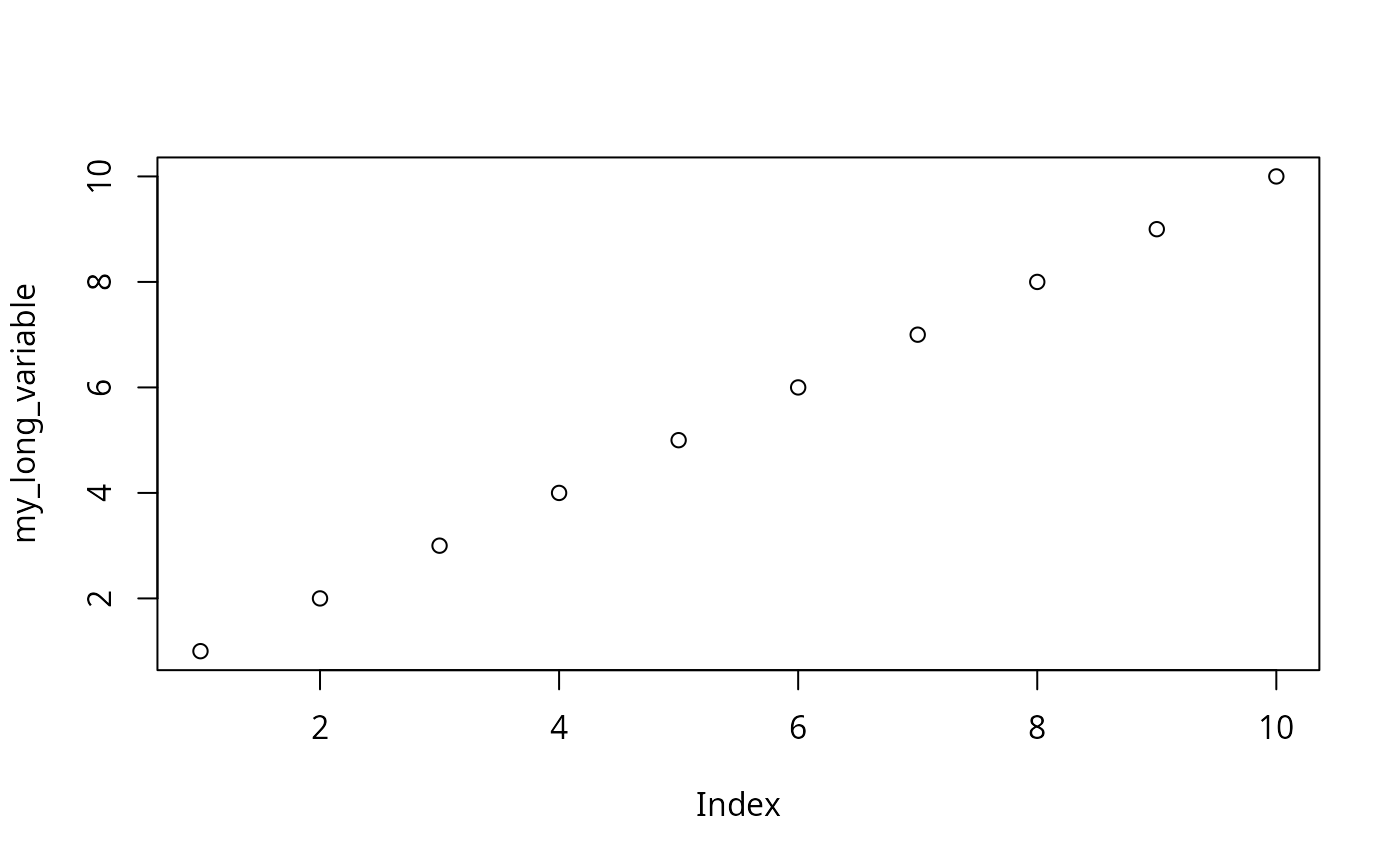
plot2()
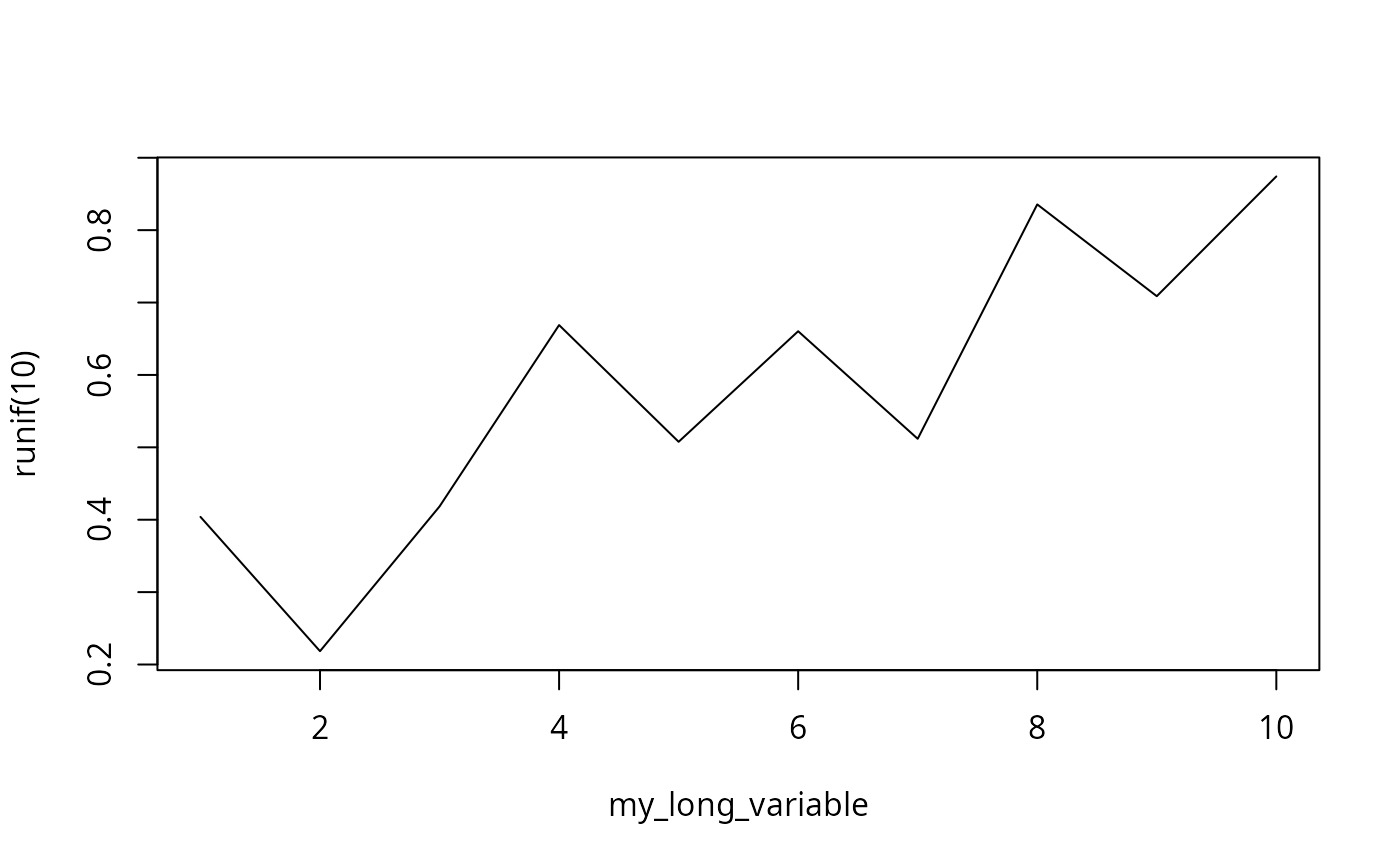
 plot2(runif(10), type = "l")