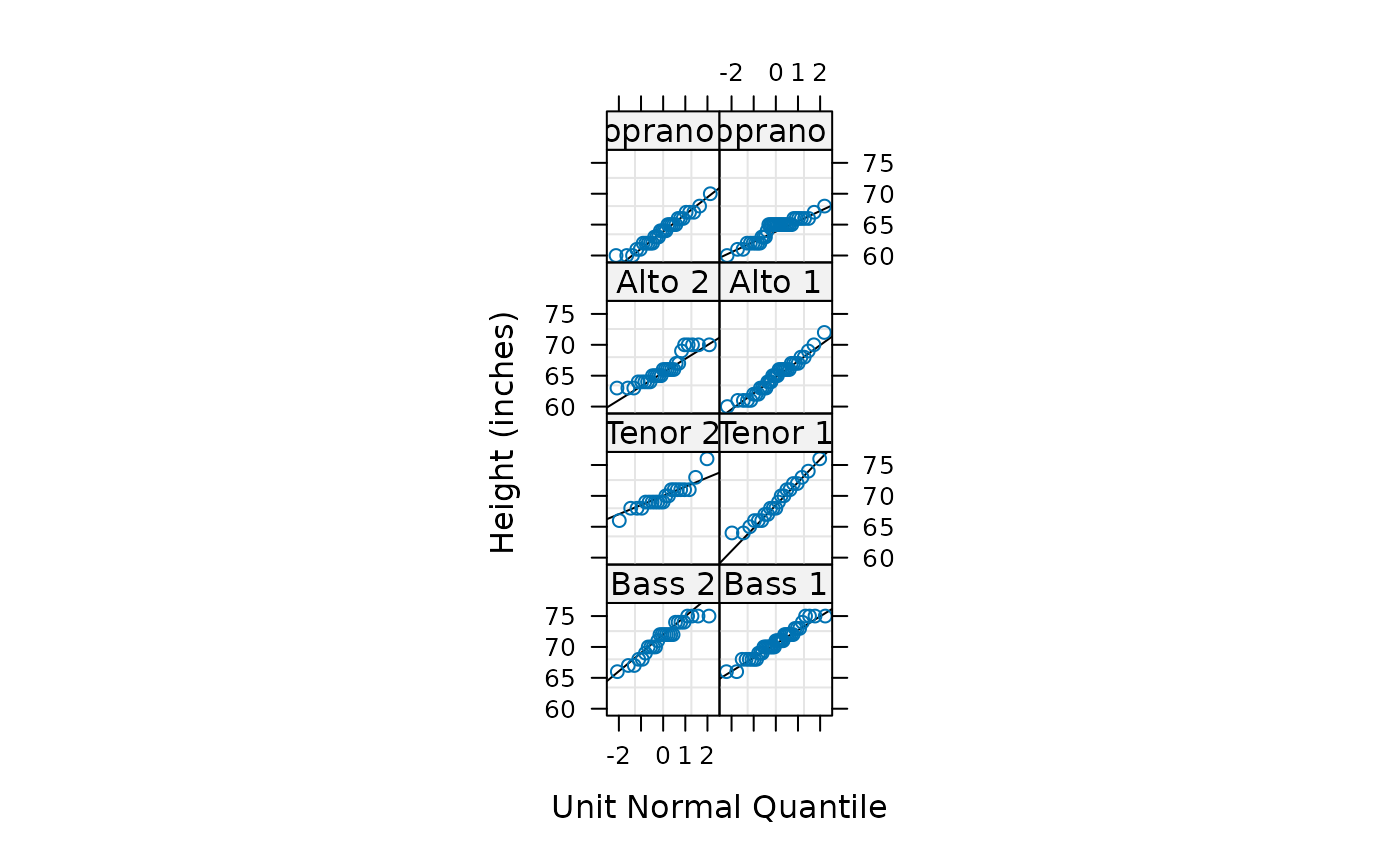
Heights of New York Choral Society singers
singer.RdHeights in inches of the singers in the New York Choral Society in 1979. The data are grouped according to voice part. The vocal range for each voice part increases in pitch according to the following order: Bass 2, Bass 1, Tenor 2, Tenor 1, Alto 2, Alto 1, Soprano 2, Soprano 1.
singerFormat
A data frame with 235 observations on the following 2 variables.
- height
Height in inches of the singers.
- voice.part
(Unordered) factor with levels "
Bass 2", "Bass 1", "Tenor 2", "Tenor 1", "Alto 2", "Alto 1", "Soprano 2", "Soprano 1".
Source
Chambers, J.M., W. S. Cleveland, B. Kleiner, and P. A. Tukey. (1983). Graphical Methods for Data Analysis. Chapman and Hall, New York.
References
Cleveland, William S. (1993) Visualizing Data. Hobart Press, Summit, New Jersey.
Examples
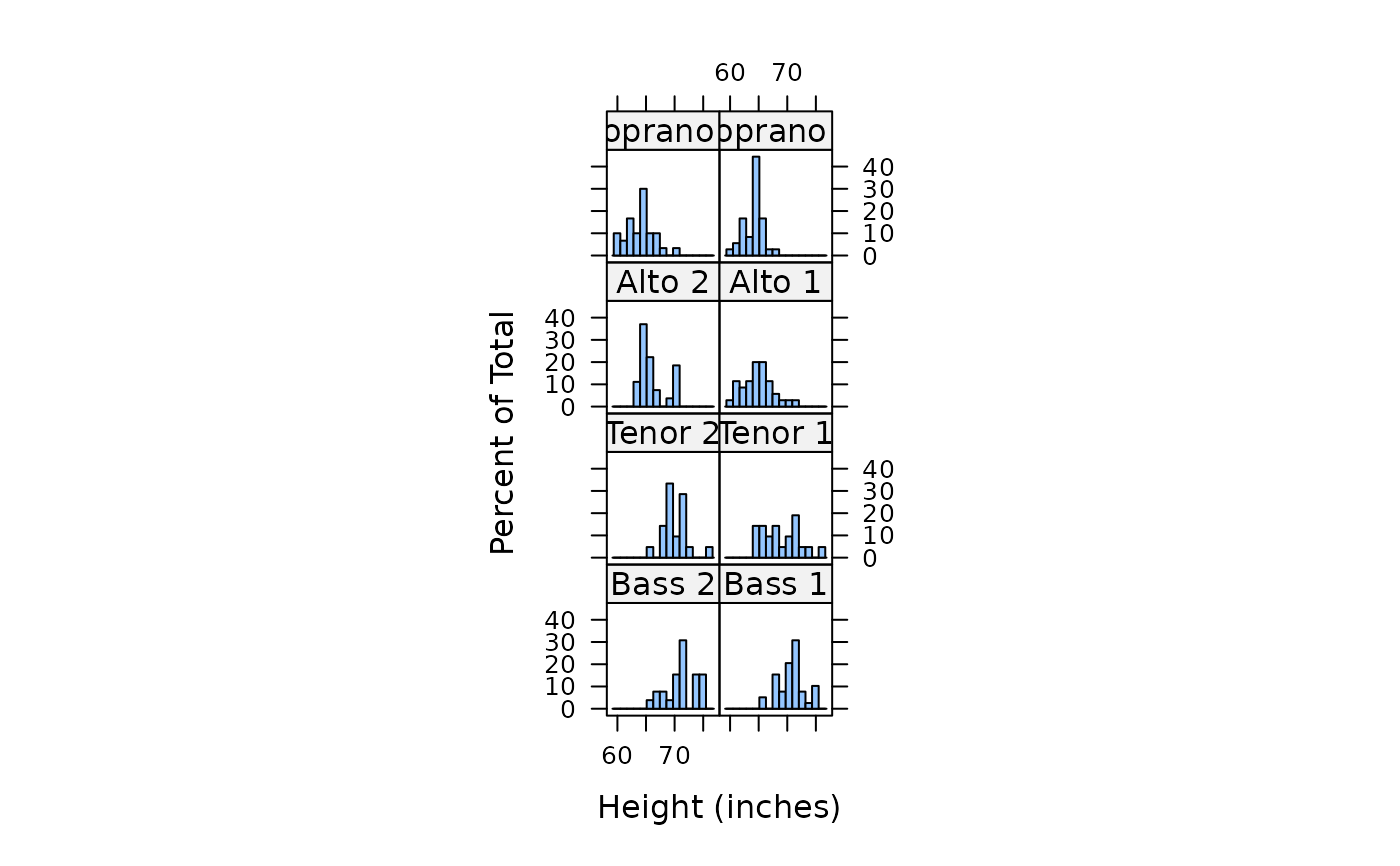
# Separate histogram for each voice part (Figure 1.2 from Cleveland)
histogram(~ height | voice.part,
data = singer,
aspect = 1,
layout = c(2, 4),
nint = 15,
xlab = "Height (inches)")
 # Quantile-Quantile plot (Figure 2.11 from Cleveland)
qqmath(~ height | voice.part,
data = singer,
aspect = 1,
layout = c(2,4),
prepanel = prepanel.qqmathline,
panel = function(x, ...) {
panel.grid()
panel.qqmathline(x, ...)
panel.qqmath(x, ..., grid = FALSE)
},
xlab = "Unit Normal Quantile",
ylab="Height (inches)")
# Quantile-Quantile plot (Figure 2.11 from Cleveland)
qqmath(~ height | voice.part,
data = singer,
aspect = 1,
layout = c(2,4),
prepanel = prepanel.qqmathline,
panel = function(x, ...) {
panel.grid()
panel.qqmathline(x, ...)
panel.qqmath(x, ..., grid = FALSE)
},
xlab = "Unit Normal Quantile",
ylab="Height (inches)")