Return the convex hull of a triangulation object
convex.hull.RdGiven a triangulation tri.obj of \(n\) points in the plane, this
subroutine returns two vectors containing the coordinates
of the nodes on the boundary of the convex hull.
ConvexHull is an experimental C++ implementation of Grahams Scan
without previous triangulation, should be much faster.
convex.hull(tri.obj, plot.it=FALSE, add=FALSE,...)
       ConvexHull(x,y)
Arguments
- tri.obj
object of class
triSht- plot.it
logical, if
TRUEthe convex hull oftri.objwill be plotted.- add
logical. if
TRUE(andplot.it=TRUE), add to a current plot.- ...
additional plot arguments
- x
only for
ConvexHull():xcoordinates for C++ call toConvexHull- y
only for
ConvexHull(): seex
Note
In case that there are several collinear nodes on the convex hull
convex.hull will return them all while ConvexHull will only
give edge points.
Value
- x
x coordinates of boundary nodes.
- y
y coordinates of boundary nodes.
See also
Examples
## random points:
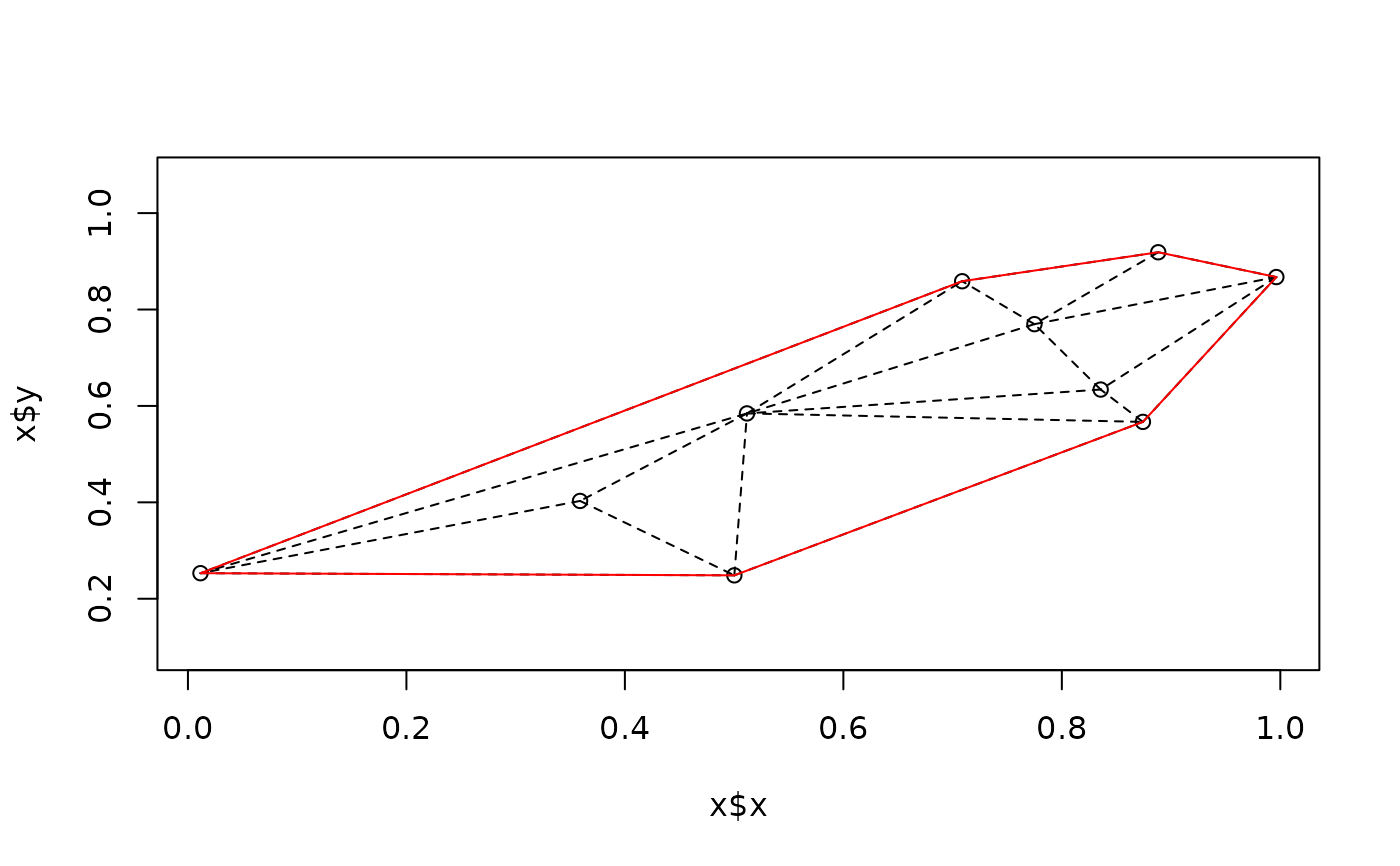
rand.tr<-tri.mesh(runif(10),runif(10))
plot(rand.tr)
rand.ch<-convex.hull(rand.tr, plot.it=TRUE, add=TRUE, col="red")
 ## use a part of the quakes data set:
data(quakes)
quakes.part<-quakes[(quakes[,1]<=-17 & quakes[,1]>=-19.0 &
quakes[,2]<=182.0 & quakes[,2]>=180.0),]
quakes.tri<-tri.mesh(quakes.part$lon, quakes.part$lat, duplicate="remove")
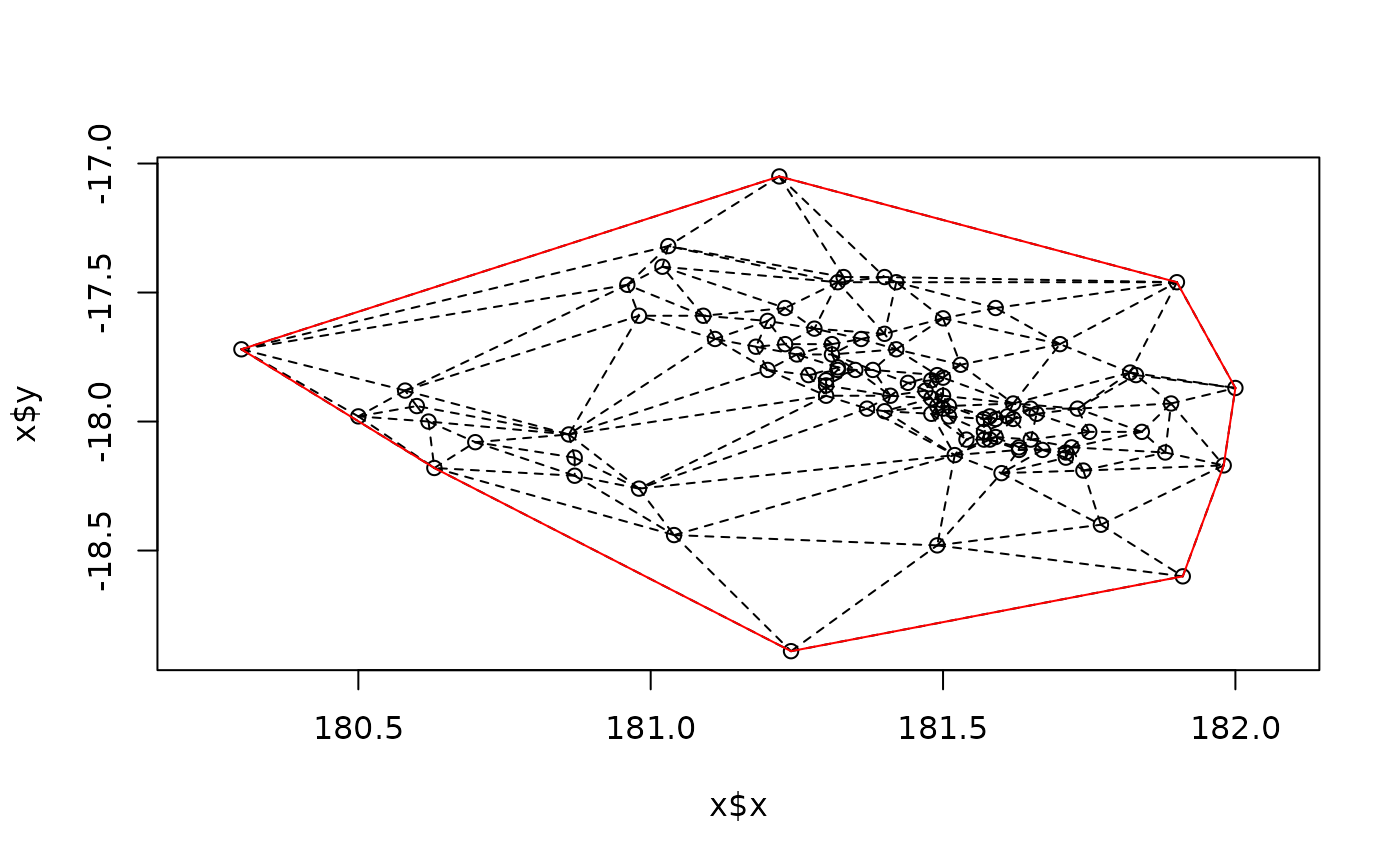
plot(quakes.tri)
convex.hull(quakes.tri, plot.it=TRUE, add=TRUE, col="red")
## use a part of the quakes data set:
data(quakes)
quakes.part<-quakes[(quakes[,1]<=-17 & quakes[,1]>=-19.0 &
quakes[,2]<=182.0 & quakes[,2]>=180.0),]
quakes.tri<-tri.mesh(quakes.part$lon, quakes.part$lat, duplicate="remove")
plot(quakes.tri)
convex.hull(quakes.tri, plot.it=TRUE, add=TRUE, col="red")