Bivariate Interpolation for Data on a Rectangular grid
bicubic.RdThis is a placeholder function for backward compatibility with packaga akima.
In its current state it simply calls the reimplemented Akima algorithm for irregular grids applied to the regular gridded data given.
Later a reimplementation of the original algorithm for regular grids may follow.
bicubic(x, y, z, x0, y0)Arguments
- x
a vector containing the
xcoordinates of the rectangular data grid.- y
a vector containing the
ycoordinates of the rectangular data grid.- z
a matrix containing the
z[i,j]data values for the grid points (x[i],y[j]).- x0
vector of
xcoordinates used to interpolate at.- y0
vector of
ycoordinates used to interpolate at.
Details
This function is a call wrapper for backward compatibility with package akima.
Currently it applies Akimas irregular grid splines to regular grids, later a FOSS reimplementation of his regular grid splines may replace this wrapper.
Value
This function produces a list of interpolated points:
- x
vector of
xcoordinates.- y
vector of
ycoordinates.- z
vector of interpolated data
z.
If you need an output grid, see bicubic.grid.
References
Akima, H. (1996) Rectangular-Grid-Data Surface Fitting that Has the Accuracy of a Bicubic Polynomial, J. ACM 22(3), 357-361
Note
Use interp for the general case of irregular gridded data!
See also
Examples
data(akima474)
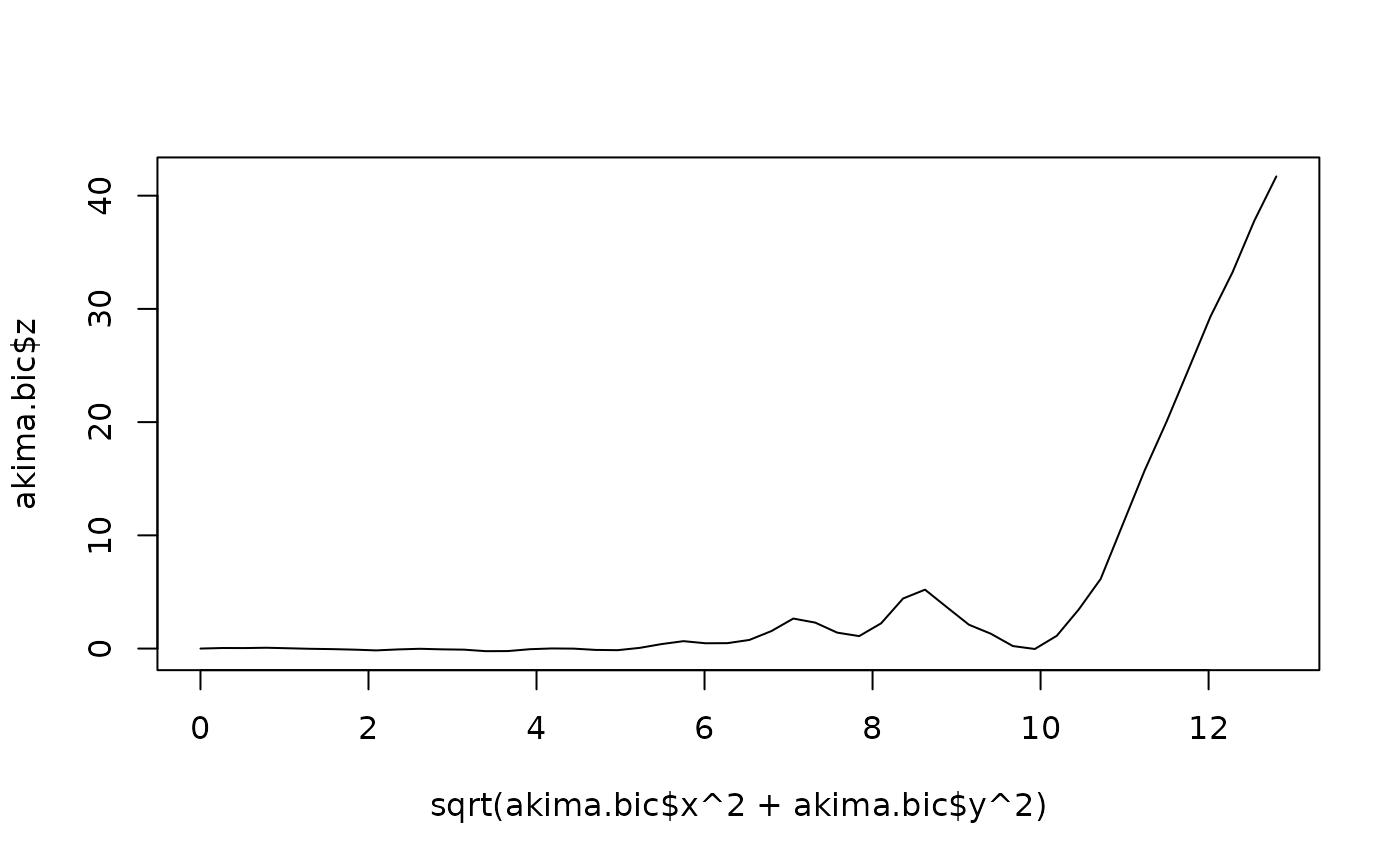
# interpolate at the diagonal of the grid [0,8]x[0,10]
akima.bic <- bicubic(akima474$x,akima474$y,akima474$z,
                     seq(0,8,length=50), seq(0,10,length=50))
#> Warning: this output is generated according to Akimas irregular grid splines, not the regular grid one! This is a temporary workaround until Akimas ACM algorithm 760 is reimplmented from scratch!
plot(sqrt(akima.bic$x^2+akima.bic$y^2), akima.bic$z, type="l")