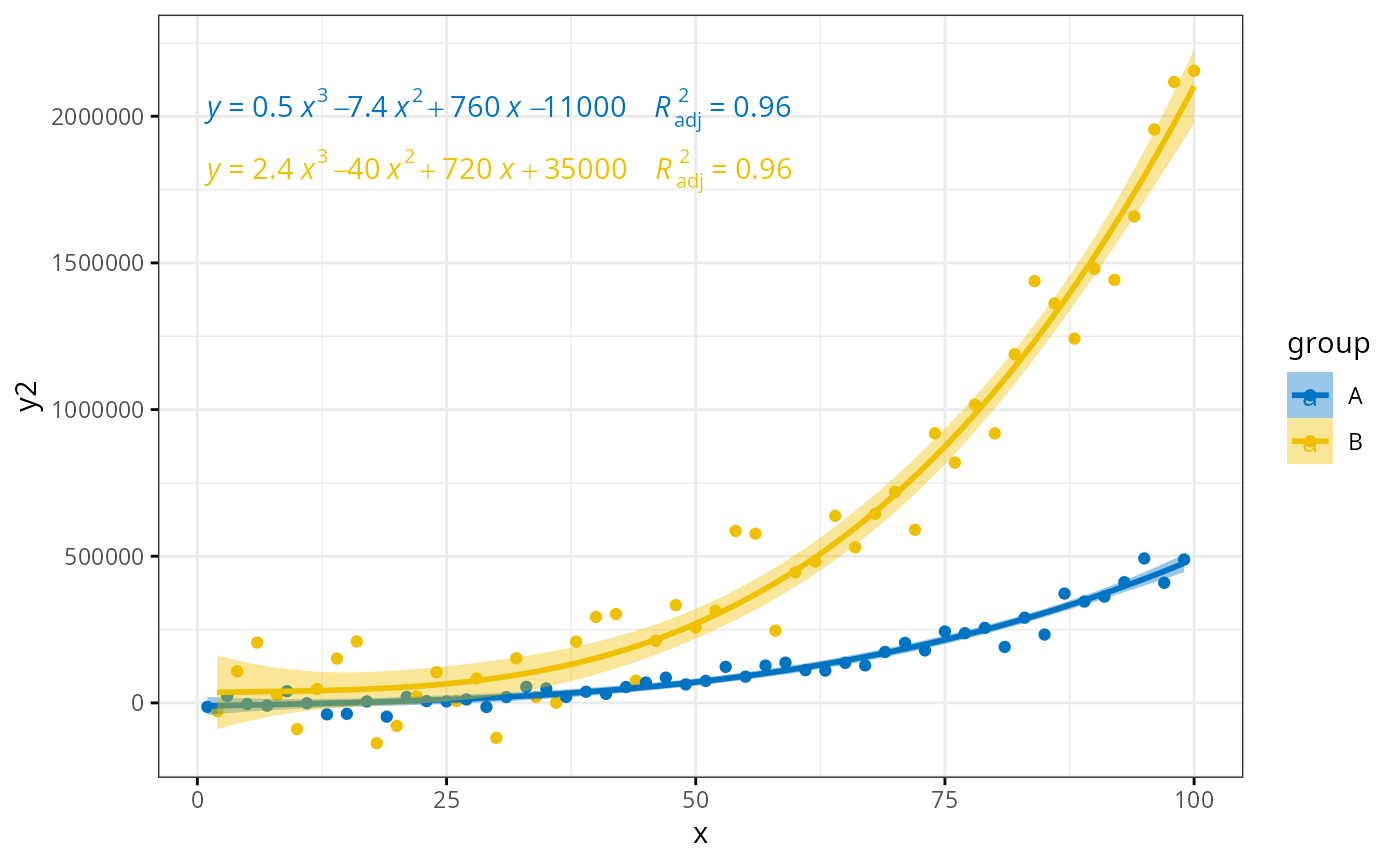
Add Regression Line Equation and R-Square to a GGPLOT.
Source:R/stat_regline_equation.R
stat_regline_equation.RdAdd regression line equation and R^2 to a ggplot. Regression
model is fitted using the function lm.
Usage
stat_regline_equation(
  mapping = NULL,
  data = NULL,
  formula = y ~ x,
  label.x.npc = "left",
  label.y.npc = "top",
  label.x = NULL,
  label.y = NULL,
  output.type = "expression",
  decreasing = TRUE,
  geom = "text",
  position = "identity",
  na.rm = FALSE,
  show.legend = NA,
  inherit.aes = TRUE,
  ...
)
Arguments
- mapping
Set of aesthetic mappings created by
aes(). If specified andinherit.aes = TRUE(the default), it is combined with the default mapping at the top level of the plot. You must supplymappingif there is no plot mapping.- data
The data to be displayed in this layer. There are three options:
If
NULL, the default, the data is inherited from the plot data as specified in the call toggplot().A
data.frame, or other object, will override the plot data. All objects will be fortified to produce a data frame. Seefortify()for which variables will be created.A
functionwill be called with a single argument, the plot data. The return value must be adata.frame, and will be used as the layer data. Afunctioncan be created from aformula(e.g.~ head(.x, 10)).- formula
a formula object
- label.x.npc, label.y.npc
can be
numericorcharactervector of the same length as the number of groups and/or panels. If too short they will be recycled.If
numeric, value should be between 0 and 1. Coordinates to be used for positioning the label, expressed in "normalized parent coordinates".If
character, allowed values include: i) one of c('right', 'left', 'center', 'centre', 'middle') for x-axis; ii) and one of c( 'bottom', 'top', 'center', 'centre', 'middle') for y-axis.
If too short they will be recycled.
- label.x, label.y
numericCoordinates (in data units) to be used for absolute positioning of the label. If too short they will be recycled.- output.type
character One of "expression", "latex" or "text".
- decreasing
logical. If
TRUE(the default), the equation is formatted in standard mathematical convention with terms in decreasing order of powers (e.g., "y = 2*x + 1"). IfFALSE, terms are in increasing order (e.g., "y = 1 + 2*x").- geom
The geometric object to use to display the data for this layer. When using a
stat_*()function to construct a layer, thegeomargument can be used to override the default coupling between stats and geoms. Thegeomargument accepts the following:A
Geomggproto subclass, for exampleGeomPoint.A string naming the geom. To give the geom as a string, strip the function name of the
geom_prefix. For example, to usegeom_point(), give the geom as"point".For more information and other ways to specify the geom, see the layer geom documentation.
- position
A position adjustment to use on the data for this layer. This can be used in various ways, including to prevent overplotting and improving the display. The
positionargument accepts the following:The result of calling a position function, such as
position_jitter(). This method allows for passing extra arguments to the position.A string naming the position adjustment. To give the position as a string, strip the function name of the
position_prefix. For example, to useposition_jitter(), give the position as"jitter".For more information and other ways to specify the position, see the layer position documentation.
- na.rm
If FALSE (the default), removes missing values with a warning. If TRUE silently removes missing values.
- show.legend
logical. Should this layer be included in the legends?
NA, the default, includes if any aesthetics are mapped.FALSEnever includes, andTRUEalways includes. It can also be a named logical vector to finely select the aesthetics to display. To include legend keys for all levels, even when no data exists, useTRUE. IfNA, all levels are shown in legend, but unobserved levels are omitted.- inherit.aes
If
FALSE(the default for most ggpubr functions), overrides the default aesthetics, rather than combining with them. This is most useful for helper functions that define both data and aesthetics and shouldn't inherit behaviour from the default plot specification. Set toTRUEto inherit aesthetics from the parent ggplot layer.- ...
other arguments to pass to
geom_textorgeom_label.
Computed variables
- x
x position for left edge
- y
y position near upper edge
- eq.label
equation for the fitted polynomial as a character string to be parsed
- rr.label
\(R^2\) of the fitted model as a character string to be parsed
- adj.rr.label
Adjusted \(R^2\) of the fitted model as a character string to be parsed
- AIC.label
AIC for the fitted model.
- BIC.label
BIC for the fitted model.
- hjust
Set to zero to override the default of the "text" geom.
References
the source code of the function stat_regline_equation() is
inspired from the code of the function stat_poly_eq() (in ggpmisc
package).
Examples
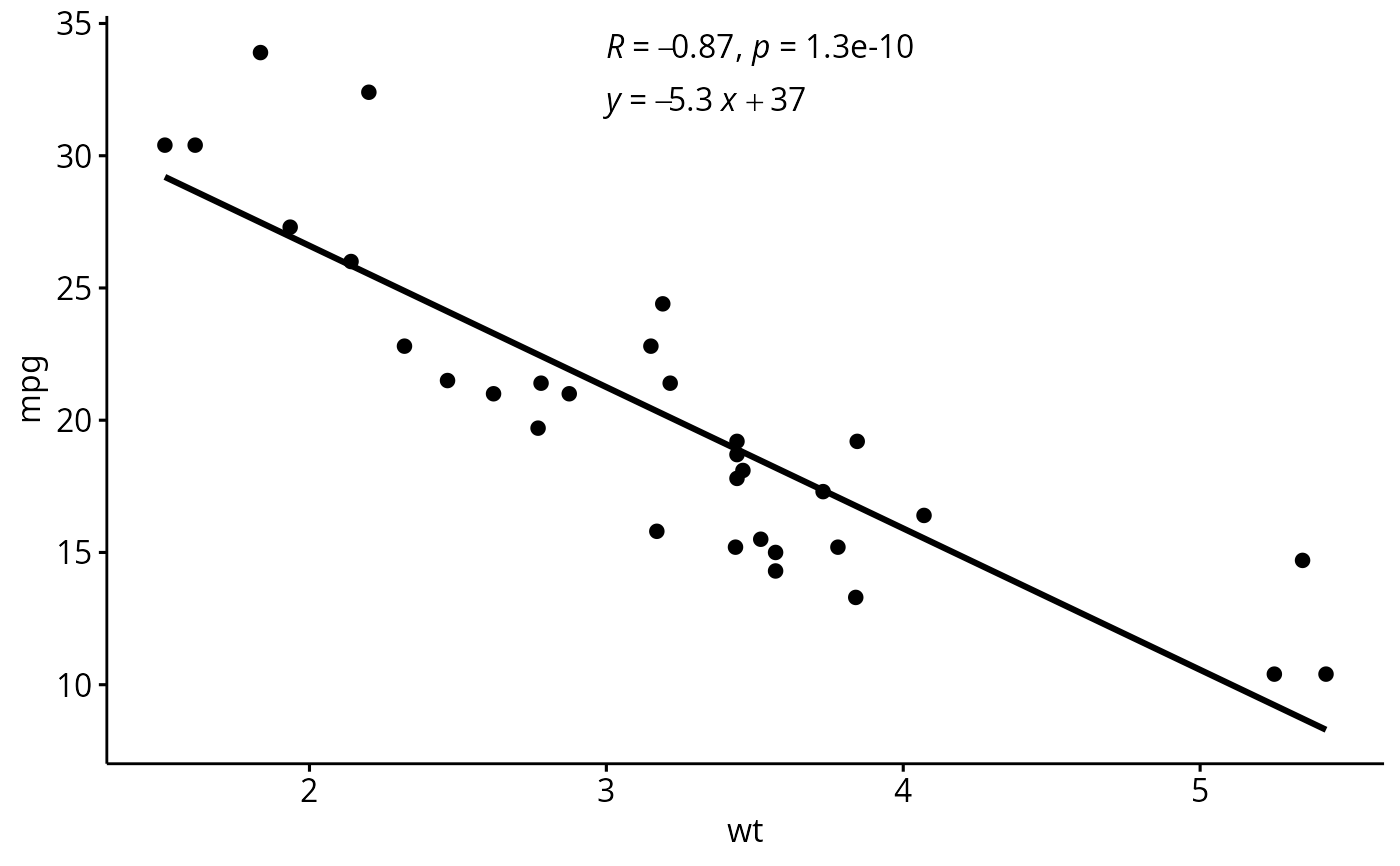
# Simple scatter plot with correlation coefficient and
# regression line
#::::::::::::::::::::::::::::::::::::::::::::::::::::
ggscatter(mtcars, x = "wt", y = "mpg", add = "reg.line") +
stat_cor(label.x = 3, label.y = 34) +
stat_regline_equation(label.x = 3, label.y = 32)
 # Groupped scatter plot
#::::::::::::::::::::::::::::::::::::::::::::::::::::
ggscatter(
iris, x = "Sepal.Length", y = "Sepal.Width",
color = "Species", palette = "jco",
add = "reg.line"
) +
facet_wrap(~Species) +
stat_cor(label.y = 4.4) +
stat_regline_equation(label.y = 4.2)
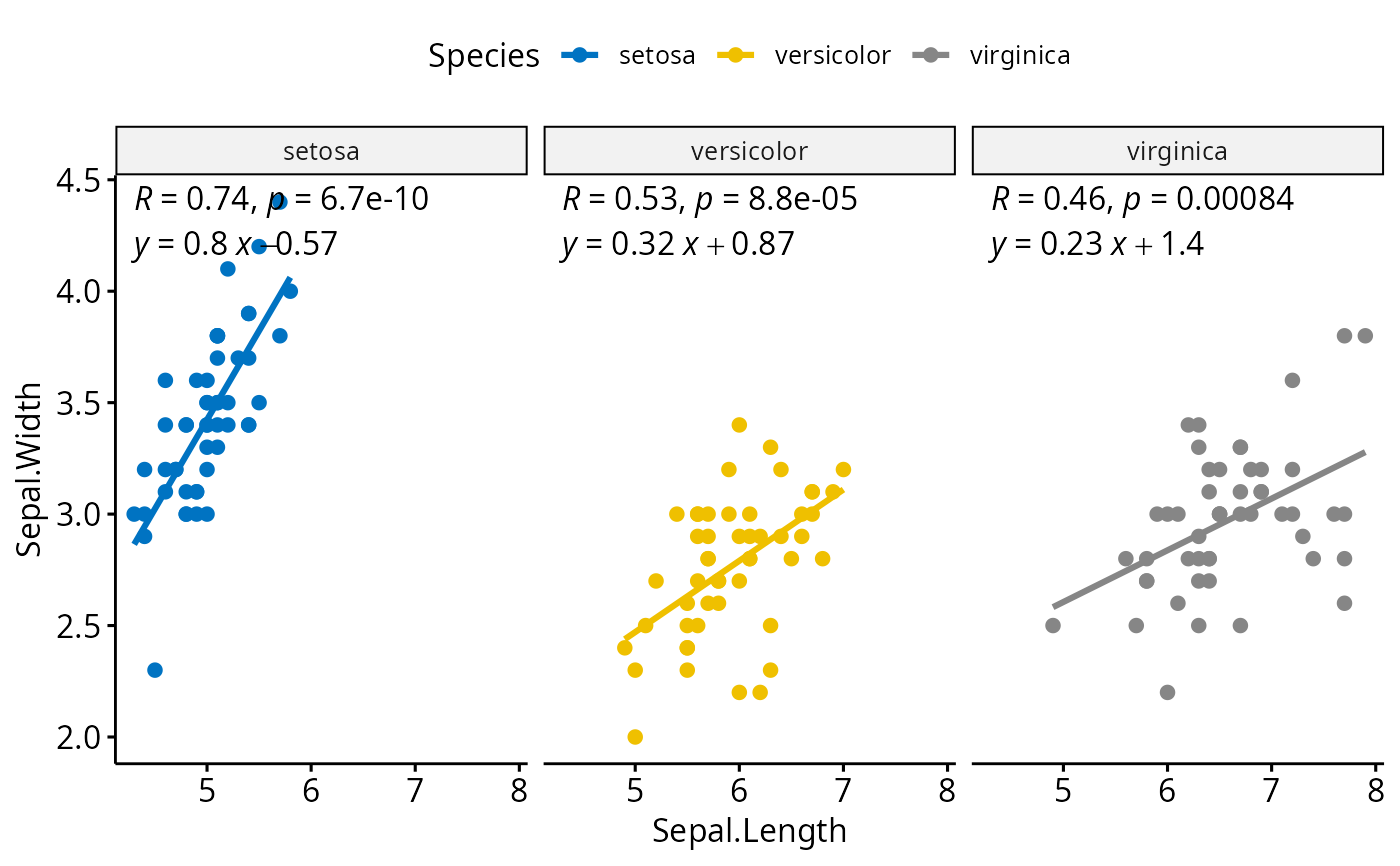
# Groupped scatter plot
#::::::::::::::::::::::::::::::::::::::::::::::::::::
ggscatter(
iris, x = "Sepal.Length", y = "Sepal.Width",
color = "Species", palette = "jco",
add = "reg.line"
) +
facet_wrap(~Species) +
stat_cor(label.y = 4.4) +
stat_regline_equation(label.y = 4.2)
 # Polynomial equation
#::::::::::::::::::::::::::::::::::::::::::::::::::::
# Demo data
set.seed(4321)
x <- 1:100
y <- (x + x^2 + x^3) + rnorm(length(x), mean = 0, sd = mean(x^3) / 4)
my.data <- data.frame(x, y, group = c("A", "B"),
y2 = y * c(0.5,2), block = c("a", "a", "b", "b"))
# Fit polynomial regression line and add labels
formula <- y ~ poly(x, 3, raw = TRUE)
p <- ggplot(my.data, aes(x, y2, color = group)) +
geom_point() +
stat_smooth(aes(fill = group, color = group), method = "lm", formula = formula) +
stat_regline_equation(
aes(label = paste(..eq.label.., ..adj.rr.label.., sep = "~~~~")),
formula = formula
) +
theme_bw()
ggpar(p, palette = "jco")
# Polynomial equation
#::::::::::::::::::::::::::::::::::::::::::::::::::::
# Demo data
set.seed(4321)
x <- 1:100
y <- (x + x^2 + x^3) + rnorm(length(x), mean = 0, sd = mean(x^3) / 4)
my.data <- data.frame(x, y, group = c("A", "B"),
y2 = y * c(0.5,2), block = c("a", "a", "b", "b"))
# Fit polynomial regression line and add labels
formula <- y ~ poly(x, 3, raw = TRUE)
p <- ggplot(my.data, aes(x, y2, color = group)) +
geom_point() +
stat_smooth(aes(fill = group, color = group), method = "lm", formula = formula) +
stat_regline_equation(
aes(label = paste(..eq.label.., ..adj.rr.label.., sep = "~~~~")),
formula = formula
) +
theme_bw()
ggpar(p, palette = "jco")