Monotone Regression: Isotonic Regression and Antitonic Regression
monoreg.Rdmonoreg performs monotone regression (either isotonic
or antitonic) with weights.
Arguments
- x, y
coordinate vectors of the regression points. Alternatively a single “plotting” structure can be specified: see
xy.coords.- w
data weights (default values: 1).
- type
fit a monotonely increasing ("isotonic") or monotonely decreasing ("antitonic") function.
Details
monoreg is similar to isoreg, with the addition
that monoreg accepts weights.
If several identical x values are given as input, the
corresponding y values and the
weights w are automatically merged, and a warning is issued.
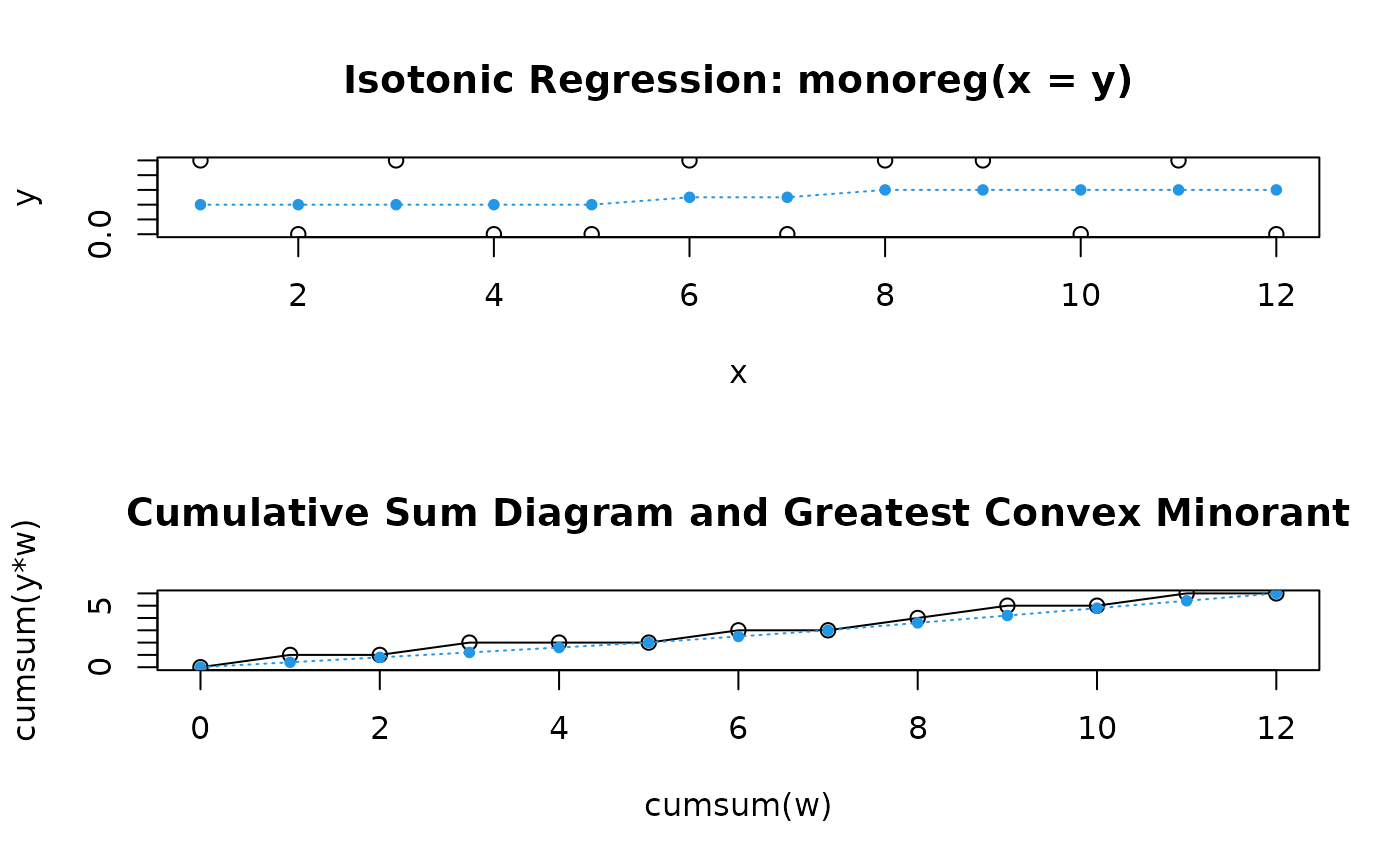
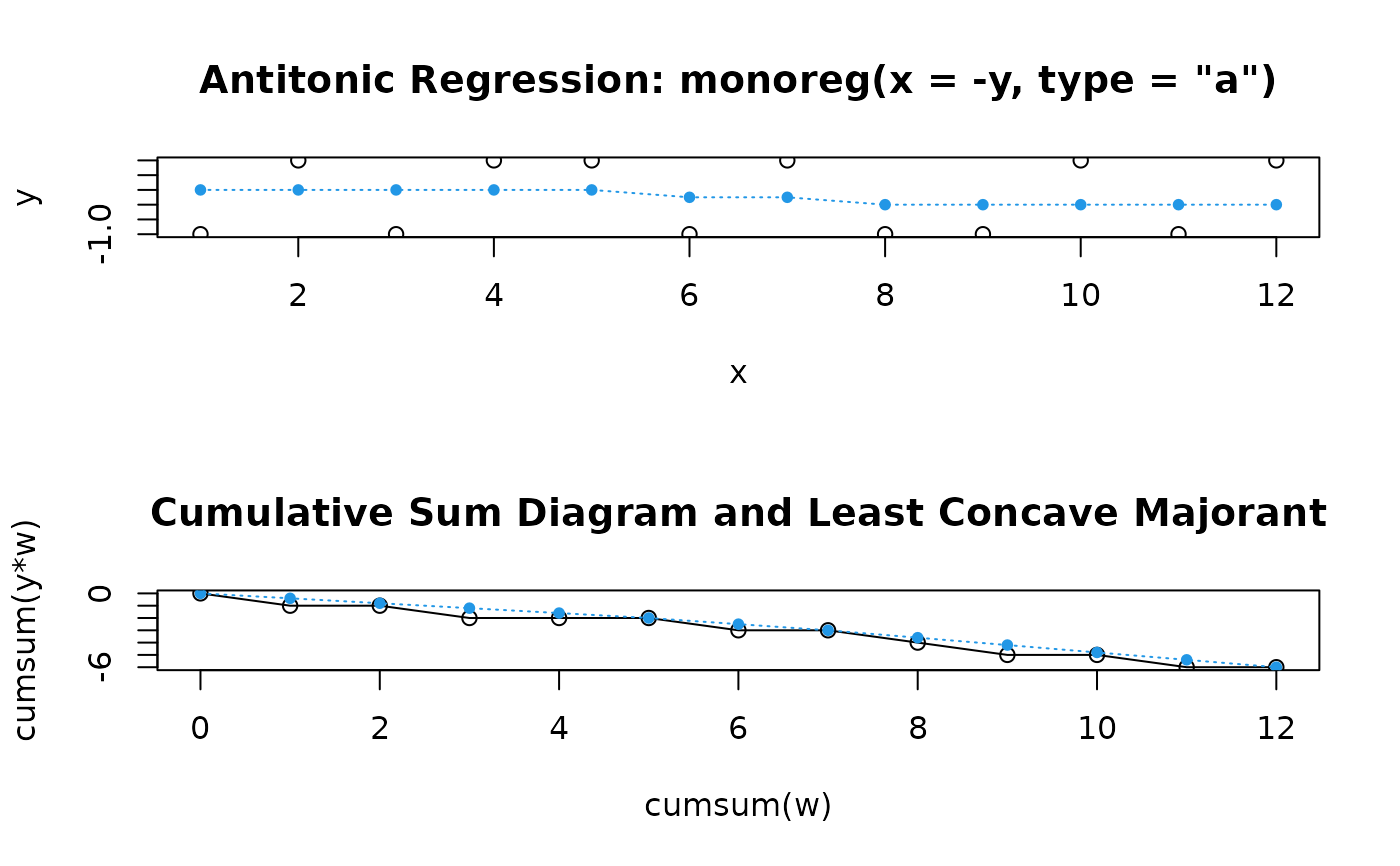
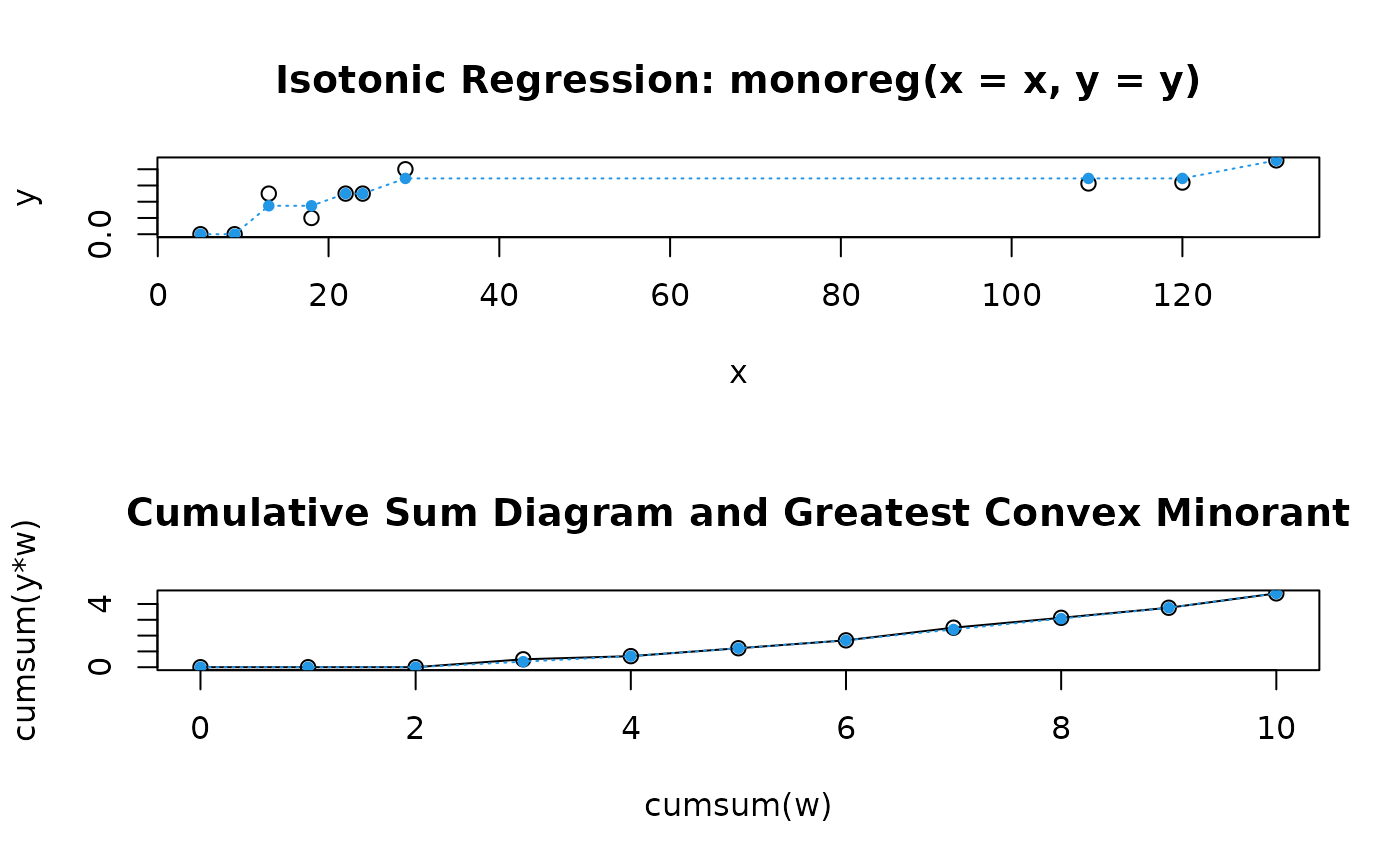
The plot.monoreg function optionally plots the cumulative
sum diagram with the greatest convex minorant (isotonic regression)
or the least concave majorant (antitonic regression), see the
examples below.
Value
A list with the following entries:
- x
the sorted and unique x values
- y
the corresponding y values
- w
the corresponding weights
- yf
the fitted y values
- type
the type of monotone regression ("isotonic" or "antitonic"
- call
the function call
References
Robertson, T., F. T. Wright, and R. L. Dykstra. 1988. Order restricted statistical inference. John Wiley and Sons.
See also
Examples
# load "fdrtool" library
library("fdrtool")
# an example with weights
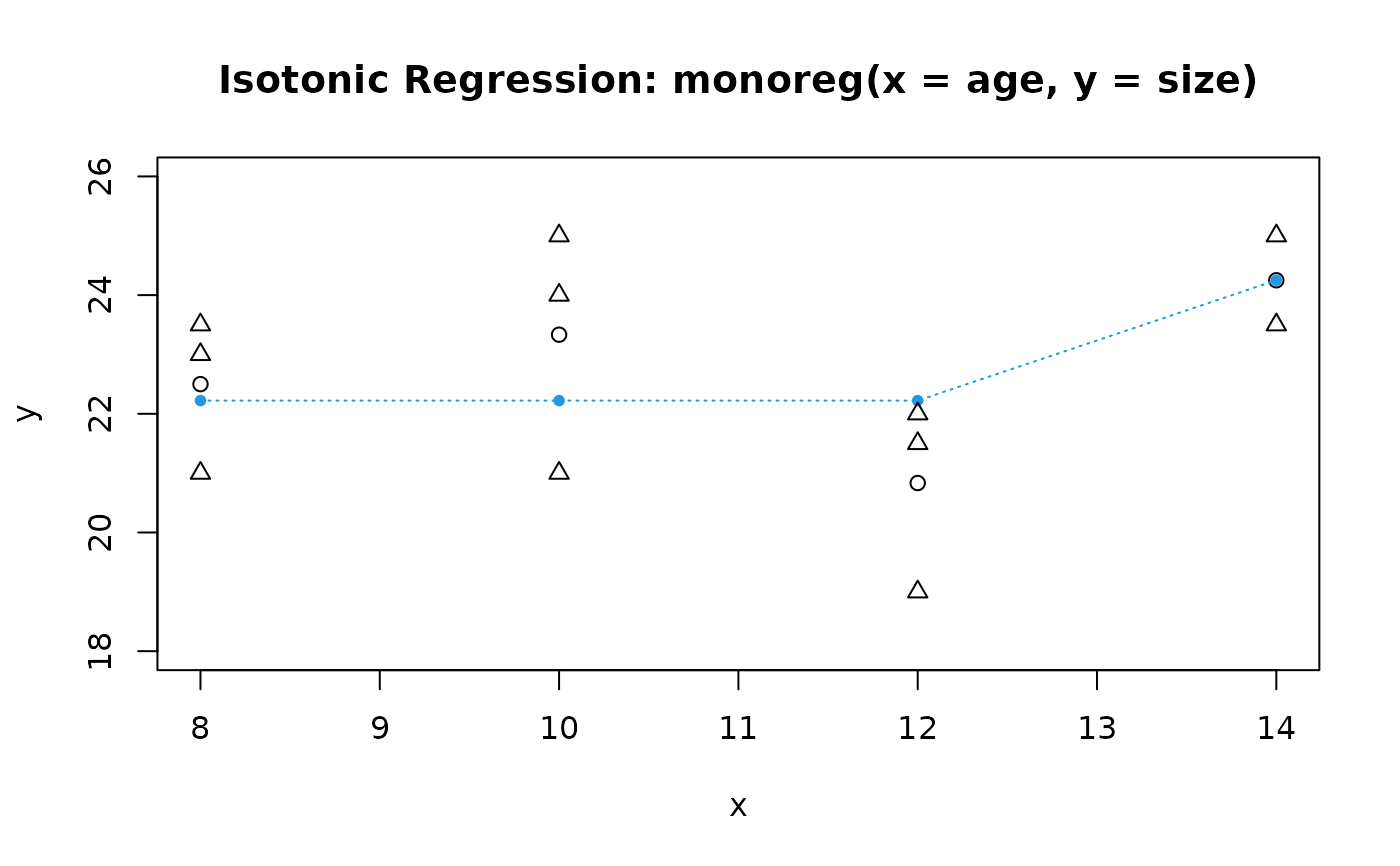
# Example 1.1.1. (dental study) from Robertson, Wright and Dykstra (1988)
age = c(14, 14, 8, 8, 8, 10, 10, 10, 12, 12, 12)
size = c(23.5, 25, 21, 23.5, 23, 24, 21, 25, 21.5, 22, 19)
mr = monoreg(age, size)
#> Warning: Duplicated x value (x=14) detected!
#> The corresponding weights and y values will be merged.
#> Warning: Duplicated x value (x=8) detected!
#> The corresponding weights and y values will be merged.
#> Warning: Duplicated x value (x=10) detected!
#> The corresponding weights and y values will be merged.
#> Warning: Duplicated x value (x=12) detected!
#> The corresponding weights and y values will be merged.
# sorted x values
mr$x # 8 10 12 14
#> [1] 8 10 12 14
# weights and merged y values
mr$w # 3 3 3 2
#> [1] 3 3 3 2
mr$y # 22.50000 23.33333 20.83333 24.25000
#> [1] 22.50000 23.33333 20.83333 24.25000
# fitted y values
mr$yf # 22.22222 22.22222 22.22222 24.25000
#> [1] 22.22222 22.22222 22.22222 24.25000
fitted(mr)
#> [1] 22.22222 22.22222 22.22222 24.25000
residuals(mr)
#> [1] 0.2777778 1.1111111 -1.3888889 0.0000000
plot(mr, ylim=c(18, 26)) # this shows the averaged data points
points(age, size, pch=2) # add original data points
 ###
y = c(1,0,1,0,0,1,0,1,1,0,1,0)
x = 1:length(y)
mr = monoreg(y)
# plot with greatest convex minorant
plot(mr, plot.type="row.wise")
###
y = c(1,0,1,0,0,1,0,1,1,0,1,0)
x = 1:length(y)
mr = monoreg(y)
# plot with greatest convex minorant
plot(mr, plot.type="row.wise")
 # this is the same
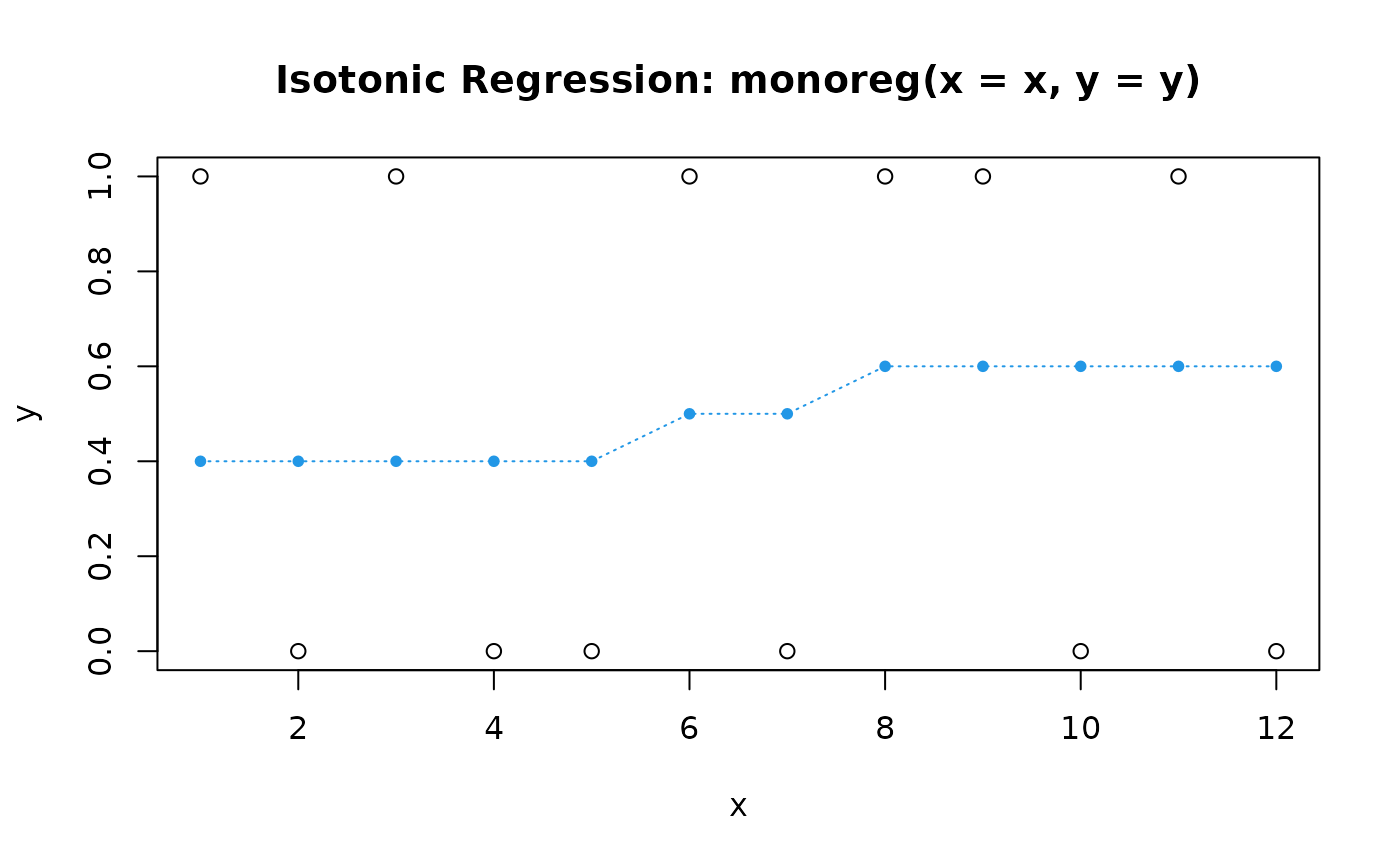
mr = monoreg(x,y)
plot(mr)
# this is the same
mr = monoreg(x,y)
plot(mr)
 # antitonic regression and least concave majorant
mr = monoreg(-y, type="a")
plot(mr, plot.type="row.wise")
# antitonic regression and least concave majorant
mr = monoreg(-y, type="a")
plot(mr, plot.type="row.wise")
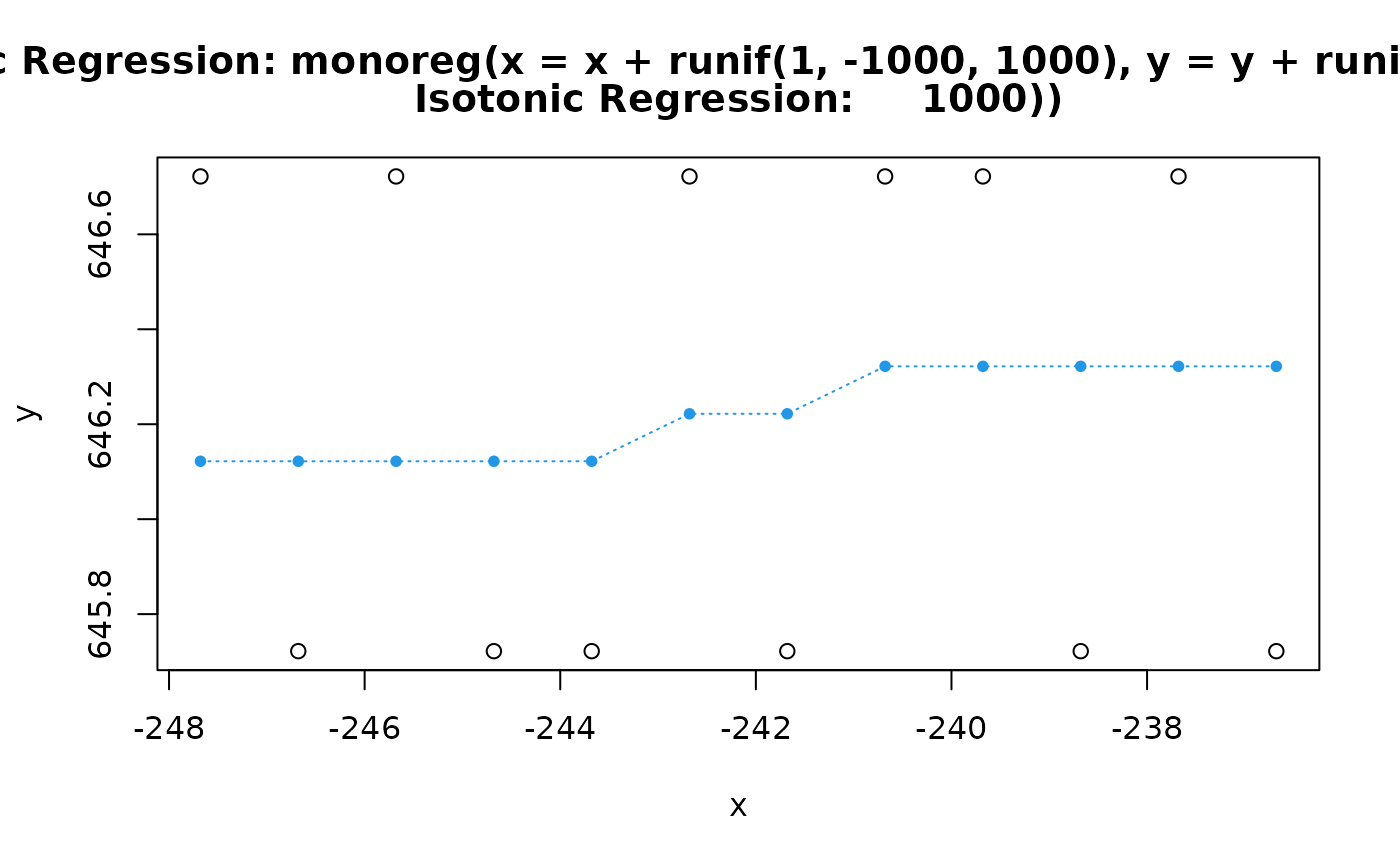
 # the fit yf is independent of the location of x and y
plot(monoreg(x + runif(1, -1000, 1000),
y +runif(1, -1000, 1000)) )
# the fit yf is independent of the location of x and y
plot(monoreg(x + runif(1, -1000, 1000),
y +runif(1, -1000, 1000)) )
 ###
y = c(0,0,2/4,1/5,2/4,1/2,4/5,5/8,7/11,10/11)
x = c(5,9,13,18,22,24,29,109,120,131)
mr = monoreg(x,y)
plot(mr, plot.type="row.wise")
###
y = c(0,0,2/4,1/5,2/4,1/2,4/5,5/8,7/11,10/11)
x = c(5,9,13,18,22,24,29,109,120,131)
mr = monoreg(x,y)
plot(mr, plot.type="row.wise")
 # the fit (yf) only depends on the ordering of x
monoreg(1:length(y), y)$yf
#> [1] 0.0000000 0.0000000 0.3500000 0.3500000 0.5000000 0.5000000 0.6871212
#> [8] 0.6871212 0.6871212 0.9090909
monoreg(x, y)$yf
#> [1] 0.0000000 0.0000000 0.3500000 0.3500000 0.5000000 0.5000000 0.6871212
#> [8] 0.6871212 0.6871212 0.9090909
# the fit (yf) only depends on the ordering of x
monoreg(1:length(y), y)$yf
#> [1] 0.0000000 0.0000000 0.3500000 0.3500000 0.5000000 0.5000000 0.6871212
#> [8] 0.6871212 0.6871212 0.9090909
monoreg(x, y)$yf
#> [1] 0.0000000 0.0000000 0.3500000 0.3500000 0.5000000 0.5000000 0.6871212
#> [8] 0.6871212 0.6871212 0.9090909