Discretize Continuous Random Variables
discretize.Rddiscretize puts observations from a continuous random variable
into bins and returns the corresponding vector of counts.
discretize2d puts observations from a pair of continuous random variables
into bins and returns the corresponding table of counts.
Arguments
- x
vector of observations.
- x1
vector of observations for the first random variable.
- x2
vector of observations for the second random variable.
- numBins
number of bins.
- numBins1
number of bins for the first random variable.
- numBins2
number of bins for the second random variable.
- r
range of the random variable (default: observed range).
- r1
range of the first random variable (default: observed range).
- r2
range of the second random variable (default: observed range).
Details
The bins for a random variable all have the same width. It is determined by the length of the range divided by the number of bins.
Value
discretize returns a vector containing the counts for each bin.
discretize2d returns a matrix containing the counts for each bin.
See also
Examples
# load entropy library
library("entropy")
### 1D example ####
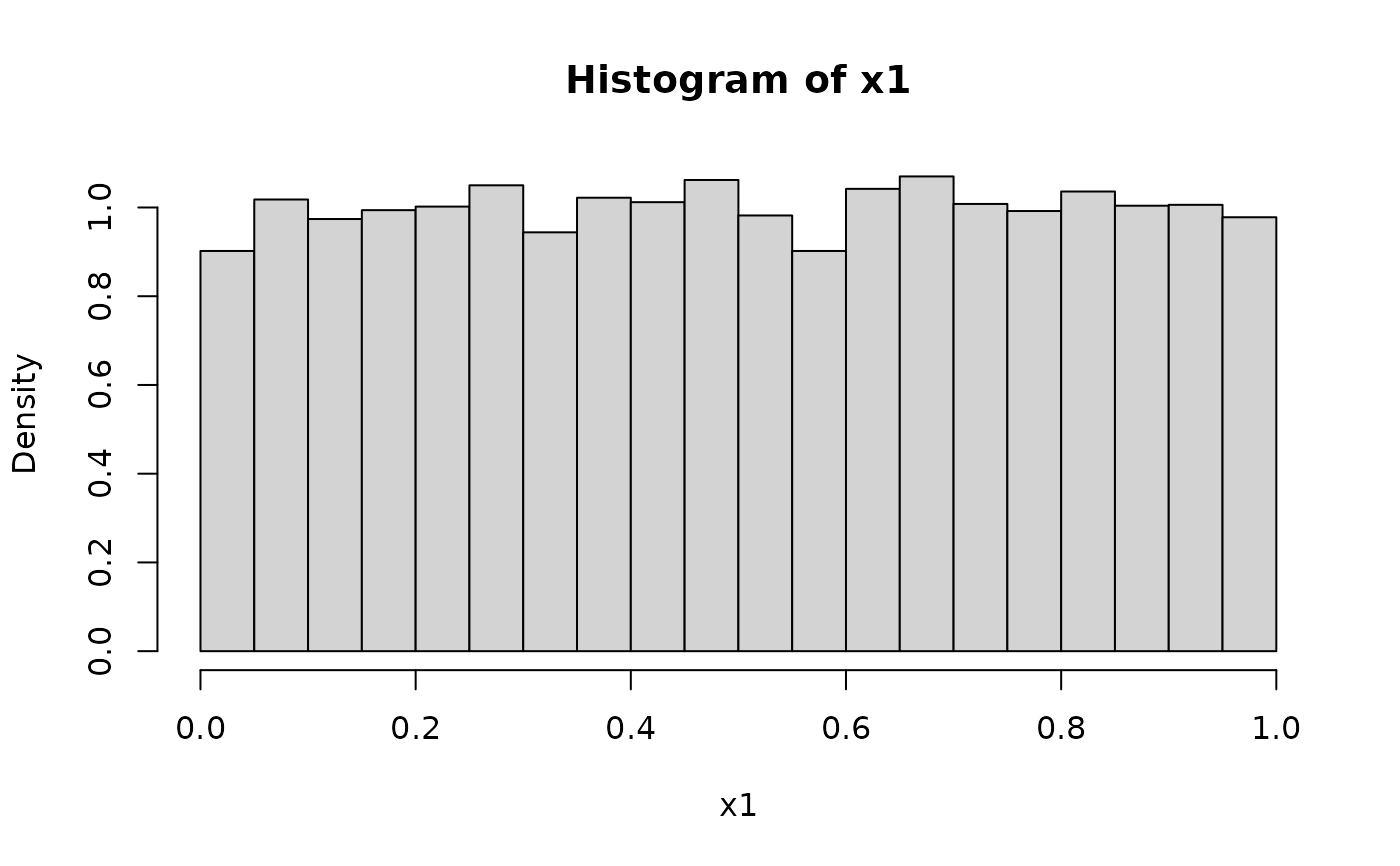
# sample from continuous uniform distribution
x1 = runif(10000)
hist(x1, xlim=c(0,1), freq=FALSE)
 # discretize into 10 categories
y1 = discretize(x1, numBins=10, r=c(0,1))
y1
#>
#> [0,0.1] (0.1,0.2] (0.2,0.3] (0.3,0.4] (0.4,0.5] (0.5,0.6] (0.6,0.7] (0.7,0.8]
#> 960 984 1026 983 1037 942 1056 1000
#> (0.8,0.9] (0.9,1]
#> 1020 992
# compute entropy from counts
entropy(y1) # empirical estimate near theoretical maximum
#> [1] 2.302027
log(10) # theoretical value for discrete uniform distribution with 10 bins
#> [1] 2.302585
# sample from a non-uniform distribution
x2 = rbeta(10000, 750, 250)
hist(x2, xlim=c(0,1), freq=FALSE)
# discretize into 10 categories
y1 = discretize(x1, numBins=10, r=c(0,1))
y1
#>
#> [0,0.1] (0.1,0.2] (0.2,0.3] (0.3,0.4] (0.4,0.5] (0.5,0.6] (0.6,0.7] (0.7,0.8]
#> 960 984 1026 983 1037 942 1056 1000
#> (0.8,0.9] (0.9,1]
#> 1020 992
# compute entropy from counts
entropy(y1) # empirical estimate near theoretical maximum
#> [1] 2.302027
log(10) # theoretical value for discrete uniform distribution with 10 bins
#> [1] 2.302585
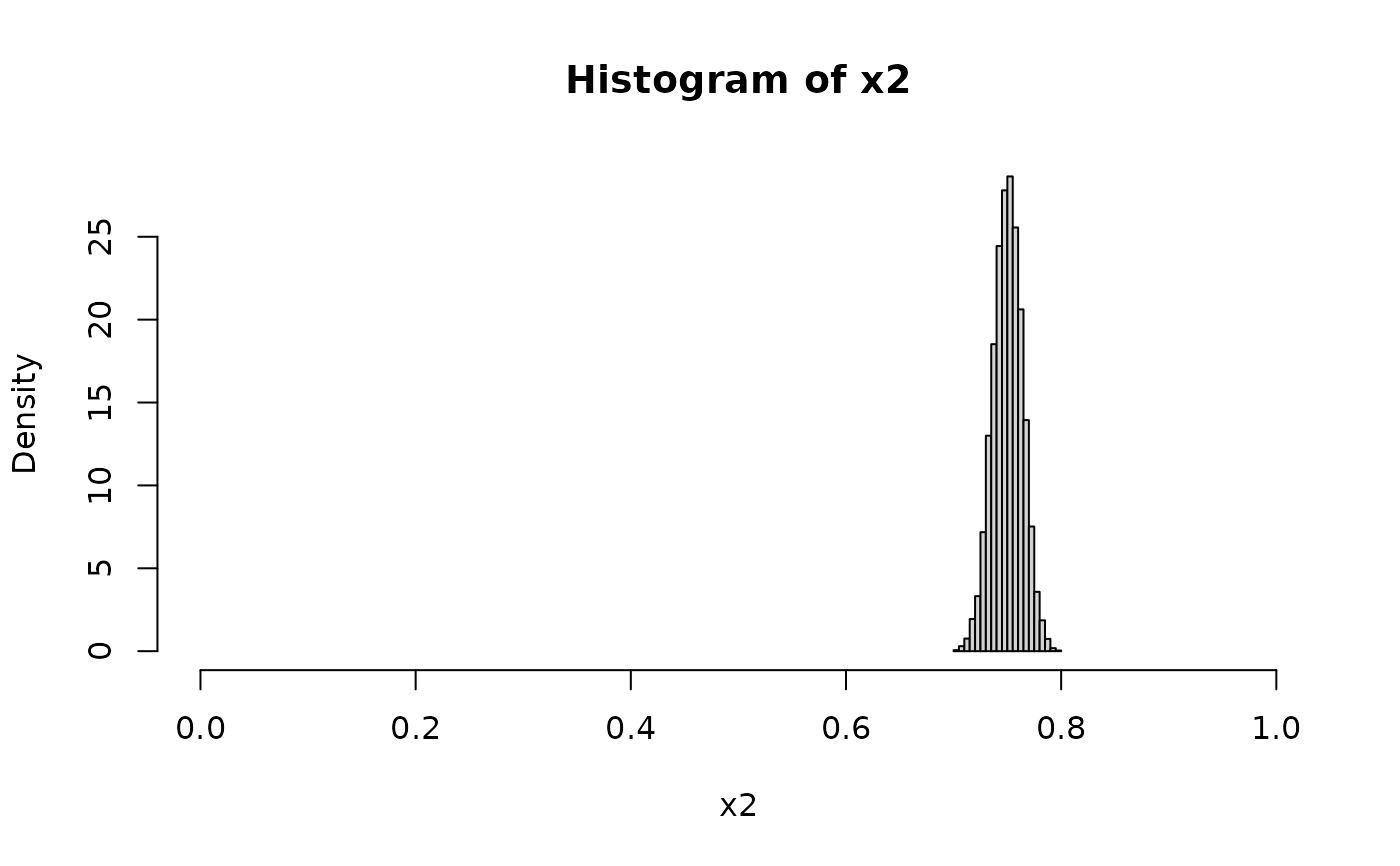
# sample from a non-uniform distribution
x2 = rbeta(10000, 750, 250)
hist(x2, xlim=c(0,1), freq=FALSE)
 # discretize into 10 categories and estimate entropy
y2 = discretize(x2, numBins=10, r=c(0,1))
y2
#>
#> [0,0.1] (0.1,0.2] (0.2,0.3] (0.3,0.4] (0.4,0.5] (0.5,0.6] (0.6,0.7] (0.7,0.8]
#> 0 0 0 0 0 0 0 10000
#> (0.8,0.9] (0.9,1]
#> 0 0
entropy(y2) # almost zero
#> [1] 0
### 2D example ####
# two independent random variables
x1 = runif(10000)
x2 = runif(10000)
y2d = discretize2d(x1, x2, numBins1=10, numBins2=10)
sum(y2d)
#> [1] 10000
# joint entropy
H12 = entropy(y2d )
H12
#> [1] 4.600044
log(100) # theoretical maximum for 10x10 table
#> [1] 4.60517
# mutual information
mi.empirical(y2d) # approximately zero
#> [1] 0.004318825
# another way to compute mutual information
# compute marginal entropies
H1 = entropy(rowSums(y2d))
H2 = entropy(colSums(y2d))
H1+H2-H12 # mutual entropy
#> [1] 0.004318825
# discretize into 10 categories and estimate entropy
y2 = discretize(x2, numBins=10, r=c(0,1))
y2
#>
#> [0,0.1] (0.1,0.2] (0.2,0.3] (0.3,0.4] (0.4,0.5] (0.5,0.6] (0.6,0.7] (0.7,0.8]
#> 0 0 0 0 0 0 0 10000
#> (0.8,0.9] (0.9,1]
#> 0 0
entropy(y2) # almost zero
#> [1] 0
### 2D example ####
# two independent random variables
x1 = runif(10000)
x2 = runif(10000)
y2d = discretize2d(x1, x2, numBins1=10, numBins2=10)
sum(y2d)
#> [1] 10000
# joint entropy
H12 = entropy(y2d )
H12
#> [1] 4.600044
log(100) # theoretical maximum for 10x10 table
#> [1] 4.60517
# mutual information
mi.empirical(y2d) # approximately zero
#> [1] 0.004318825
# another way to compute mutual information
# compute marginal entropies
H1 = entropy(rowSums(y2d))
H2 = entropy(colSums(y2d))
H1+H2-H12 # mutual entropy
#> [1] 0.004318825