![[Stable]](figures/lifecycle-stable.svg)
Note that the samples are generated using inverse transform sampling, and the means and variances are estimated from samples.
Details
We recommend reading this documentation on pkgdown which renders math nicely. https://pkg.mitchelloharawild.com/distributional/reference/dist_truncated.html
In the following, let \(X\) be a truncated random variable with
underlying distribution \(Y\), truncation bounds lower = \(a\) and
upper = \(b\), where \(F_Y(x)\) is the c.d.f. of \(Y\) and
\(f_Y(x)\) is the p.d.f. of \(Y\).
Support: \([a, b]\)
Mean: For the general case, the mean is approximated numerically. For a truncated Normal distribution with underlying mean \(\mu\) and standard deviation \(\sigma\), the mean is:
$$ E(X) = \mu + \frac{\phi(\alpha) - \phi(\beta)}{\Phi(\beta) - \Phi(\alpha)} \sigma $$
where \(\alpha = (a - \mu)/\sigma\), \(\beta = (b - \mu)/\sigma\), \(\phi\) is the standard Normal p.d.f., and \(\Phi\) is the standard Normal c.d.f.
Variance: Approximated numerically for all distributions.
Probability density function (p.d.f):
$$ f(x) = \begin{cases} \frac{f_Y(x)}{F_Y(b) - F_Y(a)} & \text{if } a \le x \le b \\ 0 & \text{otherwise} \end{cases} $$
Cumulative distribution function (c.d.f):
$$ F(x) = \begin{cases} 0 & \text{if } x < a \\ \frac{F_Y(x) - F_Y(a)}{F_Y(b) - F_Y(a)} & \text{if } a \le x \le b \\ 1 & \text{if } x > b \end{cases} $$
Quantile function:
$$ Q(p) = F_Y^{-1}(F_Y(a) + p(F_Y(b) - F_Y(a))) $$
clamped to the interval \([a, b]\).
Examples
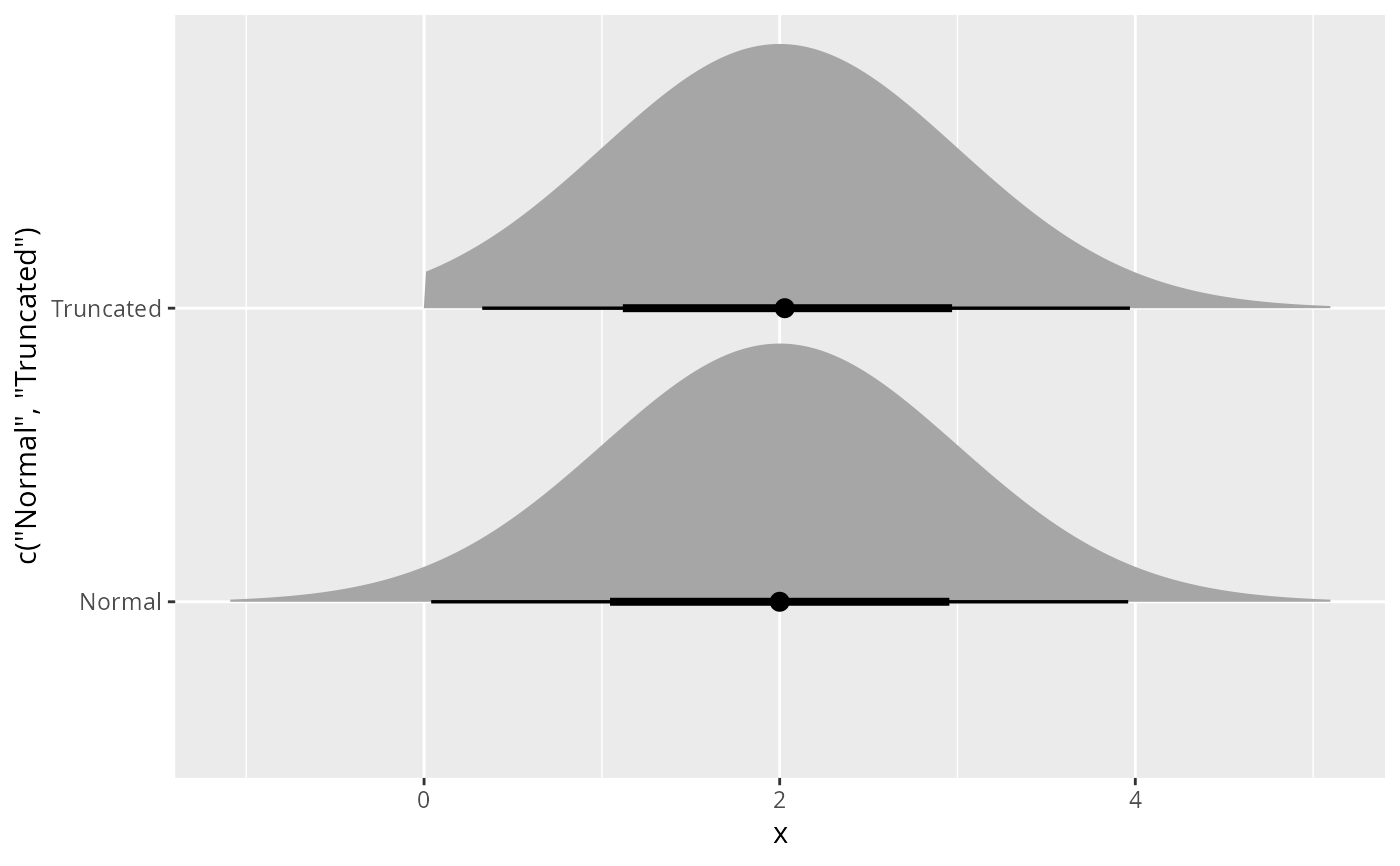
dist <- dist_truncated(dist_normal(2,1), lower = 0)

dist
#> <distribution[1]>
#> [1] N(2, 1)[0,Inf]
mean(dist)
#> [1] 2.055248
variance(dist)
#> [1] 0.8864519

generate(dist, 10)
#> [[1]]
#>  [1] 1.7415534 0.7471783 2.6599636 2.4990165 2.9423018 1.9174482 3.7826920
#>  [8] 1.4461079 3.6731440 1.4203806
#>

density(dist, 2)
#> [1] 0.4082296
density(dist, 2, log = TRUE)
#> [1] -0.8959256

cdf(dist, 4)
#> [1] 0.9767203

quantile(dist, 0.7)
#> [1] 2.544133

if(requireNamespace("ggdist")) {
library(ggplot2)
ggplot() +
  ggdist::stat_dist_halfeye(
    aes(y = c("Normal", "Truncated"),
        dist = c(dist_normal(2,1), dist_truncated(dist_normal(2,1), lower = 0)))
  )
}