Plant Species Traits Data
plantTraits.RdThis dataset constitutes a description of 136 plant species according to biological attributes (morphological or reproductive)
data(plantTraits)Format
A data frame with 136 observations on the following 31 variables.
pdiasDiaspore mass (mg)
longindexSeed bank longevity
durflowFlowering duration
heightPlant height, an ordered factor with levels
1<2< ... <8.
% Plant height}{an ordered factor with levels \code{1} <10cm < \code{2} 10-30cm< \code{3} 30-60cm< \code{4}60-100cm < \code{5}1-3m < \code{6}3-6m < \code{7}:6-15m < \code{8}>15m}
begflowTime of first flowering, an ordered factor with levels
1<2<3<4<5<6<7<8<9
% {\code{begflow}}{an ordered factor with levels \code{1} january< \code{2} february< \code{3} march< \code{4}april < \code{5} may< \code{6} june< \code{7} july< \code{8}august < \code{9}september}
mycorMycorrhizas, an ordered factor with levels
0never <1sometimes<2alwaysvegaeraerial vegetative propagation, an ordered factor with levels
0never <1present but limited<2important.vegsoutunderground vegetative propagation, an ordered factor with 3 levels identical to
vegaerabove.autopollselfing pollination, an ordered factor with levels
0never <1rare <2often< the rule3insectsinsect pollination, an ordered factor with 5 levels
0< ... <4.windwind pollination, an ordered factor with 5 levels
0< ... <4.ligna binary factor with levels
0:1, indicating if plant is woody.piqa binary factor indicating if plant is thorny.
rosa binary factor indicating if plant is rosette.
semirossemi-rosette plant, a binary factor (
0: no;1: yes).leafyleafy plant, a binary factor.
sumansummer annual, a binary factor.
winanwinter annual, a binary factor.
monocarpmonocarpic perennial, a binary factor.
polycarppolycarpic perennial, a binary factor.
seasaesseasonal aestival leaves, a binary factor.
seashivseasonal hibernal leaves, a binary factor.
seasverseasonal vernal leaves, a binary factor.
everalwleaves always evergreen, a binary factor.
everpartileaves partially evergreen, a binary factor.
elaiofruits with an elaiosome (dispersed by ants), a binary factor.
endozooendozoochorous fruits, a binary factor.
epizooepizoochorous fruits, a binary factor.
aquataquatic dispersal fruits, a binary factor.
windglwind dispersed fruits, a binary factor.
unspunspecialized mechanism of seed dispersal, a binary factor.
Details
Most of factor attributes are not disjunctive. For example, a plant can be usually pollinated by insects but sometimes self-pollination can occured.
Source
Vallet, Jeanne (2005) Structuration de communautés végétales et analyse comparative de traits biologiques le long d'un gradient d'urbanisation. Mémoire de Master 2 'Ecologie-Biodiversité-Evolution'; Université Paris Sud XI, 30p.+ annexes (in french)
Examples
data(plantTraits)
## Calculation of a dissimilarity matrix
library(cluster)
dai.b <- daisy(plantTraits,
type = list(ordratio = 4:11, symm = 12:13, asymm = 14:31))
## Hierarchical classification
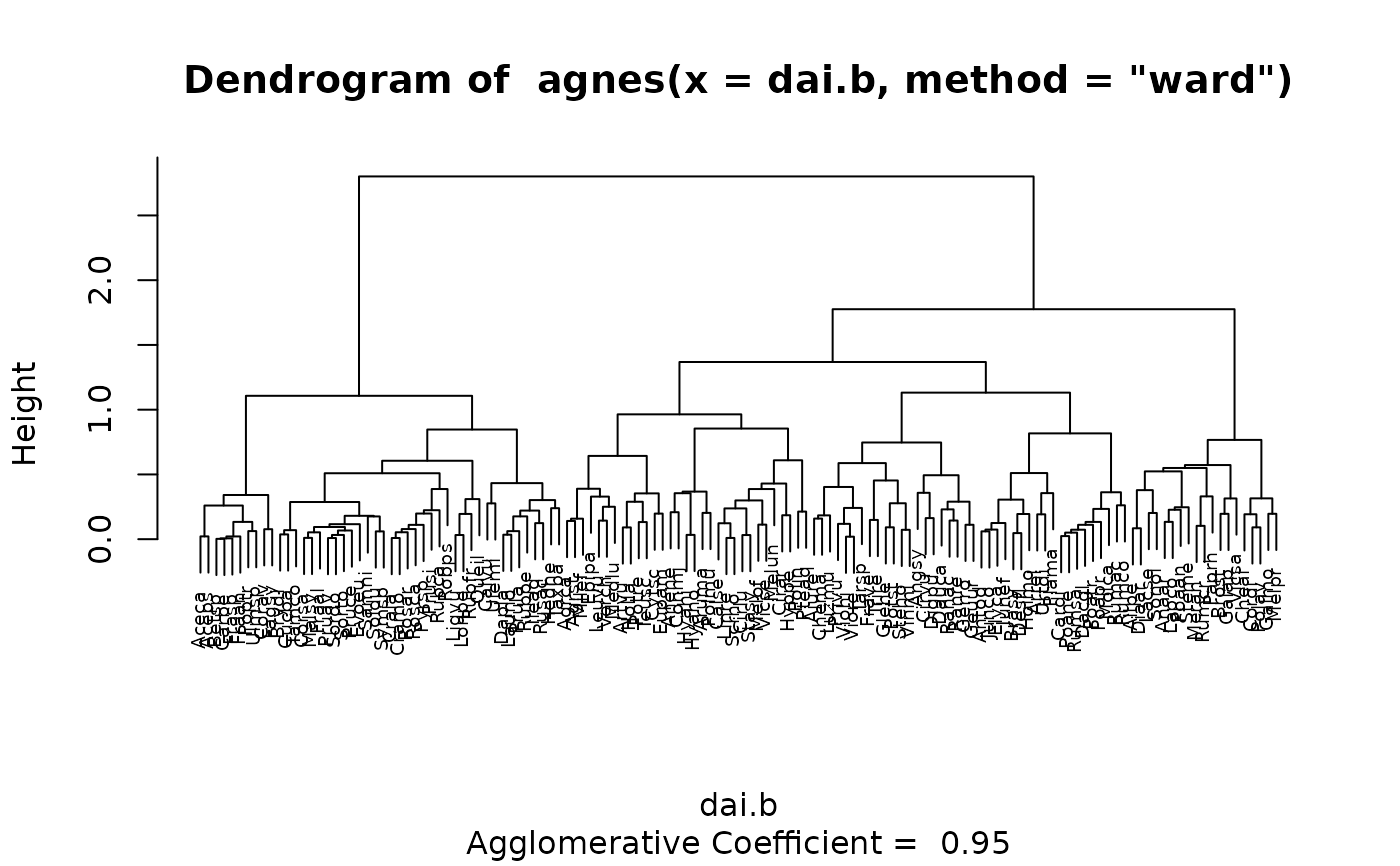
agn.trts <- agnes(dai.b, method="ward")
plot(agn.trts, which.plots = 2, cex= 0.6)
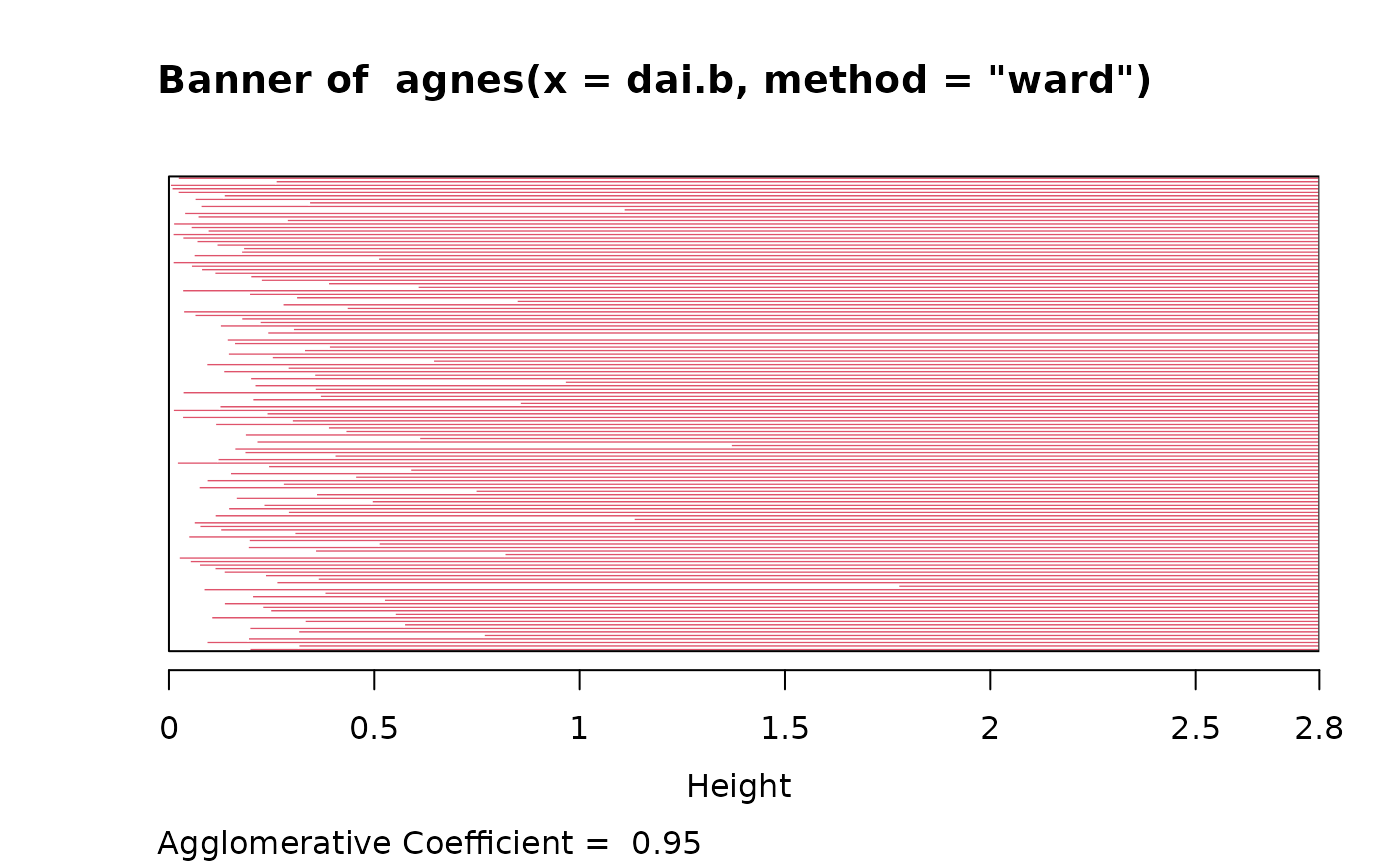
 plot(agn.trts, which.plots = 1)
 cutree6 <- cutree(agn.trts, k=6)
cutree6
#> [1] 1 1 2 2 3 4 4 2 3 5 5 2 2 1 5 4 6 2 6 1 5 4 3 2 2 3 2 1 4 6 6 6 6 2 5 6 3
#> [38] 5 4 3 5 2 2 6 1 6 1 1 3 4 4 3 3 3 6 2 5 2 2 2 6 5 5 4 4 6 2 6 2 6 3 6 2 2
#> [75] 4 2 4 2 5 4 5 4 5 5 5 4 2 2 1 2 3 3 6 6 6 6 2 6 6 3 3 6 6 6 6 6 6 5 5 4 5
#> [112] 6 6 2 6 4 6 6 2 3 4 6 6 3 6 2 3 6 1 5 2 4 2 3 3 3
## Principal Coordinate Analysis
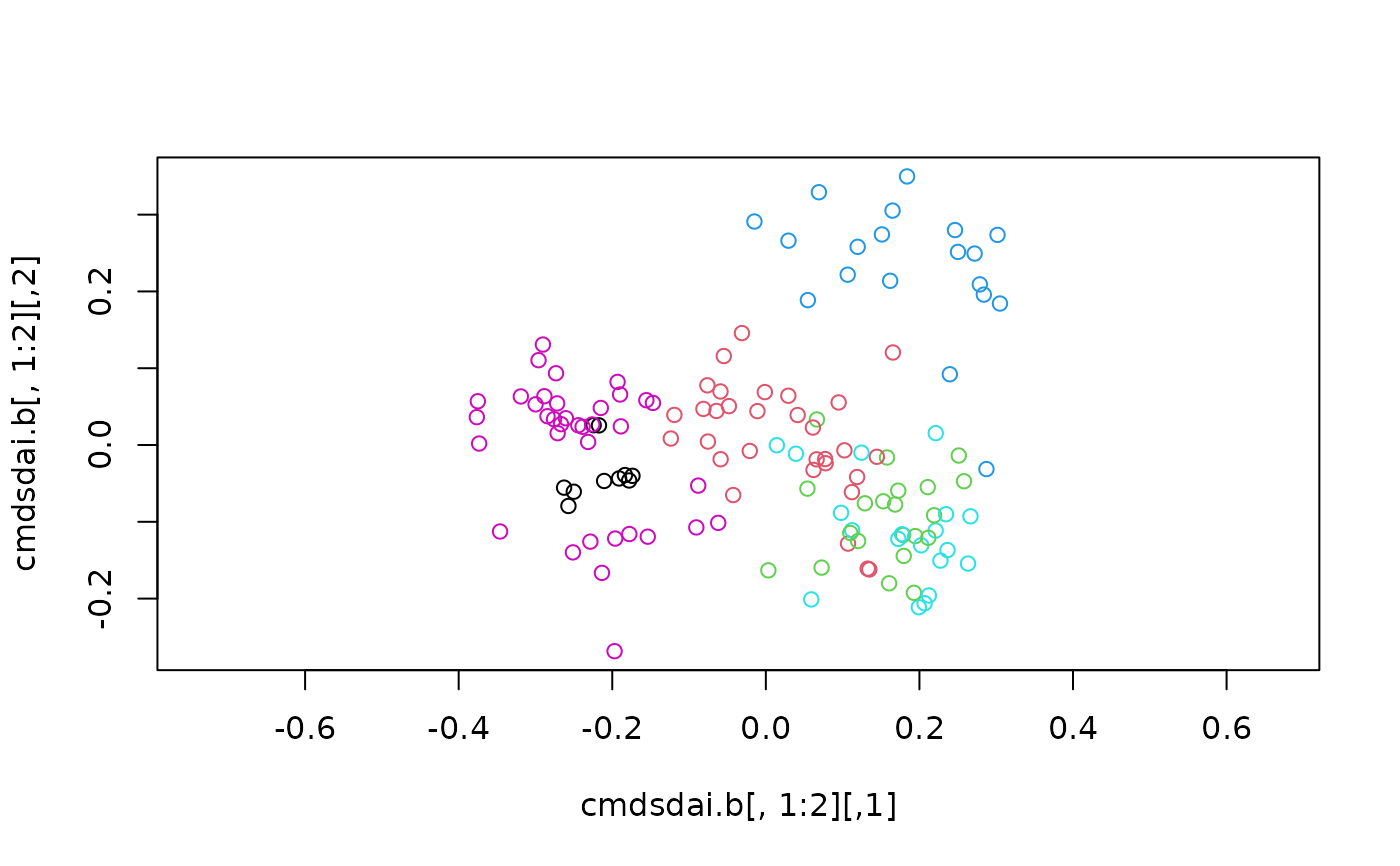
cmdsdai.b <- cmdscale(dai.b, k=6)
plot(cmdsdai.b[, 1:2], asp = 1, col = cutree6)
cutree6 <- cutree(agn.trts, k=6)
cutree6
#> [1] 1 1 2 2 3 4 4 2 3 5 5 2 2 1 5 4 6 2 6 1 5 4 3 2 2 3 2 1 4 6 6 6 6 2 5 6 3
#> [38] 5 4 3 5 2 2 6 1 6 1 1 3 4 4 3 3 3 6 2 5 2 2 2 6 5 5 4 4 6 2 6 2 6 3 6 2 2
#> [75] 4 2 4 2 5 4 5 4 5 5 5 4 2 2 1 2 3 3 6 6 6 6 2 6 6 3 3 6 6 6 6 6 6 5 5 4 5
#> [112] 6 6 2 6 4 6 6 2 3 4 6 6 3 6 2 3 6 1 5 2 4 2 3 3 3
## Principal Coordinate Analysis
cmdsdai.b <- cmdscale(dai.b, k=6)
plot(cmdsdai.b[, 1:2], asp = 1, col = cutree6)