Attributes of Animals
animals.RdThis data set considers 6 binary attributes for 20 animals.
data(animals)Format
A data frame with 20 observations on 6 variables:
| [ , 1] | war | warm-blooded |
| [ , 2] | fly | can fly |
| [ , 3] | ver | vertebrate |
| [ , 4] | end | endangered |
| [ , 5] | gro | live in groups |
| [ , 6] | hai | have hair |
All variables are encoded as 1 = 'no', 2 = 'yes'.
Source
Leonard Kaufman and Peter J. Rousseeuw (1990): Finding Groups in Data (pp 297ff). New York: Wiley.
Details
This dataset is useful for illustrating monothetic (only a single variable is used for each split) hierarchical clustering.
References
see Struyf, Hubert & Rousseeuw (1996), in agnes.
Examples
data(animals)
apply(animals,2, table) # simple overview
#>   war fly ver end gro hai
#> 1  10  16   6  12   6  11
#> 2  10   4  14   6  11   9

ma <- mona(animals)
ma
#> mona(x, ..) fit;  x of dimension 20x6
#> Because of NA's, revised data:
#>     war fly ver end gro hai
#> ant   0   0   0   0   1   0
#> bee   0   1   0   0   1   1
#> cat   1   0   1   0   0   1
#> cpl   0   0   0   0   0   1
#> chi   1   0   1   1   1   1
#> cow   1   0   1   0   1   1
#> duc   1   1   1   0   1   0
#> eag   1   1   1   1   0   0
#> ele   1   0   1   1   1   0
#> fly   0   1   0   0   0   0
#> fro   0   0   1   1   0   0
#> her   0   0   1   0   1   0
#> lio   1   0   1   1   1   1
#> liz   0   0   1   0   0   0
#> lob   0   0   0   0   0   0
#> man   1   0   1   1   1   1
#> rab   1   0   1   0   1   1
#> sal   0   0   1   0   0   0
#> spi   0   0   0   0   0   1
#> wha   1   0   1   1   1   0
#> Order of objects:
#>  [1] ant cpl spi lob bee fly fro her liz sal cat cow rab chi lio man ele wha duc
#> [20] eag
#> Variable used:
#>  [1] gro  NULL hai  fly  gro  ver  end  gro  NULL war  gro  NULL end  NULL NULL
#> [16] hai  NULL fly  end
#> Separation step:
#>  [1] 4 0 5 3 4 2 3 4 0 1 4 0 3 0 0 4 0 2 3
#>
#> Available components:
#> [1] "data"      "hasNA"     "order"     "variable"  "step"      "order.lab"
#> [7] "call"
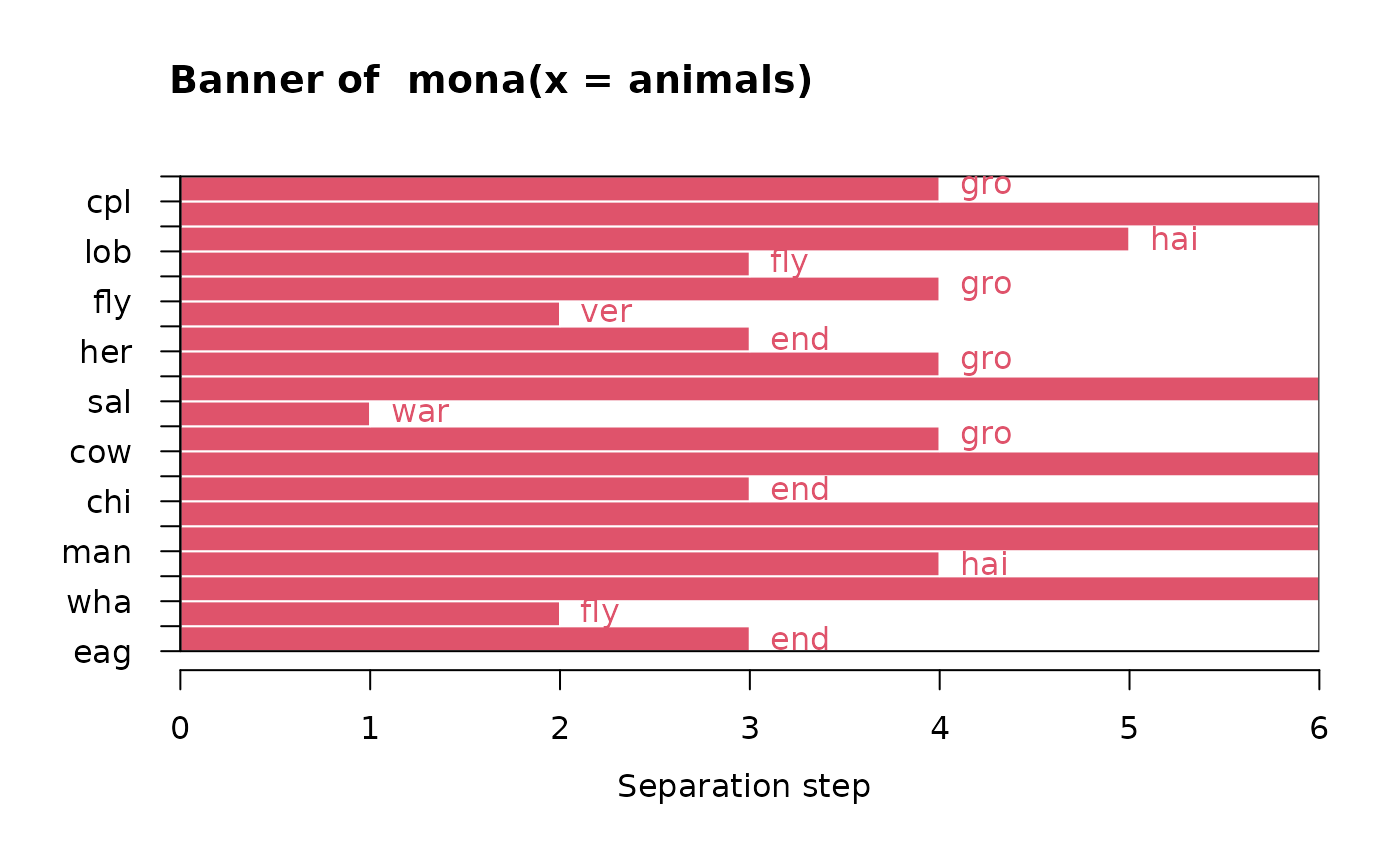
## Plot similar to Figure 10 in Struyf et al (1996)
plot(ma)