Nonparametric Density Estimates
densityPlot.RddensityPlot contructs and graphs nonparametric density estimates, possibly conditioned on a factor, using the standard R density function or by default adaptiveKernel, which computes an adaptive kernel density estimate.
depan provides the Epanechnikov kernel and dbiwt provides the biweight kernel.
Usage
densityPlot(x, ...)

# Default S3 method
densityPlot(x, g, method=c("adaptive", "kernel"),
    bw=if (method == "adaptive") bw.nrd0 else "SJ", adjust=1,
    kernel, xlim, ylim,
    normalize=FALSE, xlab=deparse(substitute(x)), ylab="Density", main="",
    col=carPalette(), lty=seq_along(col), lwd=2, grid=TRUE,
    legend=TRUE, show.bw=FALSE, rug=TRUE, ...)

# S3 method for class 'formula'
densityPlot(formula, data=NULL, subset,
    na.action=NULL, xlab, ylab, main="", legend=TRUE, ...)

adaptiveKernel(x, kernel=dnorm, bw=bw.nrd0, adjust=1.0, n=500,
    from, to, cut=3, na.rm=TRUE)

depan(x)
dbiwt(x)
Arguments
- x
a numeric variable, the density of which is estimated; for
depananddbiwt, the argument of the kernel function.- g
an optional factor to divide the data.
- formula
an R model formula, of the form
~ variableto estimate the unconditional density ofvariable, orvariable ~ factorto estimate the density ofvariablewithin each level offactor.- data
an optional data frame containing the data.
- subset
an optional vector defining a subset of the data.
- na.action
a function to handle missing values; defaults to the value of the R
na.actionoption, initially set tona.omit.- method
either
"adaptive"(the default) for an adaptive-kernel estimate or"kernel"for a fixed-bandwidth kernel estimate.- bw
the geometric mean bandwidth for the adaptive-kernel or bandwidth of the kernel density estimate(s). Must be a numerical value or a function to compute the bandwidth (default
bw.nrd0) for the adaptive kernel estimate; for the kernel estimate, may either the quoted name of a rule to compute the bandwidth, or a numeric value. If plotting by groups,bwmay be a vector of values, one for each group. Seedensityandbw.SJfor details of the kernel estimator.- adjust
a multiplicative adjustment factor for the bandwidth; the default,
1, indicates no adjustment; if plotting by groups,adjustmay be a vector of adjustment factors, one for each group. The default bandwidth-selection rule tends to give a value that's too large if the distribution is asymmetric or has multiple modes; try settingadjust< 1, particularly for the adaptive-kernel estimator.- kernel
for
densityPlotthis is the name of the kernel function for the kernel estimator (the default is"gaussian", seedensity); or a kernel function for the adaptive-kernel estimator (the default isdnorm, producing the Gaussian kernel). Foradaptivekernelthis is a kernel function, defaulting todnorm, which is the Gaussian kernel (standard-normal density).- xlim, ylim
axis limits; if missing, determined from the range of x-values at which the densities are estimated and the estimated densities.
- normalize
if
TRUE(the default isFALSE), the estimated densities are rescaled to integrate approximately to 1; particularly useful if the density is estimated over a restricted domain, as whenfromortoare specified.- xlab
label for the horizontal-axis; defaults to the name of the variable
x.- ylab
label for the vertical axis; defaults to
"Density".- main
plot title; default is empty.
- col
vector of colors for the density estimate(s); defaults to the color
carPalette.- lty
vector of line types for the density estimate(s); defaults to the successive integers, starting at 1.
- lwd
line width for the density estimate(s); defaults to 2.
- grid
if
TRUE(the default), grid lines are drawn on the plot.- legend
a list of up to two named elements:
location, for the legend when densities are plotted for several groups, defaults to"upperright"(seelegend); andtitleof the legend, which defaults to the name of the grouping factor. IfTRUE, the default, the default values are used; ifFALSE, the legend is suppressed.- n
number of equally spaced points at which the adaptive-kernel estimator is evaluated; the default is
500.- from, to, cut
the range over which the density estimate is computed; the default, if missing, is
min(x) - cut*bw, max(x) + cut*bw.- na.rm
remove missing values from
xin computing the adaptive-kernel estimate? The default isTRUE.- show.bw
if
TRUE, show the bandwidth(s) in the horizontal-axis label or (for multiple groups) the legend; the default isFALSE.- rug
if
TRUE(the default), draw a rug plot (one-dimentional scatterplot) at the bottom of the density estimate.- ...
arguments to be passed down to graphics functions.
Details
If you use a different kernel function than the default dnorm that has a
standard deviation different from 1 along with an automatic rule
like the default function bw.nrd0, you can attach an attribute to the kernel
function named "scale" that gives its standard deviation. This is true for
the two supplied kernels, depan and dbiwt
Value
densityPlot invisibly returns the "density" object computed (or list of "density" objects) and draws a graph.
adaptiveKernel returns an object of class "density"
(see density).
References
Fox, J. and Weisberg, S. (2019) An R Companion to Applied Regression, Third Edition, Sage.
W. N. Venables and B. D. Ripley (2002) Modern Applied Statistics with S. New York: Springer.
B.W. Silverman (1986) Density Estimation for Statistics and Data Analysis. London: Chapman and Hall.
Author
John Fox jfox@mcmaster.ca
Examples
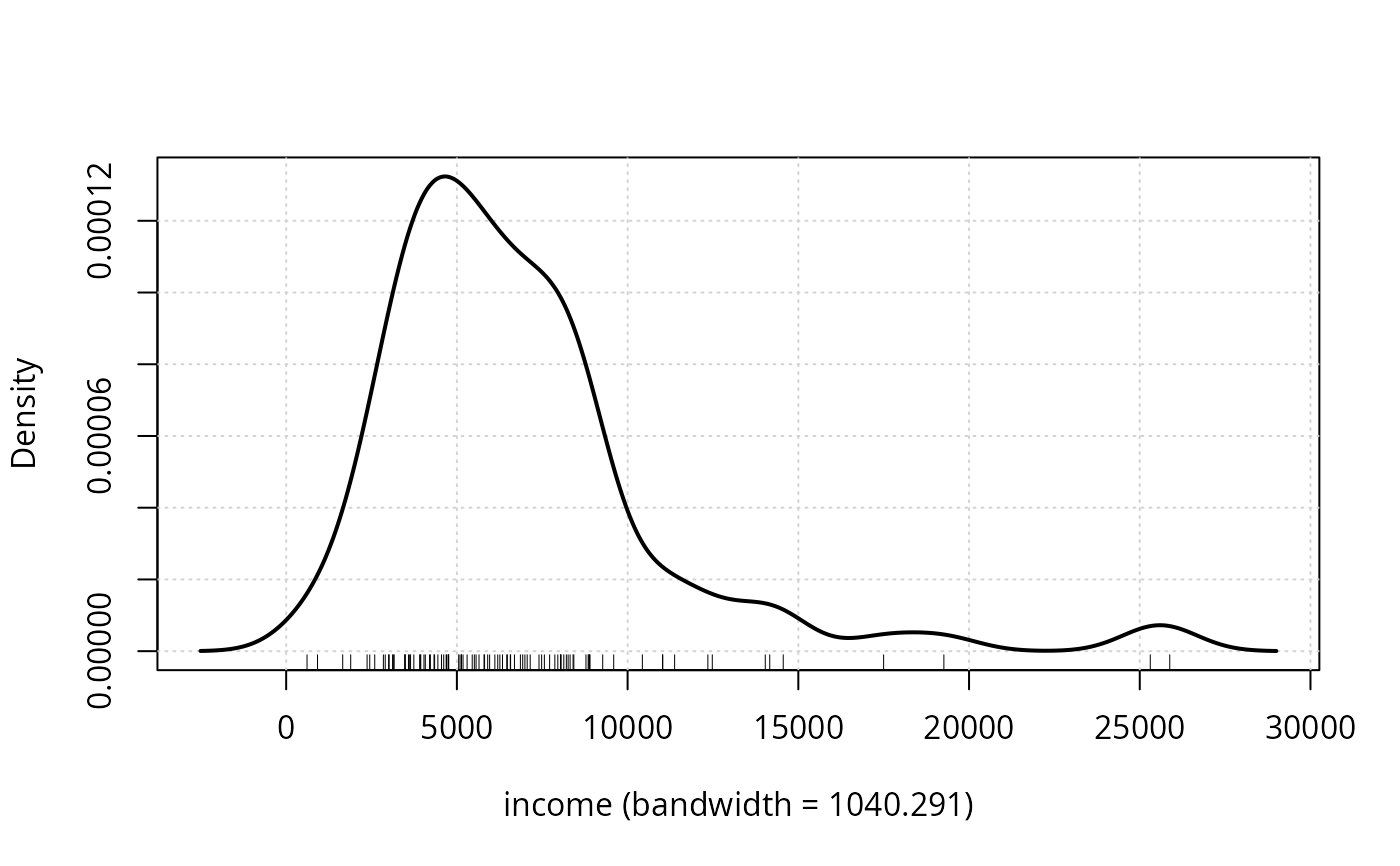
densityPlot(~ income, show.bw=TRUE, method="kernel", data=Prestige)
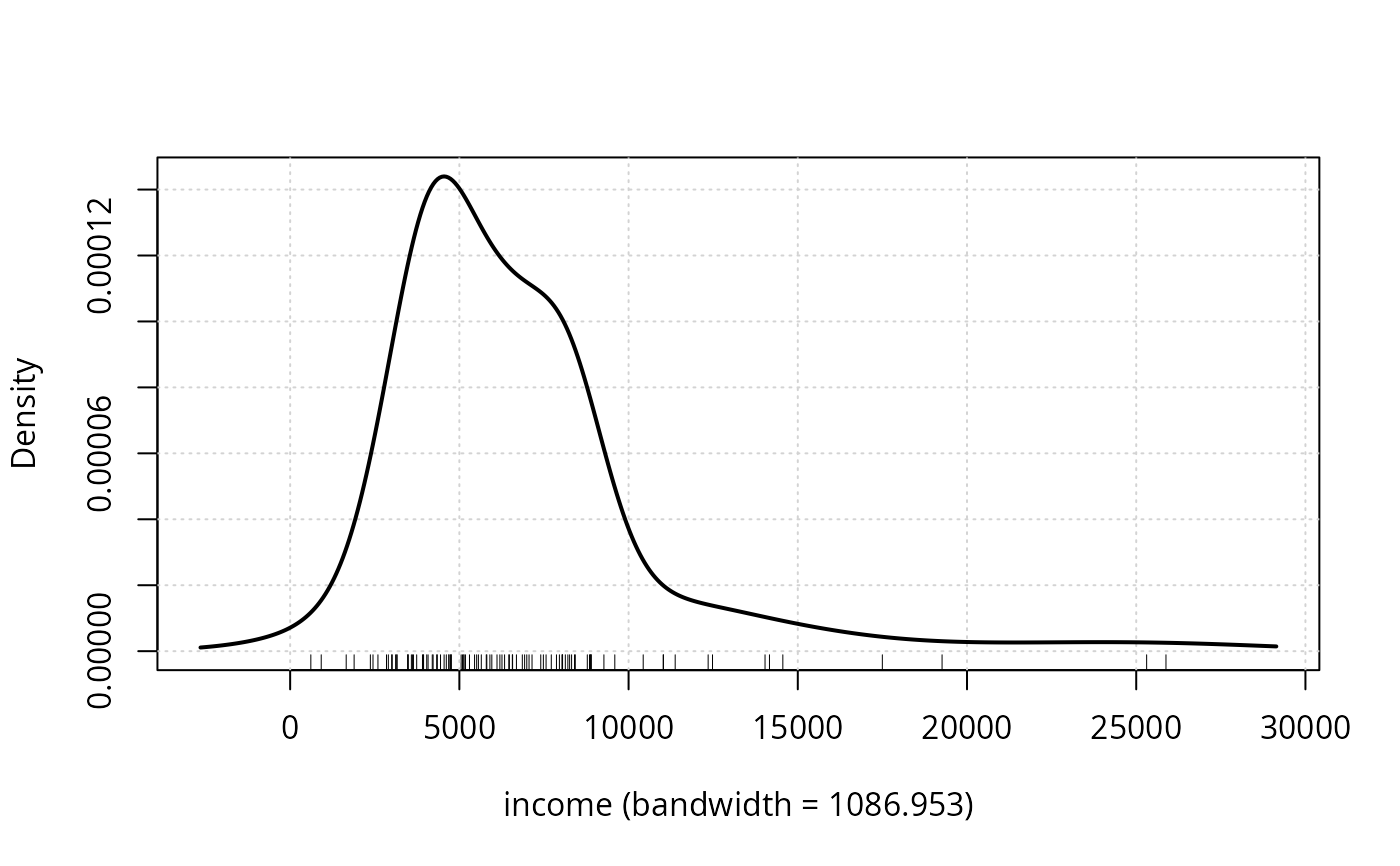
 densityPlot(~ income, show.bw=TRUE, data=Prestige)
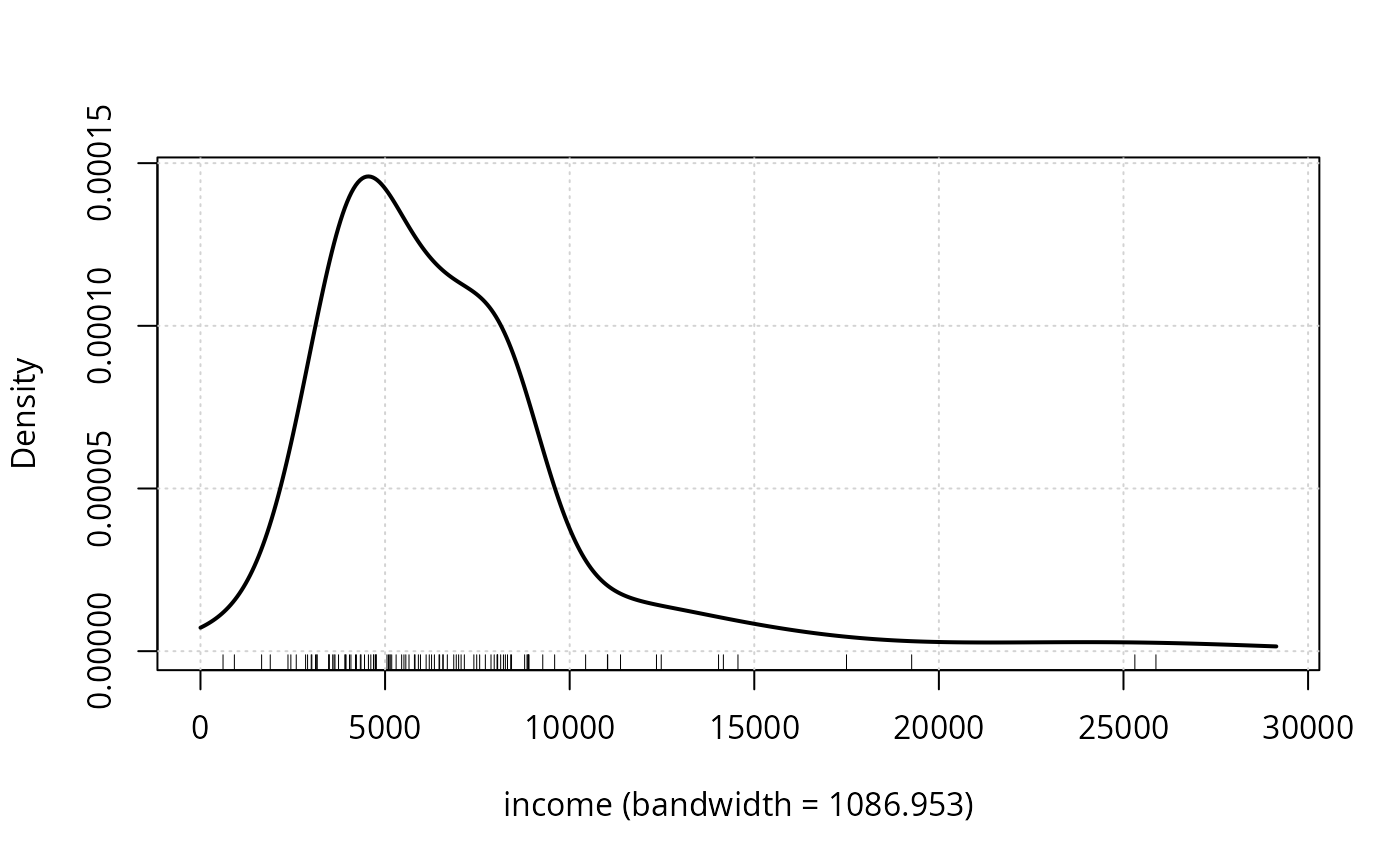
 densityPlot(~ income, from=0, normalize=TRUE, show.bw=TRUE, data=Prestige)
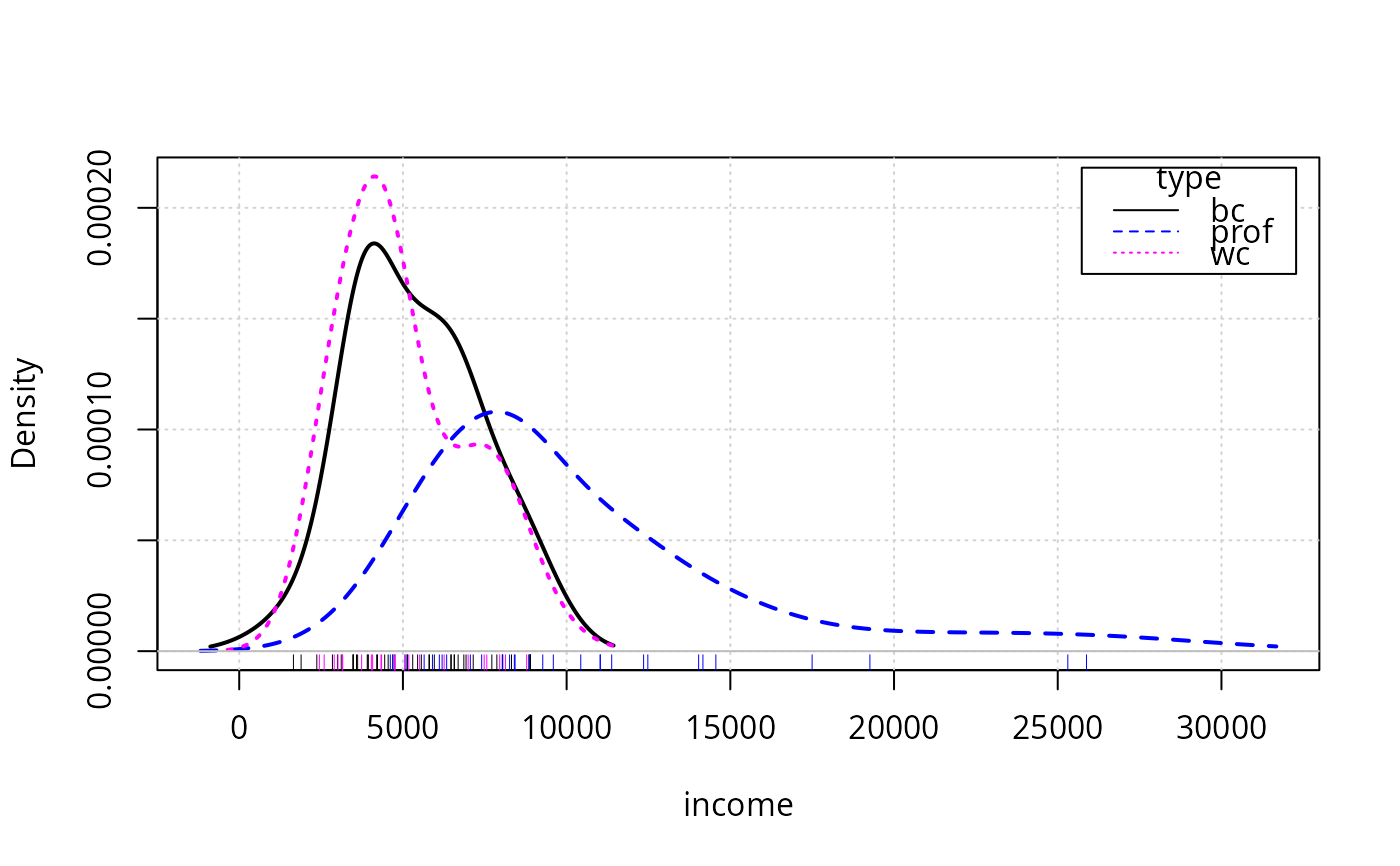
 densityPlot(income ~ type, data=Prestige)
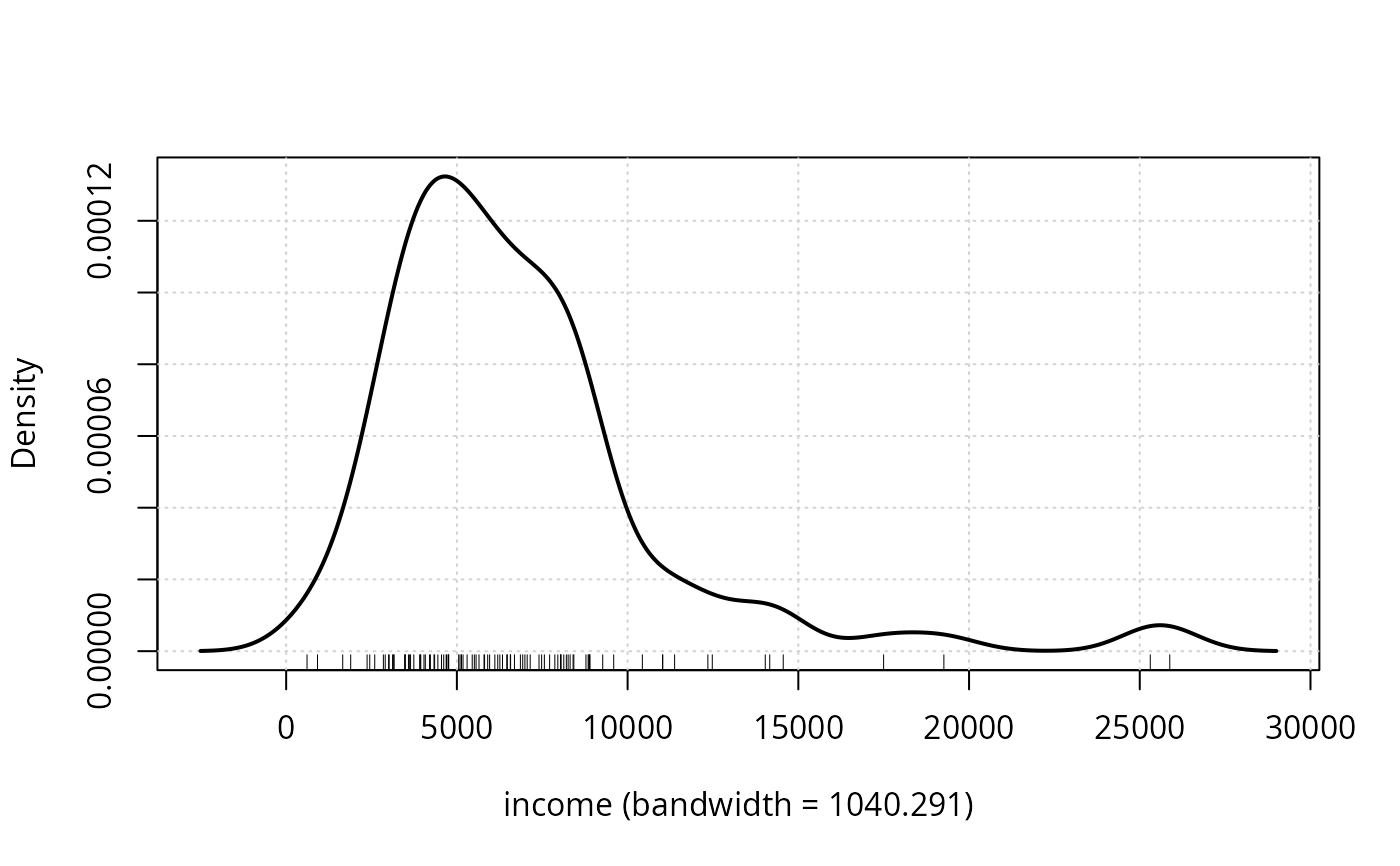
 densityPlot(~ income, show.bw=TRUE, method="kernel", data=Prestige)
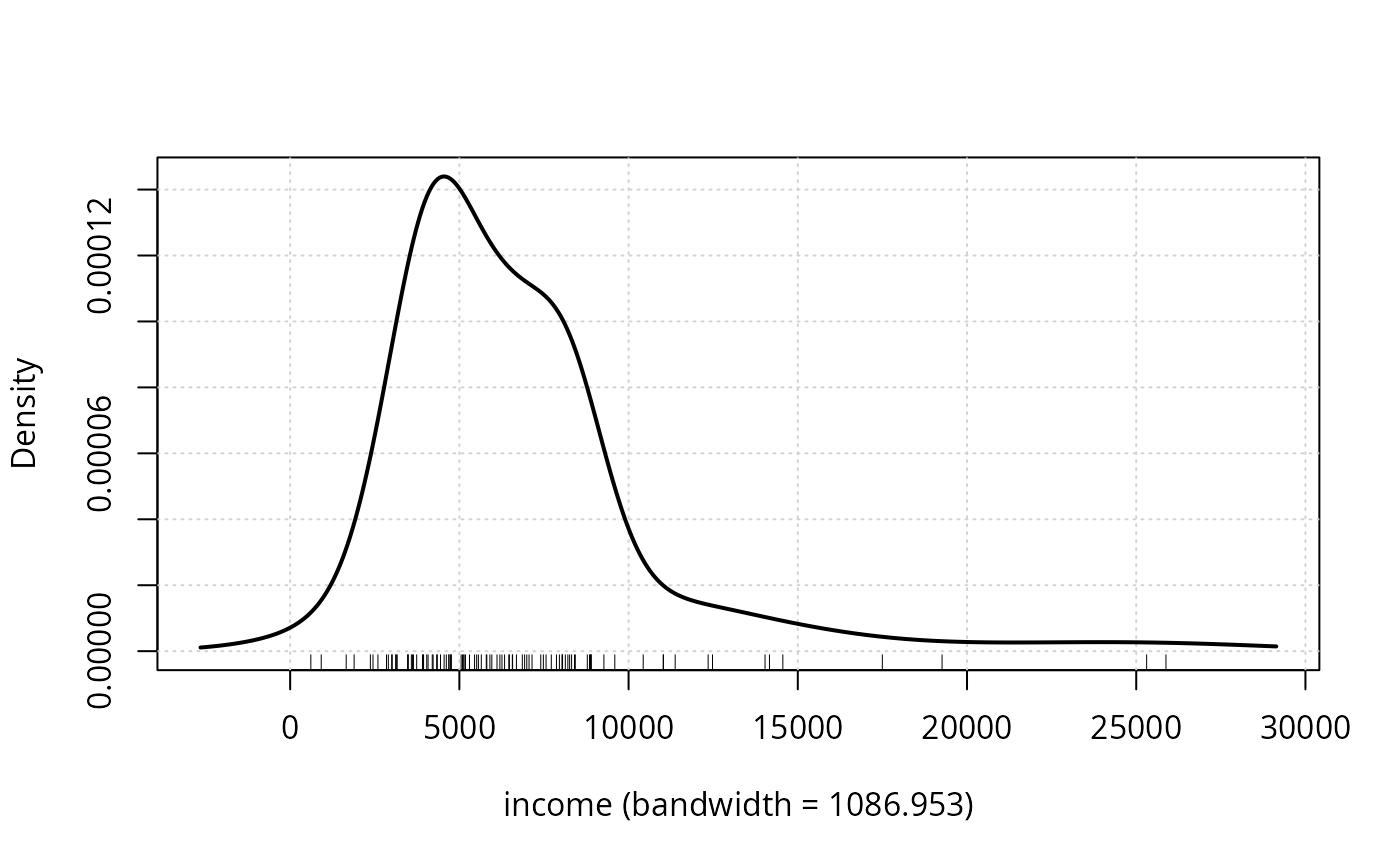
 densityPlot(~ income, show.bw=TRUE, data=Prestige)
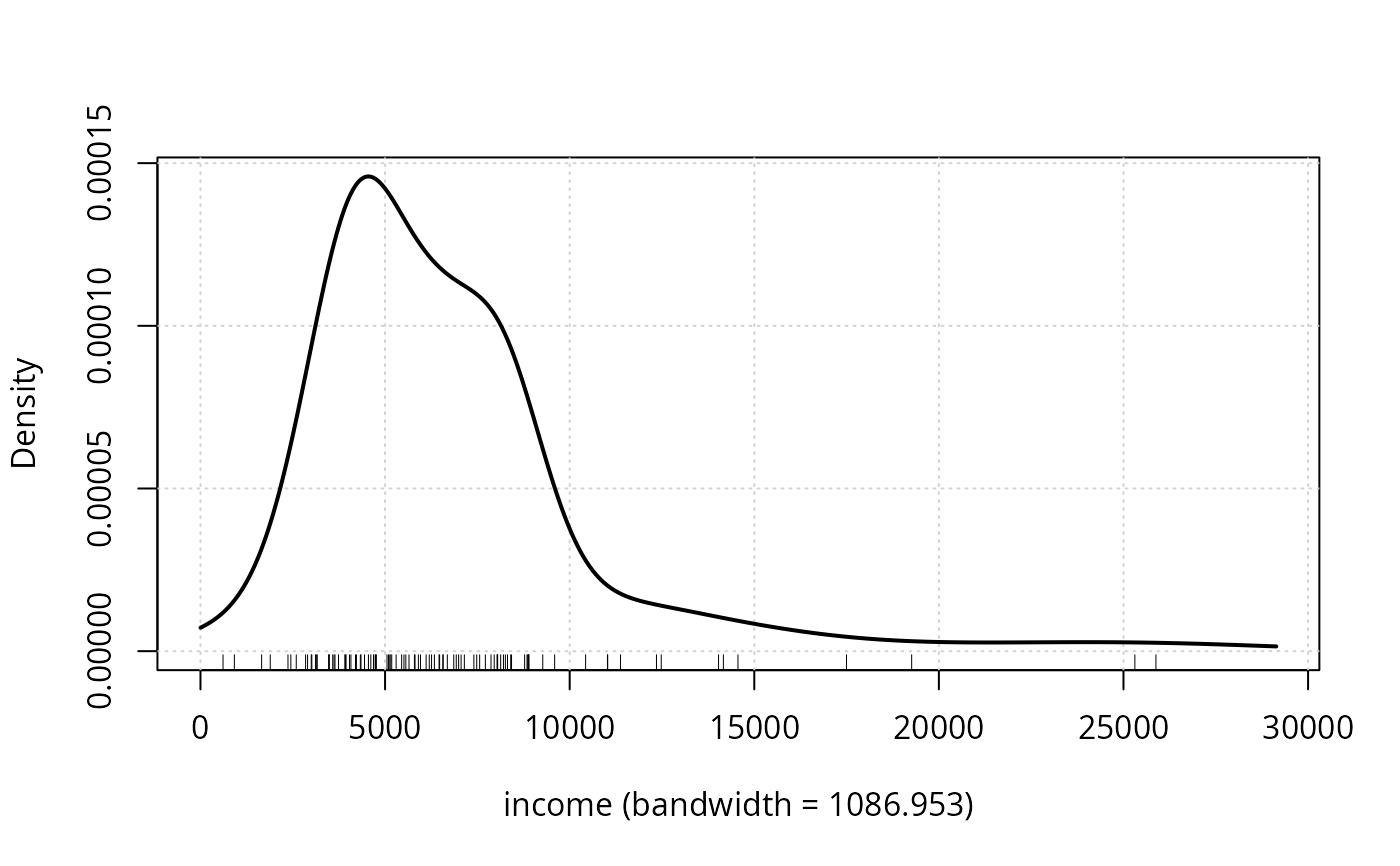
 densityPlot(~ income, from=0, normalize=TRUE, show.bw=TRUE, data=Prestige)
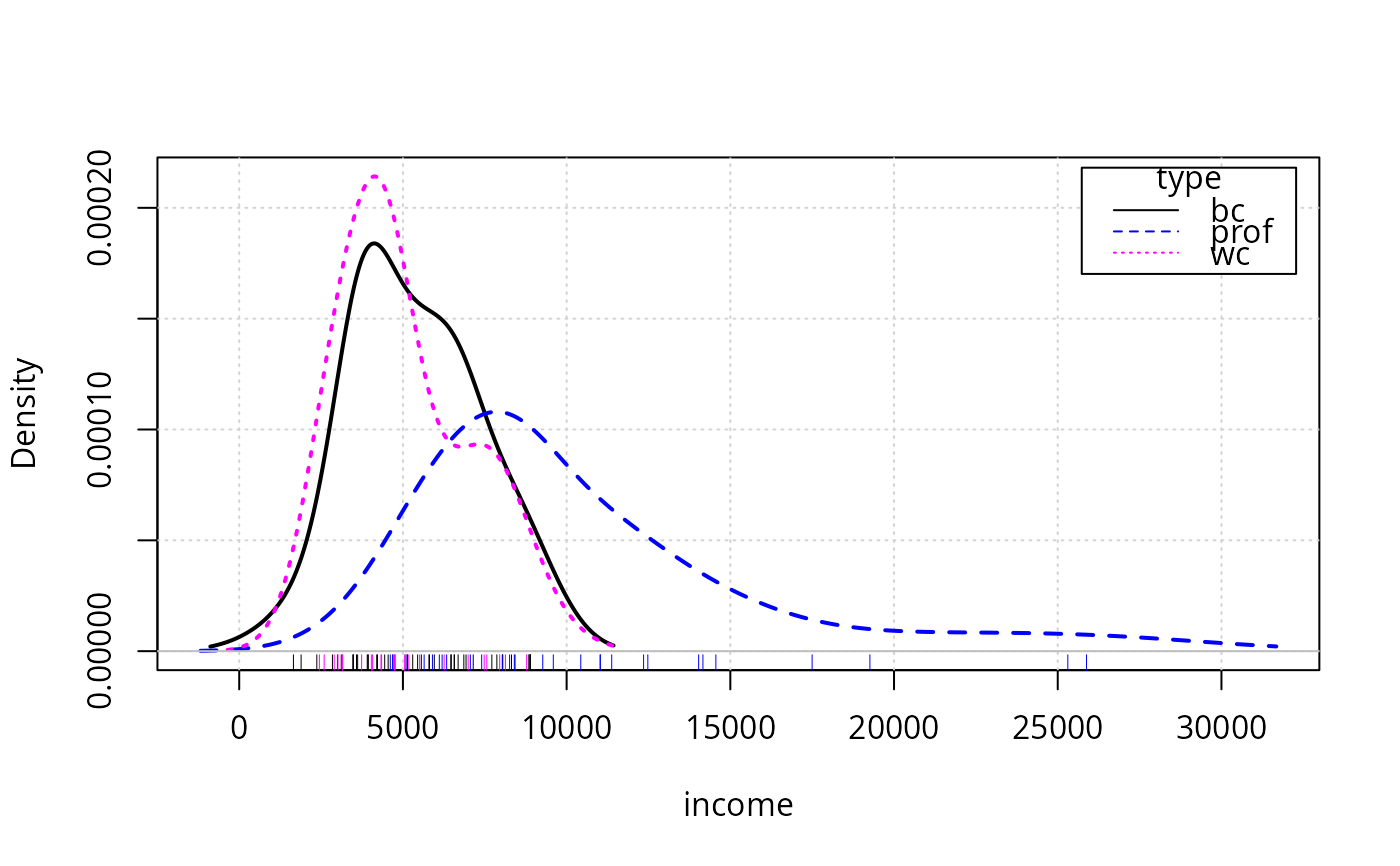
 densityPlot(income ~ type, kernel=depan, data=Prestige)
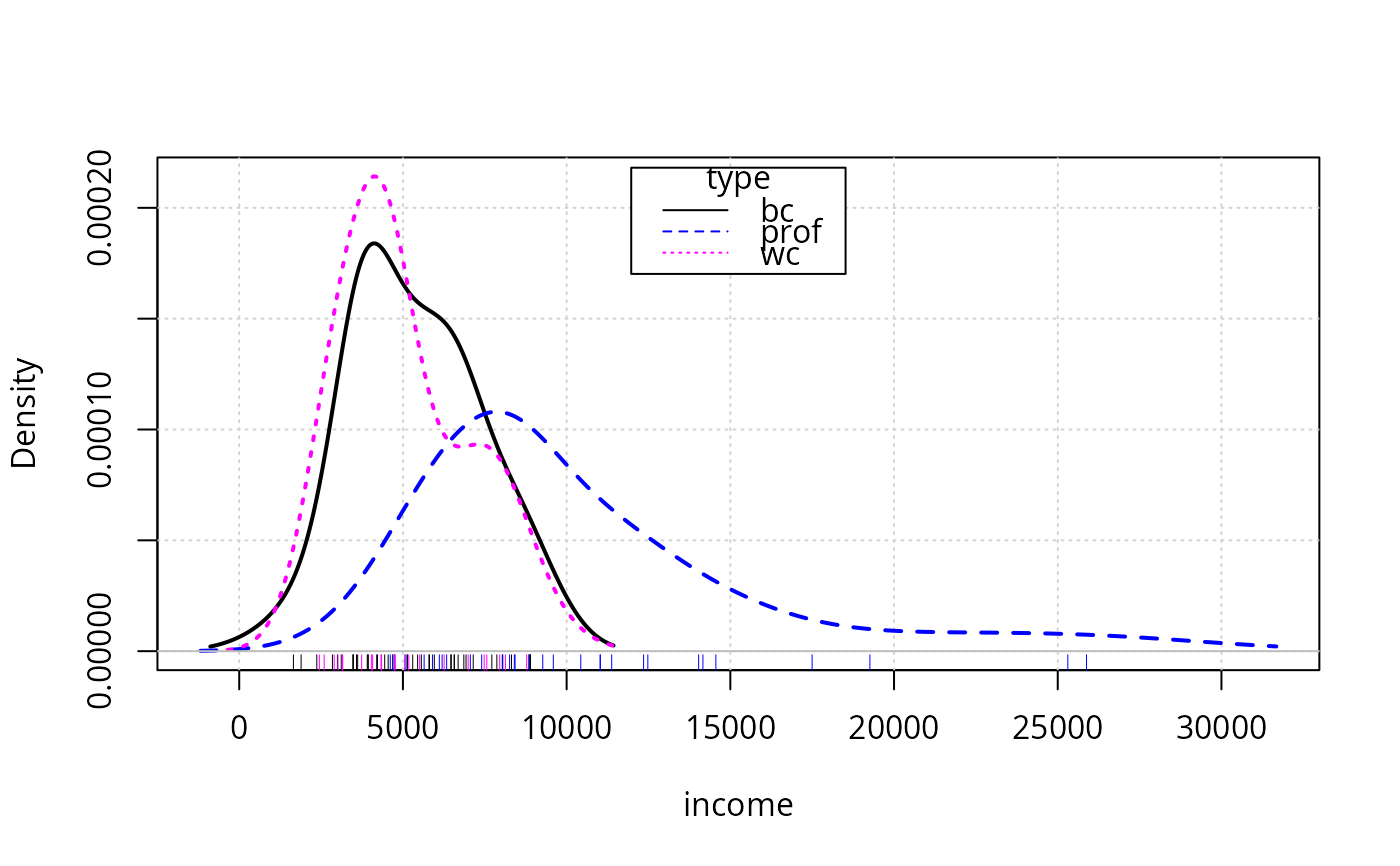
 densityPlot(income ~ type, kernel=depan, legend=list(location="top"), data=Prestige)
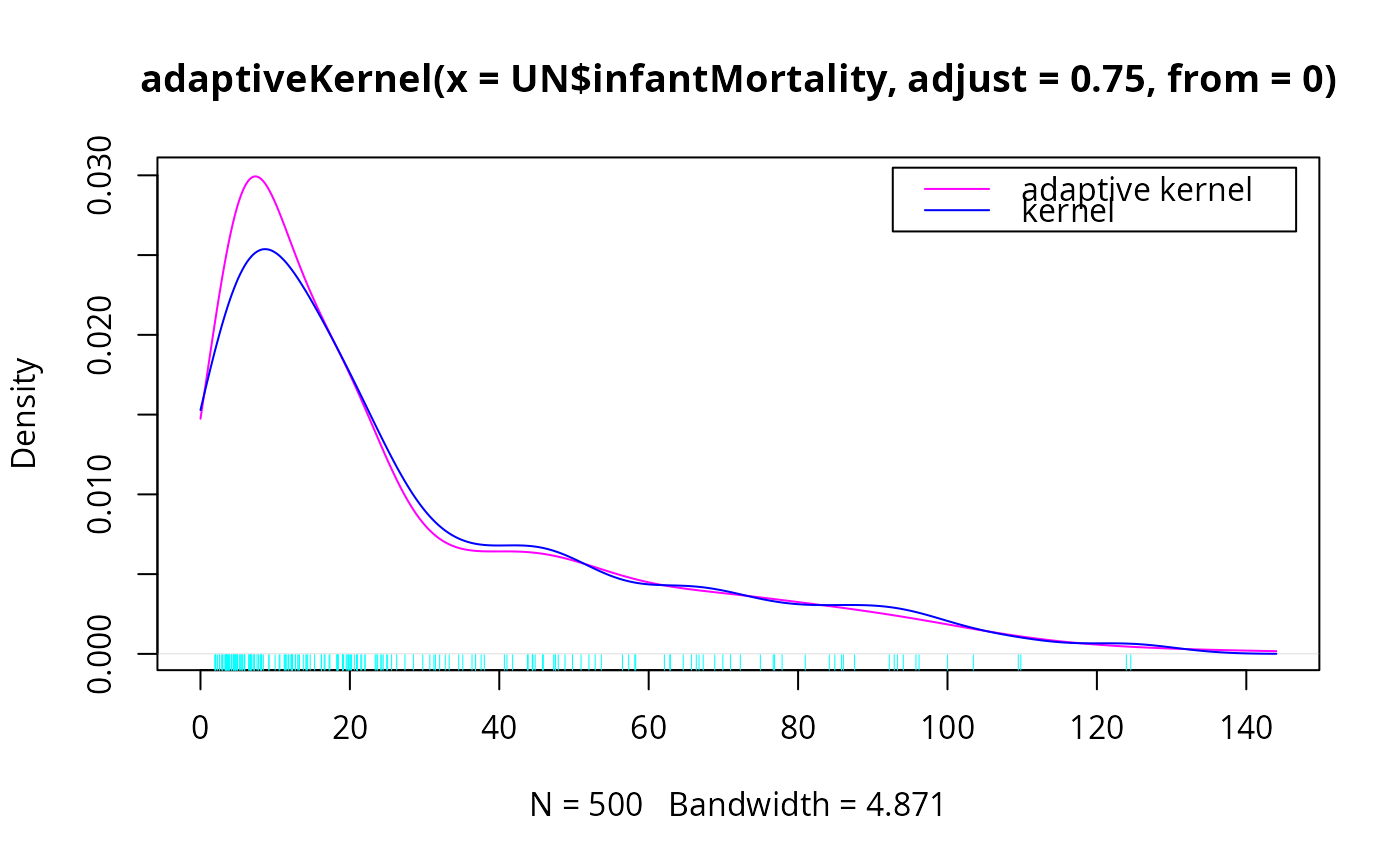
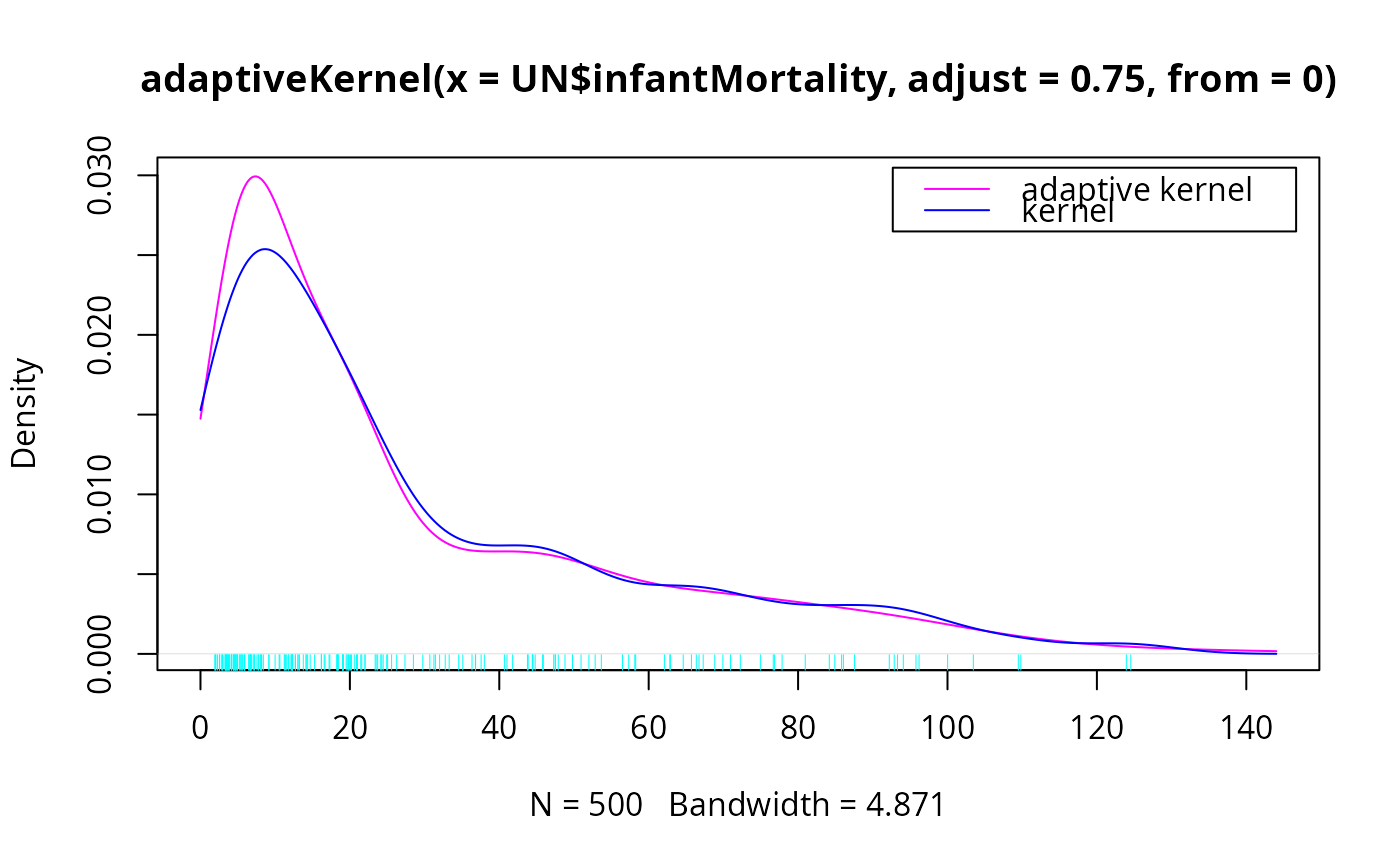
 plot(adaptiveKernel(UN$infantMortality, from=0, adjust=0.75), col="magenta")
lines(density(na.omit(UN$infantMortality), from=0, adjust=0.75), col="blue")
rug(UN$infantMortality, col="cyan")
legend("topright", col=c("magenta", "blue"), lty=1,
legend=c("adaptive kernel", "kernel"), inset=0.02)
plot(adaptiveKernel(UN$infantMortality, from=0, adjust=0.75), col="magenta")
lines(density(na.omit(UN$infantMortality), from=0, adjust=0.75), col="blue")
rug(UN$infantMortality, col="cyan")
legend("topright", col=c("magenta", "blue"), lty=1,
legend=c("adaptive kernel", "kernel"), inset=0.02)
 plot(adaptiveKernel(UN$infantMortality, from=0, adjust=0.75), col="magenta")
lines(density(na.omit(UN$infantMortality), from=0, adjust=0.75), col="blue")
rug(UN$infantMortality, col="cyan")
legend("topright", col=c("magenta", "blue"), lty=1,
legend=c("adaptive kernel", "kernel"), inset=0.02)
plot(adaptiveKernel(UN$infantMortality, from=0, adjust=0.75), col="magenta")
lines(density(na.omit(UN$infantMortality), from=0, adjust=0.75), col="blue")
rug(UN$infantMortality, col="cyan")
legend("topright", col=c("magenta", "blue"), lty=1,
legend=c("adaptive kernel", "kernel"), inset=0.02)