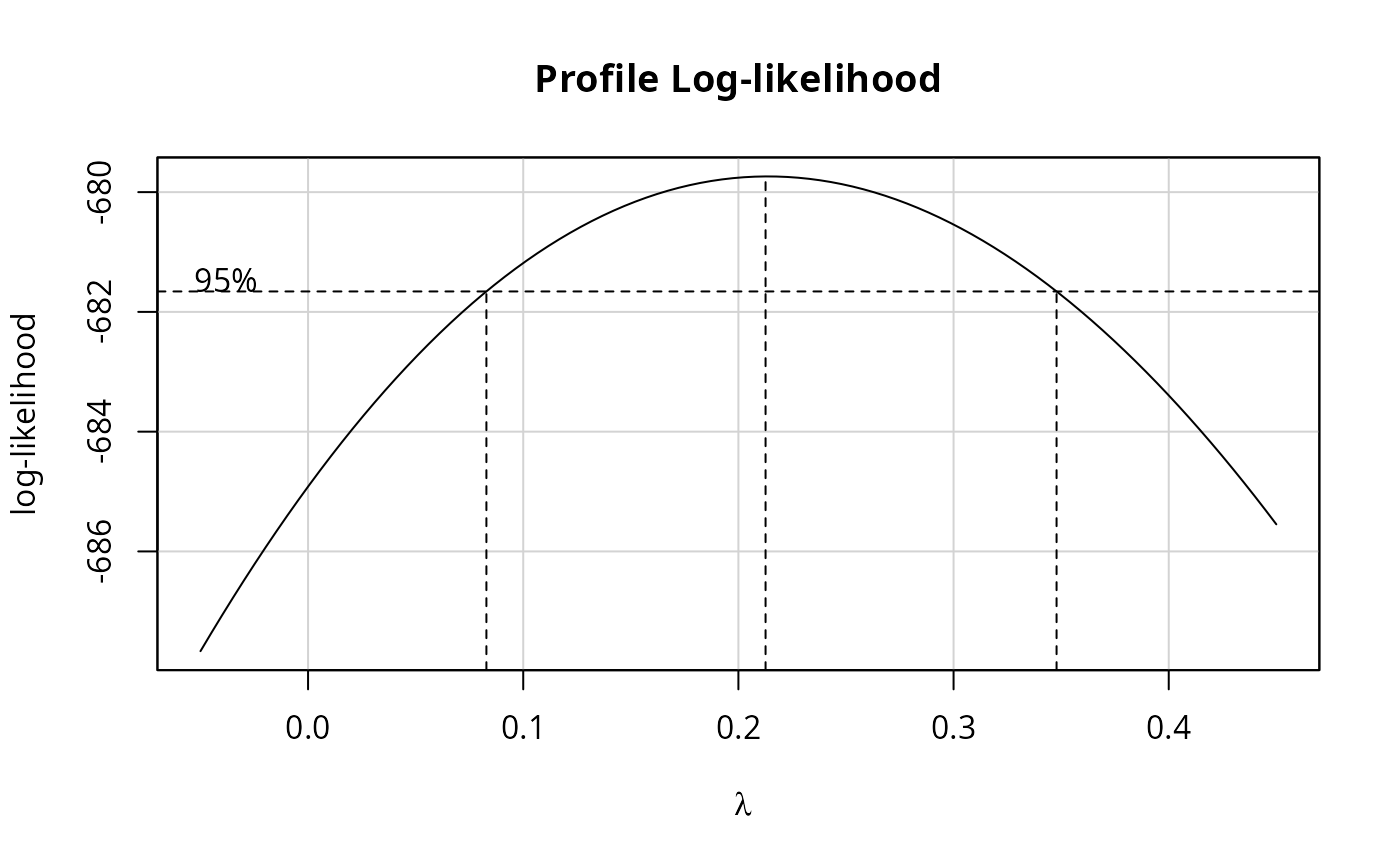
Graph the profile log-likelihood for Box-Cox transformations in 1D, or in 2D with the bcnPower family.
boxCox.RdComputes and optionally plots profile log-likelihoods for the parameter of the
Box-Cox power family, the Yeo-Johnson power family, or for either of the parameters in a bcnPower family. This is a slight generalization of the
boxcox function in the MASS package that allows for families of
transformations other than the Box-Cox power family. the boxCox2d function
produces a contour
plot of the two-dimensional likelihood profile for the bcnPower family.
Usage
boxCox(object, ...)

# Default S3 method
boxCox(object,
        lambda = seq(-2, 2, 1/10), plotit = TRUE,
        interp = plotit, eps = 1/50,
        xlab=NULL, ylab=NULL, main= "Profile Log-likelihood",
        family="bcPower",
        param=c("lambda", "gamma"), gamma=NULL,
        grid=TRUE, ...)

# S3 method for class 'formula'
boxCox(object, lambda = seq(-2, 2, 1/10), plotit = TRUE, family = "bcPower",
    param = c("lambda", "gamma"), gamma = NULL, grid = TRUE,
    ...)

# S3 method for class 'lm'
boxCox(object, lambda = seq(-2, 2, 1/10), plotit = TRUE, ...)

boxCox2d(x, ksds = 4, levels = c(0.5, 0.95, 0.99, 0.999),
                 main = "bcnPower Log-likelihood", grid=TRUE, ...)
Arguments
- object
a formula or fitted model object of class
lmoraov.- lambda
vector of values of \(\lambda\), with default (-2, 2) in steps of 0.1, where the profile log-likelihood will be evaluated.
- plotit
logical which controls whether the result should be plotted; default
TRUE.- interp
logical which controls whether spline interpolation is used. Default to
TRUEif plotting with lambda of length less than 100.- eps
Tolerance for lambda = 0; defaults to 0.02.
- xlab
defaults to
"lambda"or"gamma".- ylab
defaults to
"log-Likelihood"or for bcnPower family to the appropriate label.- family
Defaults to
"bcPower"for the Box-Cox power family of transformations. If set to"yjPower"the Yeo-Johnson family, which permits negative responses, is used. If set tobcnPowerthe function gives the profile log-likelihood for the parameter selected viaparam.- param
Relevant only to
family="bcnPower", produces a profile log-likelihood for the parameter selected, maximizing over the remaining parameter.- gamma
For use when the
family="bcnPower", param="gamma". If this is a vector of positive values, then the profile log-likelihood for the location (or start) parameter in thebcnPowerfamily is evaluated at these values of gamma. If gamma isNULL, then evaulation is done at 100 equally spaced points betweenmin(.01, gmax - 3*sd)andgmax + 3*sd, wheregmaxis the maximimum likelihood estimate of gamma, andsdis the sd of the response. SeebcnPowerfor the definition ofgamma.- grid
If TRUE, the default, a light-gray background grid is put on the graph.
- ...
additional arguments passed to
plot, or tocontourwithboxCox2d.- x
An object created by a call to
powerTransformusingfamily="bcnPower".- ksds
Contour plotting of the log-likelihood surface will cover plus of minus
ksdsstandard deviations on each axis.- levels
Contours will be drawn at the values of levels. For example,
levels=c(.5, .99)would display two contours, at the 50% level and at the 99% level.- main
Title for the contour plot or the profile log-likelihood plot
Details
The boxCox function is an elaboration of the boxcox function in the
MASS package. The first 7 arguments are the same as in boxcox, and if the argument family="bcPower" is used, the result is essentially identical to the function in MASS. Two additional families are the yjPower and bcnPower families that allow a few values of the response to be non-positive.
The bcnPower family has two parameters: a power \(\lambda\) and a start or location parameter \(\gamma\), and the boxCox function can be used to obtain a profile log-likelihood for either parameter with \(\lambda\) as the default. Alternatively, the boxCox2d function can be used to get a contour plot of the profile log-likelihood.
Value
Both functions ae designed for their side effects of drawing a graph. The boxCox function returns a list of the lambda (or possibly, gamma) vector and the computed profile log-likelihood vector,
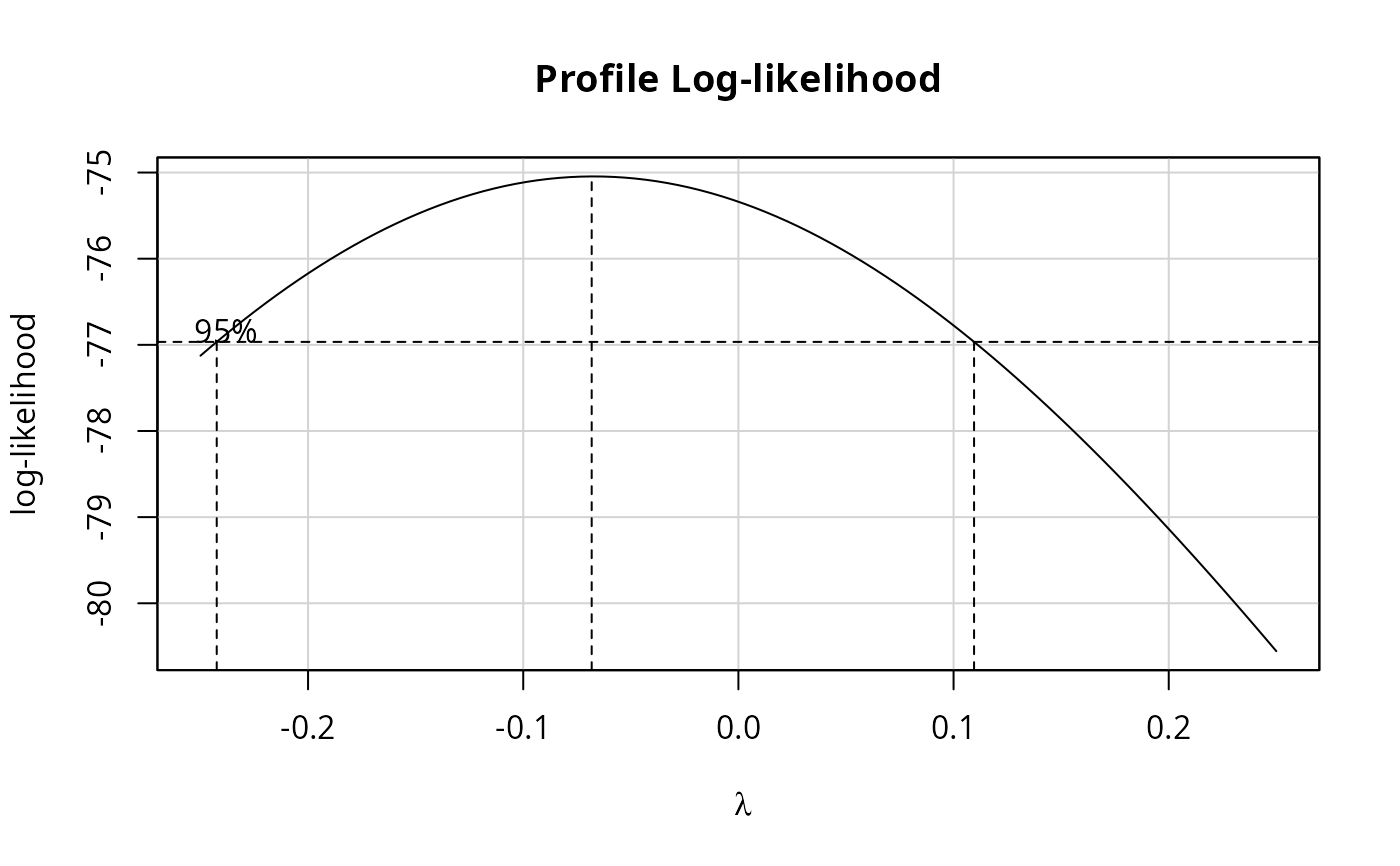
invisibly if the result is plotted. If plotit=TRUE plots log-likelihood vs
lambda and indicates a 95% confidence interval about the maximum observed value of
lambda. If interp=TRUE, spline interpolation is used to give a smoother plot.
References
Box, G. E. P. and Cox, D. R. (1964) An analysis of transformations. Journal of the Royal Statisistical Society, Series B. 26 211-46.
Cook, R. D. and Weisberg, S. (1999) Applied Regression Including Computing and Graphics. Wiley.
Fox, J. (2016) Applied Regression Analysis and Generalized Linear Models, Third Edition. Sage.
Fox, J. and Weisberg, S. (2019) An R Companion to Applied Regression, Third Edition, Sage.
Hawkins, D. and Weisberg, S. (2017) Combining the Box-Cox Power and Generalized Log Transformations to Accomodate Nonpositive Responses In Linear and Mixed-Effects Linear Models South African Statistics Journal, 51, 317-328.
Weisberg, S. (2014) Applied Linear Regression, Fourth Edition, Wiley.
Yeo, I. and Johnson, R. (2000) A new family of power transformations to improve normality or symmetry. Biometrika, 87, 954-959.
Examples
with(trees, boxCox(Volume ~ log(Height) + log(Girth), data = trees,
lambda = seq(-0.25, 0.25, length = 10)))
#> Warning: "data" is not a graphical parameter
#> Warning: "data" is not a graphical parameter
#> Warning: "data" is not a graphical parameter
#> Warning: "data" is not a graphical parameter
#> Warning: "data" is not a graphical parameter
#> Warning: "data" is not a graphical parameter
 data("quine", package = "MASS")
with(quine, boxCox(Days ~ Eth*Sex*Age*Lrn,
lambda = seq(-0.05, 0.45, len = 20), family="yjPower"))
data("quine", package = "MASS")
with(quine, boxCox(Days ~ Eth*Sex*Age*Lrn,
lambda = seq(-0.05, 0.45, len = 20), family="yjPower"))