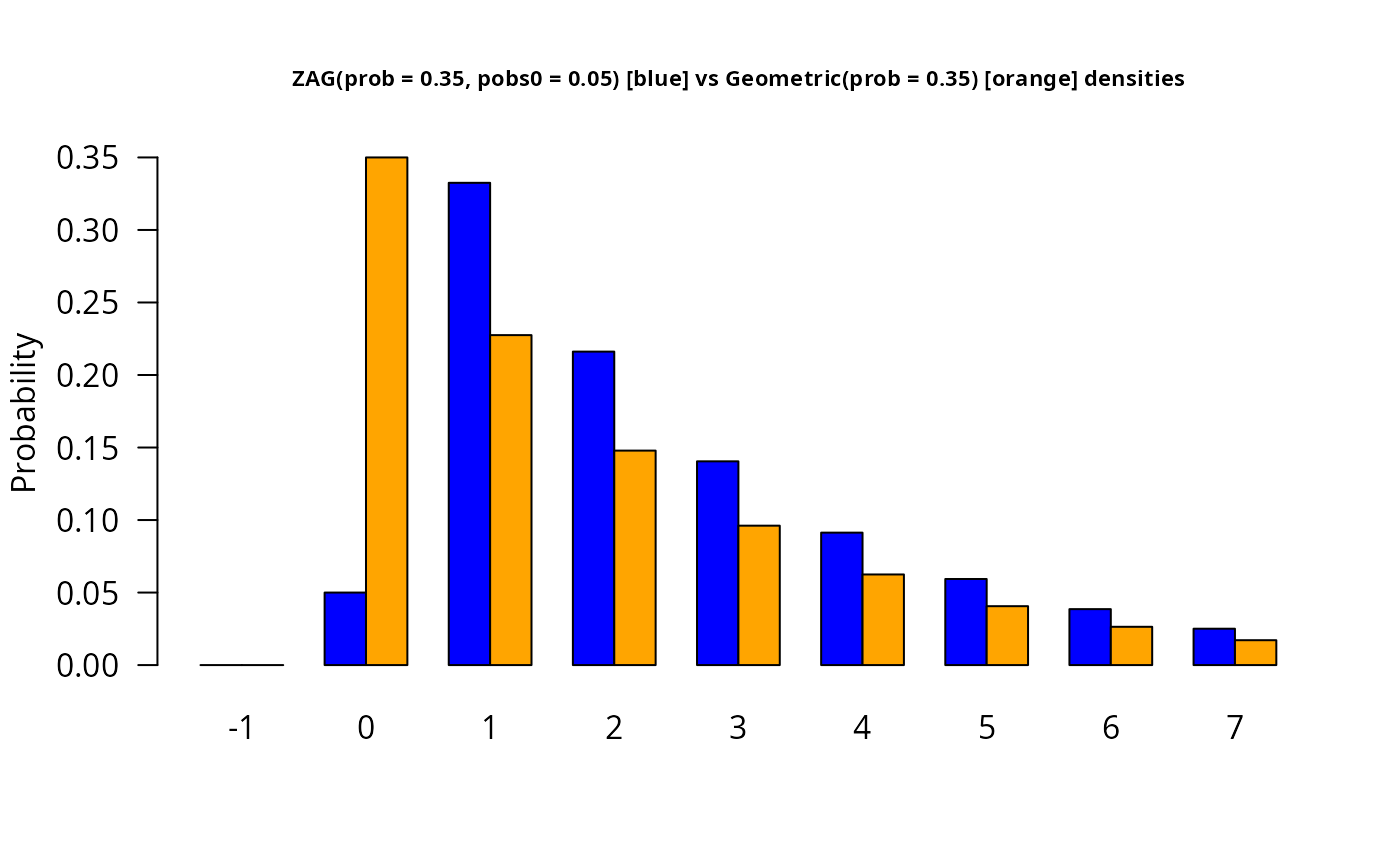
Zero-Altered Geometric Distribution
zageomUC.RdDensity, distribution function, quantile function and random
generation for the zero-altered geometric distribution with
parameter pobs0.
Usage
dzageom(x, prob, pobs0 = 0, log = FALSE)
pzageom(q, prob, pobs0 = 0)
qzageom(p, prob, pobs0 = 0)
rzageom(n, prob, pobs0 = 0)
Arguments
- x, q
vector of quantiles.
- p
vector of probabilities.
- n
number of observations. If
length(n) > 1then the length is taken to be the number required.- prob, log
Parameters from the ordinary geometric distribution (see
dgeom).- pobs0
Probability of (an observed) zero, called \(pobs0\). The default value of
pobs0 = 0corresponds to the response having a positive geometric distribution.
Details
The probability function of \(Y\) is 0 with probability
pobs0, else a positive geometric(prob) distribution.
Value
dzageom gives the density and
pzageom gives the distribution function,
qzageom gives the quantile function, and
rzageom generates random deviates.
Note
The argument pobs0 is recycled to the required length,
and must have values which lie in the interval \([0,1]\).
Examples
prob <- 0.35; pobs0 <- 0.05; x <- (-1):7
dzageom(x, prob = prob, pobs0 = pobs0)
#> [1] 0.00000000 0.05000000 0.33250000 0.21612500 0.14048125 0.09131281 0.05935333
#> [8] 0.03857966 0.02507678
table(rzageom(100, prob = prob, pobs0 = pobs0))
#>
#>  0  1  2  3  4  5  6  7 10
#>  2 32 24 24  5  5  6  1  1

if (FALSE)  x <- 0:10
barplot(rbind(dzageom(x, prob = prob, pobs0 = pobs0),
                dgeom(x, prob = prob)), las = 1,
        beside = TRUE, col = c("blue", "orange"), cex.main = 0.7,
        ylab = "Probability", names.arg = as.character(x),
        main = paste("ZAG(prob = ", prob, ", pobs0 = ", pobs0,
                   ") [blue] vs",  " Geometric(prob = ", prob,
                   ") [orange] densities", sep = ""))  # \dontrun{}