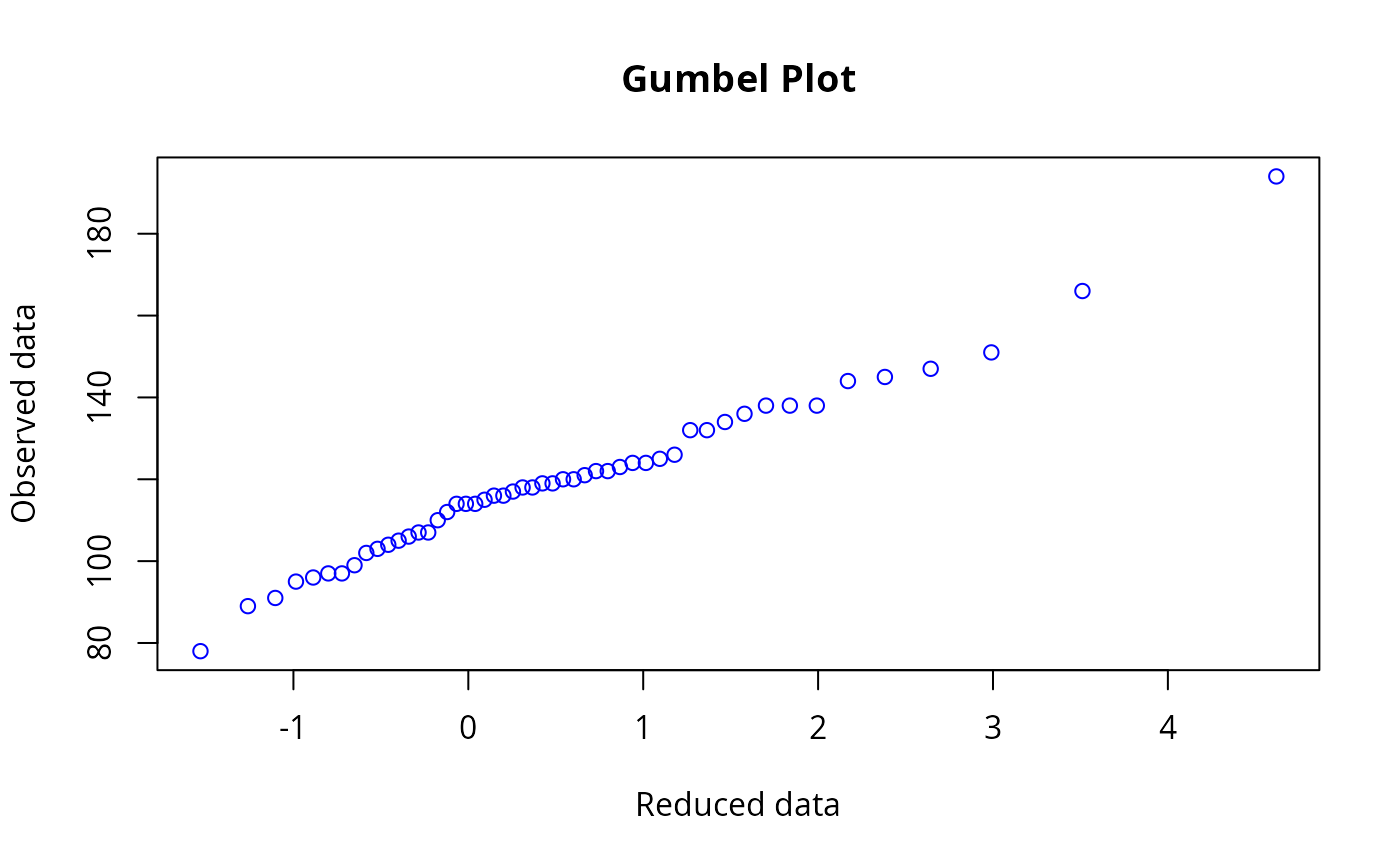
Gumbel Plot
guplot.RdProduces a Gumbel plot, a diagnostic plot for checking whether the data appears to be from a Gumbel distribution.
Usage
guplot(object, ...)
guplot.default(y, main = "Gumbel Plot",
    xlab = "Reduced data", ylab = "Observed data", type = "p", ...)
guplot.vlm(object, ...)
Arguments
- y
A numerical vector.
NAs etc. are not allowed.- main
Character. Overall title for the plot.
- xlab
Character. Title for the x axis.
- ylab
Character. Title for the y axis.
- type
Type of plot. The default means points are plotted.
- object
An object that inherits class
"vlm", usually of classvglm-classorvgam-class.- ...
Graphical argument passed into
plot. Seeparfor an exhaustive list. The argumentsxlimandylimare particularly useful.
Details
If \(Y\) has a Gumbel distribution then plotting the sorted values \(y_i\) versus the reduced values \(r_i\) should appear linear. The reduced values are given by $$r_i = -\log(-\log(p_i)) $$ where \(p_i\) is the \(i\)th plotting position, taken here to be \((i-0.5)/n\). Here, \(n\) is the number of observations. Curvature upwards/downwards may indicate a Frechet/Weibull distribution, respectively. Outliers may also be detected using this plot.
The function guplot is generic, and
guplot.default and guplot.vlm are some
methods functions for Gumbel plots.
Value
A list is returned invisibly with the following components.
- x
The reduced data.
- y
The sorted y data.
References
Coles, S. (2001). An Introduction to Statistical Modeling of Extreme Values. London: Springer-Verlag.
Gumbel, E. J. (1958). Statistics of Extremes. New York, USA: Columbia University Press.