Frank's Bivariate Distribution
bifrankcopUC.RdDensity, distribution function, and random generation for the (one parameter) bivariate Frank distribution.
Arguments
- x1, x2, q1, q2
vector of quantiles.
- n
number of observations. Same as in
runif.- apar
the positive association parameter.
- log
Logical. If
log = TRUEthen the logarithm of the density is returned.
Value
dbifrankcop gives the density,
pbifrankcop gives the distribution function, and
rbifrankcop generates random deviates (a two-column matrix).
Details
See bifrankcop, the VGAM
family functions for estimating the association
parameter by maximum likelihood estimation, for the formula of
the cumulative distribution function and other details.
Examples
if (FALSE) N <- 100; apar <- exp(2)
xx <- seq(-0.30, 1.30, len = N)
#> Error: object 'N' not found
ox <- expand.grid(xx, xx)
#> Error: object 'xx' not found
zedd <- dbifrankcop(ox[, 1], ox[, 2], apar = apar)
#> Error: object 'ox' not found
contour(xx, xx, matrix(zedd, N, N))
#> Error: object 'xx' not found
zedd <- pbifrankcop(ox[, 1], ox[, 2], apar = apar)
#> Error: object 'ox' not found
contour(xx, xx, matrix(zedd, N, N))
#> Error: object 'xx' not found
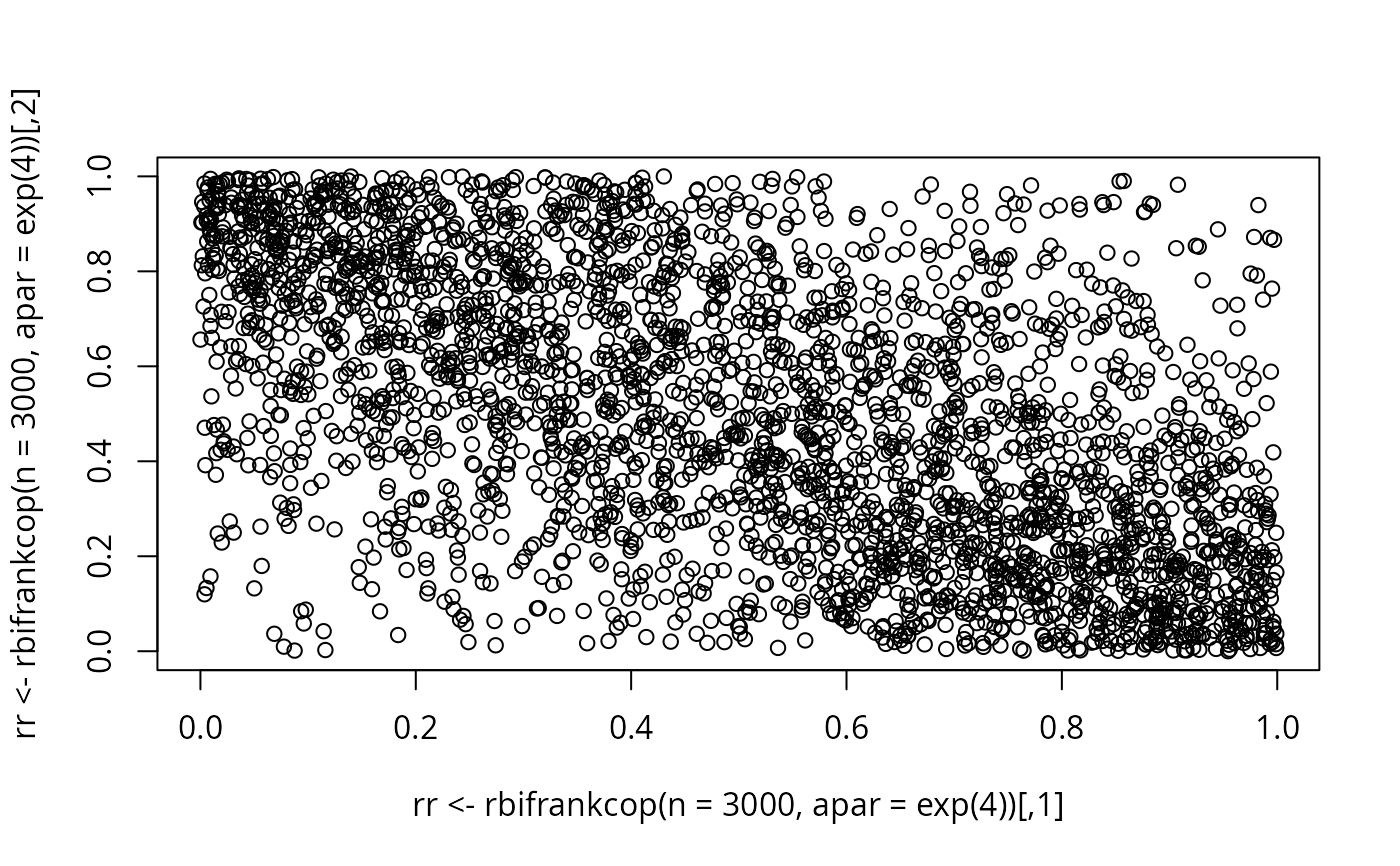
plot(rr <- rbifrankcop(n = 3000, apar = exp(4)))
 par(mfrow = c(1, 2))
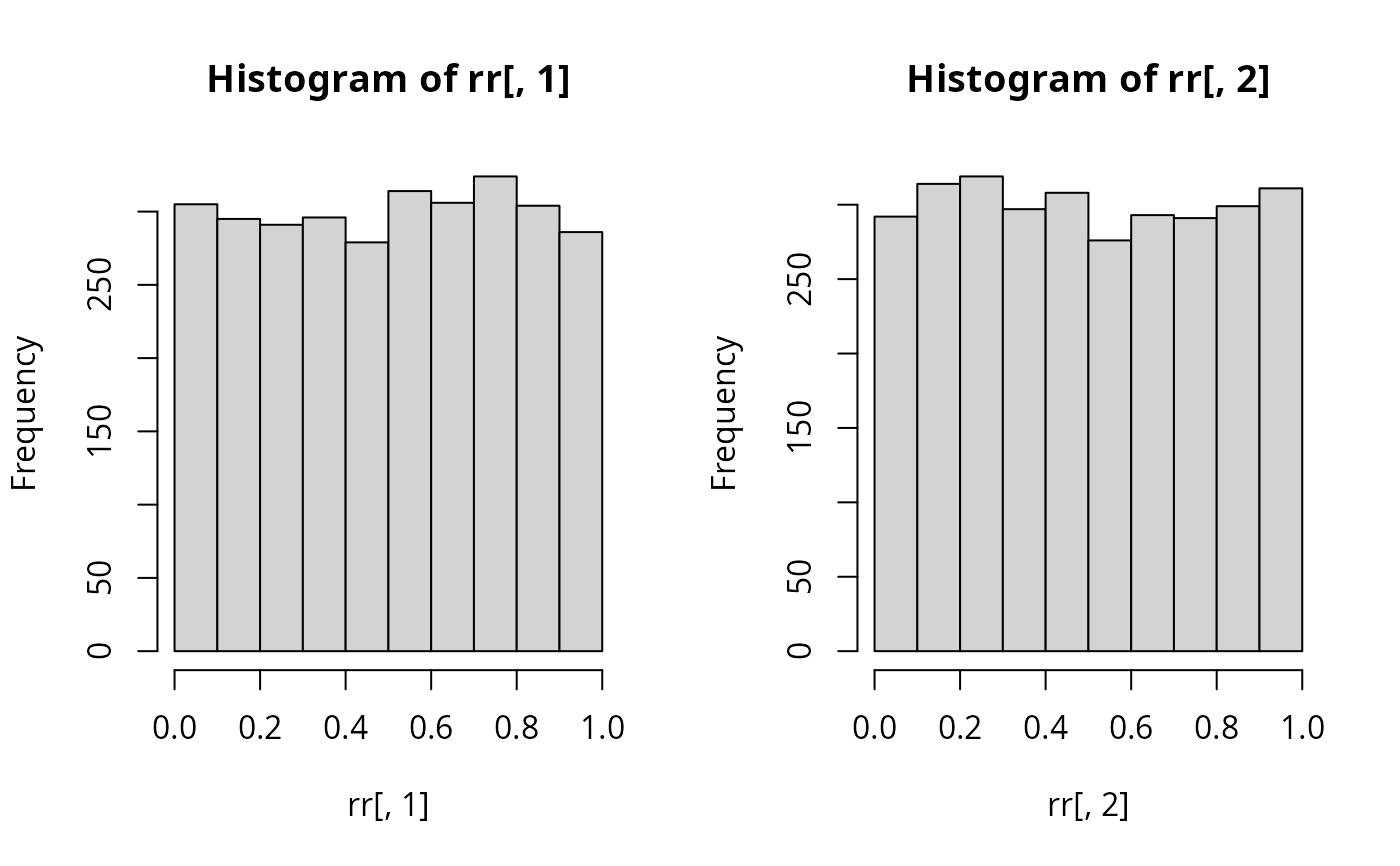
hist(rr[, 1]); hist(rr[, 2]) # Should be uniform
par(mfrow = c(1, 2))
hist(rr[, 1]); hist(rr[, 2]) # Should be uniform
 # \dontrun{}