Higher Moments Summary: Statistics and Stylized Facts
Source:R/table.HigherMoments.R
table.HigherMoments.RdSummary of the higher moements and Co-Moments of the return distribution. Used to determine diversification potential. Also called "systematic" moments by several papers.
table.HigherMoments(Ra, Rb, scale = NA, Rf = 0, digits = 4, method = "moment")Arguments
- Ra
an xts, vector, matrix, data frame, timeSeries or zoo object of asset returns
- Rb
return vector of the benchmark asset
- scale
number of periods in a year (daily scale = 252, monthly scale = 12, quarterly scale = 4)
- Rf
risk free rate, in same period as your returns
- digits
number of digits to round results to
- method
method to use when computing
kurtosisone of:excess,moment,fisher
References
Martellini L., Vaissie M., Ziemann V. Investing in Hedge Funds: Adding Value through Active Style Allocation Decisions. October 2005. Edhec Risk and Asset Management Research Centre.
Examples
data(managers)
table.HigherMoments(managers[,1:3],managers[,8,drop=FALSE])
#>                 HAM1 to SP500 TR HAM2 to SP500 TR HAM3 to SP500 TR
#> CoSkewness                0.0000           0.0000           0.0000
#> CoKurtosis                0.0000           0.0000           0.0000
#> Beta CoVariance           0.3906           0.3432           0.5572
#> Beta CoSkewness           0.5602           0.0454           0.5999
#> Beta CoKurtosis           0.4815           0.1988           0.5068
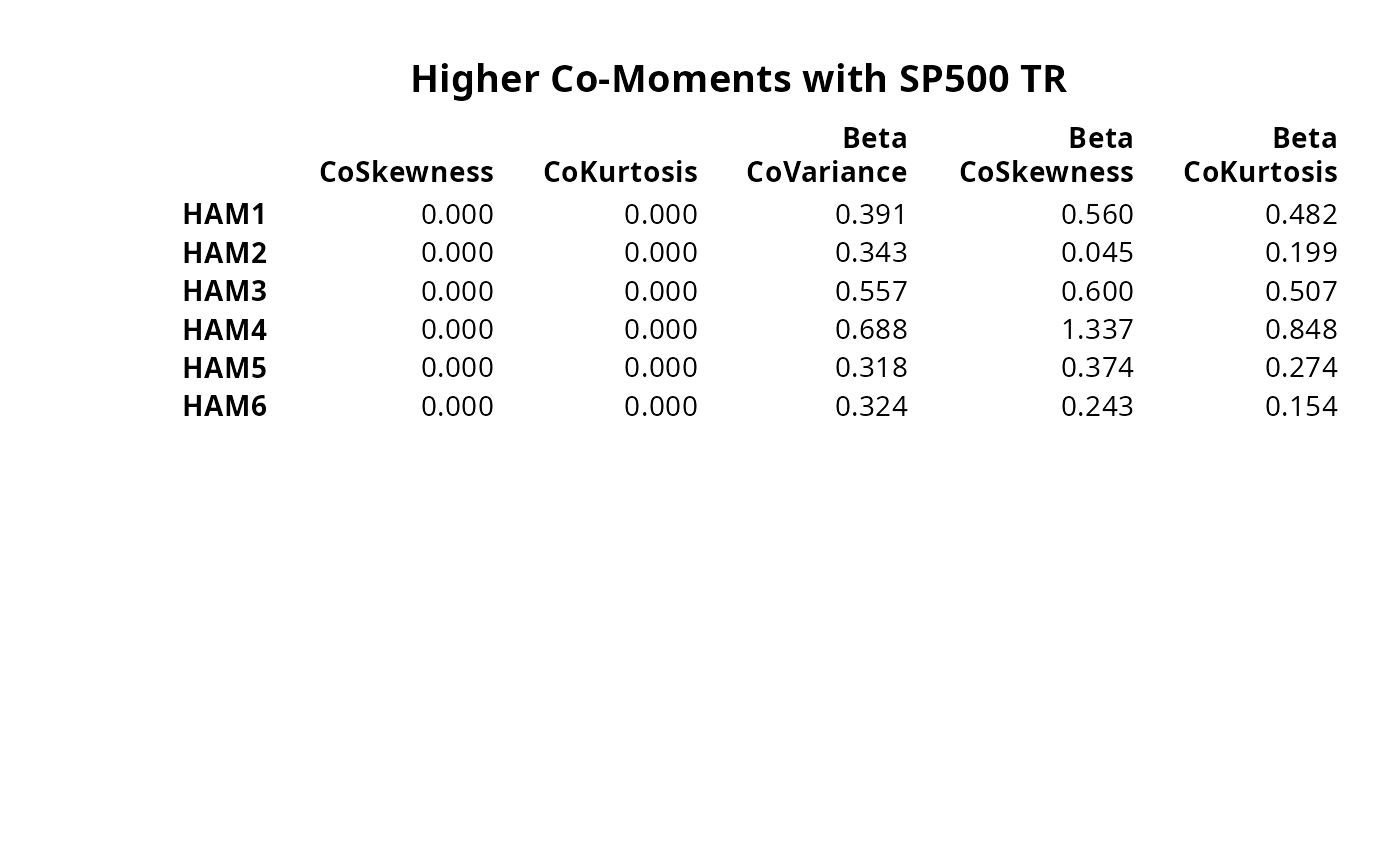
result=t(table.HigherMoments(managers[,1:6],managers[,8,drop=FALSE]))
rownames(result)=colnames(managers[,1:6])

 # don't test on CRAN, since it requires Suggested packages

require("Hmisc")
textplot(format.df(result, na.blank=TRUE, numeric.dollar=FALSE,
         cdec=rep(3,dim(result)[2])), rmar = 0.8, cmar = 1.5,
         max.cex=.9, halign = "center", valign = "top", row.valign="center",
         wrap.rownames=5, wrap.colnames=10, mar = c(0,0,3,0)+0.1)
title(main="Higher Co-Moments with SP500 TR")