Annualized Returns Summary: Statistics and Stylized Facts
Source:R/table.AnnualizedReturns.R
table.AnnualizedReturns.RdTable of Annualized Return, Annualized Std Dev, and Annualized Sharpe
table.AnnualizedReturns(R, scale = NA, Rf = 0, geometric = TRUE, digits = 4)Arguments
- R
an xts, vector, matrix, data frame, timeSeries or zoo object of asset returns
- scale
number of periods in a year (daily scale = 252, monthly scale = 12, quarterly scale = 4)
- Rf
risk free rate, in same period as your returns
- geometric
utilize geometric chaining (TRUE) or simple/arithmetic chaining (FALSE) to aggregate returns, default TRUE
- digits
number of digits to round results to
Examples
 # don't test on CRAN, since it requires Suggested packages
data(managers)
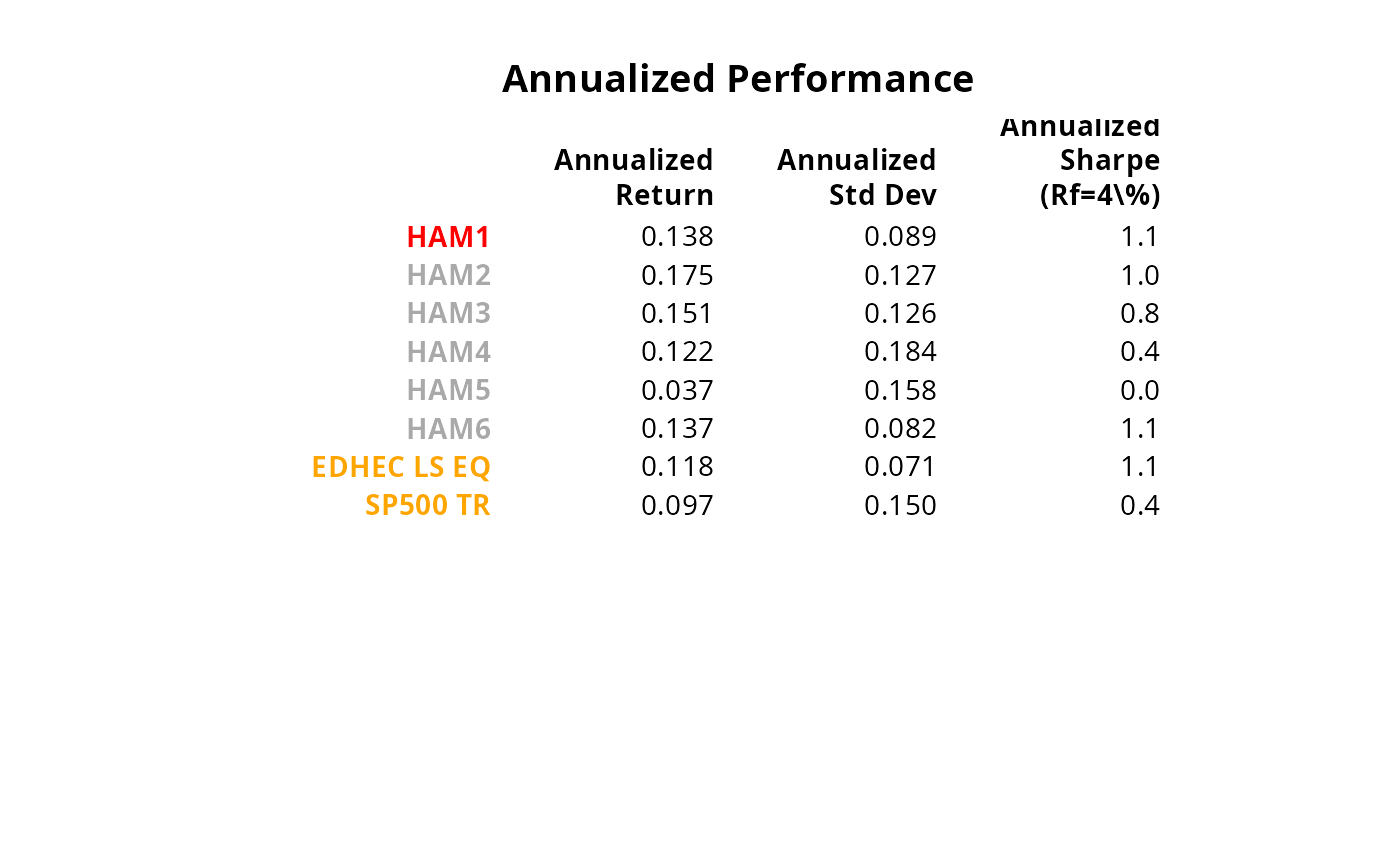
table.AnnualizedReturns(managers[,1:8])
#>                             HAM1   HAM2   HAM3   HAM4   HAM5   HAM6 EDHEC LS EQ
#> Annualized Return         0.1375 0.1747 0.1512 0.1215 0.0373 0.1373      0.1180
#> Annualized Std Dev        0.0888 0.1272 0.1265 0.1843 0.1584 0.0825      0.0708
#> Annualized Sharpe (Rf=0%) 1.5491 1.3732 1.1955 0.6592 0.2356 1.6642      1.6657
#>                           SP500 TR
#> Annualized Return           0.0967
#> Annualized Std Dev          0.1500
#> Annualized Sharpe (Rf=0%)   0.6449

require("Hmisc")
#> Loading required package: Hmisc
#>
#> Attaching package: ‘Hmisc’
#> The following objects are masked from ‘package:base’:
#>
#>     format.pval, units
result = t(table.AnnualizedReturns(managers[,1:8], Rf=.04/12))

textplot(format.df(result, na.blank=TRUE, numeric.dollar=FALSE,
         cdec=c(3,3,1)), rmar = 0.8, cmar = 2,  max.cex=.9,
         halign = "center", valign = "top", row.valign="center",
         wrap.rownames=20, wrap.colnames=10, col.rownames=c("red",
         rep("darkgray",5), rep("orange",2)), mar = c(0,0,3,0)+0.1)

title(main="Annualized Performance")