Miscellaneous Functions
Misc.RdThis documents miscellaneous small functions in Hmisc that may be of interest to users.
clowess runs lowess but if the iter argument
exceeds zero, sometimes wild values can result, in which case
lowess is re-run with iter=0.
confbar draws multi-level confidence bars using small rectangles
that may be of different colors.
getLatestSource fetches and sources the most recent
source code for functions in GitHub.
grType retrieves the system option grType, which is
forced to be "base" if the plotly package is not
installed.
prType retrieves the system option prType, which is
set to "plain" if the option is not set. print methods
that allow for markdown/html/latex can be automatically invoked by
setting options(prType="html") or
options(prType='latex').
htmlSpecialType retrieves the system option
htmlSpecialType, which is set to "unicode" if the option
is not set. htmlSpecialType='unicode' cause html-generating
functions in Hmisc and rms to use unicode for special
characters, and htmlSpecialType='&' uses the older ampersand
3-digit format.
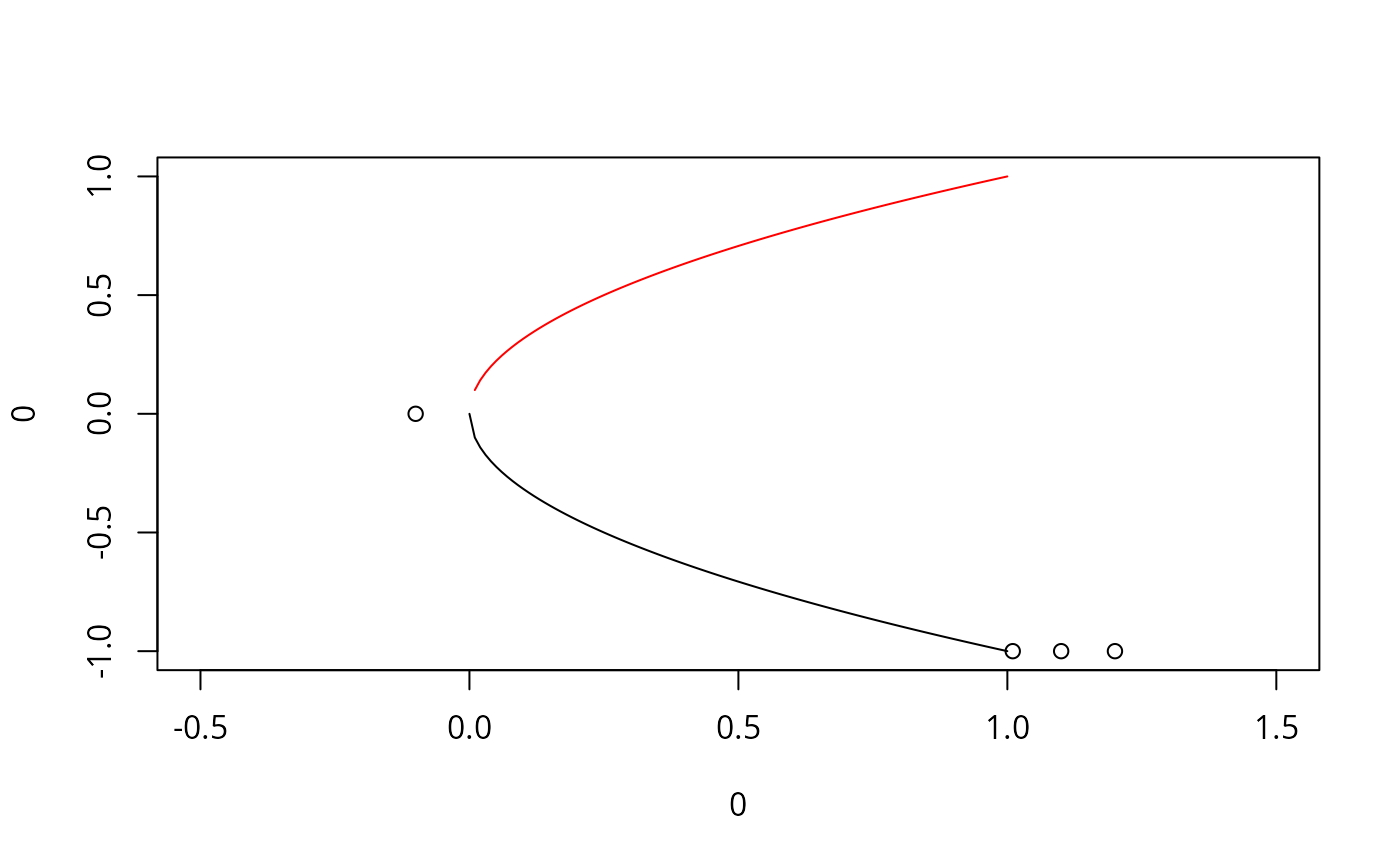
inverseFunction generates a function to find all inverses of a
monotonic or nonmonotonic function that is tabulated at vectors (x,y),
typically 1000 points. If the original function is monotonic, simple linear
interpolation is used and the result is a vector, otherwise linear
interpolation is used within each interval in which the function is
monotonic and the result is a matrix with number of columns equal to the
number of monotonic intervals. If a requested y is not within any
interval, the extreme x that pertains to the nearest extreme y is
returned. Specifying what='sample' to the returned function will cause a
vector to be returned instead of a matrix, with elements taken as a
random choice of the possible inverses.
james.stein computes James-Stein shrunken estimates of cell
means given a response variable (which may be binary) and a grouping
indicator.
keepHattrib for an input variable or a data frame, creates a
list object saving special Hmisc attributes such as label and
units that might be lost during certain operations such as
running data.table. restoreHattrib restores these attributes.
km.quick provides a fast way to invoke survfitKM in the
survival package to efficiently get Kaplan-Meier or Fleming-Harrington estimates for a
single stratum for a vector of time points (if times is given) or to
get a vector of survival time quantiles (if q is given). If neither is given,
the whole curve is returned in a list with objects time and surv, and
there is an option to consider an interval as pertaining to greater than or equal
to a specific time instead of the traditional greater than. If the censoring is not
right censoring, the more general survfit is called by km.quick.
latexBuild takes pairs of character strings and produces a
single character string containing concatenation of all of them, plus
an attribute "close" which is a character string containing the
LaTeX closure that will balance LaTeX code with respect to
parentheses, braces, brackets, or begin vs. end. When
an even-numbered element of the vector is not a left parenthesis,
brace, or bracket, the element is taken as a word that was surrounded
by begin and braces, for which the corresponding end is
constructed in the returned attribute.
lm.fit.qr.bare is a fast stripped-down function for computing
regression coefficients, residuals, \(R^2\), and fitted values. It
uses lm.fit.
matxv multiplies a matrix by a vector, handling automatic
addition of intercepts if the matrix does not have a column of ones.
If the first argument is not a matrix, it will be converted to one.
An optional argument allows the second argument to be treated as a
matrix, useful when its rows represent bootstrap reps of
coefficients. Then ab' is computed. matxv respects the
"intercepts" attribute if it is stored on b by the
rms package. This is used by orm
fits that are bootstrap-repeated by bootcov where
only the intercept corresponding to the median is retained. If
kint has nonzero length, it is checked for consistency with the
attribute.
makeSteps is a copy of the dostep function inside the
survival package's plot.survfit function. It expands a
series of points to include all the segments needed to plot step
functions. This is useful for drawing polygons to shade confidence
bands for step functions.
nomiss returns a data frame (if its argument is one) with rows
corresponding to NAs removed, or it returns a matrix with rows
with any element missing removed.
outerText uses axis() to put right-justified text
strings in the right margin. Placement depends on
par('mar')[4]
plotlyParm is a list of functions useful for specifying
parameters to plotly graphics.
plotp is a generic to handle plotp methods to make
plotly graphics.
rendHTML renders HTML in a character vector, first converting
to one character string with newline delimeters. If knitr is
currently running, runs this string through knitr::asis_output
so that the user need not include results='asis' in the chunk
header for R Markdown or Quarto. If knitr is not running, uses
htmltools::browsable and htmltools::HTML and prints the
result so that an RStudio viewer (if running inside RStudio) or
separate browser window displays the rendered HTML. The HTML code is
surrounded by yaml markup to make Pandoc not fiddle with the HTML.
Set the argument html=FALSE to not add this, in case you are
really rendering markdown. html=FALSE also invokes
rmarkdown::render to convert the character vector to HTML
before using htmltools to view, assuming the characters
represent RMarkdown/Quarto text other than the YAML header. If
options(rawmarkup=TRUE) is in effect, rendHTML will just
cat() its first argument. This is useful when rendering is
happening inside a Quarto margin, for example.
sepUnitsTrans converts character vectors containing values such
as c("3 days","3day","4month","2 years","2weeks","7") to
numeric vectors
(here c(3,3,122,730,14,7)) in a flexible fashion. The user can
specify a
vector of units of measurements and conversion factors. The units
with a conversion factor of 1 are taken as the target units,
and if those units are present in the character strings they are
ignored. The target units are added to the resulting vector as the
"units" attribute.
strgraphwrap is like strwrap but is for the current
graphics environment.
tobase64image is a function written by Dirk Eddelbuettel that
uses the base64enc package to convert a png graphic file to
base64 encoding to include as an inline image in an html file.
trap.rule computes the area under a curve using the trapezoidal
rule, assuming x is sorted.
trellis.strip.blank sets up Trellis or Lattice graphs to have a
clear background on the strips for panel labels.
unPaste provides a version of the S-Plus unpaste that
works for R and S-Plus.
whichClosePW is a very fast function using weighted multinomial
sampling to determine which element of a vector is "closest" to each
element of another vector. whichClosest quickly finds the closest
element without any randomness.
whichClosek is a slow function that finds, after jittering the
lookup table, the k closest matchest to each element of the
other vector, and chooses from among these one at random.
xless is a function for Linux/Unix users to invoke the system
xless command to pop up a window to display the result of
printing an object. For MacOS xless uses the system open command to pop up a TextEdit window.
Usage
confbar(at, est, se, width, q = c(0.7, 0.8, 0.9, 0.95, 0.99),
        col = gray(c(0, 0.25, 0.5, 0.75, 1)),
        type = c("v", "h"), labels = TRUE, ticks = FALSE,
        cex = 0.5, side = "l", lwd = 5, clip = c(-1e+30, 1e+30),
        fun = function(x) x,
        qfun = function(x) ifelse(x == 0.5, qnorm(x),
                            ifelse(x < 0.5, qnorm(x/2),
                            qnorm((1 +  x)/2))))
getLatestSource(x=NULL, package='Hmisc', recent=NULL, avail=FALSE)
grType()
prType()
htmlSpecialType()
inverseFunction(x, y)
james.stein(y, group)
keepHattrib(obj)
km.quick(S, times, q,
        type = c("kaplan-meier", "fleming-harrington", "fh2"),
        interval = c(">", ">="), method=c('constant', 'linear'), fapprox=0, n.risk=FALSE)
latexBuild(..., insert, sep='')
lm.fit.qr.bare(x, y, tolerance, intercept=TRUE, xpxi=FALSE, singzero=FALSE)
matxv(a, b, kint=1, bmat=FALSE)
nomiss(x)
outerText(string, y, cex=par('cex'), ...)
plotlyParm
plotp(data, ...)
rendHTML(x, html=TRUE)
restoreHattrib(obj, attribs)
sepUnitsTrans(x, conversion=c(day=1, month=365.25/12, year=365.25, week=7),
              round=FALSE, digits=0)
strgraphwrap(x, width = 0.9 * getOption("width"),
             indent = 0, exdent = 0,
             prefix = "", simplify = TRUE, units='user', cex=NULL)
tobase64image(file, Rd = FALSE, alt = "image")
trap.rule(x, y)
trellis.strip.blank()
unPaste(str, sep="/")
whichClosest(x, w)
whichClosePW(x, w, f=0.2)
whichClosek(x, w, k)
xless(x, ..., title)
Arguments
- a
a numeric matrix or vector
- alt,Rd
see
base64::img- at
x-coordinate for vertical confidence intervals, y-coordinate for horizontal
- attribs
an object returned by
keepHattrib- avail
set to
TRUEto havegetLatestSourcereturn a data frame of available files and latest versions instead of fetching any- b
a numeric vector
- cex
character expansion factor
- clip
interval to truncate limits
- col
vector of colors
- conversion
a named numeric vector
- data
an object having a
plotpmethod- digits
number of digits used for
round- est
vector of point estimates for confidence limits
- f
a scaling constant
- file
a file name
- fun
function to transform scale
- group
a categorical grouping variable
- html
set to
FALSEto tellrendHTMLto not surround HTML code with yaml- insert
a list of 3-element lists for
latexBuild. The first of each 3-element list is a character string with an environment name. The second specifies the order:"before"or"after", the former indicating that when the environment is found, the third element of the list is inserted before or after it, according to the second element.- intercept
set to
FALSEto not automatically add a column of ones to thexmatrix- k
get the
kclosest matches- kint
which element of
bto add to the result ifadoes not contain a column for intercepts- bmat
set to
TRUEto considerba matrix of repeated coefficients, usually resampled estimates with rows corresponding to resamples- labels
set to
FALSEto omit drawing confidence coefficients- lwd
line widths
- package
name of package for
getLatestSource, default is'Hmisc'- obj
a variable, data frame, or data table
- q
vector of confidence coefficients or quantiles
- qfun
quantiles on transformed scale
- recent
an integer telling
getLatestSourceto get therecentmost recently modified files from the package- round
set to
TRUEto round converted values- S
a
Survobject- se
vector of standard errors
- sep
a single character string specifying the delimiter. For
latexBuildthe default is"".- side
for
confbaris"b","l","t","r"for bottom, left, top, right.- str
a character string vector
- string
a character string vector
- ticks
set to
TRUEto draw lines between rectangles- times
a numeric vector of times
- title
a character string to title a window or plot. Ignored for
xlessunder MacOs.- tolerance
tolerance for judging singularity in matrix
- type
"v"for vertical,"h"for horizontal. Forkm.quickspecifies the type of survival estimator.- w
a numeric vector
- width
width of confidence rectanges in user units, or see
strwrap- x
a numeric vector (matrix for
lm.fit.qr.bare) or data frame. Forxlessmay be any object that is sensible toprint. ForsepUnitsTransis a character or factor variable. ForgetLatestSourceis a character string or vector of character strings containing base file names to retrieve from CVS. Setx='all'to retrieve all source files. Forclowess,xmay also be a list with x and y components. ForinverseFunction,xandycontain evaluations of the function whose inverse is needed.xis typically an equally-spaced grid of 1000 points. Forstrgraphwrapis a character vector. ForrendHTMLxis a character vector.- xpxi
set to
TRUEto add an element to the result containing the inverse of \(X'X\)- singzero
set to
TRUEto set coefficients corresponding to singular variables to zero instead ofNA.- y
a numeric vector. For
inverseFunctionyis the evaluated function values atx.- indent, exdent, prefix
see
strwrap- simplify
see
sapply- units
see
par- interval
specifies whether to deal with probabilities of exceeding a value (the default) or of exceeding or equalling the value
- method,fapprox
see
approx- n.risk
set to
TRUEto include the number at risk in the result- ...
arguments passed through to another function. For
latexBuildrepresents pairs, with odd numbered elements being character strings containing LaTeX code or a zero-length object to ignore, and even-numbered elements representing LaTeX left parenthesis, left brace, or left bracket, or environment name.
Examples
trap.rule(1:100,1:100)
#> [1] 4999.5
unPaste(c('a;b or c','ab;d','qr;s'), ';')
#> [[1]]
#> [1] "a" "ab" "qr"
#>
#> [[2]]
#> [1] "b or c" "d" "s"
#>
sepUnitsTrans(c('3 days','4 months','2 years','7'))
#> [1] 3.00 121.75 730.50 7.00
#> attr(,"units")
#> [1] "day"
set.seed(1)
whichClosest(1:100, 3:5)
#> [1] 3 4 5
whichClosest(1:100, rep(3,20))
#> [1] 3 3 3 3 3 3 3 3 3 3 3 3 3 3 3 3 3 3 3 3
whichClosePW(1:100, rep(3,20))
#> [1] 3 3 5 8 2 8 9 6 6 1 2 2 6 4 7 5 6 11 4 7
whichClosePW(1:100, rep(3,20), f=.05)
#> [1] 4 2 3 2 2 3 1 3 4 3 3 3 3 2 4 3 4 2 4 3
whichClosePW(1:100, rep(3,20), f=1e-10)
#> [1] 3 3 3 3 3 3 3 3 3 3 3 3 3 3 3 3 3 3 3 3
x <- seq(-1, 1, by=.01)
y <- x^2
h <- inverseFunction(x,y)
formals(h)$turns # vertex
#> [1] 0.005
a <- seq(0, 1, by=.01)
plot(0, 0, type='n', xlim=c(-.5,1.5))
lines(a, h(a)[,1]) ## first inverse
lines(a, h(a)[,2], col='red') ## second inverse
a <- c(-.1, 1.01, 1.1, 1.2)
points(a, h(a)[,1])
 d <- data.frame(x=1:2, y=3:4, z=5:6)
d <- upData(d, labels=c(x='X', z='Z lab'), units=c(z='mm'))
#> Input object size: 1008 bytes; 3 variables 2 observations
#> New object size: 2272 bytes; 3 variables 2 observations
a <- keepHattrib(d)
d <- data.frame(x=1:2, y=3:4, z=5:6)
d2 <- restoreHattrib(d, a)
sapply(d2, attributes)
#> $x
#> $x$label
#> [1] "X"
#>
#> $x$class
#> [1] "labelled" "integer"
#>
#>
#> $y
#> NULL
#>
#> $z
#> $z$label
#> [1] "Z lab"
#>
#> $z$class
#> [1] "labelled" "integer"
#>
#> $z$units
#> [1] "mm"
#>
#>
if (FALSE) { # \dontrun{
getLatestSource(recent=5) # source() most recent 5 revised files in Hmisc
getLatestSource('cut2') # fetch and source latest cut2.s
getLatestSource('all') # get everything
getLatestSource(avail=TRUE) # list available files and latest versions
} # }
d <- data.frame(x=1:2, y=3:4, z=5:6)
d <- upData(d, labels=c(x='X', z='Z lab'), units=c(z='mm'))
#> Input object size: 1008 bytes; 3 variables 2 observations
#> New object size: 2272 bytes; 3 variables 2 observations
a <- keepHattrib(d)
d <- data.frame(x=1:2, y=3:4, z=5:6)
d2 <- restoreHattrib(d, a)
sapply(d2, attributes)
#> $x
#> $x$label
#> [1] "X"
#>
#> $x$class
#> [1] "labelled" "integer"
#>
#>
#> $y
#> NULL
#>
#> $z
#> $z$label
#> [1] "Z lab"
#>
#> $z$class
#> [1] "labelled" "integer"
#>
#> $z$units
#> [1] "mm"
#>
#>
if (FALSE) { # \dontrun{
getLatestSource(recent=5) # source() most recent 5 revised files in Hmisc
getLatestSource('cut2') # fetch and source latest cut2.s
getLatestSource('all') # get everything
getLatestSource(avail=TRUE) # list available files and latest versions
} # }